
Fauci's pardon leaves Fifth Amendment privilege unresolved
The July 29, 2026 Senate hearing where Dr. Anthony Fauci invoked the Fifth Amendment 111 times after accepting a preemptive presidential pardon presents an unresolved constitutional conflict. This record analyzes the gap between settled immunity precedent and the hybrid scenario of an accepted pardon that does not cover state prosecutions.
- Jurisdiction
- US Federal
- Court
- U.S. Senate Homeland Security Committee
- AI tool named
- None
- Ruling date
- Jul 29, 2026
- Source document
- View primary court order ↗
- Last verified
- Jul 31, 2026
Lex Machina Review is an independent risk-tracking and reference resource. Nothing on this site is legal advice, and using it does not create an attorney-client relationship. Every record is reviewed against primary sources but may not reflect the most current status of a matter — always verify directly against the cited court order, rule text, or a licensed attorney before relying on it.
Companion explanation — secondary to the source document above
Risk Digest classification: risk-digest. Last verified: July 31, 2026. Source status: current reporting, Supreme Court precedent, and secondary legal analysis; official text of the Jan. 20, 2025 Fauci pardon not independently verified in the materials reviewed. This record is not legal advice. The operative classification is unresolved constitutional question.
The immediate fact pattern is simple enough to be politically useful and legally treacherous: Dr. Anthony Fauci invoked the Fifth Amendment 111 times during a three-hour Senate Homeland Security hearing on July 29, 2026, after accepting a preemptive presidential pardon from President Biden issued on Jan. 20, 2025.[1] The harder question is not whether that looks damaging. It is whether the accepted federal pardon actually removed the privilege as to the questions Congress wanted answered.
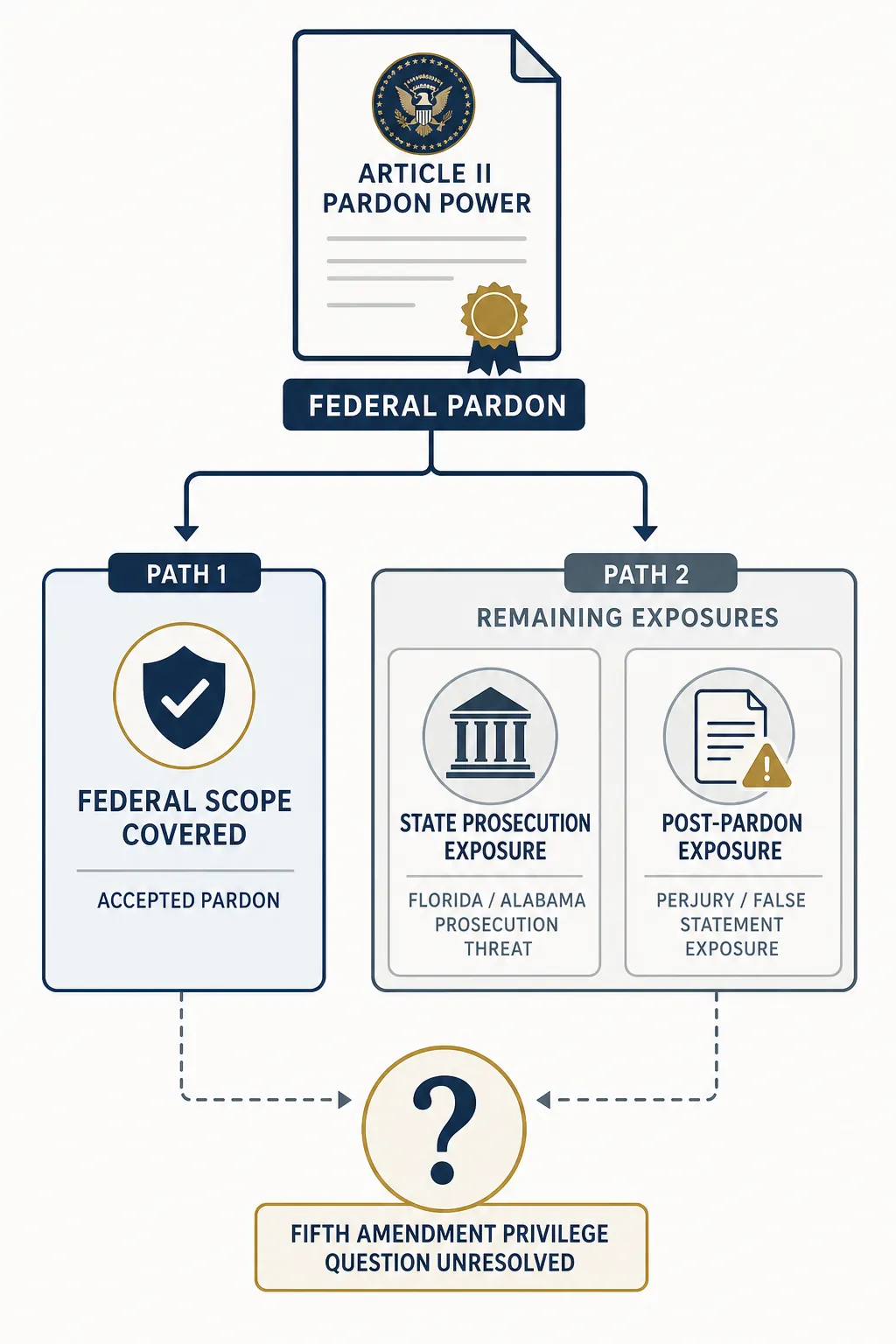
That question should be narrowed at the outset. The reported pardon covered federal offenses from Jan. 1, 2014 through Jan. 19, 2025 related to Fauci’s government work, but it did not cover new offenses after the pardon date, such as post-pardon false statements or perjury, and it could not reach state prosecutions.[1][2] Those two boundaries matter more than the hearing count.
The settled cases do not quite settle this case
The fastest route to overstatement is to quote Brown v. Walker as though it were written for an accepted preemptive presidential pardon. It was not. Brown involved a federal statutory immunity scheme in an Interstate Commerce Commission inquiry. The Court reasoned that, because the statute protected the witness against prosecution for the compelled testimony, he could not continue to assert the privilege; the opinion states that, after receiving protection equivalent to the privilege, the witness “cannot longer set up his privilege.”[3]
That language is important. It is also not self-executing in the Fauci record. Brown dealt with immunity supplied for compelled testimony in the proceeding at hand. The Fauci scenario involves a pardon issued before the hearing, accepted months earlier, described in public reporting as covering a defined federal time period, and followed by questions that could create new exposure if answered falsely. Treating Brown as automatically controlling skips the very fit question a court would have to decide.
Burdick v. United States supplies the other familiar quotation, but it creates a different problem. In Burdick, the Court held that a pardon carries an imputation of guilt and that acceptance carries a confession of it; because a pardon may be rejected, it could not be forced on an unwilling recipient so as to strip the recipient of the Fifth Amendment privilege.[4] That principle helps a witness who refuses a pardon. It does not cleanly answer what happens after the witness accepts one.
Fauci is therefore not the easy Burdick case. Available reporting describes him as having accepted Biden’s pardon before the July 2026 hearing.[1] If acceptance matters, Burdick may cut against him. If the limits of the pardon matter, Brown may not carry the government all the way. The conflict sits between those two propositions, not inside either one.
The hybrid scenario
The useful way to brief the issue is not “pardon equals waiver” or “Fifth Amendment always survives.” It is a hybrid scenario with three moving parts:
- Accepted federal pardon: the Burdick refusal principle is harder to invoke once the recipient has accepted the pardon.
- Temporal and subject-matter limits: the reported pardon covered federal offenses tied to government work during a stated period, not every possible later statement.
- Nonfederal exposure: Article II pardons do not extinguish state criminal authority.
The first part is why the Senate has an argument. If the only feared prosecution were a federal charge for conduct fully covered by the accepted pardon, Brown gives the committee a substantial line to press. A witness cannot preserve the privilege merely by preferring not to answer embarrassing questions; the privilege is about criminal exposure, not reputational cost.
The second part is why the witness has a serious answer. A congressional hearing can generate new criminal risk. A pardon issued on Jan. 20, 2025 does not, on the reporting available, immunize a false statement made in July 2026 or perjury committed during later testimony.[2] That does not mean every question at the hearing was privileged. It means the privilege analysis must be question-specific, not solved by pointing to the existence of a pardon.
The third part is the part most likely to be flattened in public commentary. State exposure is not a rhetorical flourish; it is a jurisdictional boundary. Florida Attorney General James Uthmeier announced a state investigation into Fauci on July 29, 2026, the same day as the Senate hearing, and Sen. Tommy Tuberville raised the prospect of Alabama-level prosecution.[5] Those announcements do not establish that a viable state prosecution exists. They do establish why a federal pardon alone may not eliminate all reasonable fear of criminal exposure.
What the pardon reportedly covers, and what remains unverified
Multiple reports describe Biden’s Fauci pardon as covering federal offenses from Jan. 1, 2014 through Jan. 19, 2025, related to Fauci’s government work.[1][2] For a risk record, that description is usable but not enough. The precise wording of the pardon could affect whether particular categories of testimony are inside or outside the pardon’s protection.
| Issue | Current record status | Why it matters |
|---|---|---|
| Federal offenses within reported date range | Reportedly covered by Biden’s Jan. 20, 2025 pardon | This is the strongest setting for the Senate’s Brown-based argument. |
| False statements or perjury after Jan. 20, 2025 | Reportedly not covered | A later answer before Congress could create new exposure. |
| State prosecutions | Not reachable by a presidential pardon | State exposure can preserve a reasonable fear of prosecution if the risk is not speculative. |
| Official pardon text | Not directly verified in reviewed materials | Exact language may control the privilege analysis. |
The verification gap is not cosmetic. Pardon instruments can turn on verbs, covered persons, covered conduct, exceptions, and time periods. A memo that treats the reported scope as final text is taking on unnecessary precision risk.
State investigations are pressure, not proof
Florida’s same-day announcement changes the risk posture, but it should not be overstated. The available materials do not provide a developed charging theory, a detailed scope, or evidence of investigative progress beyond the announcement itself.[5] That leaves the state-exposure point real but underdeveloped.
The same restraint applies to Alabama. A senator’s proposal for state-level prosecution is a political and procedural signal, not a charging document. It matters because a federal pardon does not bind state prosecutors. It does not prove that any state offense can be charged.
That distinction is the difference between a careful privilege record and a partisan one. State exposure can preserve the privilege only if the feared prosecution is sufficiently real in context. The current record supports a caveat, not a conclusion that every invocation was valid.
The contempt path adds procedural risk, not a merits answer
Committee Chair Rand Paul scheduled a contempt vote for the week of Aug. 3, 2026, and reporting noted that a full Senate referral would require a 60-vote majority.[6] As of the current record date, that vote had not occurred. The procedural posture is therefore prospective, not resolved.
Solomon Wisenberg, identified by The Hill as a Fox News legal contributor and former prosecutor, said on July 30, 2026 that the Senate would “lose in court” if it pursued contempt against Fauci.[7] That view is worth recording because it captures the litigation risk facing the committee. It is not a court ruling, and it does not substitute for the missing judicial answer on the accepted-pardon scenario.
Historical analogs such as congressional contempt fights involving other witnesses can help frame DOJ discretion and institutional practice, but they do not decide this issue. The research record contains no DOJ position on Fauci’s Fifth Amendment claim. Without that position, analogies to prior contempt disputes should remain background, not authority.
The narrow answer for the risk file
For a risk file, the clean answer is bounded. Biden’s reported pardon does not make the Fifth Amendment issue disappear. Fauci’s 111 invocations do not prove the privilege was valid in full. The hearing created a first-impression conflict between an accepted preemptive federal pardon and remaining criminal-exposure theories outside that pardon.
Brown gives Congress its strongest argument where the pardon has eliminated federal exposure. Burdick gives the witness a strong argument when a pardon is refused. Fauci fits neither template cleanly because he reportedly accepted the pardon, yet still faced at least arguable exposure from post-pardon statements and possible state proceedings.
The record should therefore carry five flags: first-impression status; unresolved fit between Brown and Burdick; state-exposure caveat; unverified official pardon text; and forthcoming contempt-vote status. Until a court addresses the accepted preemptive-pardon scenario, or the pardon text and state exposure are clarified, the safest classification is open constitutional question, not settled waiver or settled privilege.
References
- Fauci's legal protection from pardon, Fifth Amendment is an open question, The Hill, July 30, 2026
- Fauci's Pardon From Biden Would Not Shield Him From New Offenses, The New York Times, July 29, 2026
- Brown v. Walker, 161 U.S. 591 (1896), Justia
- Burdick v. United States, 236 U.S. 79 (1915), Justia
- Legal experts weigh Fauci's Fifth Amendment claim after pardon, Fox News, July 30, 2026
- Explainer: Could Fauci face criminal charges for refusing Senate COVID questions?, Reuters, July 30, 2026
- Fox News legal contributor: Senate will lose Fauci contempt fight, The Hill, July 31, 2026
Related records
Tool profile
Browse tool evaluations →Governing regulation
Browse the obligations tracker →Preventive workflow
Browse verification workflows →
Report a correction or tip
Spotted an outdated figure, a misstated fact, or a ruling this case record should reflect? Public comments are disabled for this content given the professional cost of a misreported case outcome, penalty amount, or rule text — use the structured correction channel instead.
Report a correction or tip for this record →