
Big Tech Earnings Expose Legal AI Vendor Concentration Risk
The Q2 2026 big tech earnings cycle reveals which AI providers face the greatest investor pressure, helping law firms assess single-provider dependency risk in their legal AI tool stack before procurement commitments become irreversible.
- Jurisdiction
- US Federal
- Court
- General
- AI tool named
- Multiple
- Ruling date
- Jul 29, 2026
- Source document
- View primary court order ↗
- Last verified
- Jul 29, 2026
Lex Machina Review is an independent risk-tracking and reference resource. Nothing on this site is legal advice, and using it does not create an attorney-client relationship. Every record is reviewed against primary sources but may not reflect the most current status of a matter — always verify directly against the cited court order, rule text, or a licensed attorney before relying on it.
Companion explanation — secondary to the source document above
A law firm preparing to standardize research, drafting, review, or compliance work on GPT, Claude, Gemini, Azure, or another Big Tech-backed legal AI layer is no longer making a simple tool choice. It is choosing whose infrastructure budget, product roadmap, and investor tolerance may become part of the firm’s own operating risk.
That is the practical value of reading July earnings as an AI trade-impact analysis for legal buyers. The question is not whether a parent-company stock drop means a legal AI product will fail next quarter. It does not. The question is narrower and more useful: when the legal AI market is concentrating around a small group of model owners, do July 2026 earnings signals help identify which dependencies deserve harder exit planning before lawyers build habits around them?
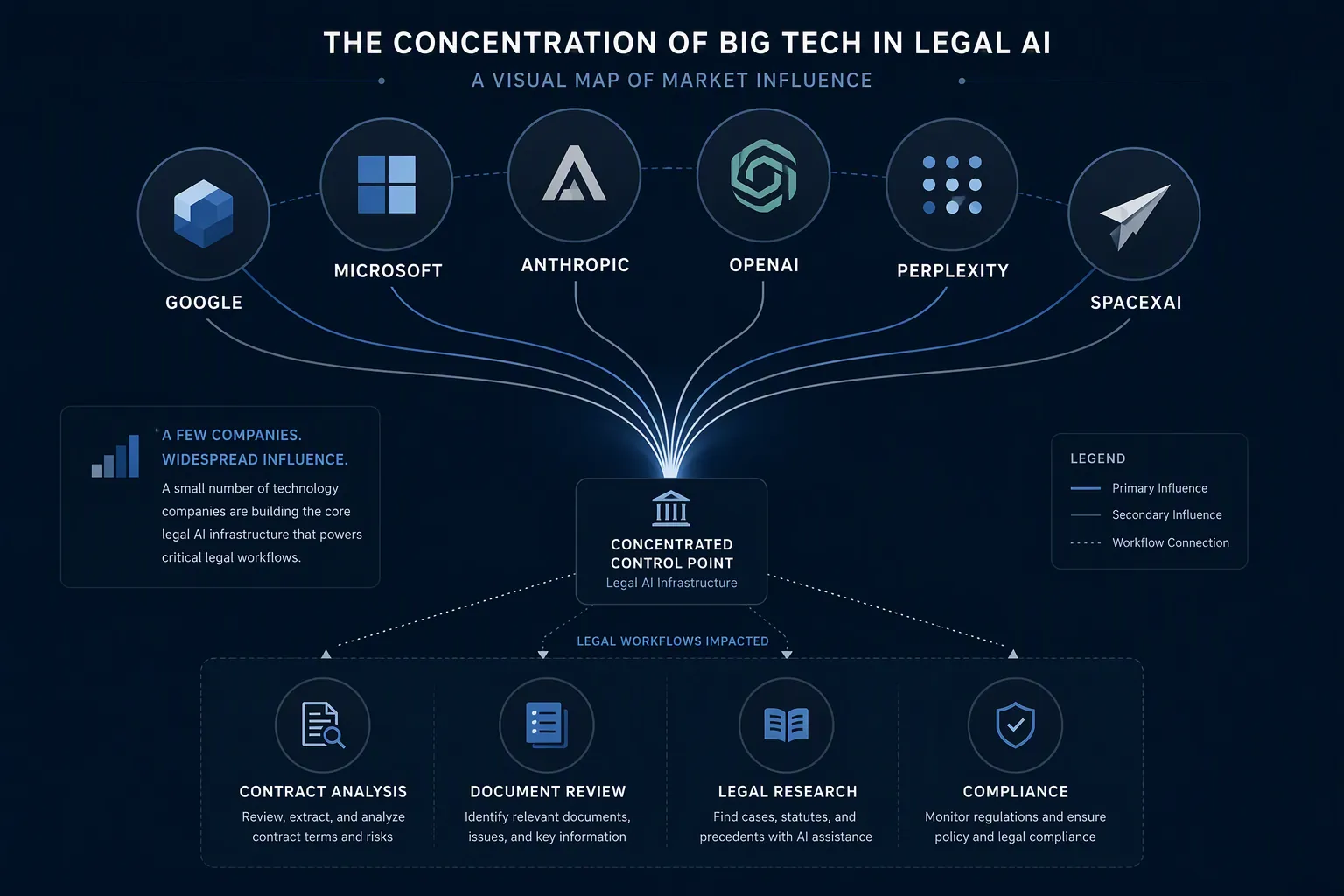
The concentration problem is already visible. Bloomberg Law reported in July 2026 that six Big Tech companies had advanced into legal AI within a four-month period and quoted one observer’s blunt assessment that “the folks that own the models are going to dictate the market.”[1] Law.com’s June 2026 tracking of Big Tech’s legal market moves listed legal-tool activity from Anthropic, Microsoft, OpenAI, Google, Perplexity, and SpaceXAI.[2]
That compressed launch window matters because law firms are not buying isolated software boxes. They are connecting model families to document repositories, knowledge systems, matter workflows, review processes, billing-sensitive drafting tasks, and firmwide AI policies. Once the template bank, usage guidance, security exceptions, training materials, and lawyer muscle memory all point toward one provider, a vendor decision outside the firm can become an internal remediation project.
Demand makes the dependency easier to build. Thomson Reuters and Georgetown Law reported in 2026 that law firm technology spending had risen 39.3% since 2021.[3] That does not prove every firm is overexposed to AI vendors. It does show why a market with newly available legal AI products can lock in quickly: budget exists, practice groups want relief from repetitive work, and procurement teams are under pressure to turn experiments into approved platforms.
The earnings signal is a stress test, not a verdict
The July 2026 earnings cycle should not be read as a product safety scorecard. Earnings data does not show whether Gemini gives a bad legal answer, whether Claude mishandles a workflow, or whether a GPT-based product fits a firm’s privilege controls. It does, however, show which parent strategies are absorbing financial pressure while those same companies are trying to win legal workflow share.
The data available at the time of writing came during the July 22-30, 2026 earnings window, with some Q2 figures still being finalized. Fortune reported that the Magnificent Seven had lost $797 billion in combined market capitalization, that Alphabet recorded its first negative free cash flow since its 2004 IPO, and that Meta’s stock dropped 9% after a capex raise to $125 billion-$145 billion.[4]
Those numbers do not justify a lazy conclusion that Big Tech-backed legal AI is unsafe. MarketWise reported countervailing monetization signals: Google Cloud up 63% to $20 billion, Azure up 40%, Microsoft Copilot at more than 20 million seats with 250% year-over-year growth, and AWS up 28% to $37.6 billion.[5] A risk committee should take those signals seriously. Revenue growth and seat adoption are not decorative talking points; they affect whether a platform has the patience and internal sponsorship to keep improving.
The procurement issue is the spread between adoption and dependency. A tool can be widely adopted and still create switching costs that the law firm, not the vendor, must absorb. A cloud business can be growing and still push customers toward deeper ecosystem commitments. A model provider can have excellent technical momentum and still reprice, redesign, or deprecate a product path that a practice group has already made routine.
Provider exposure differs by pressure profile
The more useful comparison is not “which company is most doomed.” It is which dependency would be most awkward to unwind if financial pressure reaches the legal workflow layer. The answer differs by provider.
| Provider layer | Legal AI relevance | Earnings or market signal | Procurement risk to test |
|---|---|---|---|
| Alphabet / Google / Gemini | Part of the 2026 Big Tech legal AI expansion tracked by Bloomberg Law and Law.com | Alphabet’s first negative free cash flow since its 2004 IPO; Google Cloud reported up 63% to $20 billion | Whether legal AI commitments survive budget discipline, product consolidation, or repricing tied to Gemini and cloud strategy |
| Microsoft / Azure / Copilot | Legal agent activity and deep integration potential across Microsoft environments | Azure reported up 40%; Copilot had more than 20 million seats and 250% year-over-year growth | Whether strong monetization increases lock-in faster than the firm can preserve model and workflow portability |
| Anthropic / Claude | Legal plugin and legal ecosystem activity, including market impact from a Claude legal plugin event | The research brief supports market-impact evidence, not public-company earnings exposure | Whether a Claude-centered workflow depends on product choices that can quickly shift the surrounding legal tech market |
| OpenAI / GPT-dependent tools | A large share of legal AI tools and workflows depend on GPT-class model access or OpenAI-linked capabilities | The research brief supports concentration exposure, not a specific July 2026 earnings line | Whether the firm can separate the application vendor from the underlying model dependency |
| Other entrants | Perplexity and SpaceXAI appeared in Law.com’s legal-market tracking | The research brief does not provide comparable earnings detail | Whether procurement treats entrant novelty as a pilot risk rather than a firmwide standardization path |
Alphabet’s signal is the most obvious budget-pressure case. Negative free cash flow is not a prediction that Gemini legal products will be abandoned. It is a reason to ask how much of the firm’s workflow should depend on a product line that may compete internally for capital against cloud infrastructure, consumer AI, search economics, and other Alphabet priorities. For readers who want the single-provider version of that analysis, the companion Risk Digest piece, What Alphabet’s Negative Free Cash Flow Means for Legal AI, is the better place to go deep; the concentration issue here is broader.
Microsoft presents almost the opposite problem. The MarketWise figures point to real monetization, not a weak product story: Azure growth, Copilot seat count, and Copilot year-over-year growth all indicate commercial traction.[5] For a law firm already operating inside Microsoft identity, document, email, collaboration, and security tooling, that strength can make adoption feel administratively sensible. It can also make exit planning feel unnecessary until it is too late.
That is a different risk from vendor disappearance. The operational danger is that AI policy, document access, matter workflows, and lawyer training become optimized for one ecosystem’s assumptions. If a feature changes, a license tier moves, a governance control is bundled differently, or a legal agent roadmap turns away from the firm’s use case, the switching burden lands on the KM lawyer, security lead, litigation support manager, and practice-group associate who must explain why the approved workflow now needs exceptions.
Anthropic is harder to evaluate through public-company earnings because the research materials do not provide a comparable July 2026 earnings line. That does not make the Claude layer irrelevant. Its legal plugin market-impact event is one of the clearest examples in the brief of a model-owner move affecting the legal technology ecosystem at market speed. Tool evaluations such as For Law Firms, Claude Opus 5 Offers Better Compliance Than Fable 5 can help with product-level fit, but product fit and dependency resilience are separate questions.
OpenAI creates another version of the same issue. The research brief supports concentration risk around GPT-dependent legal tools, not a precise July earnings vulnerability. That distinction matters. A firm should not invent a financial weakness just to fill a table. The procurement question is still real: when a legal application depends heavily on GPT access, the firm needs to know whether its vendor can preserve service quality, cost predictability, and workflow continuity if the underlying model economics or access terms change.

How financial pressure reaches the legal workflow layer
The bridge from earnings pressure to legal operations is usually indirect. A disappointed investor does not rewrite a law firm’s privilege policy. A capex raise does not delete a drafting workflow. The risk moves through product decisions that look ordinary until the firm has built dependency around them.
- Repricing: a provider can preserve the product but move the features a firm relies on into a more expensive tier.
- Roadmap narrowing: a company under capital discipline can focus AI investment on broader enterprise use cases and slow legal-specific development.
- Model substitution: an application vendor can change the underlying model family, requiring renewed evaluation of confidentiality, accuracy, retention, and audit controls.
- Integration hardening: a platform can make its own ecosystem the easiest path, increasing the cost of using alternative models or legal tools.
- Support degradation: a provider can keep a feature alive while reducing the attention, documentation, or legal-market support that made it usable.
None of those outcomes requires a dramatic product shutdown. That is why procurement files that ask only whether the vendor is solvent are incomplete. The more practical questions are whether the firm can export instructions, preserve matter-specific workflow logic, swap model providers, revalidate outputs, and retrain lawyers without turning a budget correction elsewhere into a practice-support emergency.
Capex escalation is especially awkward for buyers because it can support two competing conclusions. Heavy spending may signal commitment and capacity. It may also create pressure to monetize more aggressively. Meta’s reported capex raise to $125 billion-$145 billion and stock drop show that investors were testing the patience of AI spending narratives in July 2026.[4] For legal procurement, the lesson is not about Meta specifically unless the firm is buying a Meta-linked legal workflow. The lesson is that infrastructure-heavy AI strategies can convert external capital pressure into product and pricing decisions.
The monetization counterpoint should change the analysis, not be stapled on at the end. Microsoft’s Copilot seat growth and Azure growth suggest a provider with strong reasons to keep investing in enterprise AI.[5] That lowers one kind of risk and raises another: the firm may be less exposed to abandonment but more exposed to deep operational lock-in. A tool that succeeds can become harder to leave than a tool that fails early.
The Robin AI and Anthropic precedents make the risk concrete
The objection from partners will be familiar: parent-company earnings are too remote from the tool lawyers use every day. That objection is partly right. The evidence does not support treating every earnings disappointment as a legal AI reliability incident. But the legal market already has examples showing that vendor and platform shocks can arrive before law firms have finished absorbing the last procurement cycle.
The Anthropic Claude legal plugin event is the market-level precedent. Digital Applied’s February 2026 analysis reported that the event wiped $285 billion in market capitalization from RELX, Wolters Kluwer, and LegalZoom over 48 hours, with RELX and Wolters Kluwer each down more than 10% and LegalZoom down 19.68%.[6] That does not prove those companies’ products failed. It shows how quickly a model-owner legal AI move can change market expectations around incumbent legal technology.
For a law firm, that speed matters more than the stock-market drama. If a provider’s model layer changes what customers expect from research, drafting, contract review, or self-service legal tools, downstream vendors may be pushed to rebuild, partner, sell, or reposition. The firm experiences that not as a trading event but as contract amendments, feature changes, integration changes, and renewed policy review.
Robin AI is the operational precedent. Lumay AI’s vendor stability analysis documents Robin AI’s collapse timeline from October 2025 to January 2026.[7] Law.com later reported in April 2026 that Microsoft’s Legal Agent launch was built partly by hiring from the now-defunct Robin AI.[8] That sequence is not a general rule that every well-funded legal AI vendor will disappear. It is a reminder that “well-funded” and “durable in my workflow” are not the same procurement finding.
The Robin AI example also shows why Big Tech expansion can be both stabilizing and destabilizing. Talent and product ideas may migrate into a larger platform with better distribution and infrastructure. Customers of the failed vendor still have to unwind the old workflow. The receiving platform may not preserve the same controls, user experience, pricing, or roadmap that made the original tool attractive.
What to ask before standardizing on one model family
The right response is not to freeze AI adoption. That would ignore the genuine productivity gains firms are pursuing and the real monetization signals visible in cloud and Copilot adoption. The better response is to write procurement questions as if the firm may need to unwind the workflow under time pressure.
- Map model dependency separately from application dependency. A legal product may have one vendor name on the contract and another provider controlling the model layer.
- Require a workflow exit plan before firmwide rollout. The plan should identify who owns instruction libraries, templates, integrations, training materials, and policy updates.
- Test whether outputs and audit records remain usable after a provider switch. Export rights are not enough if the exported material cannot support supervision, review, or defensibility.
- Separate adoption metrics from resilience metrics. Seat growth may support vendor durability, but it does not answer whether the firm can leave without disrupting active matters.
- Watch for roadmap dependence. If the business case assumes a promised legal-specific feature, treat that feature as a contingency, not as current control evidence.
The most important line in the procurement memo may be the one that names the person who will do the cleanup. If a drafting assistant loses a feature, does knowledge management rebuild the templates? If a review workflow changes model providers, does litigation support revalidate output behavior? If a Copilot-style integration expands access in a way the firm did not anticipate, does security rewrite the policy or disable the workflow? If a Claude- or GPT-dependent legal tool changes its model path, who tells the practice group that the approved process is no longer approved?
Those questions are deliberately mundane. They are also where concentration risk becomes real. A law firm does not bear the $797 billion market-cap loss reported across the Magnificent Seven.[4] It bears the cost of replacing a matter workflow while attorneys are still trying to file, negotiate, review, and advise.
The procurement judgment
July 2026 earnings do not tell law firms which Big Tech AI strategy will win. They do show that the legal AI market is being built on a narrow provider base whose members face different financial and strategic pressures. Alphabet’s negative free cash flow points to budget-discipline questions. Microsoft’s Azure and Copilot strength points to monetization and lock-in. Anthropic’s legal plugin event shows how quickly model-owner moves can unsettle the legal tech market. GPT-dependent tools require separation of application risk from model-layer risk.
A firm does not need to forecast the winning AI stock. It does need to avoid making one provider’s budget correction, roadmap shift, or platform consolidation its own workflow failure.
References
- Big Tech Advances Into Crowded Legal AI Arena, Bloomberg Law, July 16, 2026.
- Tracking Big Tech's Move Into the Legal Market, Law.com, June 28, 2026.
- State of the US Legal Market, Thomson Reuters/Georgetown Law, 2026.
- Big Tech earnings slam into a market in revolt over AI spending, Fortune, July 26, 2026.
- What Alphabet, Amazon, Meta, and Microsoft Earnings Say About AI, MarketWise, July 2026.
- Anthropic Claude Legal Plugin: Market Impact Analysis, Digital Applied, February 2026.
- Robin AI Vendor Stability Analysis, Lumay AI.
- Microsoft Legal Agent launch, Law.com, April 2026.
Related records
Tool profile
Browse tool evaluations →Governing regulation
Browse the obligations tracker →Preventive workflow
Browse verification workflows →
Report a correction or tip
Spotted an outdated figure, a misstated fact, or a ruling this case record should reflect? Public comments are disabled for this content given the professional cost of a misreported case outcome, penalty amount, or rule text — use the structured correction channel instead.
Report a correction or tip for this record →