
Which EU Rules Apply to BlackRock's Tokenized MMFs?
Explains why BlackRock's Aug 4, 2026 launch of tokenized money market funds in Europe is not a MiCA event and which regimes govern instead: the Money Market Fund Regulation, UCITS/AIFMD, PRIIPs, MiFID II distribution duties, and AML/KYC wallet mechanics, with primary sources for each obligation.
- Jurisdiction
- European Union
- Court
- ESMA / European Commission
- AI tool named
- BlackRock Tokenized Money Market Funds (JPMorgan Kinexys)
- Ruling date
- Aug 4, 2026
- Source document
- View primary court order ↗
- Last verified
- Aug 4, 2026
Lex Machina Review is an independent risk-tracking and reference resource. Nothing on this site is legal advice, and using it does not create an attorney-client relationship. Every record is reviewed against primary sources but may not reflect the most current status of a matter — always verify directly against the cited court order, rule text, or a licensed attorney before relying on it.
Companion explanation — secondary to the source document above
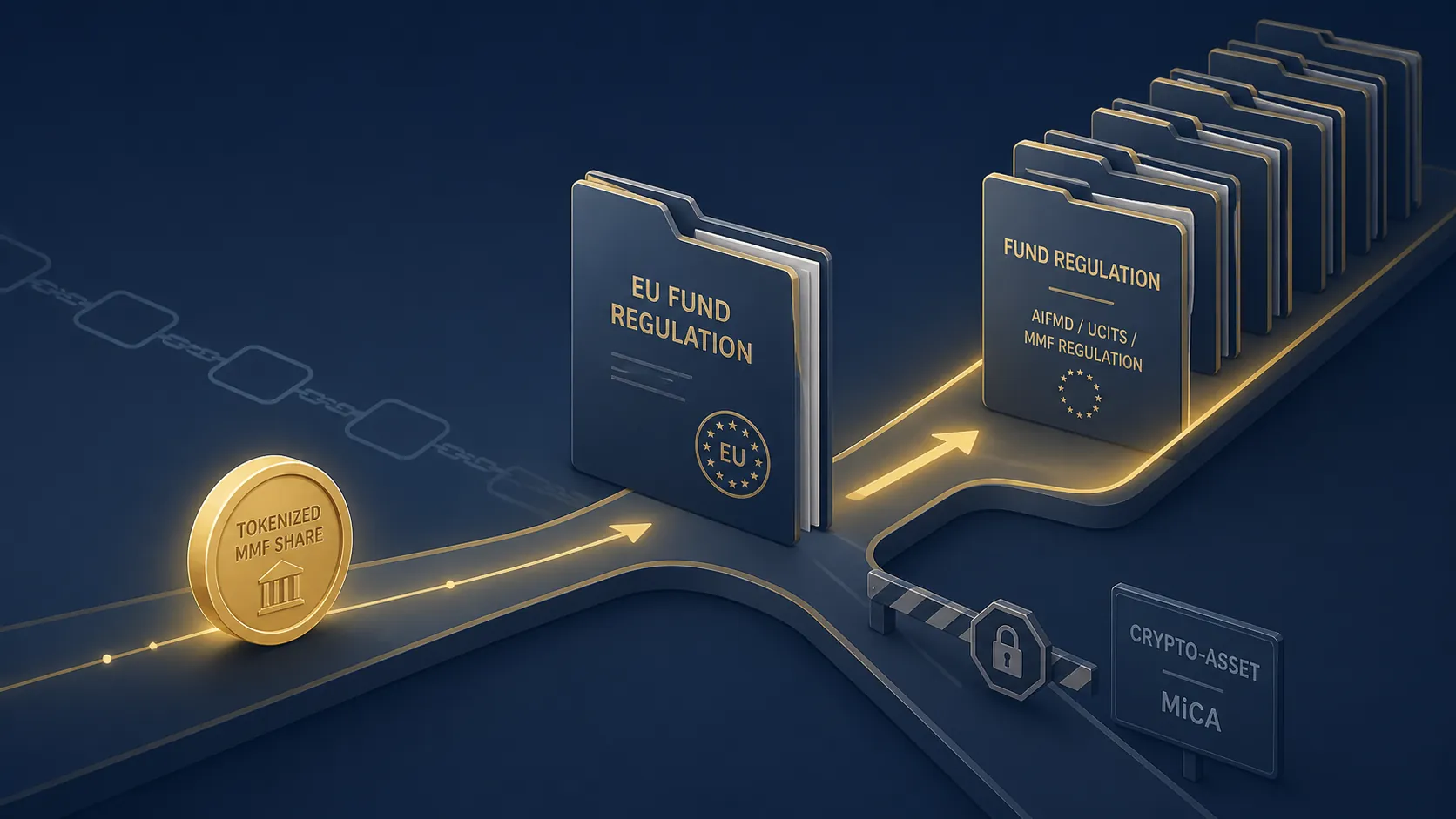
Scope note, last checked Aug. 4, 2026, UTC: this record addresses the EU regulatory classification of BlackRock’s European tokenized money market fund shares as described in the launch materials available on that date. It is not legal advice. The short answer is that the launch should not be briefed as a Markets in Crypto-Assets Regulation event under current EU law. The starting point is the fund interest: a tokenized money market fund share remains a unit in a collective investment undertaking, which is a financial instrument under MiFID II Annex I Section C(3). That status triggers the MiCA Article 2(4) exclusion for financial instruments, and the analysis then moves to the Money Market Fund Regulation, UCITS or AIFMD as applicable, disclosure, distribution, and AML/KYC controls.
The Aug. 4 launch facts are the trigger, not the classification answer
BlackRock said on Aug. 4, 2026, that it launched tokenized versions of select Institutional Cash Series money market funds in Europe, covering sterling, euro, and U.S. dollar share classes. The company-reported combined assets under management figure was approximately $311 billion. The tokenization arrangement uses JPMorgan’s Kinexys platform, with JPMorgan continuing as transfer agent, according to the launch report and company statement details carried by Reuters and The Edge Malaysia.[1]
Those facts matter for the operational map: who records ownership, how transfers are controlled, and which investors can hold the tokenized shares. They do not, by themselves, create a new EU regulatory category. BlackRock’s own explainer frames tokenized money market funds as fund shares represented through tokenized records, with investor access and transfer mechanics built around approved wallets rather than an unrestricted public-token model.[2]
Why MiCA is not the governing box
The governing question is not whether a blockchain or token is involved. The governing question is what the token represents. If the token represents a share or unit in a fund, the classification begins with the fund interest.
ESMA’s guidelines on the qualification of crypto-assets as financial instruments make the technology-neutral point that the form of technology used does not determine whether an asset is a financial instrument. The analysis looks through the digital representation to the rights, obligations, and economic function attached to the instrument.[3]
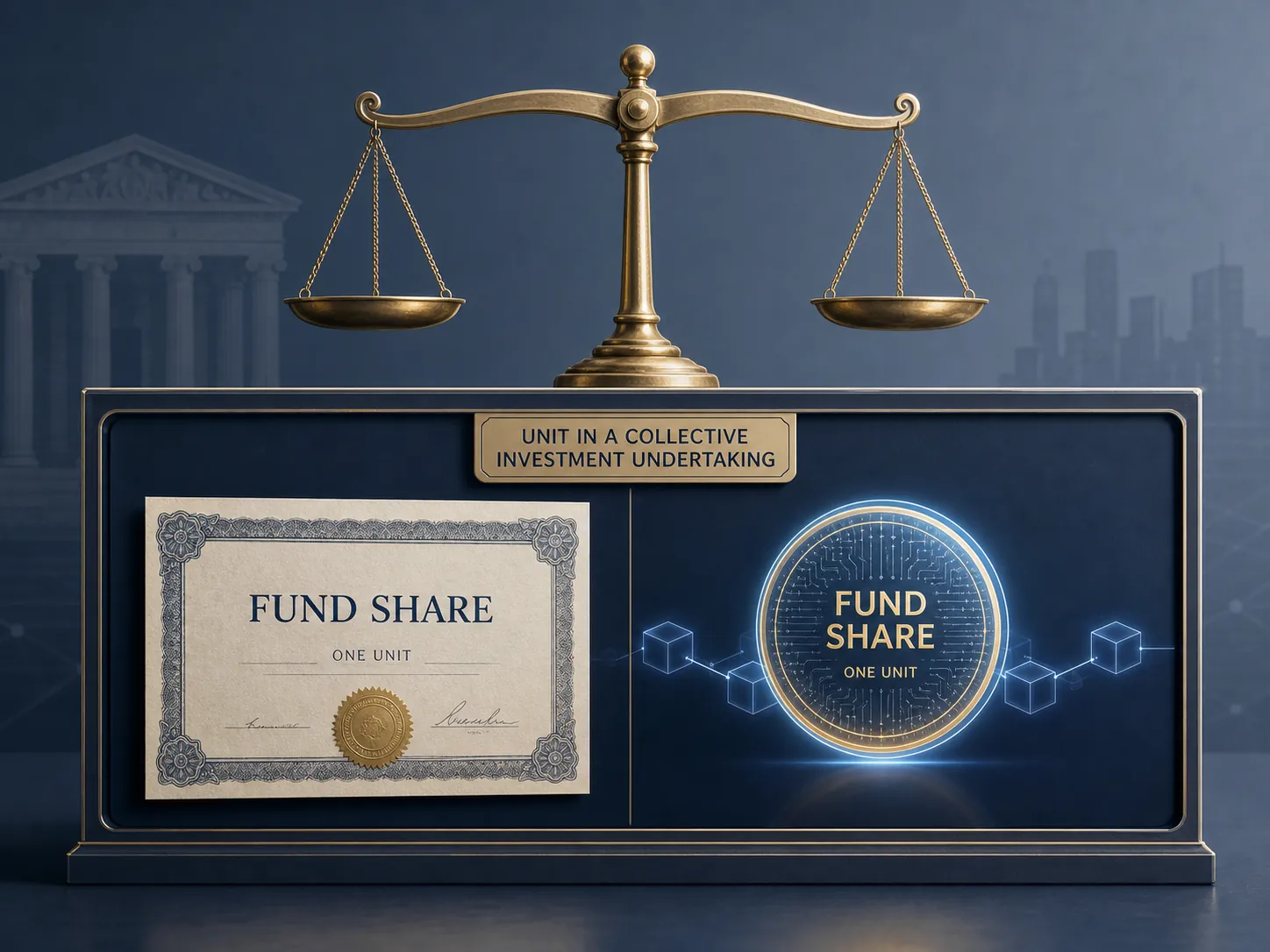
That matters because MiFID II Annex I Section C(3) includes “units in collective investment undertakings” within the list of financial instruments. A tokenized money market fund share is still a unit or share in a collective investment undertaking; the tokenized wrapper does not, on the materials available, change the legal substance of the holding. Once the interest is a MiFID II financial instrument, MiCA’s Article 2(4) exclusion becomes decisive: MiCA does not apply to crypto-assets that qualify as financial instruments.[3][4]
That is the clean source chain for the current answer: fund unit, MiFID II financial instrument, MiCA exclusion, residual fund and securities-law perimeter. A cautious memo can add that tokenization may change recordkeeping, transfer controls, and settlement workflows. It should not say that tokenization changes the underlying instrument unless the relevant fund documents and regulatory approvals say so.
The obligation map after classification
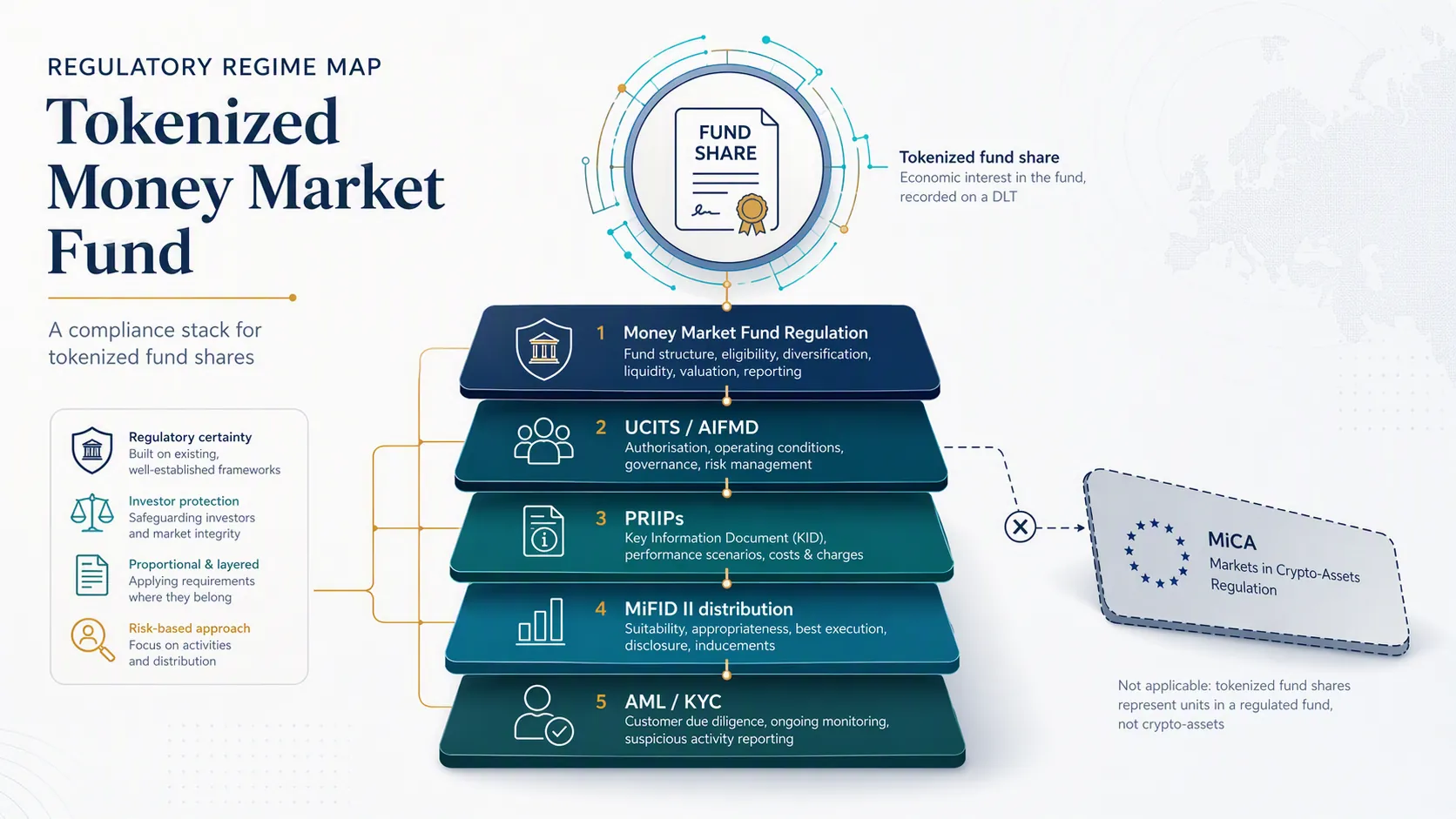
After the MiCA exclusion, the work is more familiar and less optional. The applicable regimes are not all equal in sequence. First, the product must be treated as a money market fund and as a fund vehicle. Then the disclosure and distribution duties attach to the way the share class is offered and sold. Finally, tokenization introduces operational controls around wallets, recordkeeping, and transfer restrictions.
| Regulatory layer | Why it is relevant to tokenized MMF shares | Practical question for the file |
|---|---|---|
| Money Market Fund Regulation | The product is a money market fund, regardless of tokenized representation. | Which MMF type, valuation model, liquidity tools, and support restrictions apply? |
| UCITS or AIFMD | The fund’s legal structure determines the fund-management and authorization regime. | Is the vehicle a UCITS or an AIF, and which management company obligations follow? |
| Prospectus Regulation, where relevant | Offering and admission facts may trigger securities disclosure analysis. | Is there a public offer or admission to trading requiring a prospectus or exemption analysis? |
| PRIIPs KID | Retail-facing packaged investment products can require a key information document. | Who is the target investor, and is a KID required before distribution? |
| MiFID II distribution duties | Intermediaries distributing financial instruments must address product governance, suitability or appropriateness, and client classification. | Who distributes the tokenized share class, to whom, and under what target-market controls? |
| AML/KYC and wallet controls | Tokenized transfer mechanics require investor identification and controlled wallet permissions. | Which wallets are whitelisted, who approves them, and how are transfers blocked or escalated? |
Money Market Fund Regulation remains central
The ECB’s April 2026 Macroprudential Bulletin treats EU-domiciled tokenized money market funds as being subject to the Money Market Fund Regulation. It also notes features of the EU MMF regime that matter for the risk file: external support to stabilize net asset value is prohibited, while constant net asset value and low-volatility net asset value structures rely on regulated valuation mechanics and liquidity tools such as gates or suspensions.[5]
That does not make every tokenized MMF identical. The fund’s classification, assets, investor base, denomination, and governing documents still do work. But the presence of a tokenized register does not remove the product from the MMF rulebook.
UCITS or AIFMD depends on the vehicle, not the token
The next box is the fund wrapper. If the MMF is a UCITS, the UCITS regime supplies the authorization, eligible-assets, risk-spreading, depositary, management-company, and investor-disclosure perimeter. If it is an AIF, AIFMD supplies the manager and marketing perimeter. Tokenization does not answer that question; the fund documents do.
This is where a launch note can become misleading if it treats “tokenized fund” as the primary label. A fund-compliance review still needs the prospectus, constitutional documents, management company details, depositary arrangements, target-market analysis, and distribution permissions. The tokenized share class is then checked against those documents, not the other way around.
Disclosure and distribution duties travel with the financial instrument
Where the offering facts require it, the Prospectus Regulation analysis is still a securities-law question: public offer, admission to trading, exemption, and approved disclosure. Separately, the PRIIPs regime may require a key information document before retail distribution. Nothing in the available launch facts supports treating tokenized representation as a substitute for those disclosure checks.
MiFID II also remains in the chain because distribution of a financial instrument brings product governance and client-facing duties. The relevant review is practical: target market, negative target market, distribution strategy, client classification, suitability or appropriateness where applicable, cost and charge disclosure, and ongoing distributor oversight. If the tokenized share class is available only to certain institutional or professional channels, that fact narrows the distribution file. It does not erase it.
Where tokenization does change the compliance work
The useful tokenization questions are operational. BlackRock’s materials describe tokenized MMF access through approved wallet mechanics, and the launch report states that JPMorgan remains transfer agent while the tokenized version uses JPMorgan Kinexys.[1][2] Those details are not decoration. They determine how the regulated fund perimeter meets the on-chain transfer environment.
- Wallet approval: the file should show how an investor wallet is linked to a KYC’d investor and who can approve, reject, freeze, or remove a wallet.
- Transfer restrictions: the system should prevent transfers to non-approved wallets if the fund is not intended to circulate freely.
- Register continuity: the transfer-agent role should be reconciled with the tokenized record so that legal ownership, investor servicing, and redemption rights do not depend on an ambiguous ledger hierarchy.
- AML monitoring: subscriptions, redemptions, wallet changes, and secondary transfers, if permitted, need controls consistent with the fund’s AML/KYC obligations.
- Operational incident handling: the documents should say what happens if a wallet is compromised, a token is sent incorrectly, or a blockchain service becomes unavailable.
These points are where the legal classification touches the product. They are also where a superficial “MiCA may apply” answer is least helpful. If the share is a financial instrument outside MiCA, the control question becomes whether the fund and its service providers can enforce the ordinary fund-transfer, ownership, investor-eligibility, AML, and redemption rules in the tokenized workflow.
Policy materials support the same-risk reading, with an open boundary review
The broader policy materials line up with the same-risk, same-rules approach. Banque de France’s Eco Notepad No. 408 discusses tokenized money market funds through technological neutrality and financial-stability implications, rather than treating tokenization as a reason to leave the existing fund-regulation perimeter.[6]
The ECB’s April 2026 discussion is similar in tone. It looks at tokenized MMFs as MMFs with potentially different settlement, liquidity, and operational channels, not as assets that escape the MMF framework. That distinction is important: policy concern about tokenized settlement does not equal a present-law finding that MiCA governs tokenized fund shares.[5]
There are also legal-certainty precedents at member-state and supervisory levels. Luxembourg has promoted fund tokenization under its Blockchain Law 4 framework, and Luxembourg for Finance has pointed to Franklin Templeton’s OnChain U.S. Government Money Fund as the first CSSF-approved tokenized UCITS. Those examples are useful as evidence of supervised fund tokenization inside a fund-law perimeter, not as proof that every future tokenized fund structure receives identical treatment.[7]
The policy boundary is not frozen. The European Commission’s 2026 tokenization materials refer to the May 2025 MiCA review consultation and the broader Market Integration and Supervision Package, including extension of the DLT Pilot Regime. KPMG’s regulatory analysis likewise treats the EU workstream as an effort to adapt regulation for tokenized markets rather than a declaration that the current perimeter is permanent.[8][9]
That is why the safer current formulation is narrow: under Q3 2026 EU law and the available product facts, tokenized MMF shares are analyzed as financial instruments and fund interests outside MiCA. The Commission review matters because it asks whether that allocation should continue to hold as tokenized markets develop.
Do not mix market-size figures into the legal answer
Market-size figures around tokenized assets and tokenized funds are easy to misuse. The available materials themselves flag inconsistent snapshots: BUIDL assets have been reported at different levels by different outlets around the launch window, and total tokenized-asset market figures vary depending on the source, date, and measurement boundary. Those numbers may be relevant for a market note. They are not needed to classify BlackRock’s European tokenized MMF shares.
For this file, the only launch-size figure worth carrying is the company-reported approximately $311 billion combined AUM of the selected Institutional Cash Series money market funds, and even that figure should stay labeled as company-reported. It does not prove the regulatory classification. The instrument does.
The briefing answer for Q3 2026
A partner or compliance committee does not need a tokenization essay to open the file. It needs the applicable-law path: BlackRock’s European tokenized MMF shares should be treated as units in a collective investment undertaking; units in collective investment undertakings are MiFID II financial instruments; MiCA excludes financial instruments; the governing work is therefore the MMF, UCITS or AIFMD, disclosure, PRIIPs, MiFID II distribution, and AML/KYC wallet-control analysis.
That answer is settled enough for current-law classification. It is not settled enough to ignore the policy file. Counsel should brief BlackRock’s launch today as a fund-regulation and distribution-compliance matter, while tracking the Commission’s MiCA review because the live debate is whether the financial-instrument boundary should remain where current EU law places it.
References
- BlackRock launches tokenized money market funds in Europe, Reuters via The Edge Malaysia, Aug. 4, 2026, link
- What are tokenised money market funds?, BlackRock, link
- Guidelines on the conditions and criteria for the qualification of crypto-assets as financial instruments, ESMA, December 2024, link
- Markets in Crypto-Assets Regulation (MiCA), ESMA, link
- Tokenised money market funds: implications for financial stability, European Central Bank, April 2026, link
- Tokenised money market funds: what are the implications for financial stability?, Banque de France, link
- Fund tokenisation: a competitive edge, Luxembourg for Finance, link
- DLT and tokenisation: paving the way for the internet of value, European Commission, April 21, 2026, link
- Tokenisation: adaption of regulation to support European markets, KPMG, link
Related records
Tool profile
Browse tool evaluations →Governing regulation
Browse the obligations tracker →Preventive workflow
Browse verification workflows →
Report a correction or tip
Spotted an outdated figure, a misstated fact, or a ruling this case record should reflect? Public comments are disabled for this content given the professional cost of a misreported case outcome, penalty amount, or rule text — use the structured correction channel instead.
Report a correction or tip for this record →