
Data Broker Gap for Lawyers After Boelter Sentencing
The Vance Boelter sentencing reveals how data broker sites supplied home addresses used in the Minnesota lawmaker assassination. This article analyzes the gap in federal protections that leaves attorneys and law firm staff exposed, and outlines practical steps firms can take now.
- Jurisdiction
- US-Federal
- Court
- U.S. District Court for the District of Minnesota
- Judge
- John R. Tunheim
- AI tool named
- Data broker websites
- Ruling date
- Jul 23, 2026
- Source document
- View primary court order ↗
- Last verified
- Jul 24, 2026
Lex Machina Review is an independent risk-tracking and reference resource. Nothing on this site is legal advice, and using it does not create an attorney-client relationship. Every record is reviewed against primary sources but may not reflect the most current status of a matter — always verify directly against the cited court order, rule text, or a licensed attorney before relying on it.
Companion explanation — secondary to the source document above
Vance Boelter’s murder sentencing ended with the harshest non-capital federal punishment available: two consecutive life terms without parole, followed by 40 consecutive years. Judge John R. Tunheim imposed the sentence in the District of Minnesota on July 23, 2026, after prosecutors described the assassination of Minnesota House Speaker Melissa Hortman and the attempted murder of other officials as targeted political violence.[1] Readers who need the case chronology can start with the earlier sentencing report, Two consecutive life terms for Minnesota lawmaker assassination.
The sentence supplies the legal endpoint. It does not supply the operational lesson. That lesson appears in the reported mechanics of targeting: according to Lawfare’s account of the FBI affidavit, Boelter’s notebook listed 11 people-search or data broker websites and contained names and home addresses for more than 45 Minnesota officials.[2] WIRED likewise reported that investigators tied the address-gathering process to people-search sites.[3] Those facts matter because they move the risk from abstraction to workflow. A person did not need inside access to a government system to assemble a home-address map. Public-facing civic roles, commercial data trails, and time were enough.

For lawyers and law-firm staff, the question after Boelter’s life-plus-40-year sentence is not whether the profession faces the same risk as elected officials in Minnesota. The narrower, better question is whether legal professionals have a comparable tool when their names, household connections, and home addresses travel through the same commercial ecosystem. At the federal level, the answer is no.
The Judicial Model Exists, but It Stops at the Courthouse Door
Congress has already recognized that data-broker exposure can become a safety problem for legal actors. The Daniel Anderl Judicial Security and Privacy Act, enacted in December 2022, created federal protections allowing federal judges to restrict publication or resale of certain personal information, including through data brokers.[4] The statute followed the 2020 attack that killed Daniel Anderl, the son of U.S. District Judge Esther Salas, and injured her husband.[4]
That law is important not because it solves data-broker violence, but because it identifies the mechanism accurately. Home addresses, family-member data, and household links can create an attack surface. The federal response gives judges a role-specific opt-out framework. Attorneys, paralegals, legal assistants, reception staff, investigators, and litigation-support personnel are not covered by the same federal shield merely because their work places them near hostile disputes.
That boundary is hard to defend operationally. A judge signs the order, but a law-firm associate may sign the filing. A paralegal may call the angry witness. A receptionist may be the named person on a firm directory page. A spouse may appear in a household record that links back to the employee. In high-conflict matters, the risk does not politely stop at Article III.
| Role or group | Federal opt-out protection discussed here | Operational concern |
|---|---|---|
| Federal judges | Covered by the Daniel Anderl Judicial Security and Privacy Act | Personal and family information can be restricted through a judge-specific framework |
| Attorneys | No equivalent federal protection identified in the research materials | Names appear on pleadings, firm pages, public calendars, bar records, and matter communications |
| Paralegals and legal staff | No equivalent federal protection identified in the research materials | Staff may contact hostile parties, coordinate service, manage records, and appear on websites or email signatures |
| Household members | Protected only indirectly where a covered person’s statute reaches family information | People-search sites may connect relatives, shared addresses, prior residences, and property records |
The Boelter case does not prove that every lawyer is likely to be targeted through data brokers. It proves a narrower and more useful point: people-search sites can be used as part of a real targeting process, and role-specific legal protections leave large portions of the legal workforce outside the federal opt-out model.
State Laws Are Moving, but They Do Not Create a Single Shield
The state-law picture is active, but not clean. California’s Delete Act created the Delete Request and Opt-Out Platform, known as DROP, which went live on January 1, 2026.[5] Under the implementation schedule described in privacy-law coverage, data brokers must begin processing deletion requests through the system every 45 days by August 1, 2026.[6] That is a meaningful administrative development. It is also a calendar-driven process, not an immediate national safety perimeter.
New Jersey enacted A5328 on June 30, 2026, adding a costly registration and compliance regime for data brokers.[7] Connecticut’s 2026 SB 4 expanded data broker registration requirements and consumer opt-out rights.[8] These laws may improve visibility and give consumers more ways to act, depending on residence, scope, timing, and implementation. They do not give a paralegal in a volatile matter the same simple answer that a federal judge can point to under the Daniel Anderl Act.
Federal proposals show that lawmakers understand the political-safety dimension. The Brennan Center described 2026 federal activity including proposals such as the SECURE Data Act and an amendment associated with Senators Ted Cruz and Amy Klobuchar that would extend opt-out protections to members of Congress and their families in response to the Minnesota attack.[9] As of July 24, 2026, however, the research materials do not identify any enacted comprehensive federal data broker law extending comparable protection to lawyers or law-firm personnel.
That distinction matters in a risk program. A proposed bill may justify monitoring. It does not remove an associate’s address from a people-search profile this month.
What Firms Can Do Before the Law Catches Up
Personal-data removal should not be treated as a partner privilege or an emergency favor after a threat. It belongs in the same family as physical security reviews, litigation-hold discipline, and access controls: imperfect, recurring, auditable risk reduction. No removal program can promise that a determined attacker will fail. The point is to reduce easy discovery, shorten exposure windows, and create a record that the firm took the risk seriously.
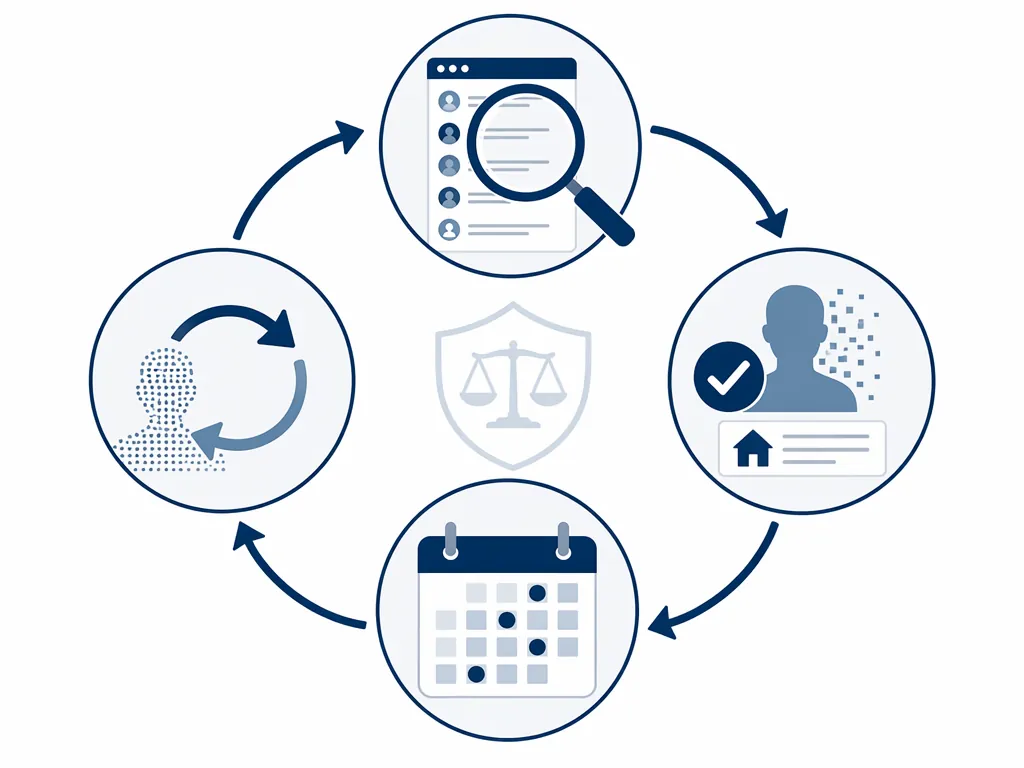
A workable program starts with scoping. Firms should identify which people are most exposed because of matter type, public visibility, or recent hostility. That list will usually include lawyers in politically sensitive, domestic-violence-adjacent, employment, insolvency, criminal, election, public-corruption, sanctions, high-net-worth family, and contentious trust or guardianship matters. It should also include staff who communicate directly with angry parties or whose names appear on public-facing pages.
- Run periodic scans for exposed home addresses, phone numbers, email addresses, relatives, prior residences, and property links on major people-search and data broker sites.
- Prioritize removal for personnel attached to high-conflict matters, public-sector representations, political clients, restraining-order work, and cases involving credible threats.
- Ask, where appropriate and lawful, whether household-member exposure is creating a backdoor path to the employee’s residence.
- Add intake questions after threats: who was threatened, what information the hostile person already had, whether family members were referenced, and whether the person’s address appears online.
- Document removal requests, broker responses, unresolved listings, and reappearance dates so the process can be audited rather than remembered.
The re-check is not optional. Data can reappear when brokers refresh from public records, acquire new datasets, or republish through affiliated sites. A one-time scrub performed after a frightening voicemail may make people feel heard, but it does not function as a control. The better cadence depends on the firm’s threat profile, but the process should have an owner, a calendar, and escalation criteria.
Vendor Selection Is a Risk Decision, Not a Convenience Purchase
Many firms will use removal vendors because the broker landscape is tedious by design. That is not a reason to outsource judgment. Before sending employee and household information to a vendor, the firm should understand what data the vendor collects, whether it uses subcontractors, how long it retains submitted information, which sites it covers, how it verifies deletion, and what reports it provides. A vendor that cannot show what was requested, when, and with what result is selling comfort more than control.
The firm also needs consent and boundaries. Staff should know what information the firm proposes to collect for scanning and removal, who will see it, and whether participation is voluntary or tied to a particular threat response. Household-member checks require additional care because the firm may be touching information about people who are not employees, clients, or agents of the firm. The safest operational habit is to minimize what is collected, explain why it is needed, and keep the results away from ordinary personnel files.
The Threat Intake Should Capture Data Exposure
Most firms already know how to preserve an abusive email or notify building security after a direct threat. Fewer threat-response forms ask whether the hostile person mentioned a home address, a spouse, a child’s school, a prior residence, or a personal phone number. Those details change the response. They may justify faster broker removal, a security consultation, notice to the affected person’s household, or a decision to route future communications through a different channel.
A hypothetical example shows the difference. If a former opposing party calls a firm and says only that a lawyer is corrupt, the response may stay within ordinary incident handling. If the same caller names the lawyer’s street and spouse, the matter has moved from professional hostility toward personal-location exposure. The next step should not depend on whether the lawyer is senior enough to know whom to call.
The Case Proves a Threat Model, Not a Cure
It would overstate the evidence to claim that a broader data broker law would have prevented the Minnesota attack. The record described in the reporting supports a more disciplined conclusion: commercial people-search tools were reportedly part of the targeting process, and existing federal privacy protection is uneven by role. Judges have a dedicated federal model. Lawyers and the staff around them largely improvise through state-law rights, vendor tools, employer policies, and personal persistence.
That is not enough structure for a profession that routinely puts ordinary employees between angry people and legal consequences. Until a broader federal broker law exists, firms should treat personal-data exposure as an operational safety issue: recurring, documented, and owned by someone with authority to act.
References
- Justice Department Press Release on Vance Boelter Sentencing, U.S. Department of Justice, July 23, 2026.
- Lawfare Reporting on the FBI Affidavit in the Vance Boelter Case, Lawfare.
- WIRED Reporting on People-Search Sites and the Minnesota Targeting Evidence, WIRED.
- Daniel Anderl Judicial Security and Privacy Act Signed Into Law, United States Courts, December 2022.
- California’s Delete Act and DROP Platform Coverage, CalMatters, January 2026.
- California Delete Act Implementation and 45-Day Processing Requirements, Troutman Pepper.
- New Jersey Enacts A5328 Data Broker Registration and Compliance Regime, Troutman Pepper, July 2026.
- Connecticut SB 4, Connecticut General Assembly, 2026.
- Federal Data Broker and Public Official Safety Proposals, Brennan Center for Justice, March 2026.
Related records
Tool profile
Browse tool evaluations →Governing regulation
Browse the obligations tracker →Preventive workflow
Browse verification workflows →
Report a correction or tip
Spotted an outdated figure, a misstated fact, or a ruling this case record should reflect? Public comments are disabled for this content given the professional cost of a misreported case outcome, penalty amount, or rule text — use the structured correction channel instead.
Report a correction or tip for this record →