
Can Sierra Leone extradite Bolle Jos without a treaty?
An examination of Sierra Leone's Extradition Act of 1974 reveals that no bilateral treaty is required for Bolle Jos's extradition to the Netherlands, but procedural choke points and political factors have stalled the process for over 18 months.
- Jurisdiction
- Sierra Leone
- Court
- Sierra Leone High Court
- AI tool named
- Not applicable
- Ruling date
- Jul 25, 2026
- Source document
- View primary court order ↗
- Last verified
- Jul 25, 2026
Lex Machina Review is an independent risk-tracking and reference resource. Nothing on this site is legal advice, and using it does not create an attorney-client relationship. Every record is reviewed against primary sources but may not reflect the most current status of a matter — always verify directly against the cited court order, rule text, or a licensed attorney before relying on it.
Companion explanation — secondary to the source document above
The easiest mistake in the Bolle Jos extradition dispute is also the most consequential one: treating the absence of a bilateral Netherlands-Sierra Leone extradition treaty as the end of the legal analysis. It is not. Sierra Leone’s Extradition Act of 1974 contains its own route. The Netherlands appears in the Third Schedule as a country to which Part IV applies on a reciprocal basis, and the Fourth Schedule includes drug-trafficking offences under Sierra Leone’s dangerous-drugs legislation among extraditable offences.[1]
That matters because Jos Leijdekkers, widely known as Bolle Jos, is not being discussed in the abstract. The Dutch case concerns serious drug-crime allegations and a Dutch sentence reported as 24 years, far beyond the Act’s 12-month threshold for an extraditable offence.[1][2] On the materials now available, the legal problem is not that Sierra Leone lacks a treaty. The problem is that the domestic statutory machinery that could test the Dutch request has not visibly moved to the point where a court can decide anything.
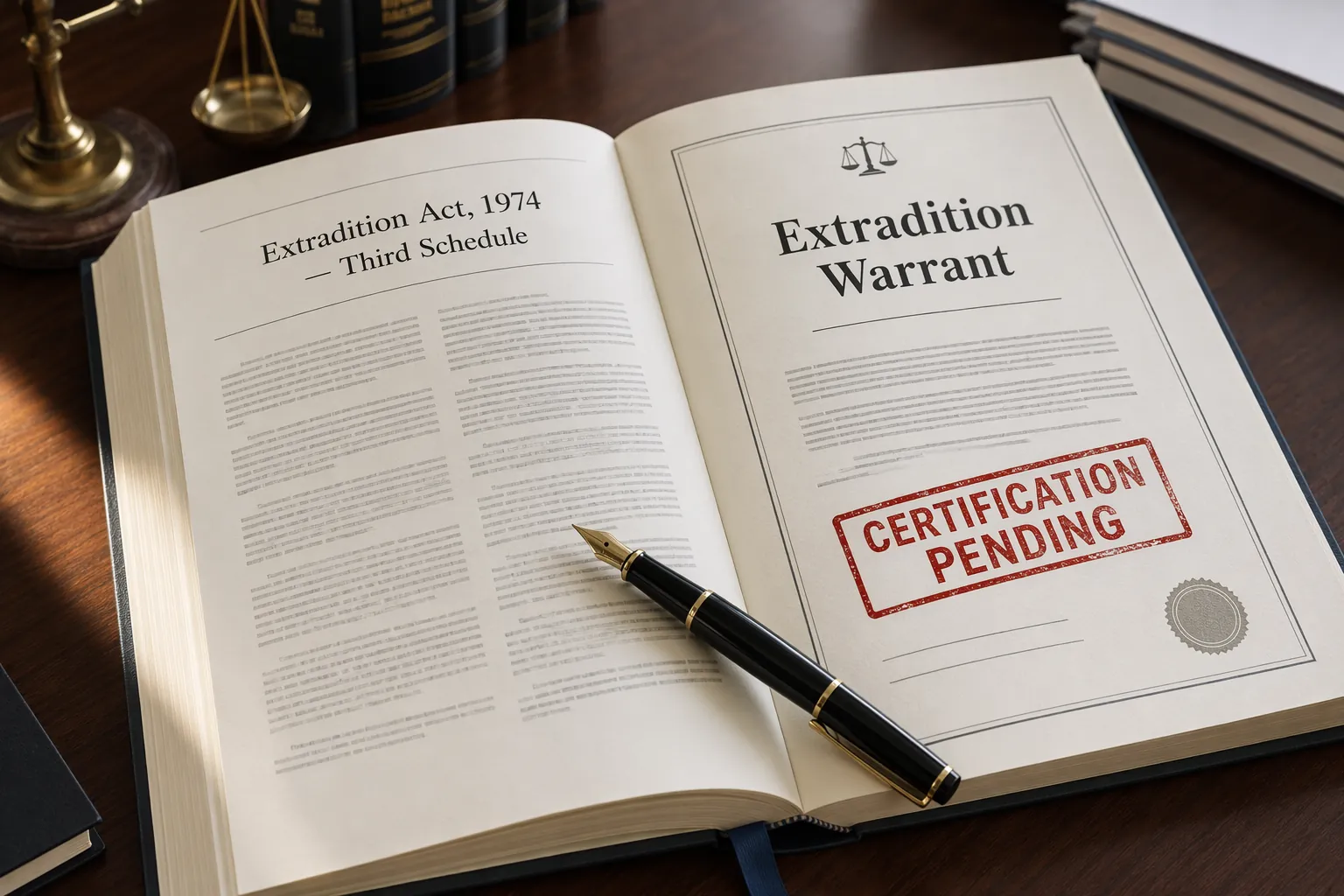
The statutory doorway is wider than the public shorthand suggests
Part IV of Sierra Leone’s 1974 Act is the provision that does the work here. It applies to countries listed in the Third Schedule, and the Netherlands is listed there. The significance is practical: extradition can proceed on the statutory basis of reciprocity rather than on a bespoke bilateral treaty between the two states.[1]
The second part of the doorway is the offence. Extradition statutes do not operate simply because a foreign government wants a person returned. They require a qualifying offence, usually with a minimum seriousness threshold. Sierra Leone’s Fourth Schedule lists drug-trafficking offences, and the Act’s threshold is met where the conduct is punishable by at least 12 months’ imprisonment. The reported Dutch sentence of 24 years is not a close case on that threshold.[1][2]
This does not mean extradition is automatic. It means the often-repeated treaty objection is too crude. A lawyer asked whether Sierra Leone can lawfully entertain a Dutch extradition request should start with the Act, not with the diplomatic inventory of bilateral treaties. Once the Netherlands is found in the Third Schedule and drug trafficking is found in the Fourth Schedule, the question changes from capacity to process.
| Legal issue | What the available materials show |
|---|---|
| Bilateral treaty | No Netherlands-Sierra Leone bilateral treaty is identified, but Part IV of the 1974 Act provides a domestic-law route. |
| Country coverage | The Netherlands is listed in the Third Schedule on a reciprocal basis. |
| Offence coverage | Drug-trafficking offences are listed in the Fourth Schedule. |
| Seriousness threshold | The reported 24-year Dutch sentence exceeds the Act’s 12-month threshold. |
| Immediate bottleneck | The Attorney-General’s certification is required before the warrant stage can move. |
Where the Act can stall
The central gate is not a courtroom. It is the Attorney-General. Section 10 of the Act requires the Attorney-General’s certificate before an extradition warrant can issue. That certificate is not an ornament. Without it, the request does not become the kind of case that a magistrate can process through arrest, hearing, committal, and surrender.[1]
The sequence matters because Sierra Leone has publicly positioned itself as waiting for a court decision, while reporting and legal analysis indicate that no court proceeding has yet been initiated in the extradition matter.[2][3] If no warrant has issued and no hearing has begun, the reference to “the courts” does not answer the operational question. Which court? On what warrant? Following which certification?
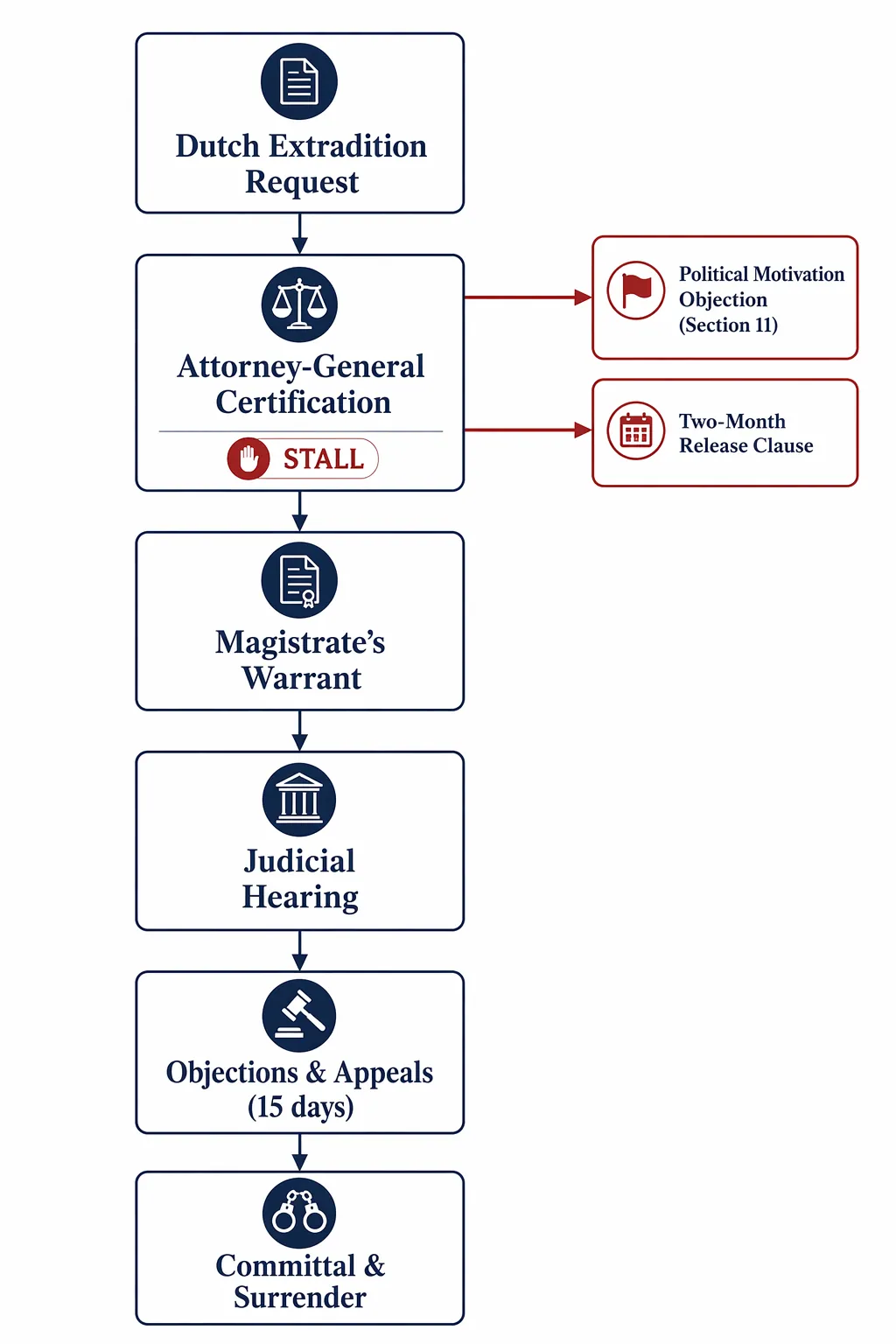
After certification, the path becomes more recognizably judicial. A magistrate’s warrant can be issued. The requested person can be brought before a court. The court can examine whether the statutory conditions are met. The person sought can raise objections. If committal follows, the Act then gives a 15-day appeal window. It also contains a two-month release clause if the person remains committed without surrender proceeding as required.[1]
- A foreign request arrives and must fit within the Act’s country, offence, and seriousness requirements.
- The Attorney-General certifies the case before the warrant stage can begin.
- A magistrate’s warrant permits arrest and production before a court.
- A judicial hearing tests the statutory basis and any available objections.
- If committal is ordered, appeal and timing protections then become relevant.
Section 11 is the other important brake. It permits refusal where the request is politically motivated, oppressive, unjust, or otherwise falls within protected categories. In a conventional organized-crime drug-trafficking case, a political-offence objection should not be assumed to be a likely winner. The more careful point is that the Act gives room for objections and executive assessment, and no published Sierra Leone court ruling has tested those objections on this extradition request.[1][2]
The 18-month standstill is procedural before it is diplomatic
The public timeline aggravates the legal puzzle. A formal Dutch extradition request was reported as submitted in February 2025. Months passed without a substantive reply. Ministerial engagement continued through mid-2026. By July 2026, the status being reported was still that no warrant had been executed and Sierra Leone’s stated position was that it would act after a court decision.[3]
For practitioners, that is the point at which the file stops being a debate about treaty doctrine and becomes a question of institutional sequencing. If Sierra Leone says a court must decide first, the court needs a procedurally valid case before it. If the Attorney-General has not certified the matter, the case remains upstream of the court. If the warrant has not issued, the person sought is not yet in the statutory posture contemplated by the Act.
The distinction is not pedantic. It determines who bears responsibility for delay. A court cannot be blamed for not deciding a case that has not been placed before it. A requesting state cannot cure the certification problem by announcing that a treaty exists when the better argument is that the 1974 Act already supplies the route. And Sierra Leonean officials cannot resolve the statutory question by speaking in generalities about judicial process if the executive gate remains closed.
Politics enters through discretion, not by replacing the statute
The political material is not irrelevant. It is just not the source of the legal power. Africa Confidential reported in February 2025 that Leijdekkers had a family connection to President Julius Maada Bio’s daughter, that he had armed escorts from the Operational Support Division of Sierra Leone police, and that the chief immigration officer had purchased US$1.9 million in US properties while on a civil-servant salary.[4] Those are serious allegations about the operating environment around the file, not judicial findings in the extradition proceeding.
They matter because the Attorney-General’s certification function sits in precisely the space where legal sufficiency and political exposure meet. A purely private criminal defendant with no reported protection network presents one kind of extradition file. A defendant allegedly connected to the presidential family, allegedly moving with state-linked security protection, presents another. The statute may be the same, but the risk borne by officials who activate it is not.
The reported aid pressure fits the same pattern. The Netherlands asked the EU to suspend €325 million in development aid allocated for 2021–2027, and the EU publicly backed the Dutch position, according to NL Times reporting in July 2026.[3] That does not prove that Sierra Leone’s legal discretion has been improperly exercised. It does show that the extradition file has moved beyond ordinary mutual legal assistance into a field where development finance, diplomatic credibility, and domestic political cost are all visible.
Opposition pressure inside Sierra Leone has sharpened the stakes. Abdul Kargbo warned in May 2026 that the country risked being categorized as a narco-transit or narco-state, with consequences for foreign direct investment, banking relationships, visas, and maritime confidence.[5] That is a political warning, not a legal conclusion. Still, it explains why silence on the extradition mechanics has become harder to treat as ordinary administrative delay.
The covert-operation episode shows frustration, not a substitute legal route
The most dramatic reported development is also the least useful as legal architecture. DutchNews.nl, citing De Telegraaf, reported in May 2026 that Dutch special forces, including marines and the DSI, had prepared a covert arrest operation approved by the Jetten cabinet, and that the operation was aborted twice because of unspecified external factors.[6]
That episode may reveal Dutch frustration with the standstill. It may also indicate that officials had lost confidence in the ordinary path producing a timely result. But it does not answer whether Sierra Leone can extradite without a bilateral treaty. Nor does it tell a Sierra Leonean court how to apply the 1974 Act. If anything, it underlines why the statutory route should be kept separate from operational improvisation. Extradition is supposed to leave a paper trail: request, certificate, warrant, hearing, order.
What a court would likely have to examine
If the file reaches a Sierra Leonean court, the first questions should be statutory, not atmospheric. Is the Netherlands covered under the Third Schedule? Is the offence extraditable under the Fourth Schedule? Does the sentence or alleged conduct meet the Act’s seriousness threshold? Has the Attorney-General certified the case? Has the warrant been properly issued? Those are threshold questions, and the available Act text gives a requesting Dutch authority a coherent answer on several of them.[1]
Only then do objections become meaningful. The person sought could test whether the request is politically motivated, whether surrender would be oppressive or unjust, or whether any statutory bar applies. But those objections need a forum. At present, the more striking feature is not that a court has rejected extradition. It is that no located court decision has yet done the work Sierra Leone says must be done before action follows.[2][3]
That absence also limits what can be responsibly said. It would be too strong to conclude that Sierra Leone is legally refusing extradition. It would also be too soft to say the matter is merely awaiting judicial review. The better reading is narrower: the Act appears to allow the request to be processed, but the certification-and-warrant sequence has not produced a visible court case.
The bounded legal implication
The legal implication is therefore bounded but important. No bilateral treaty appears to be required on the available materials. Sierra Leone’s 1974 Act supplies a domestic statutory basis through Part IV, the Third Schedule’s inclusion of the Netherlands, the Fourth Schedule’s coverage of drug trafficking, and the applicable sentence threshold.[1][2]
The unresolved issue is not whether a treaty exists. It is whether Sierra Leone’s Attorney-General and courts will put the existing Act into motion. Until certification, warrant, hearing, objections, appeal rights, and any surrender order are tested in sequence, the case remains suspended between a legal route that appears to exist and an institutional process that has not yet delivered a decision.
References
- The Extradition Act, 1974, UNODC / Sierra Leone
- Extradition Between Sierra Leone and the Netherlands Under the Extradition Act of 1974, ILRAJ
- NL Times report on Dutch pressure over Bolle Jos extradition, NL Times, July 22, 2026
- President Bio keeps cocaine lord in the family, Africa Confidential, February 2025
- Opposition Leader open letter, The Sierra Leone Telegraph, May 2026
- Dutch special forces twice nearly arrested Bolle Jos: Telegraaf, DutchNews.nl, May 2026
Related records
Tool profile
Browse tool evaluations →Governing regulation
Browse the obligations tracker →Preventive workflow
Browse verification workflows →
Report a correction or tip
Spotted an outdated figure, a misstated fact, or a ruling this case record should reflect? Public comments are disabled for this content given the professional cost of a misreported case outcome, penalty amount, or rule text — use the structured correction channel instead.
Report a correction or tip for this record →