
Bon Jovi's Selective Trademark Enforcement on Tribute Bands
Bon Jovi Productions has simultaneously authorized some tribute bands while threatening others with trademark infringement. This digest identifies the selective enforcement pattern and its implications for tribute operators and mark owners alike.
- Jurisdiction
- United States
- Court
- Not specified
- AI tool named
- Not applicable
- Source document
- View primary court order ↗
- Last verified
- Jul 24, 2026
Lex Machina Review is an independent risk-tracking and reference resource. Nothing on this site is legal advice, and using it does not create an attorney-client relationship. Every record is reviewed against primary sources but may not reflect the most current status of a matter — always verify directly against the cited court order, rule text, or a licensed attorney before relying on it.
Companion explanation — secondary to the source document above
When a Bon Jovi tribute act receives a trademark legal threat, the dispute is rarely just about one pub-stage name or one poster. The useful question is narrower and more practical: which uses did Bon Jovi Productions or Bon Jovi management appear to approve, which uses drew objections, and what can either side safely infer from that pattern before a court ever looks at it?
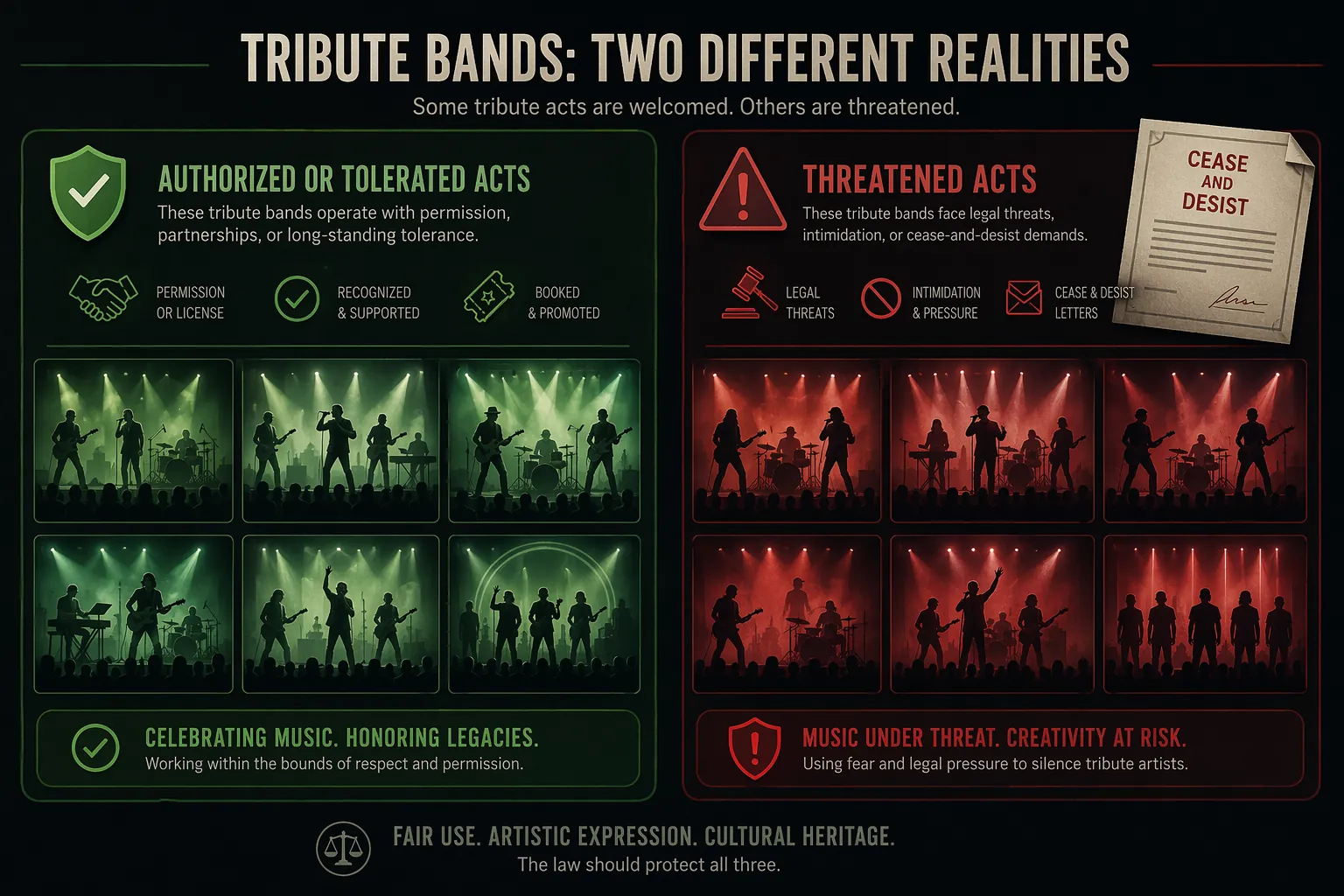
The public record points to a middle path rather than a blanket war on tribute acts. Slippery When Wet says that in 2007 it received the “official nod of approval from Bon Jovi management,” has played more than 2,300 shows worldwide, and was selected as the house band for Jon Bon Jovi’s Runaway to Paradise cruise.[1] At the same time, other Jovi-adjacent commercial uses have reportedly received cease-and-desist demands and changed course without litigation.
The Enforcement Map Is Uneven, Not Random
The visible pattern is easiest to read side by side. One act has permission-adjacent treatment from Bon Jovi management. One endorsement claim, involving The Bon Jovi Experience, is stronger if verified directly, but the current record should treat it cautiously because the underlying promotional source is not included here. Three other matters show the deterrent power of correspondence: Blonde Jovi, One Jovi, and Mijovi.
| Act or use | Publicly reported posture | Operational fact that matters |
|---|---|---|
| Slippery When Wet | Authorization or permission-adjacent treatment | Band says it received Bon Jovi management’s official nod in 2007, claims more than 2,300 shows, and says it was selected for Runaway to Paradise cruises.[1] |
| The Bon Jovi Experience | Endorsement claim requiring source caution | Often described as having performed live with Jon Bon Jovi, but the direct source for that claim is not part of this record. |
| Blonde Jovi | Cease-and-desist demand; name changed | Reports say Bon Jovi Productions objected to use of the Heart and Dagger logo and alleged likely confusion; the band changed its name to Blonde Jersey.[2][3] |
| One Jovi | Reported cease-and-desist demand; resolved by email | The account comes from The Sun and singer Andy Hearn; no underlying letter or litigation record is available.[4] |
| Mijovi | Trademark objection outside the tribute-band lane | An energy drink using an “itsmilife” slogan reportedly drew a Bon Jovi trademark objection in 2007.[5] |
That map does not prove that every threatened party was infringing. It does prove something more modest and more useful for risk assessment: Bon Jovi-related enforcement has not been confined to counterfeit merchandise or full impersonation. Naming, logo use, and commercial packaging have been enough to trigger a response.
Authorization, Tolerance, and Enforcement Are Different Records
Slippery When Wet is the cleanest permission-side example, but even that example should not be overwritten into more than the source says. “Official nod of approval from Bon Jovi management” is meaningful language for marketplace signaling. It is not, on its face, the same thing as a published license agreement with quality-control terms, territory, duration, fee structure, and revocation rights.[1]
That distinction matters because tribute-band disputes often turn on the record the parties can actually prove. A poster saying “approved,” a cruise booking, a management email, and a formal trademark license all create different litigation material. They may all reduce practical enforcement risk for the operator, but they do not carry the same evidentiary weight.
Tolerance is weaker still. A tribute act that has played for years without receiving a letter may have a useful business fact, but not necessarily a legal permission. Silence can become relevant in a dispute, especially if a rights owner has ignored a crowded field of similar uses. It is not the same as authorization.
Enforcement is the third category. The Bon Jovi matters that reached public reporting did not produce filed court decisions. They produced letters, emails, and changed names. For the tribute operator, that can be the whole dispute: no complaint, no injunction, no judgment, but also a new name, new assets, and a damaged search trail.
Blonde Jovi Shows Why Logos Change the Temperature
Blonde Jovi is the most concrete threatened-tribute example because the public reports identify both the disputed branding element and the result. CelebrityAccess reported in 2009 that Bon Jovi Productions, through Blakely Sokoloff Taylor Zafman, sent the all-female tribute act a cease-and-desist letter alleging trademark infringement and likelihood of confusion.[2] MusicRadar’s account likewise reported that the objection included use of the Heart and Dagger logo, and that the band changed its name to Blonde Jersey.[3]
A name-only tribute act already invites a trademark question. A logo makes the question sharper. The Heart and Dagger symbol is not merely a descriptive cue that the show covers Bon Jovi songs. It is brand packaging. Once a tribute operator borrows the visual architecture associated with the original act, the argument moves away from “we are telling fans what music we perform” and toward “we are presenting ourselves in the trade dress of the source.”
That does not answer the legal question by itself. It does explain why Blonde Jovi sits differently from a bar band using a referential phrase in plain text. If a mark owner is choosing where to spend enforcement attention, a tribute act using both a Jovi-adjacent name and a recognizable logo is an obvious candidate.
One Jovi Is Useful, but Only If Kept Narrow
The One Jovi account is more recent and less sturdy as legal evidence. The Sun reported in July 2026 that Andy Hearn, a 53-year-old singer from Rotherham, said he received a legal threat around three years earlier over the name One Jovi, despite having trademarked the name in the United Kingdom. The report says the matter was resolved through emails and that Hearn now releases original music as Mr One Jovi.[4]
The reported “20 percent different” point should be handled with particular care. The Sun attributes that idea to Hearn’s account of what Bon Jovi’s lawyers said; the underlying correspondence is not available in the record.[4] As a practical naming rule, it sounds attractive because it is measurable. As a trademark rule, it is too neat. U.S. likelihood-of-confusion analysis does not turn on a simple percentage difference between names.
The safer inference is narrower: a short name built around “Jovi” was reportedly enough to draw an objection, and the matter ended without a judicial test. That is still important. Many tribute operators experience trademark law not as a reported decision, but as a demand letter arriving before a weekend of booked shows.
Mijovi Pushes the Pattern Beyond Tribute Bands
Mijovi matters because it was not simply another band-name dispute. The ABA Journal reported in August 2007 that Bon Jovi objected to an energy drink using the name Mijovi and the slogan “itsmilife,” a play on “It’s My Life.”[5] That use sat in a different commercial lane from a live tribute show, but it still evoked the Bon Jovi brand.
For a rights owner, that kind of objection is not surprising. A beverage brand can scale, distribute, and sit on shelves far from any explanatory tribute context. For tribute operators, it shows why the relevant risk is not limited to whether fans understand the show is a tribute. The same naming instinct that works as a wink in one setting can look like product branding in another.
What Seems to Trigger Attention
The sample is too small for a formula. It is enough, however, to identify recurring risk signals.
- Use of core logos or visual marks raises the stakes faster than a name alone, as the Blonde Jovi reports show.[2][3]
- Short names built around “Jovi” appear more exposed than names that signal a song title or tribute concept without looking like a source identifier.
- Commercial context matters: a cruise-selected act, a UK pub-circuit singer, and an energy drink do not present the same marketplace problem.
- Documented permission changes the risk profile, but the legal value depends on what the permission actually says.
- Voluntary rebranding can end the immediate dispute while leaving the legal boundary unresolved for the next operator.
The last point is easy to underweight. None of the Bon Jovi tribute-band matters in this record produced a court ruling. That means there is no judicial answer on whether Blonde Jovi, One Jovi, or a similarly named act would have won on nominative fair use, lack of confusion, parody, acquiescence, or any other defense. There is only a record of pressure and compliance.
Selective Enforcement Is Not Automatically Abandonment
A mark owner can license one user and object to another. That is the point of trademark control. If the permission is disciplined, selective authorization can strengthen the owner’s position by showing that third-party use occurs under oversight rather than in an uncontrolled free-for-all.
The danger begins when the record looks less like controlled licensing and more like unmanaged tolerance. The Earth, Wind & Fire Legacy Reunion litigation illustrates the counter-pressure. Forbes reported in 2024 that the tribute defendants raised a trademark abandonment counterclaim, arguing that the rights holder’s failure to enforce against multiple tribute acts weakened its rights.[6] Billboard’s coverage of the dispute likewise shows how a tribute act can turn the owner’s treatment of other tribute bands into litigation material rather than background noise.[7]
That does not mean Bon Jovi Productions has abandoned anything. It means a future defendant would likely ask for the permission file: who was approved, who was ignored, who was warned, who was allowed to keep using what, and whether any quality control existed. The inconsistency itself is not fatal. An undocumented inconsistency is where the risk grows.
Most of These Disputes End Before the Law Gets Interesting
ABBA Mania is a useful comparison because it shows a common endpoint: settlement rather than a fully reasoned court boundary. Reuters reported in 2022 that ABBA settled its trademark lawsuit against the tribute band over the “ABBA Mania” name, with the tribute adding a disclaimer.[8] That kind of resolution can be commercially rational for both sides and still leave later operators without a clean rule.
Disclaimers, name tweaks, and private undertakings are often the practical vocabulary of tribute-brand disputes. They are cheaper than litigating every likelihood-of-confusion factor. They also preserve ambiguity. A settlement may tell the market that the rights owner is serious; it does not necessarily tell the market what a judge would have held.
The Practical Risk for Tribute Operators
A tribute operator choosing a name should separate audience signaling from brand borrowing. “We perform Bon Jovi songs” is a different proposition from adopting a name, logo, slogan, and visual identity that make the act look commercially affiliated. The first may still need careful presentation. The second invites a letter.
The risk is operational before it is doctrinal. A band may have deposits, venue listings, social handles, printed backdrops, search rankings, and merchandise all tied to a name. A cease-and-desist letter can force a fast decision even when the legal merits are arguable. Blonde Jovi’s reported move to Blonde Jersey is the clean example: the name changed, the case did not become a lawsuit, and the public legal record stayed thin.[3]
Permission should also be captured with precision. A friendly nod, a one-time booking, a social media acknowledgment, and a license are not interchangeable. If an operator intends to rely on approval, the file should show who granted it, what marks it covered, where it applied, whether it allowed merchandise, and whether it could be revoked.
The Practical Risk for Mark Owners
For a famous mark owner, the Bon Jovi pattern shows the appeal of selective enforcement. Approve or tolerate acts that fit the brand strategy. Object to users who borrow logos, create tighter name proximity, or move into unrelated commercial products. Avoid suing fans unless the commercial presentation justifies the cost.
The weakness of that approach is recordkeeping. If an owner licenses some tribute acts, tolerates others, and threatens a third group, the internal distinctions need to be legible later. A future defendant will not accept “too close” as an explanation if discovery can show a similar act was praised, booked, or ignored.
The best enforcement file is not the loudest letter. It is a consistent map: marks covered, approved users, disapproved uses, quality-control obligations, escalation criteria, settlement terms, and reasons for non-action. Without that map, selective enforcement may still work in the marketplace, but it becomes harder to defend as principled trademark control.
On the available record, Bon Jovi Productions appears to have managed a middle path: approving or tolerating selected tribute activity while deterring others whose names, logos, slogans, or commercial posture came closer to Bon Jovi brand packaging. That is not a judicial finding of infringement, and it is not proof of overreach. It is a reminder that demand letters can define the tribute market long before any court defines the law.
References
- Bio, SlipperyWhenWetBand.com.
- Bon Jovi Sues Tribute Band, CelebrityAccess.
- Bon Jovi sue female tribute band, MusicRadar.
- Bon Jovi tribute singer legal threat name change, The Sun, July 2026.
- It’s My Trademark, Bon Jovi Says, ABA Journal, August 2007.
- Earth, Wind & Firing Off: A Cautionary Tale Of Trademark Infringement In The Music Industry, Forbes, April 11, 2024.
- Earth, Wind & Fire Lawsuit: Tribute Band Blasts Trademark Accusations, Billboard.
- ABBA settles lawsuit against tribute band over ABBA Mania name, Reuters, January 21, 2022.
Related records
Tool profile
Browse tool evaluations →Governing regulation
Browse the obligations tracker →Preventive workflow
Browse verification workflows →
Report a correction or tip
Spotted an outdated figure, a misstated fact, or a ruling this case record should reflect? Public comments are disabled for this content given the professional cost of a misreported case outcome, penalty amount, or rule text — use the structured correction channel instead.
Report a correction or tip for this record →