
Brazil's Apple antitrust ruling puts Fortnite back on iPhone
CADE's December 2025 settlement requires Apple to open iOS distribution in Brazil for three years under a BRL 150 million breach cap, shifting the live risk from contested fines to fee-regulated implementation. This verified record maps the obligations, fee tiers, deadlines, and the confirmed status of Fortnite's return to iPhone on July 30, 2026.
- Jurisdiction
- Brazil
- Court
- Administrative Council for Economic Defense (CADE)
- AI tool named
- Apple
- Ruling date
- Dec 23, 2025
- Source document
- View primary court order ↗
- Last verified
- Aug 1, 2026
Lex Machina Review is an independent risk-tracking and reference resource. Nothing on this site is legal advice, and using it does not create an attorney-client relationship. Every record is reviewed against primary sources but may not reflect the most current status of a matter — always verify directly against the cited court order, rule text, or a licensed attorney before relying on it.
Companion explanation — secondary to the source document above
Risk Digest record: Brazil iOS distribution settlement
For searches framed around Epic, Apple, Brazil, CADE and Fortnite on iPhone, the current Brazil record should not be treated as a new liability ruling. The controlling instrument is CADE’s December 2025 TCC settlement; Fortnite’s July 2026 return to iPhone in Brazil is an implementation event under that settlement.
| Field | Verified record |
|---|---|
| Category | Risk Digest — competition / app distribution / payments |
| Jurisdiction | Brazil |
| Authority | Administrative Council for Economic Defense (CADE): General Superintendence and Tribunal |
| Case references | SG Order 24/2024; Administrative Proceeding 08700.009531/2022-04; TCC 08700.007177/2022-04 [1][2][3] |
| Status flag | Settled — implementation phase |
| Key ruling / settlement dates | Nov. 25, 2024 interim measure; May 14, 2025 Tribunal uphold; Dec. 23, 2025 TCC acceptance [1][2][3] |
| Implementation events | Apple announced Brazil iOS changes on June 18, 2026; Epic announced Epic Games Store and Fortnite availability on iPhones in Brazil on July 30, 2026 [4][6] |
| Penalty fields | Prior interim fine: BRL 250,000 per day for noncompliance with the interim measure. Live settlement exposure: up to BRL 150 million, approximately US$27.09 million, for breach of the TCC [1][3] |
| Term | Three years under the TCC, as reported at settlement acceptance [3] |
| Fee source of record | Apple Developer Support page for Brazil implementation mechanics, including App Store commissions, payment processing fee, linked-out sales commissions, Core Technology Commission, and Developer Program License Agreement deadline [5] |
| Last verified | 2026-08-01 00:00 UTC |
| Reviewer | Maya Chen, Regulatory Records Editor |
| Use note | Record aid for legal, compliance, and risk tracking. Not legal advice. |
The practical effect is a shift in the file’s center of gravity. CADE’s interim measure and Tribunal uphold explain how enforcement pressure reached the settlement. They do not, as of Q3 2026, supply the main compliance question. The operative question is whether Apple’s Brazil implementation — distribution access, payment routing, developer disclosures, install flow, transaction reporting, and fees — stays inside the TCC during its term.
Controlling document and procedural posture
CADE issued the interim measure against Apple on Nov. 25, 2024. The measure carried a 20-day compliance window and a BRL 250,000 daily fine for noncompliance, which is useful for understanding the pressure that existed before settlement but is not the live cap now governing the settled record [1].
On May 14, 2025, CADE’s Tribunal unanimously upheld the interim measure. In that decision posture, CADE described the relevant market as non-licensable smart mobile operating systems and treated iOS as the relevant system for the conduct under review [2]. That market framing remains important for file history, especially when classifying the matter internally, but the day-to-day implementation analysis now starts with the TCC.
CADE accepted the TCC on Dec. 23, 2025. Reuters reported that Apple agreed to allow third-party app stores in Brazil, to implement the settlement within 105 days, to operate under a three-year term, to withdraw its judicial challenge, and to face a breach cap of BRL 150 million, approximately US$27.09 million [3]. That is the live compliance architecture.
| Date | Record event | Why it matters now |
|---|---|---|
| Nov. 25, 2024 | CADE interim measure against Apple; 20-day compliance window; BRL 250,000/day fine [1] | Shows enforcement pressure before settlement |
| May 14, 2025 | CADE Tribunal unanimously upheld the interim measure and addressed the iOS market framing [2] | Preserves procedural and market-definition context |
| Dec. 23, 2025 | CADE accepted the TCC settlement; Reuters reported three-year term, 105-day implementation period, withdrawal of Apple’s judicial challenge, and BRL 150 million breach cap [3] | Controlling document for current risk classification |
| June 18, 2026 | Apple announced changes to iOS in Brazil with iOS 26.5 [4] | Moves the file from paper settlement to platform implementation |
| July 6, 2026 | Apple listed a Developer Program License Agreement acceptance deadline for Brazil terms [5] | Developer-side deadline relevant to continued participation and fee exposure |
| July 30, 2026 | Epic announced the Epic Games Store and Fortnite availability on iPhones in Brazil [6] | Confirms a live third-party distribution implementation event |
What CADE required Apple to open or change
The TCC should be read as a cease-and-desist implementation instrument rather than as a press headline about one game. At settlement acceptance, the reported obligation was that Apple would allow third-party app stores in Brazil as part of resolving the iOS case with CADE, with implementation due within 105 days and the agreement running for three years [3]. Apple’s June 18, 2026 announcement then supplied the company-facing implementation marker: iOS changes for Brazil were being introduced with iOS 26.5 [4].
| Obligation / implementation area | Source-backed status | Record treatment |
|---|---|---|
| Third-party iOS app stores in Brazil | Reuters reported Apple would allow third-party app stores in Brazil under the TCC; Epic later announced the Epic Games Store launch on iPhones in Brazil [3][6] | Treat as implemented in live form, subject to continuing compliance review |
| Brazil-specific iOS changes | Apple announced changes to iOS in Brazil on June 18, 2026, tied to iOS 26.5 [4] | Use Apple’s implementation materials for mechanics; do not rely on generic global App Store rules |
| Developer terms and acceptance deadline | Apple’s Brazil developer support page identifies a July 6, 2026 Developer Program License Agreement acceptance deadline [5] | Track as a developer-side condition that may affect access to the Brazil terms |
| Alternative payment / linked-out sales mechanics | Apple’s Brazil developer support page lists linked-out sales commissions and payment processing charges [5] | Do not collapse into a single “commission”; separate the fee trigger |
| Breach exposure | Reuters reported a BRL 150 million breach cap under the settlement [3] | Use for current settlement-risk field; keep the earlier BRL 250,000/day fine as historical interim-pressure field |
The difference between these fields matters. A developer asking whether it can distribute through a marketplace is asking one question. A payment lawyer calculating Apple charges on linked-out purchases is asking another. A competition lawyer assessing whether a nine-step install flow undercuts the settlement is asking a third. The same Brazil file contains all three, but the source of record changes with the question.
Apple’s Brazil fee mechanics
For fee mechanics, Apple’s developer support page is the source to use. News coverage can confirm that a settlement exists; it is not granular enough to classify the fee trigger. Apple lists separate charges for App Store commission, Apple payment processing, store services on linked-out sales, and a Core Technology Commission, along with the July 6, 2026 Developer Program License Agreement acceptance deadline [5].
| Fee / deadline | Apple-listed rate or date | How to classify it in the record |
|---|---|---|
| App Store commission | 10% or 21% [5] | Commission tier for App Store transactions under Apple’s Brazil terms. Do not describe this as the only Brazil fee; it is one fee category. |
| Apple payment processing fee | 5% [5] | Separate payment-processing charge when Apple’s payment processing is used. Do not merge with App Store commission in internal summaries. |
| Store services commission on linked-out sales | 15% or 10% [5] | Commission category for linked-out sales / store services. Record separately from Apple payment processing because the trigger is different. |
| Core Technology Commission | 5% [5] | Technology-related commission under Apple’s Brazil implementation terms. Track as its own line item when reviewing alternative distribution economics. |
| Developer Program License Agreement acceptance deadline | July 6, 2026 [5] | Deadline field, not a fee. Relevant when checking whether a developer has accepted the updated terms needed for Brazil participation. |
This fee structure is the part most likely to be misfiled. A shorthand note that “Apple still charges commissions” is accurate only at a level too broad for counsel to reuse. The safer record separates the rate, the transaction path, the developer term, and the reporting source. If a product team asks whether moving a Brazil sale outside Apple payment processing eliminates all Apple charges, the table above is the reason the answer cannot be given from the headline.
The July 6, 2026 deadline also belongs in fee review rather than in a general chronology note. It marks a term-acceptance condition in Apple’s implementation materials, so it can affect whether a developer is operating under the relevant Brazil framework before any dispute arises over a particular transaction [5].
Fortnite’s return is an implementation marker, not closure
Epic announced on July 30, 2026 that the Epic Games Store had come to iPhones in Brazil and that Fortnite was available through it [6]. That confirms a live marketplace-distribution event under the Brazil implementation framework. It does not, by itself, prove that every install step, fee term, or reporting obligation is compliant with the TCC.
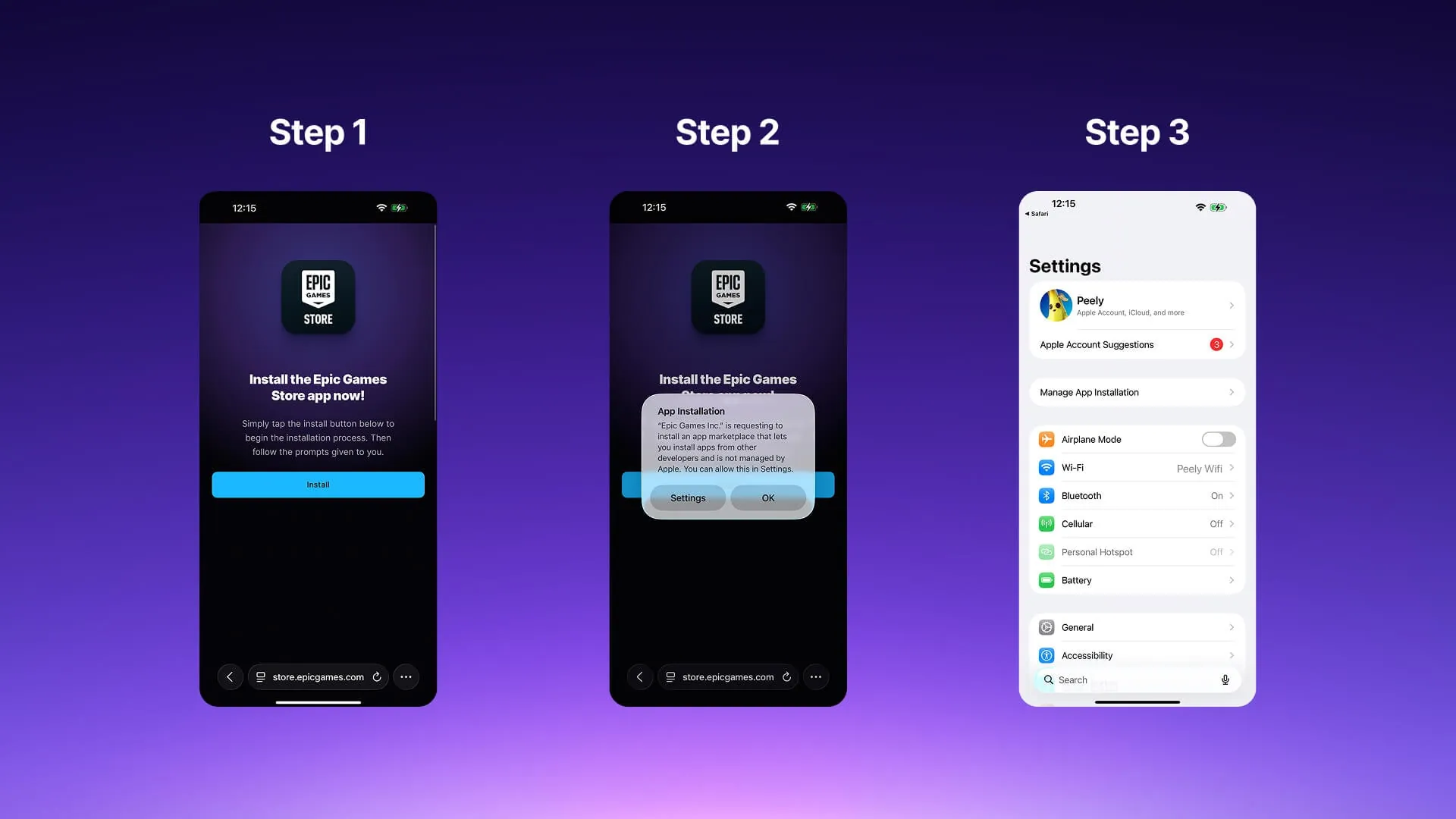
Epic’s launch post is useful because it gives the first visible adversarial read of Apple’s implementation. Epic said Apple imposed a nine-step install flow and continued to obstruct App Store competition through fees and user warnings [6]. Those statements should be recorded as Epic’s advocacy position, not as neutral measurement. They are still important because implementation friction is now the live risk category.
For record purposes, the install-flow allegation should be kept distinct from the fee allegation. An install-flow complaint asks whether access is meaningfully available under the settlement. A fee complaint asks whether the economics attached to that access comply with the Brazil terms and the TCC. A user-warning complaint may overlap with both, but it should not be allowed to blur the transaction records needed for fee verification.
Current risk classification through the TCC term
The matter should remain classified as “settled — implementation phase” unless CADE makes a new breach finding, modifies the settlement, or opens a separate proceeding. The prior BRL 250,000/day fine remains part of the historical enforcement record. The BRL 150 million breach cap is the current settlement-risk field [1][3].
| Live issue | What to verify | Primary record source |
|---|---|---|
| Install flow | Number and character of steps required to install a third-party marketplace; warnings or friction introduced during installation | Epic for allegation; Apple implementation materials for platform mechanics; CADE if breach analysis is opened [4][6] |
| Marketplace availability | Whether third-party marketplace distribution remains available to Brazil iOS users during the TCC term | CADE settlement reporting where available; Apple Brazil iOS materials; marketplace operator announcements [3][4][6] |
| Fee exposure | Correct fee category for each transaction path: App Store, Apple payment processing, linked-out sale, Core Technology Commission | Apple Developer Support [5] |
| Developer terms | Whether the developer accepted required Brazil terms and whether any later DPLA update changes participation conditions | Apple Developer Support and developer-account records [5] |
| Breach status | Any CADE finding that Apple failed to comply with the TCC and any penalty calculation up to the settlement cap | CADE docket and Tribunal materials; Reuters or other reporting only as secondary confirmation [3] |
A Brazil status note prepared today should therefore answer the narrow operational question in front of it. If the question is whether Fortnite is back on iPhone in Brazil, the verified answer is yes, based on Epic’s July 30, 2026 launch announcement [6]. If the question is whether the Apple-CADE dispute is over, the answer is narrower: the liability fight has been converted into a three-year settlement implementation record, with continuing risk around access conditions, fee mechanics, transaction reporting, and any CADE breach finding [3][5].
Maintain this record through the TCC term as a primary-source-verified implementation file. Future updates should change the status only when the source changes: CADE action for breach or modification, Apple documentation for fee or term mechanics, and developer-side launch materials for practical implementation events.
References
- CADE issues interim measure against Apple — Administrative Council for Economic Defense (CADE), Nov. 25, 2024.
- CADE upholds interim measure against Apple — Administrative Council for Economic Defense (CADE), May 14, 2025.
- Apple to allow third-party app stores in Brazil to settle iOS case with regulator — Reuters, Dec. 23, 2025.
- Apple announces changes to iOS in Brazil — Apple Newsroom, June 18, 2026.
- Changes to iOS in Brazil — Apple Developer Support.
- Epic Games Store Comes to iPhones in Brazil as Apple Obstructs App Store Competition — Epic Games, July 30, 2026.
Related records
Tool profile
Browse tool evaluations →Governing regulation
Browse the obligations tracker →Preventive workflow
Browse verification workflows →
Report a correction or tip
Spotted an outdated figure, a misstated fact, or a ruling this case record should reflect? Public comments are disabled for this content given the professional cost of a misreported case outcome, penalty amount, or rule text — use the structured correction channel instead.
Report a correction or tip for this record →