
How Brazil's Jury System Shaped the Elize Matsunaga Verdict
This analysis explains how Brazil's Tribunal do Júri — with its 7 anonymous jurors, secret-ballot voting, and simple-majority conviction threshold — produced the specific verdict and sentence in the Elize Matsunaga case, offering essential procedural intelligence for counsel advising clients with Brazilian exposure.
- Jurisdiction
- Brazil
- Court
- Tribunal do Júri de São Paulo
- AI tool named
- None
- Ruling date
- Dec 5, 2016
- Source document
- View primary court order ↗
- Last verified
- Jul 27, 2026
Lex Machina Review is an independent risk-tracking and reference resource. Nothing on this site is legal advice, and using it does not create an attorney-client relationship. Every record is reviewed against primary sources but may not reflect the most current status of a matter — always verify directly against the cited court order, rule text, or a licensed attorney before relying on it.
Companion explanation — secondary to the source document above
This is a cross-border procedural analysis, not legal advice and not a true-crime retelling. It is also not a standard AI-sanctions Risk Digest item; it belongs here only as a special risk-education piece for lawyers comparing foreign criminal procedure. The useful question in the Elize Matsunaga case is not whether the facts were lurid enough to sustain another documentary. It is how a Brazilian jury could convict her of qualified homicide while rejecting two of the three aggravating theories put to it.
That is the procedural fact worth slowing down for. After a seven-day trial running from November 28 to December 5, 2016, the jury rejected “base motive” and “cruel method,” upheld the aggravating factor described as a resource that prevented the victim’s defense, and the court imposed 18 years and 9 months for qualified homicide plus 1 year and 2 months for concealment of a corpse, for a total original sentence of 19 years and 11 months.[1]
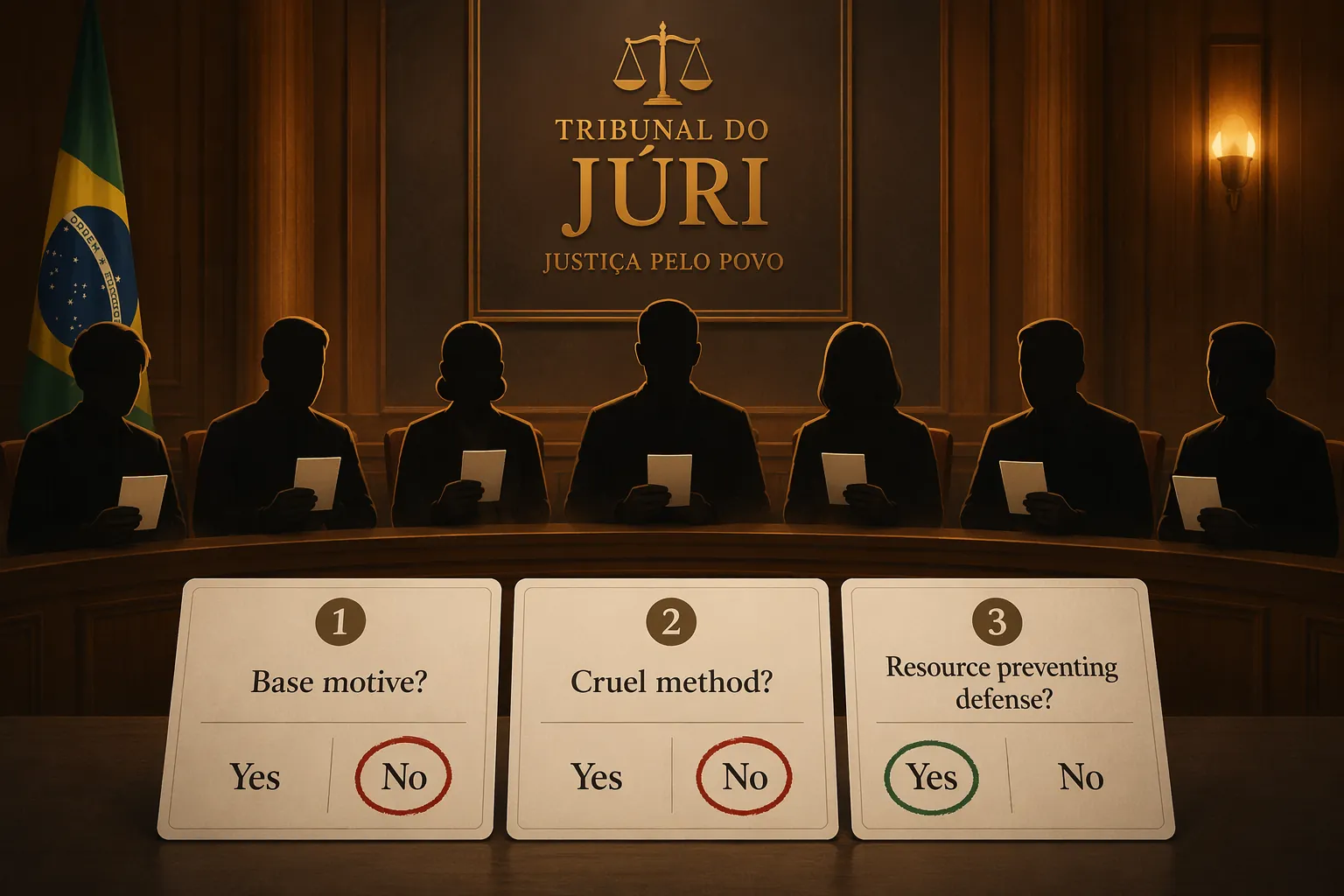
A common-law lawyer who hears “jury verdict” may instinctively imagine a deliberating group producing a general verdict after a unanimity or near-unanimity exercise. That instinct misleads here. Brazil’s Tribunal do Júri uses a different decision architecture: seven jurors, secret votes, discrete questions, and a simple majority threshold.[2]
The Brazilian “jury” is not a common-law jury wearing a local label
The Tribunal do Júri is constitutionally reserved for intentional crimes against life, such as murder, induced suicide, and abortion; civil disputes do not go to juries in Brazil.[3] That alone should prevent the lazy comparison with US civil juries or the broader Anglo-American jury tradition. The Brazilian institution is narrower in subject matter and different in voting method.
For the trial session, seven jurors form the Conselho de Sentença. They are selected from a larger pool of 25, with lists drawn from volunteers and people referred by organizations.[2][3] The jurors do not retire to deliberate together. Instead, the presiding judge poses individual questions, and each juror votes secretly. Four votes out of seven are enough to decide a point, including conviction.[2]
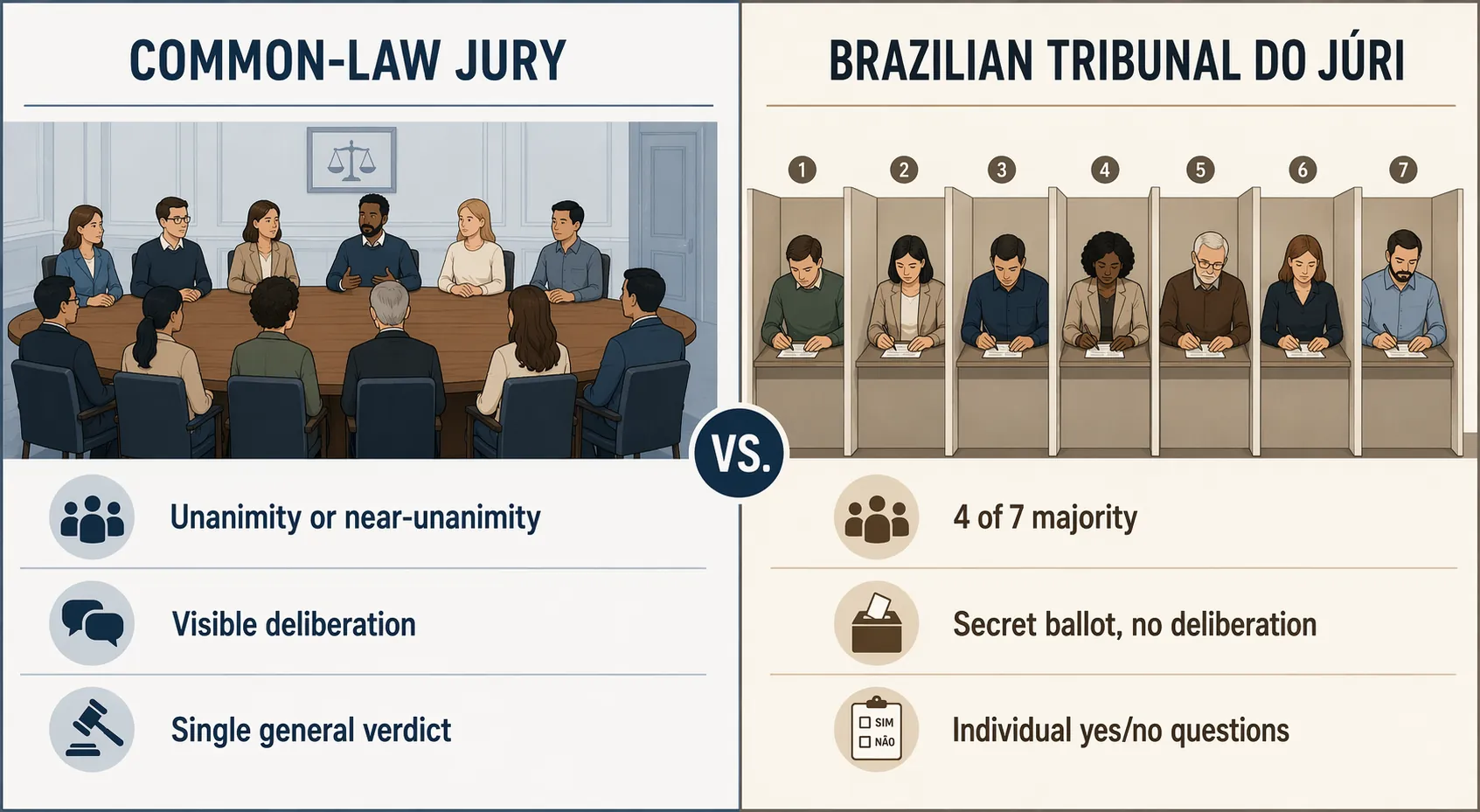
| Common-law reflex | Brazilian Tribunal do Júri feature | Why it matters in the Matsunaga verdict |
|---|---|---|
| Jurors deliberate as a group | Jurors vote secretly and do not deliberate together | The verdict can reflect separate private answers rather than a negotiated group account |
| Conviction usually requires unanimity or near-unanimity | A 4-of-7 majority is sufficient | A qualified-homicide conviction need not show overwhelming juror alignment |
| The verdict is often understood as one general outcome | The judge asks discrete yes/no questions | The jury can convict while rejecting particular aggravating theories |
| Jury practice is associated with a broad criminal and civil trial tradition | The Brazilian jury is limited to intentional crimes against life | The institution should not be generalized to Brazilian litigation as a whole |
The practical difference is not cosmetic. In a deliberating unanimity model, lawyers often read the verdict as the product of a shared narrative that survived group pressure. In the Brazilian model, the verdict is built from answers to questions. A juror can accept the core act, reject one aggravating characterization, accept another, and never have to persuade the person sitting nearby.
This also changes how one should read an apparently mixed result. A conviction with rejected aggravators is not necessarily an inconsistency or a compromise in the common-law sense. It may simply be the visible output of a question-by-question voting system.
How the Matsunaga questions narrowed the prosecution’s win
The available reporting supports the outcome and the categories of aggravation, but it should not be treated as a verbatim transcript of the judge’s questions. Conjur reports the sentence and the jury’s acceptance and rejection of the qualifying factors.[1] Piauí’s account provides a granular narrative reconstruction of the trial, but a Portuguese-language official transcript would be needed before quoting the exact wording of the jury questions as court text.[4]
With that limitation stated, the procedural pattern is clear enough. The prosecution did not simply ask for “guilty” and receive one undifferentiated answer. The jurors rejected the alleged base motive. They rejected the alleged cruel method. They upheld the allegation that Matsunaga used a resource that prevented the victim’s defense. That remaining aggravating factor was enough for a qualified-homicide classification under Article 121, paragraph 2, of the Brazilian Penal Code.[1]
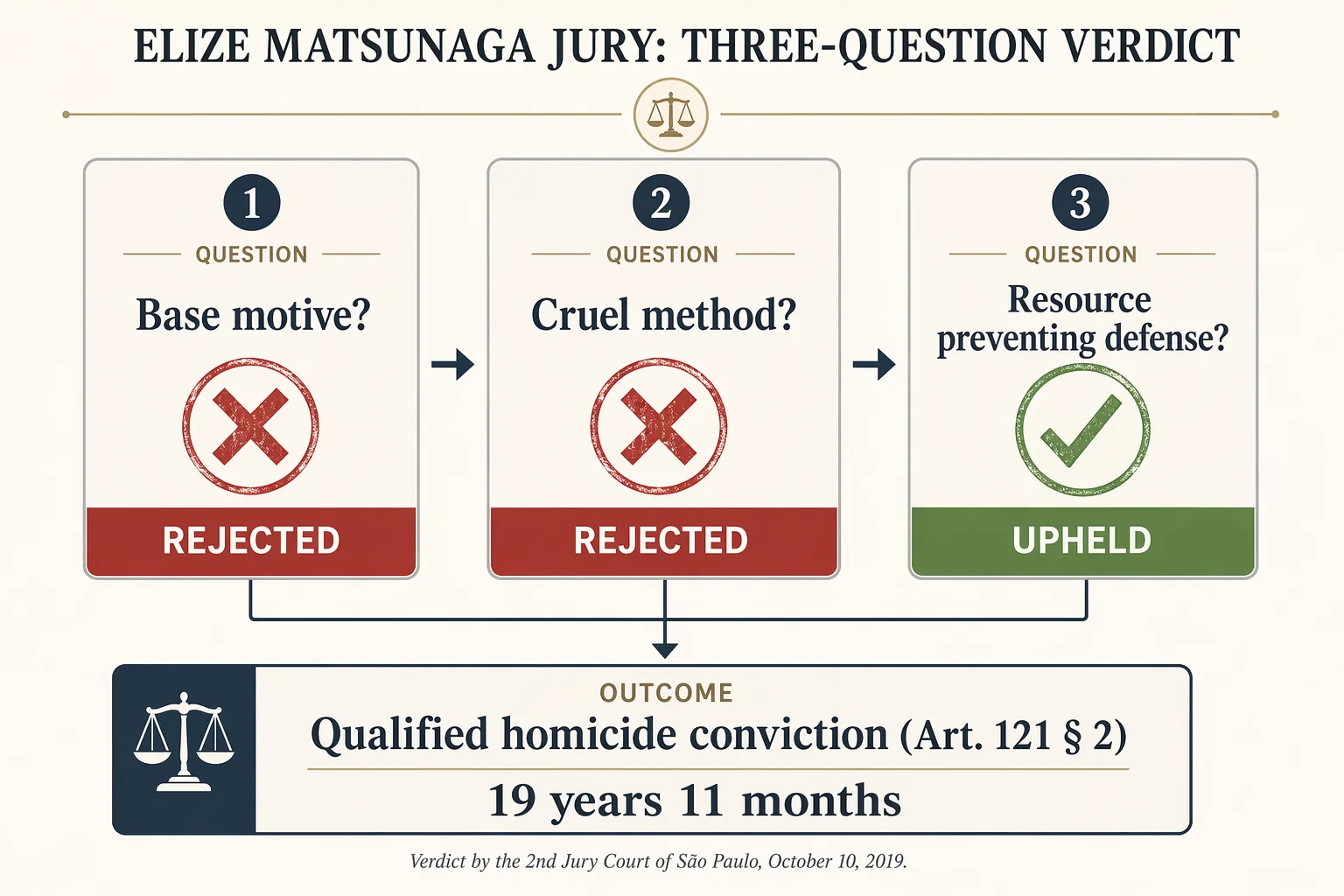
For defense counsel, that distinction is not academic. The defense lost the homicide issue in the sense that the conviction stood. Yet it succeeded in removing two aggravating theories from the verdict. The case therefore illustrates a feature that can be missed by foreign observers: Brazilian jury litigation may leave room for consequential narrowing even when the final headline says “convicted.”
The sentencing arithmetic shows why the individual answers mattered. The court imposed 18 years and 9 months for qualified homicide and 1 year and 2 months for concealment of a corpse, producing the original total of 19 years and 11 months.[1] Had the jury’s answers on the qualifying factors been different, the legal classification and sentencing frame could have been different. The defense win was partial, but it was not decorative.
Conviction risk is real, but the numbers need careful handling
The broader risk context points in the same direction, though it should be handled with some precision. An International Bar Association article, citing a 2019 study by Brazil’s National Council of Justice, reports that the average jury trial in São Paulo state took 12 years and 9 months from crime to verdict, compared with a national average of 6 years and 1 month.[2] The same IBA article reports that more than 70% of jury sessions resulted in conviction.[2]
Those figures are useful for counseling, but they are not independently reverified here against the original CNJ report. They also measure different things from what a client may first ask. The timing figure concerns the interval from crime to verdict, not merely the length of the trial hearing. The conviction figure describes jury sessions in the reported study, not the probability that any particular defendant will be convicted on every aggravating theory.
Matsunaga’s case sits comfortably inside that risk picture without being reduced to it. The jury convicted. It also cut away two qualifying allegations. A system can be conviction-heavy and still permit narrow defense gains because the vote is not one all-or-nothing narrative event.
Post-verdict review did not erase the jury’s role
The appeal history reinforces the same procedural point. In 2018, the São Paulo Court of Justice maintained Matsunaga’s sentence and recognized the sovereignty of the jury.[5] That did not turn the appeal into a fresh reweighing of the jury’s answers, as though an appellate court were beginning again.
There was later movement in the sentence. In 2019, Brazil’s Superior Court of Justice reduced Matsunaga’s sentence based on recognition of confession.[6] That development matters, but it does not convert the case into a story about appellate substitution for the jury’s fact determinations. The decisive trial-stage structure remained the Tribunal do Júri’s question format, secret voting, and simple-majority threshold.
For lawyers advising clients with Brazilian exposure, the risk is therefore not merely that Brazil “has juries.” The risk is that the word “jury” invites the wrong procedural template. In the Matsunaga case, seven anonymous jurors voting secretly on discrete questions produced a conviction, a qualified-homicide classification, and the rejection of two aggravating theories. That outcome looks puzzling only if one expects a common-law jury to be hiding behind a Brazilian name.
References
- Elize Matsunaga é condenada por crime hediondo; leia a sentença — Conjur, 2016
- Jury trial perspectives in Brazil — International Bar Association
- Jury Trials in Brazil Aren't Exactly the Same — Brazil Counsel
- A crime of note — piauí magazine
- TJ-SP mantém pena de Elize Matsunaga e reconhece soberania do júri — Conjur, 2018
- STJ reduz pena de Elize Matsunaga por reconhecimento de confissão — Conjur, 2019
Related records
Tool profile
Browse tool evaluations →Governing regulation
Browse the obligations tracker →Preventive workflow
Browse verification workflows →
Report a correction or tip
Spotted an outdated figure, a misstated fact, or a ruling this case record should reflect? Public comments are disabled for this content given the professional cost of a misreported case outcome, penalty amount, or rule text — use the structured correction channel instead.
Report a correction or tip for this record →