
Brianna Turner and the Legal Risk of Post-Termination Silence
The Brianna Turner allegation illustrates how employers can face independent liability under Title VII and state anti-retaliation laws even after terminating a harasser, if they encourage employees not to discuss the incident. This article distinguishes between formal NDAs and informal pressure, and maps the legal duties triggered by a sexual harassment report.
- Jurisdiction
- United States
- Ruling date
- Jul 24, 2026
- Source document
- View primary court order ↗
Lex Machina Review is an independent risk-tracking and reference resource. Nothing on this site is legal advice, and using it does not create an attorney-client relationship. Every record is reviewed against primary sources but may not reflect the most current status of a matter — always verify directly against the cited court order, rule text, or a licensed attorney before relying on it.
Companion explanation — secondary to the source document above
The legally important part of the Brianna Turner sexual harassment allegations is not only the reported firing. On July 23, 2026, AP News, IndyStar, and Sporting News reported the same basic pattern: Turner alleged that the Indiana Fever fired a male staffer for sexual harassment and that players were encouraged not to discuss it; the Fever declined to comment on personnel matters.[1][2][3] As of July 24, 2026, the available record does not include a lawsuit, an EEOC charge, a court ruling, or an agency finding. The allegation appears to have surfaced through social media posts, with news organizations reporting the claim shortly afterward.
That posture matters. There is no adjudicated “Fever case” to analyze. There is, however, a familiar employment-law problem inside the reported fact pattern: an employer may take decisive corrective action against the alleged harasser, then create a separate risk track by the way managers speak to the people who remain in the workplace.
Firing the alleged harasser can be relevant to whether the employer responded appropriately to harassment. It does not give the organization a free pass to discourage reporting, cooperation, or discussion afterward. If employees understand the message as “do not talk about what happened,” the legal issue can shift from the original misconduct to retaliation, interference with protected activity, witness chilling, or state-law restrictions on silencing harassment discussions.

The Two Risk Moments Are Different
A harassment file usually has two separate moments that later get collapsed into one story. The first is the employer’s response to the alleged misconduct: Did the organization receive the complaint, investigate it, and take action reasonably calculated to stop the conduct? The second is what happened after that action: Did anyone punish, isolate, warn, threaten, sideline, or pressure employees because they reported, supported, witnessed, or discussed the harassment?
Those questions use different evidence. The first may turn on complaint intake, witness interviews, findings, discipline, and whether the conduct stopped. The second may turn on texts, meeting notes, hallway instructions, playing time, assignments, promotions, scheduling, credibility attacks, or a manager’s phrase that sounded harmless in the room and much worse in an exhibit binder.
“Encouraged to keep quiet” is exactly the kind of phrase that needs careful handling. It does not prove liability by itself. It may have been imprecise shorthand, a disputed recollection, or an instruction aimed at limiting gossip during an investigation. But it is also the sort of casual managerial language that can be read as pressure not to report, not to cooperate, or not to support someone else’s complaint. Once that possibility exists, the organization’s clean corrective-action narrative is no longer the whole file.
What Title VII Requires After a Harassment Report
The EEOC describes sexual harassment as a form of sex discrimination that can include unwelcome sexual advances, requests for sexual favors, and other verbal or physical harassment of a sexual nature; harassment is unlawful where enduring it becomes a condition of employment or where the conduct is severe or pervasive enough to create a work environment that a reasonable person would consider intimidating, hostile, or abusive.[4] The EEOC’s broader harassment materials also emphasize that employers should take steps to prevent and correct harassment and that anti-retaliation protections are part of the enforcement framework.[5]
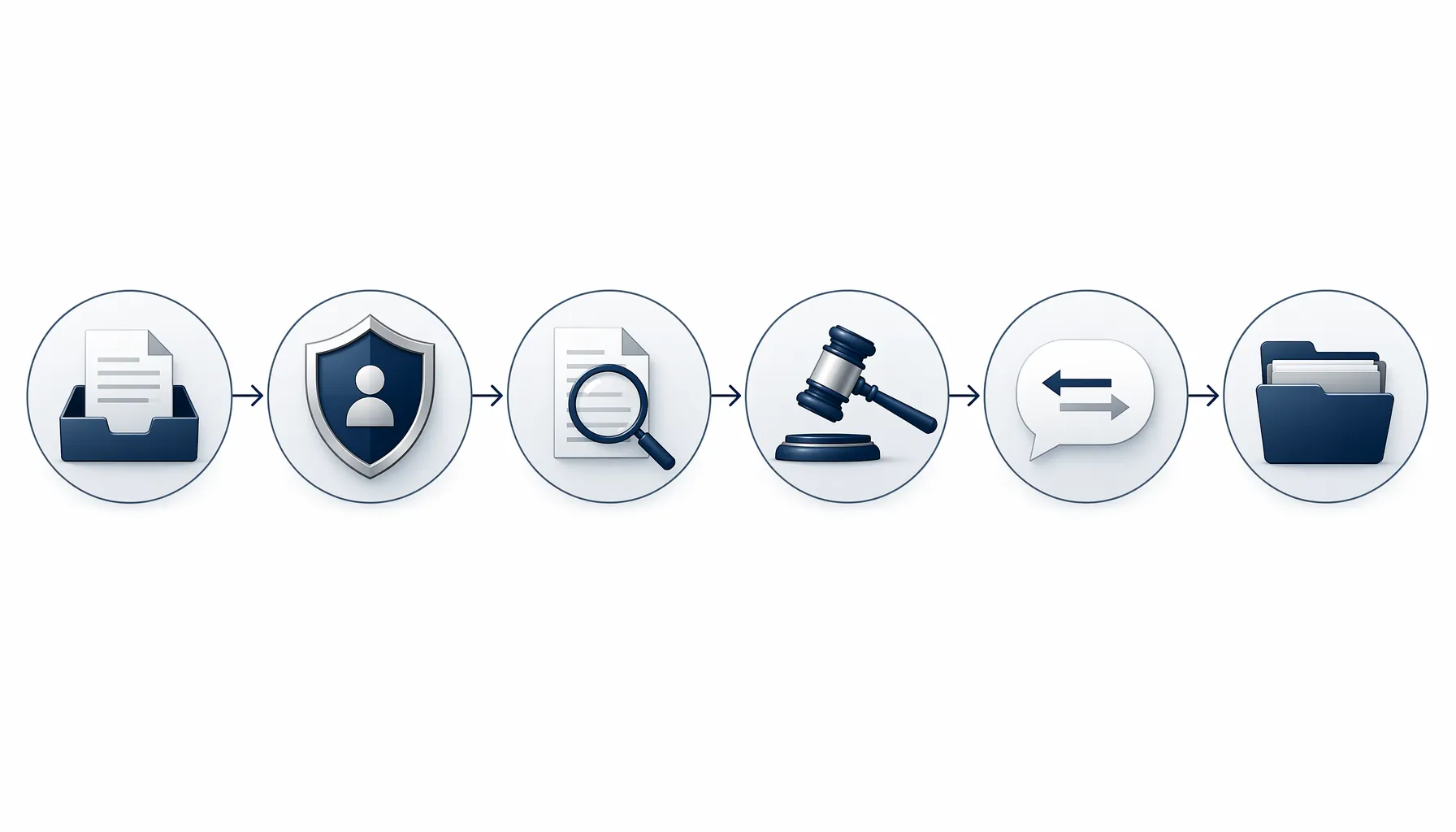
In operational terms, a sexual harassment report triggers more than a search for whether the accused person should be fired. The organization has to receive the complaint, protect the complainant and witnesses against retaliation, investigate in a manner suited to the facts, take corrective action where warranted, communicate without chilling protected activity, and preserve enough documentation to show what it did and why.
| Duty after a report | What it usually requires in practice | Where silence pressure creates risk |
|---|---|---|
| Receive the complaint | Give employees a channel to report and record what was received. | A manager frames reporting as disloyal or disruptive. |
| Protect against retaliation | Watch for adverse treatment, credibility attacks, exclusion, changed assignments, or other consequences tied to protected activity. | Employees believe they will lose status, opportunities, or trust if they talk. |
| Investigate | Interview relevant witnesses, assess documents, and avoid prejudging the outcome. | Witnesses are told not to discuss anything in a way that discourages cooperation. |
| Take corrective action | Stop the conduct and impose discipline proportionate to the findings. | The organization treats termination as the end of all legal risk. |
| Communicate carefully | Protect legitimate privacy interests while preserving rights to report, participate, and discuss workplace conditions. | Privacy language becomes a broad instruction not to speak. |
| Document | Keep records showing complaint intake, investigation steps, decisions, and anti-retaliation reminders. | The file shows discipline but not the safeguards used for remaining employees. |
That fifth line is where many organizations get careless. Confidentiality during an investigation can be legitimate when tailored to protect evidence, privacy, and the integrity of the process. A blanket or informal message that employees should not discuss harassment is different. It can interfere with a complainant’s ability to seek support, a witness’s willingness to cooperate, or a group of employees’ ability to discuss workplace conditions.
The safer communication is not performative transparency. Employers do not have to broadcast personnel details to everyone. The safer communication is disciplined: the organization can say that it takes the report seriously, that it will not tolerate retaliation, that employees may report concerns or participate in an investigation, that no one may pressure others for details, and that privacy limits do not bar protected reporting or cooperation.
Why Informal Silence Is Not the Same as an NDA
The Turner reporting should not be casually described as an “NDA” problem unless a contract actually exists. The allegation, as reported, is about players being encouraged not to discuss the firing or the harassment issue. That is informal pressure, not necessarily a nondisclosure agreement. The distinction is not technical trivia; it determines which legal tools matter most.
| Issue | Formal NDA or non-disparagement clause | Informal silence pressure |
|---|---|---|
| Form | Written contractual term, usually in an employment, separation, settlement, or other agreement. | Oral instruction, meeting message, text, cultural expectation, or managerial warning. |
| Primary legal frame | Contract enforceability, statutory limits on confidentiality, and required notices. | Retaliation, interference with protected activity, witness chilling, and state-law employee protections. |
| Speak Out Act relevance | Directly relevant to covered pre-dispute clauses involving sexual harassment or sexual assault. | Usually not the direct statute unless the pressure is tied to a covered contractual clause. |
| Evidence | Contract language, timing, carveouts, notices, settlement context. | Who said what, when, to whom, with what consequences. |
The Speak Out Act, enacted in 2022, targets pre-dispute nondisclosure and non-disparagement clauses related to sexual harassment and sexual assault. Miller Johnson’s summary explains that the Act renders covered pre-dispute clauses unenforceable, while not banning post-dispute settlement confidentiality and not creating a penalty merely for including a void clause.[6] CMLaw’s discussion also notes notice requirements in NDAs informing employees of their rights and warns that failures can lead to penalties.[7] The ACLU’s public guidance describes the layered reasons some NDAs may be unenforceable in the #MeToo context, including federal and state-law limits.[8]
For a compliance team, the practical lesson is not to force every silence problem into the NDA box. If there is a pre-dispute confidentiality clause, review it under the Speak Out Act and applicable state law. If there is no clause, do not relax. A manager’s “keep this quiet” message can still become retaliation evidence if an employee later shows that reporting, assisting, or discussing harassment led to punishment or chilled participation.
State Law Can Be Broader Than the Federal Contract Rule
The federal Speak Out Act is not a complete map of harassment-related confidentiality limits. California, New York, Illinois, and other states have adopted their own rules restricting confidentiality, non-disparagement, settlement secrecy, or employer communications in harassment and discrimination matters. The details vary, and this is not a fifty-state survey. The point for national employers is narrower: a clause or instruction that survives one federal question may still fail under a state statute, state public policy, or state retaliation law.
That is especially important for organizations with mobile workforces, remote employees, traveling teams, multistate events, or centralized HR templates. Sports organizations are an obvious example, but the same problem appears in consulting firms, health systems, law firms, sales organizations, and any employer that moves employees across state lines while using one standard communication script.
The EEOC Guidance Rescission Does Not Make Silence Safer
Some employers may be tempted to overread the January 2026 EEOC development. A Phillips Lytle client alert reports that the EEOC rescinded its Enforcement Guidance on Harassment in the Workplace on January 22, 2026, after the Commission had lacked a quorum since October 2025, and notes that a Texas federal court had already vacated the guidance’s gender-identity provisions in May 2025.[9] That source is a law-firm summary, not the primary EEOC page, but it is useful for identifying the reported procedural development.
The rescission should not be mistaken for permission to loosen harassment controls. Enforcement guidance is not the same thing as the statute. Title VII remains in force. Anti-retaliation doctrine remains central to harassment response. State laws may provide parallel or broader protections. Supreme Court precedent interpreting Title VII, including Bostock v. Clayton County, is not erased because an agency withdraws guidance.
For the specific problem raised by alleged post-action silence pressure, the rescission changes little about the safest file-building practice. An employer still wants to show that employees could report concerns, provide information, support one another, and raise retaliation concerns without being warned away from the subject.
What a Defensible Post-Action Message Looks Like
After discipline or termination, managers often want a short script because they are trying to lower the temperature. That instinct is understandable. The mistake is treating silence as the only route to order. A legally defensible message can protect privacy without making employees feel that they are risking status, assignments, credibility, or future opportunities by speaking up.
- Confirm that the organization has addressed the matter without disclosing unnecessary personnel details.
- State clearly that retaliation is prohibited, including retaliation against people who reported concerns, provided information, or may do so later.
- Tell employees where they can report additional facts, related concerns, or retaliation.
- Avoid broad instructions that employees may not discuss the issue, the conduct, or their own experiences.
- If temporary confidentiality is needed for an active investigation, explain the limited reason and avoid suggesting that employees cannot report to government agencies, counsel, union representatives, or other protected channels.
- Document the communication so the later file shows not only that discipline occurred, but that employee rights were preserved afterward.
The language should be reviewed before it is delivered, especially when the workplace is hierarchical. A player, associate, resident, junior analyst, seasonal employee, or contract worker may hear “keep quiet” differently from a senior executive. The person with less power is the one calculating whether speaking will cost them playing time, references, assignments, relationships, or credibility.
That power calculation is not a public-relations footnote. It is often where retaliation exposure forms. The employer’s intent may be to prevent rumor or protect privacy, but retaliation cases frequently examine effect, context, timing, and differential treatment. A phrase that was meant to contain disruption can become evidence that the organization chilled protected activity.
How to Read the Turner Allegation Without Overclaiming It
The Turner matter is useful as a cautionary fact pattern because it puts both risk moments in one sentence: reported termination of a male staffer for sexual harassment, followed by an allegation that players were encouraged not to talk. It is not, on the current public record, proof that the Fever violated Title VII, violated the Speak Out Act, imposed an NDA, or retaliated against anyone. The team’s refusal to comment on personnel matters is also not an admission; it is a common employer response when a personnel issue becomes public.
For lawyers and compliance staff, that restraint is part of the lesson. The public may want the story to resolve into a clean moral sequence. The file reviewer needs the sequence separated: What was alleged? Who received it? What did the employer verify? What action was taken? What were remaining employees told? Were complainants and witnesses protected? Did anyone experience consequences after speaking or being perceived as speaking?
If the answer to the last set of questions is missing, the file is not finished just because the accused employee is gone.
The Safer Compliance Question
The safer question is not only, “Did we remove the harasser?” It is also, “Did our post-action instructions preserve employees’ right to report, cooperate, seek support, and discuss harassment without fear?”
That question keeps the two legal tracks separate. Corrective action addresses the underlying harassment risk. Post-action communication controls whether the organization has created a second problem after the first emergency decision.
Last reviewed: July 24, 2026. The Brianna Turner allegations may develop as additional reporting, filings, or statements become available.
References
- Brianna Turner: Fever fired a male employee for sexual harassment, players encouraged to keep quiet, AP News, July 23, 2026
- Former player alleges Indiana Fever wanted team to 'keep quiet' about firing for sexual harassment, IndyStar, July 23, 2026
- Why Brianna Turner alleges Fever quietly fired male staffer for sexual harassment in 2025, Sporting News, July 23, 2026
- Sexual Harassment, EEOC.gov
- Harassment, EEOC.gov
- Silenced No More: New Law Protects Employees Who Speak Out on Sexual Harassment, Miller Johnson, 2022
- Speak Out Act: How It Affects Employee NDAs, CMLaw, 2023
- Is a Nondisclosure Agreement Silencing You From Sharing Your 'Me Too' Story? 4 Reasons It Might Be Illegal, ACLU, 2022
- EEOC Rescinds Enforcement Guidance on Harassment in the Workplace, Phillips Lytle, January 2026
Related records
Tool profile
Browse tool evaluations →Governing regulation
Browse the obligations tracker →Preventive workflow
Browse verification workflows →
Report a correction or tip
Spotted an outdated figure, a misstated fact, or a ruling this case record should reflect? Public comments are disabled for this content given the professional cost of a misreported case outcome, penalty amount, or rule text — use the structured correction channel instead.
Report a correction or tip for this record →