
Brooklyn Roasting Cold Brew Recall Opens Product Liability Risk
A structured incident record of the July 2026 Brooklyn Roasting Works cold brew concentrate recall (~3,048 gallons, Class II botulism risk), examining the product-liability exposure for every entity in the NY/NJ distribution chain. No illnesses have been reported as of July 21, 2026.
- Jurisdiction
- US-Federal
- Court
- FDA
- AI tool named
- None
- Ruling date
- Jul 21, 2026
- Source document
- View primary court order ↗
- Last verified
- Jul 25, 2026
Lex Machina Review is an independent risk-tracking and reference resource. Nothing on this site is legal advice, and using it does not create an attorney-client relationship. Every record is reviewed against primary sources but may not reflect the most current status of a matter — always verify directly against the cited court order, rule text, or a licensed attorney before relying on it.
Companion explanation — secondary to the source document above
Brooklyn Roasting Works LLC’s July 2026 cold brew recall is not, on the available record, a lawsuit. It is a documented risk event: FDA Event ID 99355, 1,219 units of 2.5-gallon pasteurized cold brew concentrate in bag-in-box packaging, roughly 3,048 gallons, distributed in New York and New Jersey from April 1 through June 20, 2026, and recalled for potential Clostridium botulinum toxin formation tied to ambient storage conditions.[1]
The available reports place the recall in Class II and state that no illnesses had been reported as of the FDA publication date, July 21, 2026.[1] That combination matters. Class II does not mean harmless; it means FDA classifies the event as one in which use of or exposure to the product “may cause temporary or medically reversible adverse health consequences” or where the probability of serious harm is remote.[2] No reported illness, meanwhile, is the strongest present limitation on any injury claim.

Two verification checks should remain attached to this record. First, the legal entity name should be verified against the primary FDA Enforcement Report, because secondary coverage sometimes uses Brooklyn Roasting Company while the recall record is identified here as Brooklyn Roasting Works LLC.[1] Second, most available accounts report best-by dates from June 3 through September 3, 2026, while Fox Business refers to a September 30 date; that discrepancy belongs in the verification file, not in a footnote nobody reads.[1][3]
The Recall Record Creates Risk Before It Creates a Case
As of July 25, 2026, no class action or individual lawsuit against Brooklyn Roasting Works LLC has been identified in the available materials. That should restrain the analysis. A recall notice is not proof of defect in a pleaded case, not proof that any buyer drank affected product, and not proof that anyone suffered injury.
It is still a record lawyers will recognize. It identifies a product, a quantity, a distribution territory, a shipment window, a hazard, a storage-related root cause, and a date range for product identification. Those are the parts of a later complaint, tender letter, retailer demand, insurer notice, or preservation memo that tend to survive the first pass from speculation into evidence.
The most important fact is not the headline word “botulism.” It is the route by which the hazard allegedly became plausible: a pasteurized, low-acid cold brew concentrate held under ambient storage conditions that allowed possible toxin formation.[1] That is a warning and handling problem before it is a brand story.
| Record Point | Current Status |
|---|---|
| Firm | Brooklyn Roasting Works LLC, subject to confirmation against the primary FDA Enforcement Report |
| FDA event | Event ID 99355 |
| Product | 2.5-gallon bag-in-box pasteurized cold brew concentrate |
| Units | 1,219 units, about 3,048 gallons |
| Distribution | New York and New Jersey, April 1-June 20, 2026 |
| Best-by dates | June 3-Sept. 3, 2026 in most sources; Fox Business reports Sept. 30 |
| Classification | Class II |
| Illness reports | None reported as of July 21, 2026 |
Why Ambient Storage Becomes a Failure-to-Warn Question
A low-acid, pasteurized cold brew concentrate in a 2.5-gallon bag-in-box format is not used like a single-serve can pulled from a retail shelf. It moves through businesses. A distributor may receive it, a cafe may store it, an employee may place it in or out of refrigeration, and the end user may never see the original shipping or handling context.
That is where the legal risk sharpens. If the hazard depends on storage conditions, the adequacy of refrigeration instructions and downstream handling warnings becomes central. A warning that is technically present but poorly placed, ambiguous for commercial use, separated from the container, or dependent on tribal knowledge inside cafes may be litigated differently from a warning that is conspicuous, durable, and matched to how the product actually travels.
Product-liability doctrine gives plaintiffs more than one path. Cornell’s overview of products liability describes claims based on defects in design, manufacturing, or warning, and Marler Clark’s food-safety discussion describes strict liability and chain-of-distribution exposure for food products.[4][5] Those sources do not establish that Brooklyn Roasting is liable. They do explain why a recall record involving a food product can matter to manufacturers, distributors, retailers, and commercial purchasers before anyone files a complaint.
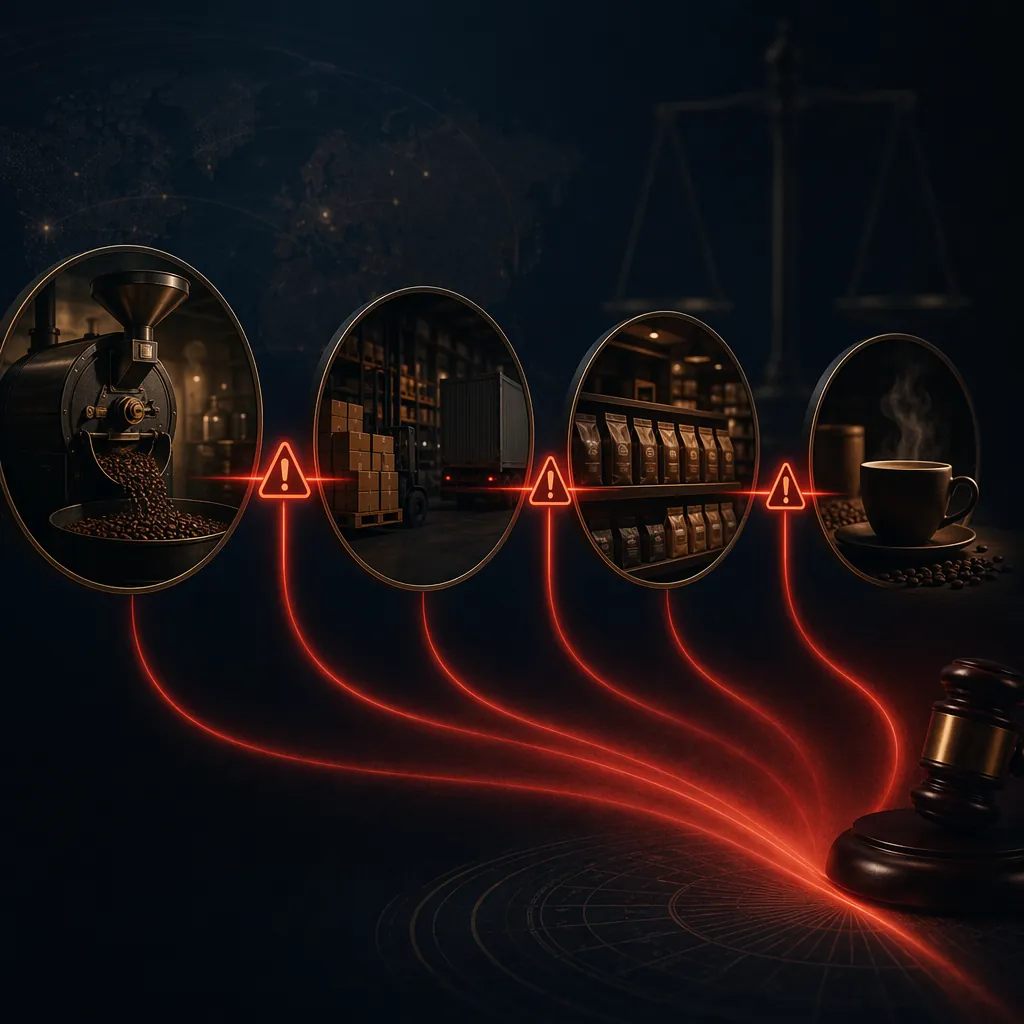
The NY/NJ geography matters for the same reason. Every entity that received, stored, resold, served, or disposed of the concentrate may need to account for what it had, when it had it, where it went, and what instructions accompanied it. The analysis here does not verify New York or New Jersey statutory nuances; it rests on general product-liability principles and should be narrowed by local counsel before anyone treats it as a pleading map.
For downstream businesses, the immediate burden is practical rather than theatrical: pull the product, preserve purchase orders and receiving logs, keep photos of labels and case markings, document customer notices, separate disposal records from ordinary waste records, and avoid rewriting the story after the fact. If later litigation turns on whether the warning followed the product, the best evidence will usually be ordinary records created before litigation looked likely.
Class II Is a Caveat, Not a Defense
Class II classification should keep the analysis proportionate. FDA did not classify this recall in the category reserved for a reasonable probability of serious adverse health consequences or death. The classification on the record points instead to remote probability of serious harm or medically reversible consequences.[2]
But Class II also creates a formal government recall record. It does not immunize a manufacturer, distributor, or retailer from state tort claims. It does not resolve whether warnings were adequate. It does not answer whether product was held at ambient temperature before a cafe received it, after a distributor received it, or after a buyer opened it. It only sets the FDA recall classification.
The absence of reported illnesses is more consequential for litigation. Without an identified injury, a would-be plaintiff faces the ordinary standing and damages problems that prevent many recall-only theories from becoming viable cases. Economic-loss claims, refund theories, and injunctive theories may be discussed in other recall contexts, but the available Brooklyn Roasting record does not establish a present injury-in-fact for any specific claimant.
The Coffee Recall Precedents Are Relevant, but Narrow
Snapchill is the closest modern comparator because it involved coffee, botulism risk, and processing controls rather than an illness outbreak. In June 2024, Snapchill LLC recalled canned coffee products because its current process could permit the growth and production of botulinum toxin in low-acid canned foods, and FDA’s notice stated that the company had not filed the required low-acid canned food process with FDA.[6]
That comparison is useful only to a point. Snapchill was a nationwide canned-coffee recall tied to process filing and low-acid canned food controls. The Brooklyn Roasting record concerns 2.5-gallon pasteurized cold brew concentrate distributed in New York and New Jersey, with the available materials emphasizing ambient storage conditions. The common thread is not corporate conduct; it is that coffee products can become legally serious when low-acid processing, storage, or warning controls fail.
Death Wish Nitro Cold Brew supplies the older warning sign. In 2017, Death Wish Coffee recalled nitro cold brew cans after a process authority determined that the manufacturing process could lead to the growth and production of botulinum toxin.[7] Marler Blog also covered the recall as a botulism-risk coffee event.[8]
Neither precedent proves liability here. They do show why “coffee” should not make the risk sound exotic or speculative. When coffee is packaged or handled in a way that brings low-acid processing and oxygen-limited storage into the picture, the legally relevant question is not whether consumers think of coffee as dangerous. It is whether the process and warnings controlled the conditions under which toxin formation could occur.
What the Chain Should Preserve Now
The downstream legal consequence is ordinary but urgent. A retailer or cafe does not need to believe a lawsuit is inevitable to treat the recall as a preservation event. Once the product identity and distribution window are known, the records that matter are predictable.
- Product identification: SKU records, case labels, lot or best-by markings, invoices, bills of lading, and receiving logs.
- Storage evidence: refrigeration logs, written cold-chain procedures, employee instructions, and any deviation records.
- Warning evidence: photographs of bags, boxes, taps, case labels, distributor notices, recall emails, and point-of-use instructions.
- Disposition evidence: product pulled, product returned, product destroyed, customer notifications, refund records, and dates of each action.
- Insurance and contract evidence: vendor agreements, indemnity provisions, additional-insured language, tender correspondence, and recall-cost documentation.
The exact best-by discrepancy is not clerical trivia. If one source says September 3 and another says September 30, the difference may determine whether a business believes it held covered product, whether a customer notice was broad enough, and whether later testimony looks careful or reconstructed. The primary FDA Enforcement Report should control once verified.
On the present record, the bounded conclusion is straightforward: the Brooklyn Roasting cold brew recall is a live, verifiable product-liability risk event for the New York and New Jersey distribution chain, not a filed case and not evidence of injury. Verify the FDA record, preserve distribution and labeling evidence, and treat the absence of reported illnesses as a major caveat rather than a dismissal of risk.
References
- Brooklyn Roasting Company Pasteurized Cold Brew — Recall Canary.
- Recalls Background and Definitions — U.S. Food and Drug Administration.
- Brooklyn Roasting Company recalls cold brew sold in New York, New Jersey over botulism risk — Fox Business.
- Products liability — Cornell Legal Information Institute.
- Strict Liability and Negligence and When They Apply and Chain of Distribution Liability — Marler Clark.
- Snapchill LLC Recalls Canned Coffee Products Due to Potential Clostridium Botulinum — U.S. Food and Drug Administration, June 2024.
- Death Wish Coffee Recalled for Botulism Risk — Schmidt & Clark, 2017.
- Death Wish Coffee Recalled Over Botulism Risk — Marler Blog, 2017.
Related records
Tool profile
Browse tool evaluations →Governing regulation
Browse the obligations tracker →Preventive workflow
Browse verification workflows →
Report a correction or tip
Spotted an outdated figure, a misstated fact, or a ruling this case record should reflect? Public comments are disabled for this content given the professional cost of a misreported case outcome, penalty amount, or rule text — use the structured correction channel instead.
Report a correction or tip for this record →