
Buc-ee's Trademark Record That Led to John Oliver's Buc-Off
This record covers every confirmed Buc-ee's federal trademark action from 2007 through John Oliver's July 2026 Buc-Off segment, documenting the enforcement pattern, win rates, and the first direct challenge from a defendant with litigation resources. Litigators can use this docket to assess the real risk of receiving a Buc-ee's demand letter and the likely outcomes.
- Jurisdiction
- US Federal
- Court
- Various US District Courts
- AI tool named
- None
- Ruling date
- Jul 26, 2026
- Source document
- View primary court order ↗
- Last verified
- Jul 28, 2026
Lex Machina Review is an independent risk-tracking and reference resource. Nothing on this site is legal advice, and using it does not create an attorney-client relationship. Every record is reviewed against primary sources but may not reflect the most current status of a matter — always verify directly against the cited court order, rule text, or a licensed attorney before relying on it.
Companion explanation — secondary to the source document above
As of July 28, 2026, the practical question behind John Oliver’s Buc-Off dispute is not whether the bit was funny. It is what Buc-ee’s has actually done when it believes another business has moved too close to its marks, and what a recipient of one of those demands should expect next. This is a record-level risk assessment, not legal advice; venue, mark design, goods and services, actual marketplace use, insurer posture, and litigation budget can change the analysis quickly.
The verification posture matters. Buc-ee’s had not filed a confirmed lawsuit against John Oliver, Last Week Tonight, HBO, or the reported Buc-Off merchandise project, and no public Buc-ee’s response was identified in the available sources as of the observation date. The legal event, for now, is an invitation to a fight, not a filed fight.
The compact risk finding is direct: Buc-ee’s has built a formidable enforcement record, but much of that record appears to come from early exits, settlements, defaults, or defendants with limited capacity to pay for discovery and motion practice. The two merits markers that deserve the most weight point in different directions: Choke Canyon is a real jury win for Buc-ee’s, while Duckees is the identified litigation loss. Oliver’s Buc-Off matters because it may be the first direct challenge from a counterparty positioned to absorb the cost of testing Buc-ee’s theory.
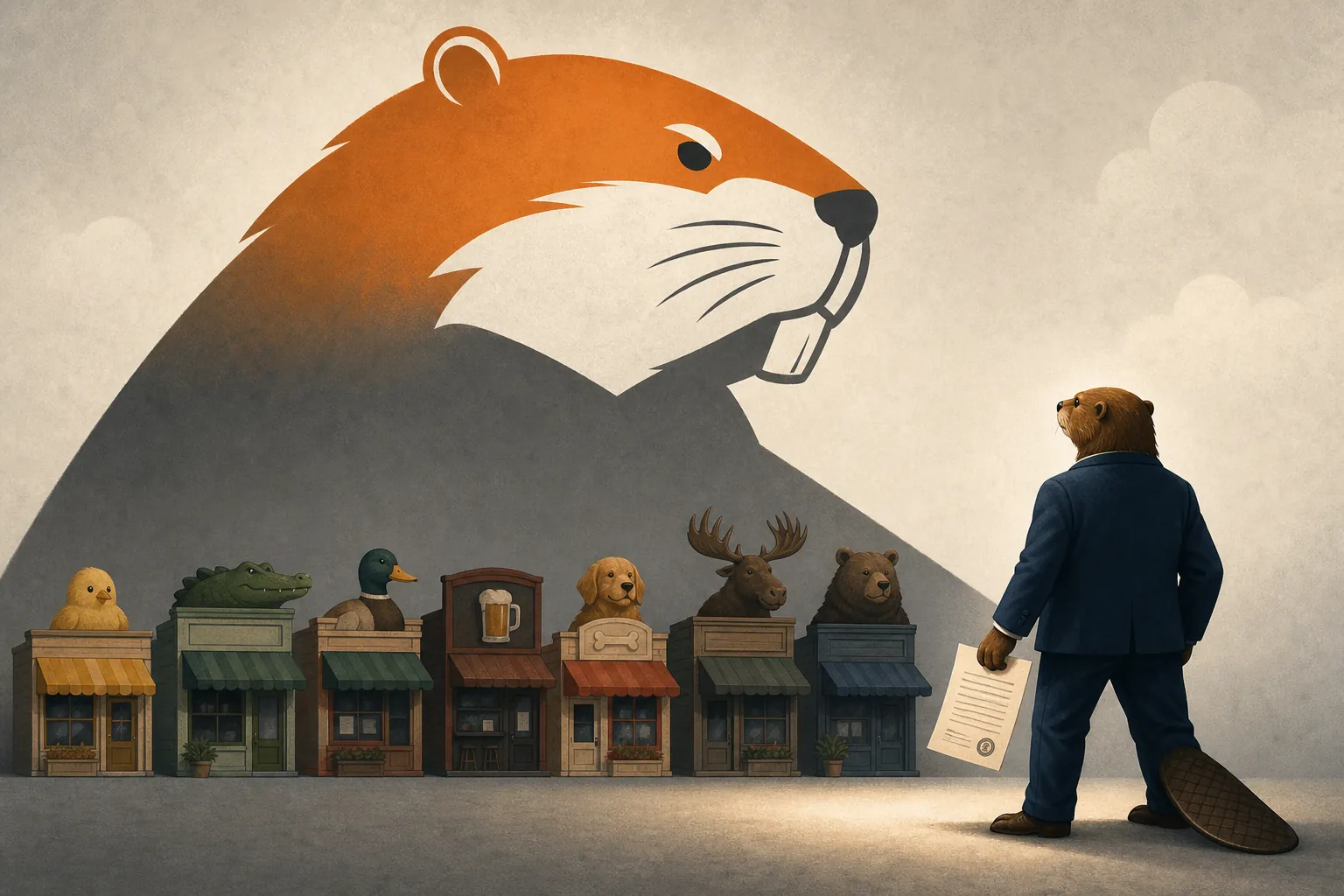
The enforcement footprint before Buc-Off
Gerben Law’s review gives the cleanest starting count: Buc-ee’s holds 62 U.S. trademark registrations, with 12 registrations protecting the beaver logo alone, and the firm counted at least 11 federal lawsuits and 15 Trademark Trial and Appeal Board oppositions since Buc-ee’s first trademark registration in 2007.[1] That count is useful, but it has to be read as a sourced snapshot rather than a live docket total; later identified actions must be added one by one rather than assumed.
LateNighter reported that Oliver’s July 26, 2026 Last Week Tonight segment launched Buc-Off merchandise through Buc-Off.com, with profits directed to Hunger Free America, and framed the project as a direct challenge to Buc-ee’s enforcement habits.[2] No official transcript was available in the reviewed sources, so segment details should be treated as reported accounts rather than verbatim record material.
For counsel assessing a demand letter, the relevant fact is not the social-media afterlife of the segment. It is that Buc-ee’s has historically pressed smaller operators, merchandisers, or adjacent brands, while Oliver’s operation sits behind a national premium-cable platform and has already chosen to make litigation risk part of the public performance.
The docket pattern: many exits, few merits tests
The following chronology classifies only what the available materials support. “Practical significance” is not a merits ruling; it is what the event would likely mean to a lawyer deciding whether to settle early, budget for litigation, or force Buc-ee’s to prove likelihood of confusion.
| Target or matter | Timing and forum posture | Alleged similarity or dispute focus | Disposition or current status in source set | Risk significance |
|---|---|---|---|---|
| Chicks | 2007-era enforcement record identified in Gerben Law’s historical count.[1] | Trademark enforcement involving a smaller target; source set does not provide a full merits account. | Outcome details are limited in the available materials. | Useful mainly as the start of the long enforcement pattern, not as a merits precedent. |
| Choke Canyon | Federal litigation culminating in a 2018 jury verdict, later analyzed by DuetsBlog.[3][4] | Buc-ee’s beaver logo versus Choke Canyon’s alligator-themed trade dress and branding. | Jury verdict for Buc-ee’s.[4] | The strongest merits-side marker for Buc-ee’s; it cannot be dismissed as mere intimidation. |
| Duckees | Filed in 2024; dismissed by a Missouri judge in October 2025 according to the identified docket summary.[1] | Duck-themed branding challenged by Buc-ee’s. | Dismissal for the defendant; identified in the available record as the rare Buc-ee’s litigation loss. | The key counterweight to Choke Canyon, because it shows Buc-ee’s theory does not always survive adjudication. |
| Barc-ee’s | Part of the later enforcement activity reported around Buc-ee’s infringement filings.[5] | Dog- or pet-themed branding using a name close to Buc-ee’s. | Available sources frame it as part of a filing cluster; final merits disposition is not established here. | Shows Buc-ee’s willingness to pursue name-adjacent marks outside direct convenience-store competition. |
| Super Fuels | Part of the later filing cluster covered by ASI Central.[5] | Fuel-station branding challenged by Buc-ee’s. | Final merits disposition is not established in the available materials. | Closer market adjacency makes it a more conventional enforcement target than parody merchandise. |
| Born United / Owl & Anchor / Prometheus Esoterica | Reported in the 2025 coverage of Buc-ee’s filing activity.[5] | Merchandise and design uses challenged by Buc-ee’s. | Available sources do not establish a final merits ruling. | Important for demand-letter risk because small merchandisers may face litigation costs disproportionate to the contested product line. |
| Mickey’s / Mickey Mart | Lawsuit reported February 25, 2026 by USA TODAY.[6] | Buc-ee’s challenged Mickey Mart’s moose logo and related branding. | Pending or unresolved in the available materials; no final merits outcome identified. | Became the public shorthand for perceived overreach because the response turned on the obvious visual difference between a moose and a beaver. |
| Teddy’s | Reported Atlanta filing in June 2026; details in the available materials are secondhand and incomplete. | Trademark dispute involving another animal-name or mascot-adjacent target, based on the limited summary available. | No reliable merits classification available from the reviewed sources. | Should be tracked as a possible later docket item, but not used as proof of any legal proposition. |
| Buc-Off / John Oliver | July 26, 2026 Last Week Tonight segment and reported merchandise launch.[2] | A deliberately provocative Buc-Off project aimed at Buc-ee’s enforcement reputation. | No confirmed Buc-ee’s lawsuit or public response as of July 28, 2026. | Potential first well-funded adversarial test, but not yet a case. |
Choke Canyon is the precedent Buc-ee’s can point to
Any serious risk assessment has to start with Choke Canyon because it is the place where Buc-ee’s did more than send letters or outlast a smaller defendant. It won in front of a jury. DuetsBlog’s 2018 coverage described the “beaver versus alligator” fight as a contest over whether Choke Canyon’s animal logo and related presentation infringed Buc-ee’s protected branding.[3] In 2019, DuetsBlog returned to the result under the pointed title “If an Alligator Infringes a Beaver Mark, Will a Cowboy?” after the jury verdict in Buc-ee’s favor.[4]
That verdict does two things for Buc-ee’s in later disputes. First, it gives the company a real adjudicated win involving a different cartoon animal, which is far more useful than a stack of untested settlements. Second, it changes bargaining leverage. A demand letter backed by a prior jury verdict lands differently from a demand letter backed only by registration certificates.
But Choke Canyon should not be stretched beyond the record. It does not mean every animal logo near a convenience store infringes Buc-ee’s. It does not decide parody merchandise, online criticism, unrelated goods, or every name ending in an “ee” sound. Its litigation-risk value is that Buc-ee’s has already persuaded a jury once that its beaver trade dress can reach another animal-themed fuel-stop presentation.
The early-exit problem
The enforcement pattern is not the same thing as a merits record. Gerben Law’s count of lawsuits and TTAB oppositions shows volume.[1] ASI Central’s coverage of Buc-ee’s later filing activity shows the company continuing to press alleged infringement across merchandise and branding uses.[5] Those facts establish persistence and breadth. They do not, by themselves, establish that every target was legally infringing.
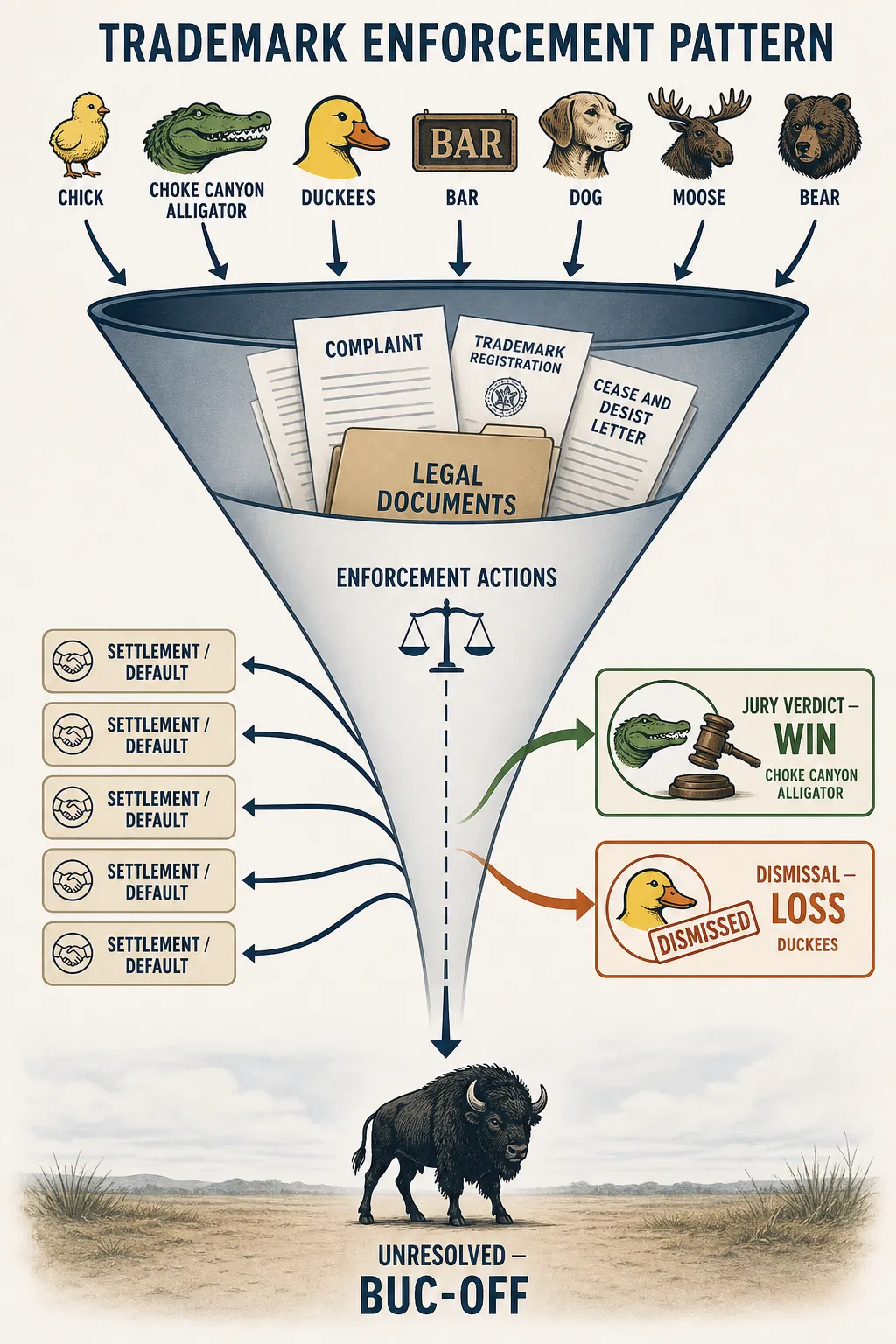
This is where demand-letter risk diverges from courtroom truth. A small store, apparel seller, or local operator may not need to believe Buc-ee’s would ultimately win. It may only need to believe that Buc-ee’s can make the next six months expensive. The business decision then becomes whether to rebrand, pull merchandise, settle under confidentiality, or spend money to reach the point where a judge or jury can test the theory.
That dynamic explains why the phrase “trademark bully” gets attached to Buc-ee’s, but it also shows why the label can be too blunt. The record supports a practical-power critique: repeated enforcement against smaller targets can produce a near-total practical win rate without producing many written merits decisions. It does not support the stronger claim that Buc-ee’s theories are categorically meritless. Choke Canyon prevents that shortcut.
Duckees is the loss that keeps the record from being one-way
Duckees matters because it is the identified exception. The available record describes a 2024-filed Duckees case that a Missouri judge dismissed in October 2025, making it the rare instance where a defendant came out ahead rather than exiting through settlement, default, or rebrand.[1]
For counsel, the immediate use of Duckees is not to tell a client, “Buc-ee’s loses if challenged.” That would overread one dismissal. Its use is narrower and more valuable: it proves the enforcement campaign is not immune to judicial rejection. If a client has facts materially different from Choke Canyon and enough budget to reach a dispositive ruling, Duckees belongs in the early risk memo.
Mickey Mart and the cost of perceived overreach
The Mickey’s or Mickey Mart dispute is the cleanest example of how enforcement can create brand risk before it creates a judicial result. USA TODAY reported on February 25, 2026 that Buc-ee’s sued Mickey Mart, an Ohio convenience-store chain, alleging trademark infringement over its moose logo and related branding.[6] The public response quickly condensed into the line that a moose is not a beaver, a point later taken up in legal and brand commentary.[7][8]
The line is useful because it captures a lay reaction, not because it decides the case. Trademark confusion analysis can consider overall commercial impression, market proximity, trade dress, consumer context, and more than anatomical species. Still, a plaintiff with a beloved mascot can pay a reputational price when ordinary consumers perceive the asserted similarity as strained. Forbes framed the dispute as a possible brand-damage problem for Buc-ee’s, while the UC Law Review piece treated it as a live trademark fight rather than a settled conclusion.[7][8]
For litigation planning, Mickey Mart belongs between Choke Canyon and Buc-Off. It is not the decisive merits test. It is evidence that Buc-ee’s enforcement perimeter had expanded far enough to make non-specialists ask where the line is.
Why Buc-Off changes the leverage analysis
LateNighter’s account of Oliver’s Buc-Off project describes a merchandise launch designed to challenge Buc-ee’s directly, with proceeds going to Hunger Free America.[2] That posture is different from an accidental proximity dispute. It is not a small operator saying, “We didn’t mean to get close.” It is a national television host saying, in effect, “If your theory reaches this, test it.”
Oliver also has a relevant litigation history. Public accounts of SLAPP suits identify Murray Energy’s lawsuit against John Oliver, HBO, and others after a 2017 Last Week Tonight segment, with the dispute later resolved in Oliver’s favor after litigation that became part of his public anti-SLAPP posture.[9] That history does not predict the outcome of a Buc-ee’s trademark case. It does show that Oliver’s team has previously endured being sued over a segment and then used the litigation itself as part of the story.
That is the feature Buc-ee’s has not often faced in the identified record: a target that may welcome discovery, briefing, public filings, and the cost of proving the enforcement theory. Against a small merchandiser, the expense of being right can be fatal. Against an HBO-scale defendant, expense may be part of the strategy.
What a demand-letter recipient should take from the record
A business receiving a Buc-ee’s demand letter should not treat the letter as empty theater. The registration portfolio is large, the company has repeatedly filed, and Choke Canyon gives it a jury-tested example of broad protection for its beaver-centered branding.[1][4] Those are real pressure points.
The same recipient should not treat the enforcement record as a perfect merits forecast. The volume of resolved disputes may reflect settlement economics as much as legal strength. The relevant first questions are practical and fact-specific: what goods or services are actually being sold, how close is the channel of trade, what does the accused mark look like in ordinary use, what evidence of confusion exists, what insurance may respond, and how far the client can afford to litigate before the cost curve forces settlement.
The cleanest risk classification from the known record is this: Buc-ee’s is dangerous in practical enforcement terms; Choke Canyon makes it dangerous in at least some merits settings; Duckees shows the theory has limits; Mickey Mart shows the public may see overreach before a court does; Buc-Off is unresolved but unusually important because it may remove the resource-disparity variable that has shaped so many earlier outcomes.
The open edge as of July 28, 2026
Nothing in the available record establishes that Oliver has beaten Buc-ee’s. Nothing establishes that Buc-ee’s has chosen not to sue. The response window is still open, and any complaint, demand letter, settlement communication, or public statement after the observation date would change the posture.
For now, the significant development is narrower and more precise: Buc-ee’s has a long, high-pressure trademark enforcement record, much of it resolved before full merits testing, and John Oliver’s Buc-Off may be the first deliberately staged, well-funded attempt to force that record into an adversarial test Buc-ee’s cannot win merely by making litigation expensive.
References
- A Look at Buc-ee's Trademark Enforcement Strategy, Gerben Law
- John Oliver Launches 'Buc-Off' Merch to Challenge Gas Station Giant Buc-ee's, LateNighter
- Brawling Brands: Beaver Versus Alligator, DuetsBlog, May 2018
- If an Alligator Infringes a Beaver Mark, Will a Cowboy?, DuetsBlog, February 2019
- Buc-ee's Files Flurry of Lawsuits Over Trademark Infringement, ASI Central, June 2025
- Buc-ee's sues Mickey Mart over logo, trademark infringement, USA TODAY, February 25, 2026
- Fueling a Trademark Fight: Buc-ee's and Mickey's Gas Station Dispute, UC Law Review, April 18, 2026
- Buc-ee's Beaver Is Fighting A Moose. This Could Bite Its Brand., Forbes, July 10, 2026
- SLAPP Suits, Wikipedia
Related records
Tool profile
Browse tool evaluations →Governing regulation
Browse the obligations tracker →Preventive workflow
Browse verification workflows →
Report a correction or tip
Spotted an outdated figure, a misstated fact, or a ruling this case record should reflect? Public comments are disabled for this content given the professional cost of a misreported case outcome, penalty amount, or rule text — use the structured correction channel instead.
Report a correction or tip for this record →