
Three Legal Patterns in Budget Insurance Tesla Repair Disputes
Tesla owners with budget insurance face out-of-pocket repair cost gaps of $700–$2,200 when insurers cap labor rates and refuse OEM parts. This article identifies three distinct litigation patterns—labor-rate gaps, OEM-parts disputes, and premature total-loss declarations—and the legal remedies available for each.
- Jurisdiction
- US - Federal and State
- Court
- Multiple courts
- AI tool named
- Tesla
- Ruling date
- Jul 17, 2025
- Source document
- View primary court order ↗
- Last verified
- Jul 30, 2026
Lex Machina Review is an independent risk-tracking and reference resource. Nothing on this site is legal advice, and using it does not create an attorney-client relationship. Every record is reviewed against primary sources but may not reflect the most current status of a matter — always verify directly against the cited court order, rule text, or a licensed attorney before relying on it.
Companion explanation — secondary to the source document above
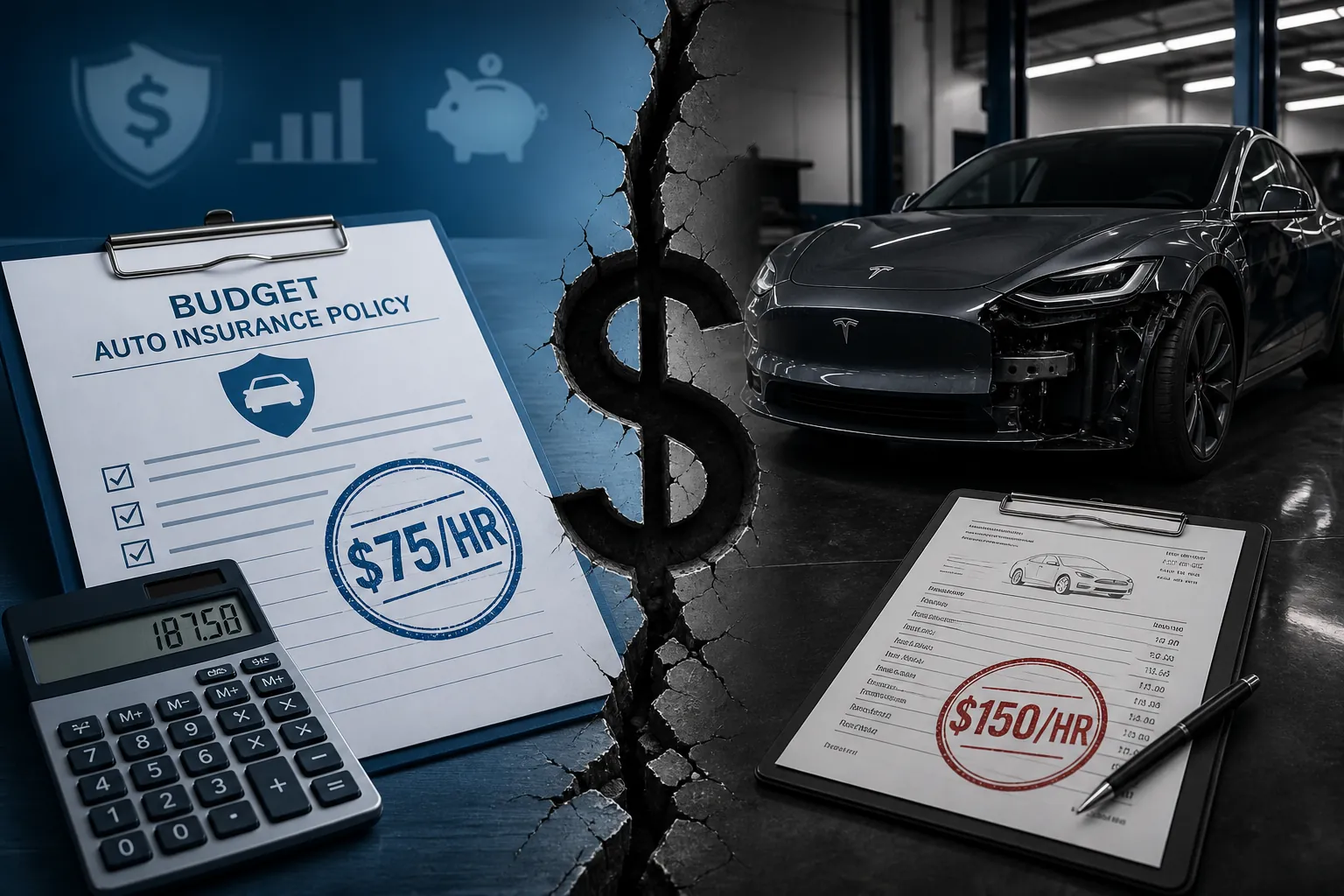
Start with the gap, because that is where the legal issue becomes concrete. A carrier reimburses labor at about $75 an hour. A Tesla-certified collision shop bills about $150 an hour. The owner is not arguing over a luxury upgrade; the owner is trying to get the vehicle repaired in the channel the vehicle effectively requires. TorqueNews reported out-of-pocket deltas of roughly $700 to $2,200, including one Model Y example with a $2,106.28 gap after a budget insurer declined to match the Tesla collision repair rate.[1]
This is not advice for any particular claim, and the record is uneven. The labor-rate figures come from a press account that includes a Reddit-originated example, not a multi-state actuarial study. One OEM-parts source is an attorney investigation page, not an adjudicated finding. The total-loss evidence includes a 2023 salvage-market snapshot that should be refreshed before anyone treats it as current frequency data. Those limits matter. They do not make the disputes imaginary; they define what can responsibly be pleaded, investigated, or defended.
The recurring legal question is whether ordinary auto-policy repair assumptions still work when the repair market is narrow, credentialed, and expensive. A policy may be written as though labor rates and replacement parts can be sourced from a competitive local market. A Tesla claim can look different: certified repair access may be limited, replacement-part options may be constrained, and the economic pressure can move quickly from a repair dispute to a total-loss decision.
The labor-rate gap is the cleanest pleading pattern
The labor-rate theory is not complicated. The insured presents a repair estimate from a Tesla-certified shop. The insurer pays, or offers to pay, at a lower hourly rate it characterizes as prevailing, reasonable, or policy-compliant. The shop will not do the work at that number. The vehicle owner is left to pay the difference, delay the repair, fight through appraisal or regulatory complaint channels, or move the claim toward litigation.
On the present materials, the best-supported dollar framing remains narrow: about $75 an hour on the insurer side, about $150 an hour on the Tesla-certified shop side, and reported owner gaps of about $700 to $2,200.[1] That is enough to describe the mechanism. It is not enough, standing alone, to prove a national market rate, a carrier-wide uniform practice, or a classwide damages model across jurisdictions.
For counsel, the evidence questions are predictable. What does the policy say about labor rates, reasonable repair cost, choice of shop, and appraisal? Did the insurer identify actual shops willing and qualified to repair the Tesla at the reimbursed rate? Were those shops Tesla-certified for the needed work? Did the insurer merely cite a database or prevailing-rate schedule, or did it verify a practical repair option for that vehicle, in that market, at that time?
A breach-of-contract claim would turn on the policy promise and the repair-cost language. A bad-faith or unfair-claims theory would need more than a high bill; it would need facts showing an unreasonable investigation, a refusal to consider the actual repair channel, delay, pressure tactics, or a pattern of knowingly paying rates that do not buy the covered repair. The $2,106.28 Model Y gap is useful because it gives the dispute a shape. It should not be inflated into proof that every Tesla labor-rate dispute looks the same.
OEM-parts disputes move the fight into policy language
The OEM-parts pattern is slightly less tidy and potentially more important. Kershaw Talley Barlow says it is investigating Geico, State Farm, and Kemper over alleged refusal to cover Tesla OEM parts, and its investigation page frames the core problem this way: no independent repair shop will install non-OEM parts on a Tesla, making standard “like kind and quality” clauses functionally impossible to satisfy in that setting.[2]
That source must be handled for what it is. An attorney investigation page is not a complaint, not a docket, and not a judicial finding. It is still a useful signal because it identifies the legal theory plaintiff-side counsel is screening for: an insurer relies on replacement-parts language written for a market where alternatives are practically available, while the Tesla repair channel allegedly does not operate that way.
The strongest OEM-parts file would not merely say the owner preferred Tesla-branded parts. It would show that the insurer specified, priced, or refused to pay for OEM components even though the actual repair could not be performed safely, warrantably, or at all with the proposed non-OEM alternative. The legal distinction matters. Preference is a weaker fact. Practical impossibility is the pressure point.
In that posture, “like kind and quality” stops being boilerplate and becomes the fact question. Like kind to whom: the insurer’s estimating system, a generic parts market, a certified Tesla repair facility, or the vehicle owner who bought coverage for a car that can only be put back into service through a constrained repair ecosystem? A carrier may have defensible policy language. It still has to connect that language to a repair path that exists.
Total loss is the high-stakes endpoint
The total-loss pattern is not just a larger version of the labor-rate dispute. It changes the remedy, the leverage, and the owner’s practical loss. Car and Driver reported, citing Reuters, that more than 120 Tesla Model Ys with under 10,000 miles had appeared at salvage auction, while repair costs on vehicles worth about $61,000 could run from $30,000 to more than $50,000. The article described insurers writing off vehicles when estimates reached roughly 50% to 75% of actual cash value.[3][4]
Those numbers should not be treated as a live 2026 count. They are still relevant because they show how quickly Tesla repair economics can move a claim from “repair my car” to “the carrier says the car is gone.” In litigation terms, the issue is not whether a damaged EV can ever be totaled early. The issue is whether the insurer’s valuation, estimate review, salvage assumptions, and claims communications were reasonable under the governing policy and state law.
A premature-total-loss file needs different proof than a labor-rate gap file. Counsel would want the actual cash value analysis, comparable vehicles, repair estimate history, supplements, battery and structural-damage assumptions, salvage bid information if available, and the communications that show whether the insured had any meaningful way to challenge the decision. Appraisal may matter more here than in a small labor-rate shortfall, because the valuation fight can determine whether the owner keeps the vehicle at all.
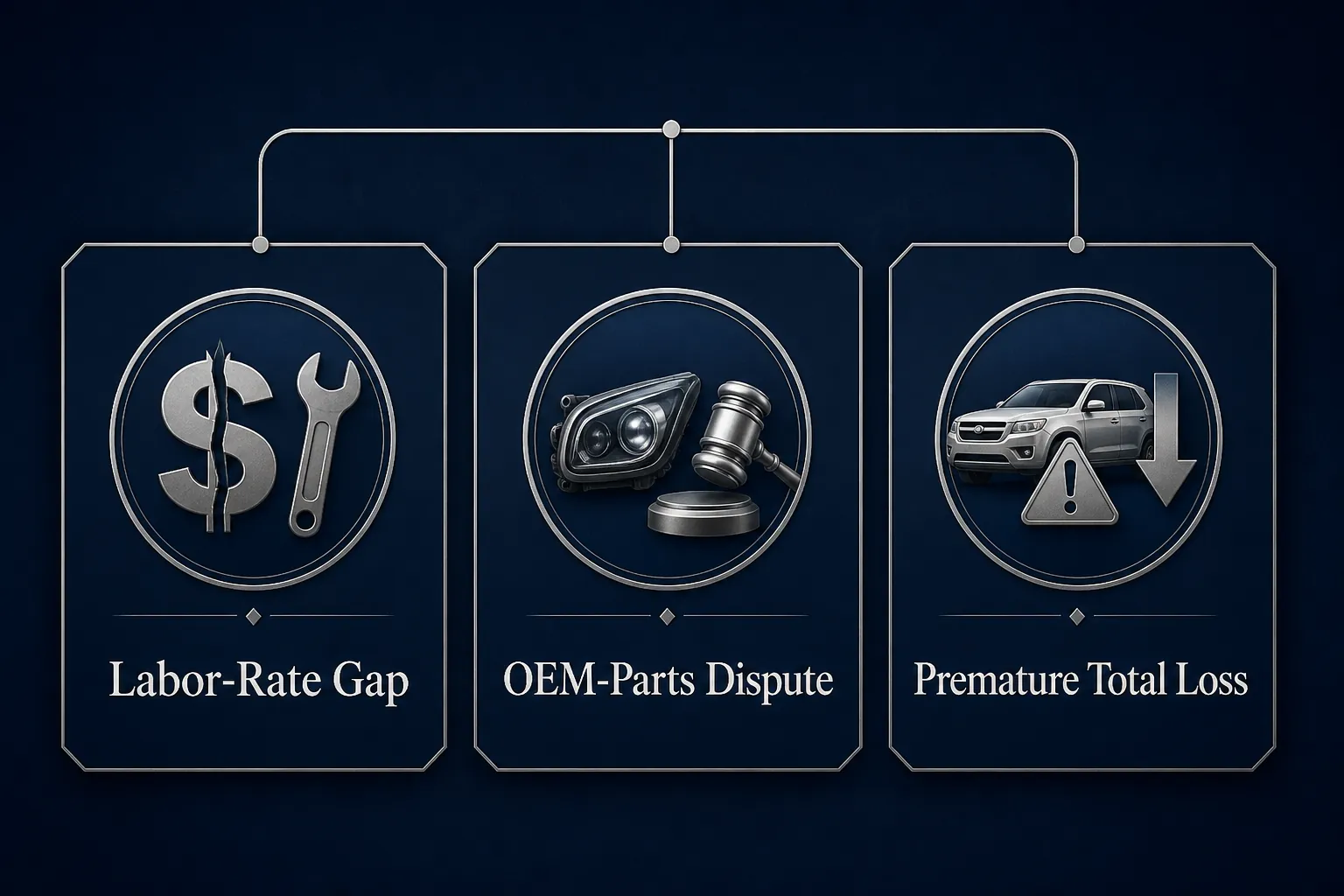
| Pattern | What counsel would test | Likely legal framing |
|---|---|---|
| Labor-rate gap | Whether qualified Tesla repair was actually available at the reimbursed hourly rate | Breach of contract, bad faith, unfair claims-handling theory |
| OEM-parts dispute | Whether non-OEM parts were practically installable and policy-compliant for the needed repair | Policy-language dispute, practical-impossibility argument, bad-faith investigation theory |
| Premature total loss | Whether valuation, repair estimates, supplements, and salvage assumptions supported the write-off | Valuation challenge, appraisal, claims-handling scrutiny |
The legal context is wider than one repair bill
Regulatory and class-action developments make the repair disputes harder to dismiss as isolated owner frustration, though they do not prove every labor-rate or OEM-parts claim. In October 2025, the California Department of Insurance announced enforcement actions alleging that Tesla insurance entities committed nearly 3,000 violations, including 396 late responses and 22 missed acceptance-or-denial deadlines.[5]
The Magana class action gives the claims-handling issue a docketed form. Reuters reported that Magana v. Tesla Insurance Co., No. 25STCV20622, alleges systematic delay and minimization of payouts by Tesla’s auto insurance arm.[6] That case is not the same as a budget-carrier labor-rate suit against a non-Tesla insurer. Its relevance is narrower: it shows that Tesla insurance claims handling is already being pleaded as a systemic consumer issue in California.
The repair-market backdrop also has antitrust litigation around it. Lambrix v. Tesla, No. 23-cv-01145, and Orendain v. Tesla, No. 23-cv-01157, were filed in the Northern District of California and alleged monopolization of Tesla repair services and parts under Sherman Act Section 2.[7][8] Bloomberg Law also reported that Tesla was the only major U.S. automaker that had not signed the 2023 right-to-repair memorandum of understanding.[7]
Those antitrust cases should not be imported wholesale into an insurance coverage dispute. They help explain why the repair channel may be narrower than policy language assumes. They do not decide whether a particular insurer breached a particular policy, acted in bad faith, or owed a particular labor rate. The procedural status of those dockets also should be checked on PACER before publication or pleading reliance, especially because the available research indicates later motion practice may have narrowed some claims.
Where the claims overlap
The three patterns are analytically separate, but real files will not always stay that way. A carrier may cap labor, refuse OEM-parts pricing, and then declare the vehicle a total loss after the certified-shop estimate rises. The owner experiences one claim. Counsel has to separate the moving parts because each one calls for different proof.
A small labor-rate gap may be better suited to a demand letter, appraisal, small-claims filing, or department-of-insurance complaint than to full-scale litigation. A repeated carrier practice affecting many Tesla owners may be more attractive for class screening, but only if the policy language, state law, repair-market facts, and damages method can be made common enough. An OEM-parts denial may rise or fall on shop testimony. A total-loss challenge may depend on valuation evidence more than repair ideology.
For insurers, the defensive problem is also practical. A “prevailing rate” explanation is stronger when the file identifies actual qualified shops that would do the work at the stated rate. It is weaker when it leaves the insured with a Tesla-certified estimate, no equivalent repair option, and a balance the carrier treats as the owner’s private problem. The same is true for parts: policy language carries more weight when the proposed part can be installed in the real repair channel.
A litigation-screening frame for Q3 2026
The viable files are the ones that can tie the policy promise to the constrained repair facts. A Tesla owner’s anger at a high repair bill is not enough. A carrier’s invocation of ordinary market rates is not enough either. The file has to show where the assumed market failed: no qualified shop at the paid rate, no installable non-OEM part, no adequately supported total-loss valuation, or claim communications that turned a predictable Tesla repair delta into an individualized surprise.
Before heavy reliance, several inputs need verification. The $75-versus-$150 labor-rate comparison needs broader market confirmation. The 120-plus salvage figure is from a 2023 reporting window and should be updated against current salvage or estimating data. The Kershaw Talley Barlow matter should be treated as an investigation unless a filed complaint is confirmed. The Tesla antitrust dockets should be checked for current procedural posture.
That leaves a cautious but usable judgment: these are claim patterns worth matching against client facts now, not proven nationwide liability theories. The strongest cases will not be the ones that simply complain Tesla repairs cost more. They will be the ones that document how a policy written for an ordinary repair market was applied to a vehicle whose repair path was narrower, more expensive, and known before the loss was ever adjusted.
References
- Tesla Collision Warns Of Out-Of-Pocket Costs As Budget Insurance Refuses To Match Repair Rates On Model Y Damage, TorqueNews, Apr. 2026
- Geico Tesla Repair Lawsuits | OEM Parts Insurance Disputes, Kershaw Talley Barlow
- Tesla EVs, Even Mildly Damaged, Being Written Off by Insurers, Car and Driver
- Tesla launched its own car insurance. These drivers say it's a lemon, Reuters
- Commissioner Lara announces enforcement action against Tesla Insurance for claims handling violations, California Department of Insurance, Oct. 2025
- Tesla's auto insurance arm hit with consumer class action in California, Reuters, July 17, 2025
- Tesla Accused in Consumer Suit of Monopolizing Repairs, Parts, Bloomberg Law
- Tesla Repair Services Antitrust Litigation, Saveri Law Firm
Related records
Tool profile
Browse tool evaluations →Governing regulation
Browse the obligations tracker →Preventive workflow
Browse verification workflows →
Report a correction or tip
Spotted an outdated figure, a misstated fact, or a ruling this case record should reflect? Public comments are disabled for this content given the professional cost of a misreported case outcome, penalty amount, or rule text — use the structured correction channel instead.
Report a correction or tip for this record →