
Can Caitlin Clark Sue Over an Emmett Till Comparison?
This article analyzes whether Caitlin Clark could successfully sue Nancy Armour and USA Today for the Emmett Till comparison column, examining the public-figure actual-malice standard, the opinion defense, and the narrow vulnerability created by the column's verifiable factual claims.
- Jurisdiction
- US Federal
- Court
- Federal District Court
- AI tool named
- None
- Ruling date
- Jul 22, 2026
- Source document
- View primary court order ↗
- Last verified
- Jul 25, 2026
Lex Machina Review is an independent risk-tracking and reference resource. Nothing on this site is legal advice, and using it does not create an attorney-client relationship. Every record is reviewed against primary sources but may not reflect the most current status of a matter — always verify directly against the cited court order, rule text, or a licensed attorney before relying on it.
Companion explanation — secondary to the source document above
As of July 25, 2026, Caitlin Clark has not filed a defamation lawsuit over Nancy Armour’s USA Today column. That matters, because much of the backlash has treated litigation as if it were a moral referendum: if the column was offensive enough, Clark should sue; if it ran under an Opinion label, USA Today is safe. Neither shortcut is legal analysis.
The legal temperature changes with the wording. Armour’s July 22, 2026 column used three phrases that would dominate any complaint: a reference to a “white nationalist faction of Caitlin Clark’s fandom,” an invocation of Emmett Till, and the assertion that Clark’s conduct “puts Black and queer players in danger.” The first two are inflammatory. The third is the sentence a plaintiff’s lawyer would isolate, underline, and try to turn from moral accusation into factual assertion. [1]

The likely answer is still that Clark would face an uphill, expensive, probably losing case. She is not an ordinary private person pulled unwillingly into a neighborhood dispute. She is a WNBA star, a national media figure, and a recurring subject in a public controversy over race, fandom, officiating, physical play, and the treatment of other players. That puts her in the hardest defamation lane. But “probably losing” is not the same as “frivolous,” and the distinction sits almost entirely in the danger language.
The Statements That Would Matter
A complaint would not be built around the public’s dislike of the column. It would be built around allegedly defamatory meaning. The claim would have to identify what USA Today communicated about Clark, why that meaning is false, why it injured her reputation, and why the publisher acted with the required level of fault.
| Column Language | Likely Legal Treatment | Why It Matters |
|---|---|---|
| “White nationalist faction of Caitlin Clark’s fandom” | Likely protected opinion or commentary about a subset of fans, unless read as imputing Clark’s own allegiance | The phrase is ugly, but it appears directed at part of the fanbase rather than a clean factual accusation that Clark herself is a white nationalist. |
| Emmett Till reference | Likely protected as rhetorical analogy, though highly charged | The legal question is not taste; it is whether the analogy implies a provably false fact about Clark. |
| Clark’s conduct “puts Black and queer players in danger” | The narrow vulnerability | This sounds closer to a causal claim about real-world risk: Clark does X, and Black and queer players face danger because of it. |
That last formulation is different from saying Clark is selfish, reckless, entitled, insensitive, or blind to how parts of her fanbase behave. Those are judgments, and harsh judgments are not automatically actionable. Saying her conduct puts identifiable groups of players in danger implies something more observable: that her on-court behavior or public posture contributes to threats or unsafe conditions for Black and queer players. A court would have to decide whether an ordinary reader understood that as rhetorical condemnation or as a factual claim capable of being tested.
Clark Would Almost Certainly Be Treated as a Public Figure
The first serious obstacle is not the Opinion label. It is Clark’s status. Under New York Times Co. v. Sullivan, public officials and public figures cannot win a defamation case merely by showing that a statement was false and carelessly published. They must prove “actual malice”: that the defendant knew the statement was false or acted with reckless disregard for whether it was false. [2]
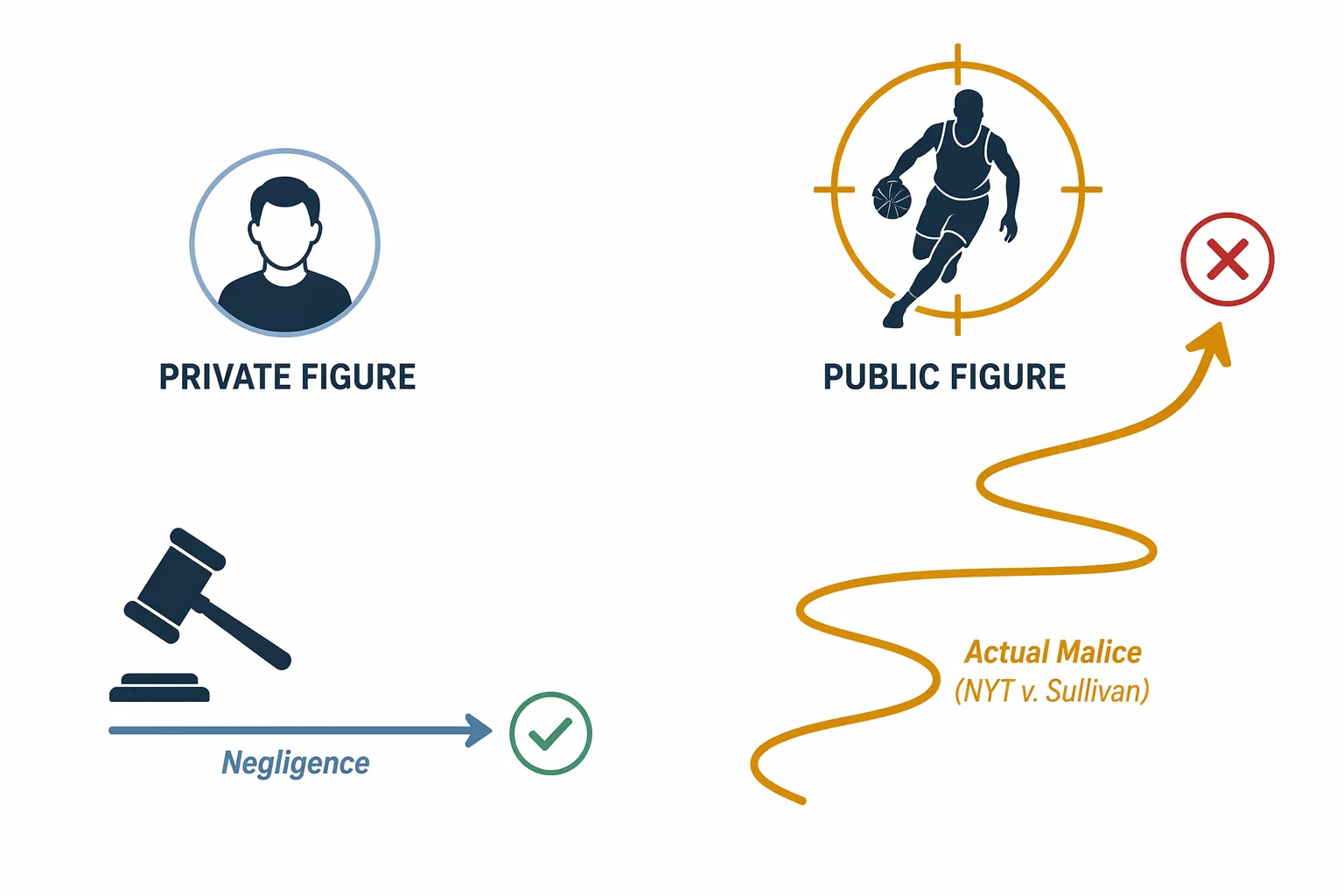
Clark would have little room to argue she is a private figure for this controversy. The column did not discuss a private medical matter, a family dispute, or an obscure event. It addressed her public play, public visibility, public fan culture, and the social meaning attached to her celebrity. Even if a court declined to treat her as an all-purpose public figure, it would have strong grounds to treat her as a limited-purpose public figure for the WNBA race-and-fandom controversy the column addressed.
That classification does enormous work. It means Clark would not win by proving Armour was unfair. She would not win by proving the analogy was overwrought. She would not win by proving editors should have anticipated backlash. Actual malice is about the defendant’s state of mind toward truth or falsity, not the public’s reaction to the published piece.
Reckless disregard is also a term of art. It is not the same as sloppy reasoning, ideological zeal, or a refusal to write with generosity. A plaintiff usually needs evidence that the publisher entertained serious doubts about the truth of the factual assertion or had obvious reasons to distrust it and published anyway. Protect Democracy’s explainer usefully emphasizes that actual malice protects erroneous speech about public figures unless the plaintiff can meet that demanding knowledge-or-recklessness threshold. [3]
That is why online claims that “she should sue” skip the hard part. A complaint can quote the sentence. A motion can argue meaning. But to get to a damages verdict, Clark would need evidence about what Armour and USA Today knew, what they reviewed, what they ignored, and whether they subjectively doubted the factual implication they published. Outrage does not substitute for that record.
Opinion Protects More Than Many Readers Think
USA Today’s best first-line defense would be that Armour wrote an opinion column about a public sports controversy. That does not end the case, but it shapes how a court reads the challenged language. Under Gertz v. Robert Welch, there is no such thing as a false idea, although false statements of fact may still be actionable. [4]
Milkovich v. Lorain Journal prevents the defense from becoming too easy. A publisher cannot immunize a factual accusation by prefacing it with “in my opinion.” If the statement implies an assertion of objective fact, the Opinion label is not a disinfectant. Courts look at wording, context, verifiability, and the expectations of the forum. [5]
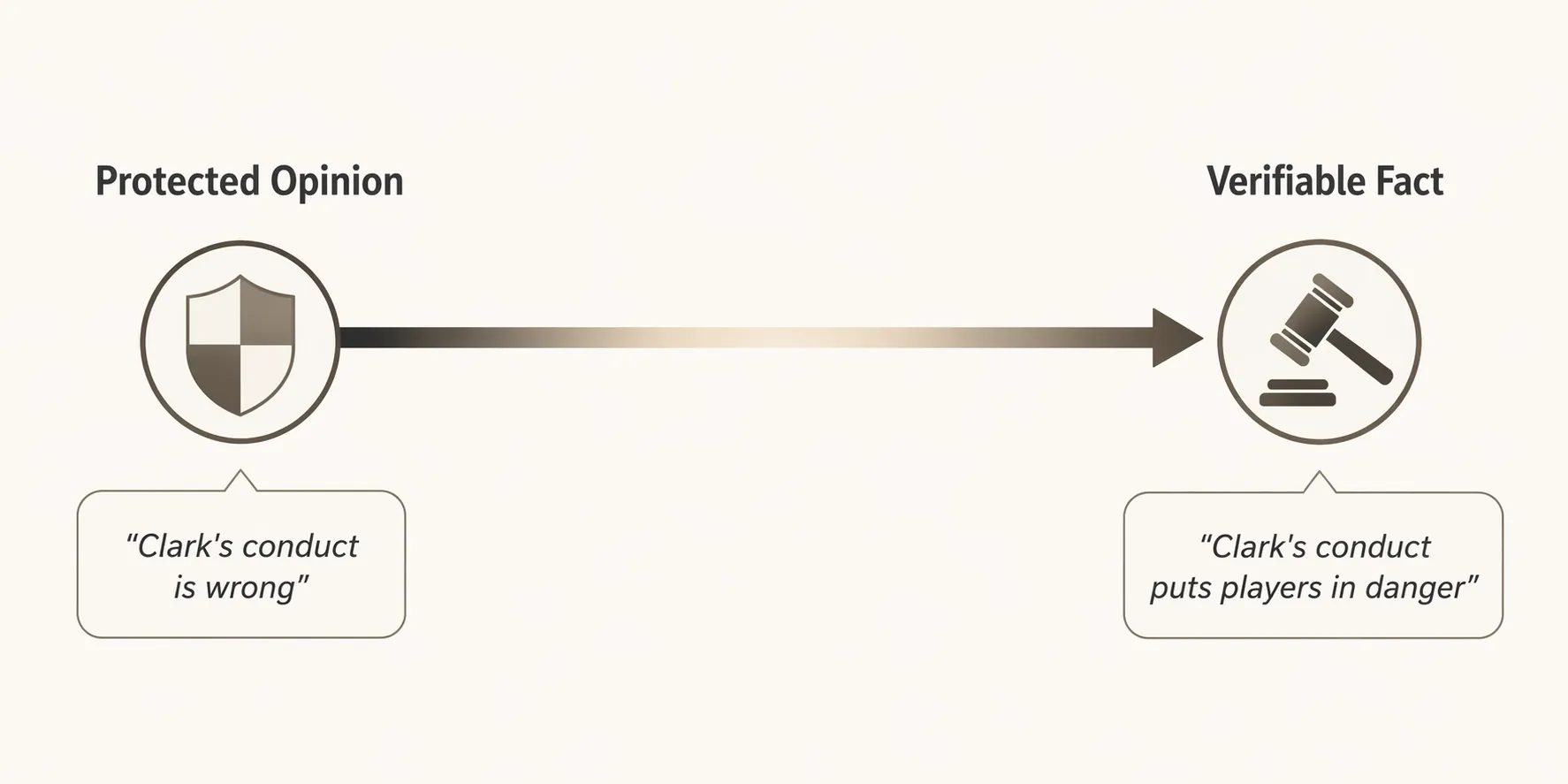
Most of Armour’s column likely stays on the protected side of that line. Criticism that Clark flops, benefits from racialized narratives, fails to restrain supporters, or should understand how her conduct lands in a racially charged league environment is severe commentary. It may be contestable, ungenerous, or incomplete. But courts have long given columnists room to make evaluative judgments about public figures, especially in heated public controversies.
The Emmett Till reference is the emotionally heaviest part of the column, and no legal analysis should sand that down into a sterile metaphor dispute. Invoking Till places Clark inside a moral field with a specific history of white accusation and Black vulnerability. It asks her to carry a meaning much larger than a basketball foul. Still, for defamation purposes, the question remains narrower: did the comparison assert, or imply, a provably false fact about Clark?
Standing alone, the Till reference would probably be treated as rhetorical analogy rather than a literal factual claim. A reasonable reader would not think Armour accused Clark of participating in a lynching. The stronger argument is not literal equivalence. It is defamatory implication: that the column linked Clark’s conduct to a pattern in which white female accusation or performance creates danger for Black people. That implication is morally explosive, but defamation law still asks whether it is sufficiently factual to be proved false.
The Narrow Vulnerability: “Puts Black and Queer Players in Danger”
The danger sentence is where USA Today would have the most work to do. It does not merely say Clark’s conduct is harmful discourse, symbolically loaded, or irresponsible in a broad cultural sense. It says her conduct “puts Black and queer players in danger.” [1]
That can be read as a factual proposition with moving parts: Clark engaged in identifiable conduct; that conduct contributed to danger; the danger was directed at Black and queer players; and the causal connection was strong enough to attribute the risk to Clark’s behavior. Those are not easy facts to prove or disprove, but they are not purely aesthetic judgments either.
A plaintiff’s pleading would likely frame the statement this way: Armour and USA Today told readers that Clark, through her conduct, endangers Black and queer players. That meaning, Clark would argue, is defamatory because it accuses her of causing or materially contributing to threats against vulnerable colleagues. It is not just an accusation of bad sportsmanship. It is an accusation of creating unsafe conditions for other players.
USA Today would answer that the sentence appeared in a column about social dynamics, not in a news report purporting to quantify security threats. It would argue that “puts players in danger” is the language of moral and political commentary: a warning about foreseeable social consequences, not a literal claim that Clark caused a specific threat. That argument has force. Opinion columns use compressed, heated language, and courts often resist surgically extracting one phrase from a polemical whole.
But the defense is not automatic. If discovery showed that editors knew there was no factual basis for connecting Clark’s specific conduct to danger for Black and queer players, or that they consciously avoided contrary information while publishing the claim as if it were established, the actual-malice analysis would become more dangerous for the publisher. That is a narrow path, not a broad one. It depends on internal evidence Clark does not currently have in public view.
The Backlash Shows Heat, Not Legal Merit
Riley Gaines publicly urged Clark to sue, and Dave Portnoy called for Armour’s firing. Those reactions matter as evidence that the column generated political and reputational heat. They do not establish falsity, defamatory meaning, actual malice, or damages. [6][7]
That distinction is not pedantic. Defamation cases are not applause meters. A statement can be widely condemned and still be constitutionally protected. A statement can also be published in an opinion column and still carry a factual implication. The useful legal work starts only after the outrage is set aside.
The Editor’s Note Helps, But It Does Not Erase the Issue
USA Today later updated the column with an editor’s note after backlash, and Front Office Sports reported that the note described the Emmett Till reference as “inartful.” [8]
That note matters in several ways. It may reduce sting by signaling that the publication did not intend a literal equivalence between Clark and the historical actors surrounding Till’s murder. It may help USA Today argue context: the newsroom recognized the analogy was poorly framed, not that the underlying criticism was knowingly false. It may also matter to mitigation if a court ever reached damages.
It does not, however, make the original publication disappear. Nor does a later statement by Armour, if offered to clarify intent, automatically cure an earlier defamatory implication. A correction, clarification, or editor’s note can affect how later readers understand the piece and how a jury measures harm. It rarely functions as a magic eraser.
Procedural Risk Cuts Both Ways
Any lawsuit would immediately raise forum questions. Clark, Armour, USA Today, the league, and the readership are not confined to one local market. Jurisdiction would affect pleading standards, anti-SLAPP protection, discovery timing, fee-shifting risk, and appellate posture. The available materials do not identify a filed complaint, so any jurisdictional prediction would be premature.
Anti-SLAPP exposure is a real caution for Clark. Depending on where she sued and which law applied, USA Today could seek early dismissal and potentially fees by arguing the column addressed a matter of public concern. That does not mean a claim centered on a factual danger assertion could never proceed. It means the cost of testing that theory could rise quickly.
Damages would be another disciplined part of the case. Clark’s public profile and commercial trajectory were already extraordinary. If she alleged economic injury, she would need to tie a specific loss to this column rather than to the general noise surrounding her celebrity. Reputational harm may be easier to describe than to price, especially when the challenged publication also intensified support from readers who viewed her as unfairly attacked.
The Likely Litigation Shape
If Clark sued, the complaint should not sprawl. The more it attacked the column’s politics, tone, analogy, and general unfairness, the easier it would be for USA Today to characterize the case as an attempt to punish protected opinion. The cleaner claim would focus on the statement that her conduct puts Black and queer players in danger and any surrounding language that makes that assertion appear factual rather than metaphorical.
USA Today’s motion to dismiss would likely argue that Clark is at least a limited-purpose public figure, that the column is protected opinion, that the challenged statements are nonactionable rhetorical hyperbole, that no reasonable reader would understand the Till reference literally, and that the complaint lacks facts supporting actual malice. Those are strong arguments.
Clark’s best response would be narrower: the case is not about banning harsh commentary on race or fandom; it is about a national publication asserting that her conduct causes danger to Black and queer players without a factual basis. That framing gives her a nonfrivolous route past the easiest objections, especially at the pleading stage, if a court reads the danger language as factual implication rather than opinion.
Even then, the actual-malice burden remains the central wall. Without discovery showing knowledge of falsity or reckless disregard, the case probably fails before trial. With only the public record described here, Clark has a theory worth understanding, not a claim one would confidently price as a winner.
Bottom Line for Media-Liability Risk
This is not legal advice, and no lawsuit is pending as of July 25, 2026. On the present materials, Clark would face a difficult and likely losing defamation case against Armour and USA Today. Her public-figure status forces her into actual malice. The Opinion setting protects much of the column’s moral and political criticism. The Emmett Till comparison, however painful and provocative, is likely to be defended as rhetorical analogy rather than literal factual accusation.
The risk for USA Today is narrower and more concrete: the assertion that Clark’s conduct “puts Black and queer players in danger.” If a court treats that as an implied factual claim about causation and safety, it could survive longer than the rest of the controversy. That would not make Clark’s lawsuit easy. It would make it expensive, serious, and probably still uphill — but not frivolous.
References
- Nancy Armour column, USA Today, July 22, 2026, usatoday.com/story/sports/columnist/nancy-armour/2026/07/22/...
- New York Times Co. v. Sullivan, 376 U.S. 254, 1964, 376 U.S. 254, 1964
- The Actual Malice Standard Explained, Protect Democracy, protectdemocracy.org/work/the-actual-malice-standard-explained/
- Gertz v. Robert Welch, Inc., 418 U.S. 323, 1974, 418 U.S. 323, 1974
- Milkovich v. Lorain Journal, Milkovich v. Lorain Journal
- Riley Gaines urges Caitlin Clark to sue, College Football Network, collegefootballnetwork.com/...riley-gaines-urges-caitlin-clark-to-sue/
- Dave Portnoy: USA Today writer belongs in insane asylum, Fox Business, foxbusiness.com/media/dave-portnoy-usa-today-writer-belongs-insane-asylum
- USA Today updates Caitlin Clark column after backlash, Front Office Sports, frontofficesports.com/usa-today-updates-caitlin-clark-column-after-backlash/
Related records
Tool profile
Browse tool evaluations →Governing regulation
Browse the obligations tracker →Preventive workflow
Browse verification workflows →
Report a correction or tip
Spotted an outdated figure, a misstated fact, or a ruling this case record should reflect? Public comments are disabled for this content given the professional cost of a misreported case outcome, penalty amount, or rule text — use the structured correction channel instead.
Report a correction or tip for this record →