
California AG Ticketmaster verdict: state risk after DOJ deal
The California Attorney General led a 34-state coalition to a jury verdict against Live Nation/Ticketmaster after rejecting the DOJ's settlement, and now seeks a full breakup. This article explains why companies settling with federal enforcers still face significant state-level antitrust exposure.
- Jurisdiction
- California, USA
- Court
- U.S. District Court for the Southern District of New York
- Judge
- Arun Subramanian
- AI tool named
- None
- Ruling date
- Apr 15, 2026
- Source document
- View primary court order ↗
- Last verified
- Jul 29, 2026
Lex Machina Review is an independent risk-tracking and reference resource. Nothing on this site is legal advice, and using it does not create an attorney-client relationship. Every record is reviewed against primary sources but may not reflect the most current status of a matter — always verify directly against the cited court order, rule text, or a licensed attorney before relying on it.
Companion explanation — secondary to the source document above
The March settlement was the kind of antitrust resolution that can look complete from a distance: the U.S. Department of Justice, Live Nation, Ticketmaster, money, fee limits, divestitures, and a consent-decree track. It was not complete. In the 2026 Ticketmaster monopoly litigation, the important fact is not just what the federal government accepted. It is who refused to stop there.
On March 9, 2026, the DOJ announced a settlement under which Live Nation would pay $280 million, accept a 15% fee cap, and divest 13 venues; six states joined that federal deal: Arkansas, Iowa, Mississippi, Nebraska, Oklahoma, and South Dakota.[1][2] The National Independent Venue Association’s comparison was useful because it put the headline figure in scale rather than rhetoric: roughly four days of Live Nation’s 2025 revenue.[1]
The settlement did not bind the rest of the state enforcers. A 34-state coalition led by California Attorney General Rob Bonta continued to trial, preserving a separate litigation track with its own liability findings and remedies demand.[3] By July 29, 2026, that split had become the central risk lesson of the case: a federal consent decree can close one sovereign’s case while leaving another sovereign positioned to ask for more severe relief.
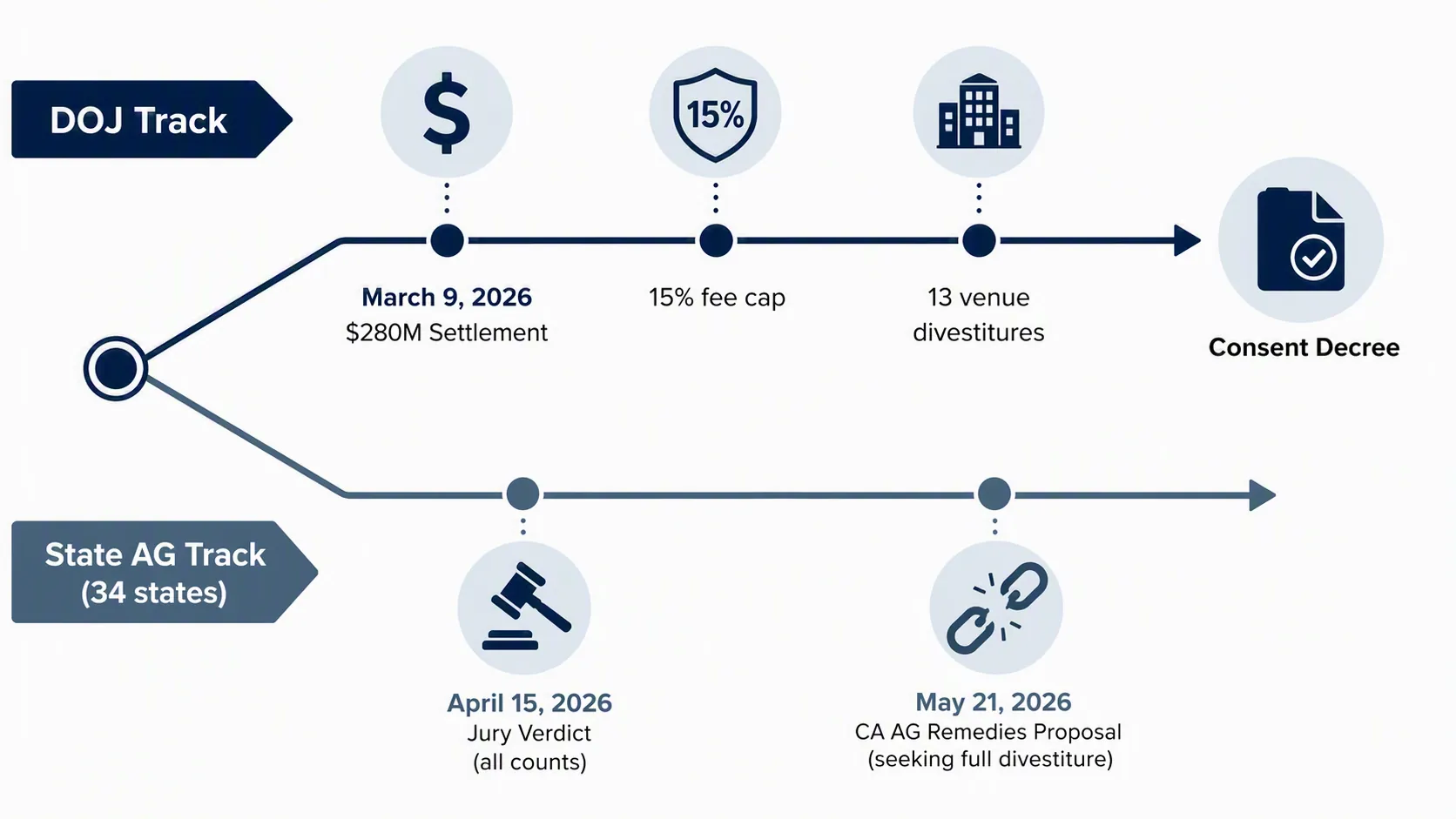
The Settlement Was Federal; The Remaining Risk Was Not
Calling the March deal a “global” resolution would obscure the thing that mattered most. It was a DOJ settlement joined by six states, not a settlement with the 34-state coalition that kept litigating. The difference is not housekeeping. It is the difference between behavioral relief and money on one track, and a jury verdict followed by a breakup request on another.
The states that declined to join the federal compromise did not merely preserve leverage in the abstract. On April 15, 2026, they obtained a jury verdict finding Live Nation liable on all counts, including monopolization of primary ticketing, monopolization of large amphitheaters, and illegal tying of amphitheater access to promotion services.[4] The verdict form mattered because of its specificity: the jury answered 33 questions unanimously on an 11-page form.[4]
That posture changed the remedies discussion. Before the verdict, the state case could be described as unresolved exposure. After the verdict, the same state coalition could point to jury findings, market evidence, and tying liability as support for structural relief. The federal government had made its compromise; the state enforcers had made a record.
| Date | Track | What Happened | Why It Matters |
|---|---|---|---|
| March 9, 2026 | DOJ and six states | $280 million settlement, 15% fee cap, 13 venue divestitures | Resolved the federal settlement track without requiring a Ticketmaster breakup |
| March 2026 | 34-state coalition | California-led states continued litigating | Preserved independent state claims and remedies |
| April 15, 2026 | State trial | Jury found Live Nation liable on all counts | Converted state leverage from pending allegations into verdict-backed exposure |
| May 21, 2026 | California-led remedies phase | California AG sought divestiture of Ticketmaster and Live Nation-owned amphitheaters | Put structural breakup relief squarely before the court |
The Verdict Gave The States A Different Kind Of Leverage
The April verdict did not rest on general dissatisfaction with ticket fees. The trial evidence described Ticketmaster as controlling about 86% of major concert venue primary ticketing and Live Nation as controlling about 78% of large amphitheaters.[4] The jury also found an illegal tying arrangement involving amphitheater access and promotion services.[4] Those findings are why the remedies fight cannot be reduced to a consumer-fee dispute.
Consumer overcharge evidence still belongs in the analysis, but in the right place. The jury found a $1.72 per-ticket overcharge, while Live Nation estimated single damages below $150 million, which would be trebled under the Clayton Act to about $450 million.[5] Those figures are litigation-position figures, not a court-verified final damages number; the same reporting notes that expert testimony remained contested through post-trial motion practice.[5]
For settlement valuation, that distinction matters. A damages estimate can be modeled. A structural remedy can change the business that produces the damages. Once the states had a unanimous verdict on liability and market power, their remedies demand was no longer simply a negotiating threat carried over from the complaint.
The internal communications introduced at trial added pressure, but they should not be mistaken for the legal engine of the case. Reports described employees referring to a “velvet hammer” against competitors and “robbing them blind, baby” in connection with consumers.[6] Those phrases are damaging trial texture. The operative risk comes from the market definition, the market shares, the tying finding, and the verdict form.
California’s May Remedies Demand Went Past The DOJ Deal
On May 21, 2026, Attorney General Bonta asked the court to order full divestiture of Ticketmaster from Live Nation and divestiture of Live Nation-owned amphitheaters.[7] That request is the point at which the state case most clearly separated itself from the federal settlement. The DOJ deal imposed money, a fee cap, and venue divestitures; the California-led proposal asked the court to unwind the vertical structure at the center of the case.[1][2][7]
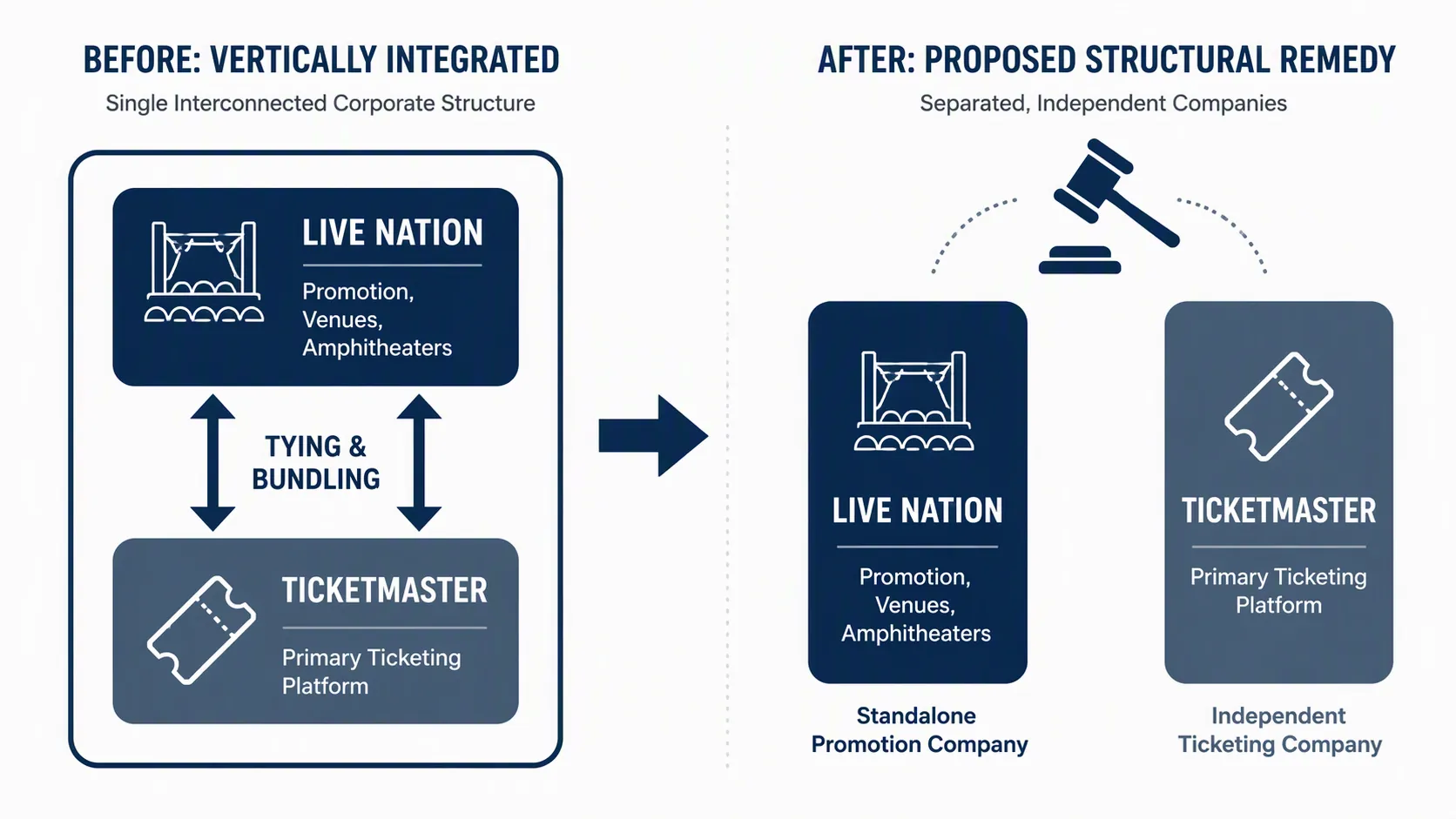
That does not mean the breakup will happen. Remedies remain for the court, not the press release. But the demand itself is legally significant because it shows how a state coalition can use an independent trial victory to seek relief beyond the federal consent decree. The March settlement did not set the ceiling; it became the comparison point.
The difference between behavioral and structural relief is practical, not academic. A fee cap tells a defendant how to price within a covered category. Venue divestitures remove specified assets. A forced separation of Ticketmaster from Live Nation would address ownership and incentives across ticketing, promotion, and venue operations. For a vertically integrated company, that is a different order of consequence.
Bonta’s remedies position also fits the broader state-enforcement message delivered after the verdict. The California DOJ framed the continuing case as a state-led effort after the federal settlement, not as a supplement to it.[3][7] That framing matters because it rejects the premise that federal settlement architecture should define the outer boundary of antitrust relief.
The Calendar Still Matters
As of July 29, 2026, the case remained active on several procedural fronts. Post-trial Rule 50 and Rule 59 motion briefing ran from May through July 2026, the Tunney Act decision on the federal settlement was expected around mid-September or October 2026, and a remedies bench trial was likely in the February-to-spring 2027 window, with appeals potentially extending into 2028 or beyond.[8] Those are scheduling markers from the May 2026 conference reporting, not fixed outcomes.[8]
The Tunney Act process is particularly awkward in this sequence because the federal settlement arrived before the state verdict, while judicial review of the federal consent decree continued after it. Courthouse News reported that Judge Arun Subramanian criticized the delayed settlement announcement as “absolute disrespect for the court.”[8] That comment does not decide the merits of the settlement, but it underscores the procedural discomfort created when parallel sovereign tracks move at different speeds.
For counsel, the live calendar limits how far the case can be used. It is not yet a completed breakup precedent. It is already a completed warning about sequencing. The defendant settled with the federal government in March; the state coalition obtained a liability verdict in April; California sought structural relief in May; and by Q3 2026, the company still faced unresolved post-trial, remedies, consent-decree, and appellate risk.
Political Pressure Was Real, But It Was Not A Substitute For The Verdict
The case also attracted congressional scrutiny after the settlement and verdict. At a May 2026 Senate hearing, Senators Amy Klobuchar, Elizabeth Warren, and Richard Blumenthal criticized the settlement; former DOJ official Roger Alford testified that the DOJ had “abused its prosecutorial discretion,” and Bonta testified that “behavioral remedies have proven inadequate.”[9]
That hearing is worth noting because it shows the settlement did not quiet the political environment. But the court-facing posture still turns on litigation record and remedy authority. Public anger over concert ticketing can explain why the case had oxygen; it cannot replace the jury’s answers on monopolization, tying, and market power.
This Is Not A One-Off Theory Of State Divergence
The Live Nation/Ticketmaster sequence is unusually visible, but the federal-state divergence problem is not unique to concert ticketing. Crowell & Moring pointed to the Nexstar/Tegna matter, where eight states sued after DOJ and FCC clearance of the merger.[5] The comparison should be kept modest: different facts, different posture, different markets. Its usefulness is narrower and more important than analogy for analogy’s sake. It shows that state enforcers may continue to litigate after federal actors have declined to block, settled, or otherwise cleared a transaction or practice.
The operational consequence is that multi-jurisdictional settlement analysis cannot stop at the federal term sheet. Counsel need a sovereign-by-sovereign map: which states joined, which states refused, which claims remain live, which remedies remain available, and whether any state plaintiff is positioned to build its own trial record. The Live Nation/Ticketmaster docket is a reminder that “government settlement” is too imprecise a category when the sovereigns are not aligned.
The Due-Diligence Question After Live Nation/Ticketmaster
The March DOJ settlement bought something real. It narrowed federal exposure, established payment and conduct obligations, and brought six states into the compromise. It did not buy peace from the California-led coalition.
By Q3 2026, the Live Nation/Ticketmaster matter shows that the practical exposure for vertically integrated companies is not only higher damages. It is a parallel sovereign track capable of rejecting a federal compromise, reaching a unanimous jury verdict, preserving independent remedies, and asking for structural relief after the DOJ has chosen a narrower deal.
The better diligence question is therefore not simply, “What did the federal enforcer accept?” It is, “Which state attorneys general declined to be bound by that compromise, and what remedies are they still positioned to pursue?”
References
- Live Nation, Ticketmaster settle DOJ antitrust case, NPR, March 9, 2026
- Live Nation-Ticketmaster DOJ lawsuit settlement details, Los Angeles Times, March 9, 2026
- Attorney General Bonta and State Attorneys General Carry Fight Against Live Nation-Ticketmaster, California Department of Justice
- Live Nation/Ticketmaster Antitrust Verdict: Key Takeaways From the States’ Jury Trial Win, Paul Weiss
- After the Verdict: Navigating the Live Nation/Ticketmaster Antitrust Fallout, Crowell & Moring
- States Win Antitrust Case Against Live Nation: Lessons From a Landmark Antitrust Case, Duane Morris Antitrust Law Blog, April 15, 2026
- Attorney General Bonta Asks Court to Break Up Live Nation/Ticketmaster, California Department of Justice, May 21, 2026
- Penalties phase of Live Nation ticket monopoly trial will stretch into 2027, Courthouse News Service
- Lawmakers, Witnesses Dissect ‘Corrupt’ Live Nation Settlement, Press for Breakup After Ticketmaster Verdict, TicketNews, May 2026
Related records
Tool profile
Browse tool evaluations →Governing regulation
Browse the obligations tracker →Preventive workflow
Browse verification workflows →
Report a correction or tip
Spotted an outdated figure, a misstated fact, or a ruling this case record should reflect? Public comments are disabled for this content given the professional cost of a misreported case outcome, penalty amount, or rule text — use the structured correction channel instead.
Report a correction or tip for this record →