
Canada's Coercive Control Offence Becomes Law With Two-Year Delay
Bill C-16 creates a new Criminal Code offence for coercive control in intimate relationships with a hybrid penalty of up to 10 years, but enforcement is suspended for up to two years pending police and judicial training. This entry breaks down the offence elements, identifies what is already in force, and maps the transition risks for Canadian criminal and family law practitioners.
- Jurisdiction
- Canada
- Court
- Parliament of Canada
- AI tool named
- Bill C-16
- Ruling date
- Jun 18, 2026
- Source document
- View primary court order ↗
- Last verified
- Jul 31, 2026
Lex Machina Review is an independent risk-tracking and reference resource. Nothing on this site is legal advice, and using it does not create an attorney-client relationship. Every record is reviewed against primary sources but may not reflect the most current status of a matter — always verify directly against the cited court order, rule text, or a licensed attorney before relying on it.
Companion explanation — secondary to the source document above
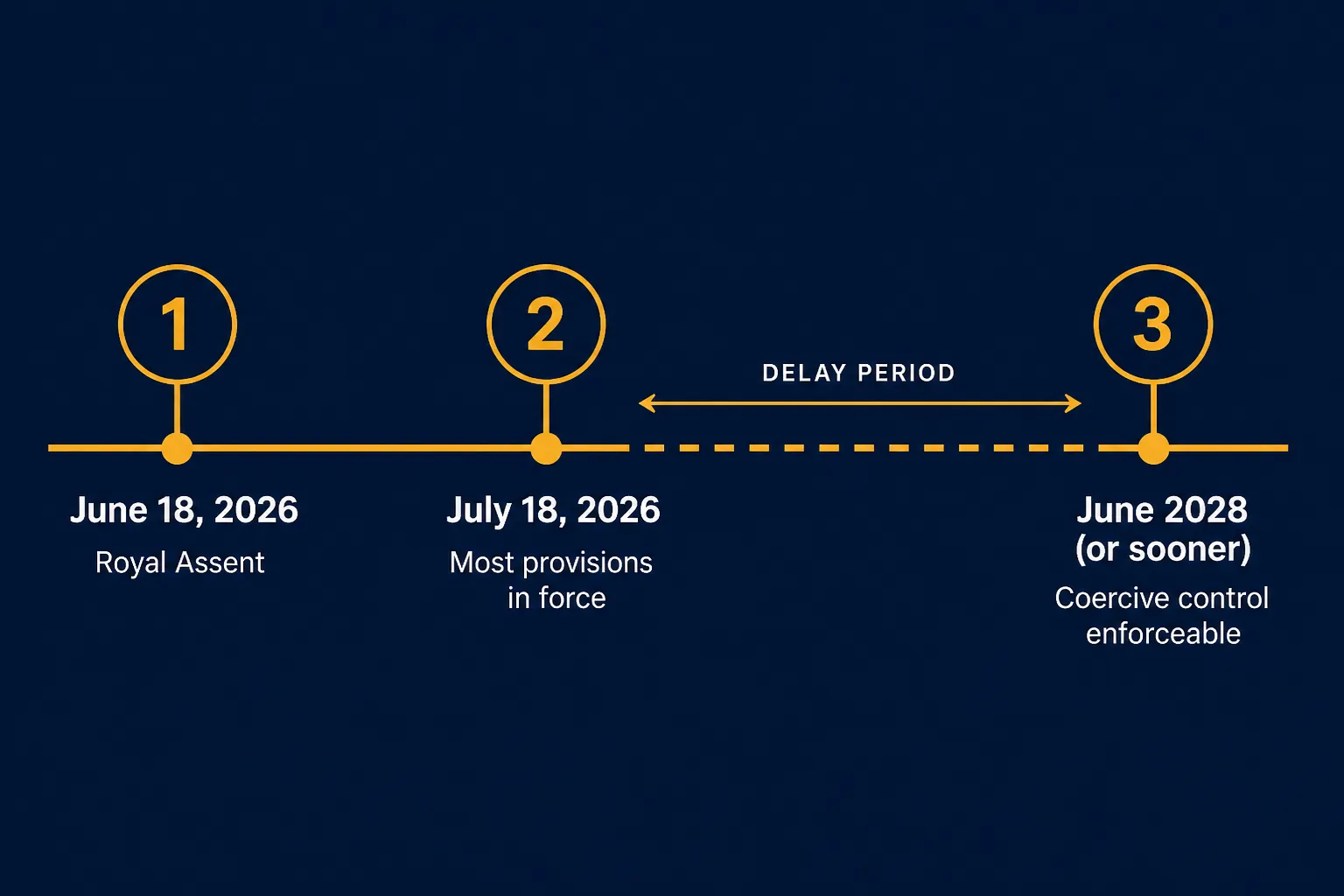
Canada now has a Criminal Code coercive control offence for intimate relationships. It just cannot yet be charged. That distinction is the first risk point in any Q3 2026 briefing: Bill C-16 received Royal Assent on June 18, 2026, and most of its reforms came into force on July 18, 2026, but the new coercive control offence is delayed under the statute for up to two years while justice-system actors prepare for implementation.[1]
The outside date is no later than June 2028 unless the federal government brings the provision into force sooner.[2] Until that happens, s. 264.01 sits in an awkward but very practical category: enacted law, pending enforcement, already available as vocabulary.
That vocabulary will not wait politely for a proclamation date. Police notes, bail plans, peace bond negotiations, prosecutorial screening memos, defence advice, parenting affidavits, and internal firm precedents will begin absorbing the new language before anyone can lay a standalone coercive control charge. The danger is not only that someone will overstate the law. It is that someone else will understate the legal significance of conduct now described in statutory terms.
The Status Check: Live Reforms, Pending Offence
Justice Canada’s July 18 release draws the operative line. As of that date, reforms already in force include changes addressing femicide as first-degree murder, amendments to criminal harassment, new offences dealing with intimate images and deepfakes, and victim-rights measures.[1] Those are not waiting for the coercive control rollout.
| Bill C-16 Item | Q3 2026 Status | Practical Consequence |
|---|---|---|
| Coercive control offence, Criminal Code s. 264.01 | Enacted but not yet enforceable; in force no later than June 2028 unless brought in sooner | Cannot be charged yet, but the statutory language can shape advice, screening, risk assessments, and family-law evidence |
| Femicide-related murder reform | In force July 18, 2026 | Must be treated as live criminal law in applicable homicide analysis |
| Criminal harassment amendments | In force July 18, 2026 | Relevant immediately to harassment charging and defence review |
| Deepfake and intimate-image offences | In force July 18, 2026 | Relevant immediately to digital abuse and image-based harm files |
| Victim-rights changes | In force July 18, 2026 | Relevant immediately to process obligations and victim participation |
For practitioners, the point is not semantic. A client asking whether coercive control is “illegal now” is asking at least three questions at once: whether the statute exists, whether police can charge it today, and whether the conduct can matter in another proceeding. The answer is yes, no, and very likely.
What Section 264.01 Actually Requires
The new offence targets a pattern of conduct, not a single ugly argument or one isolated act. Justice Canada describes s. 264.01 as applying where a person engages in a pattern of conduct toward an intimate partner and intends, or is reckless as to whether, the conduct could cause the intimate partner to believe their physical or psychological safety is threatened.[2]
The offence is hybrid. If prosecuted by indictment, the maximum penalty is 10 years’ imprisonment.[2] That maximum matters even before first prosecutions begin because it signals Parliament’s view of seriousness, and that signal tends to travel into bail submissions, resolution posture, and collateral family-law rhetoric.
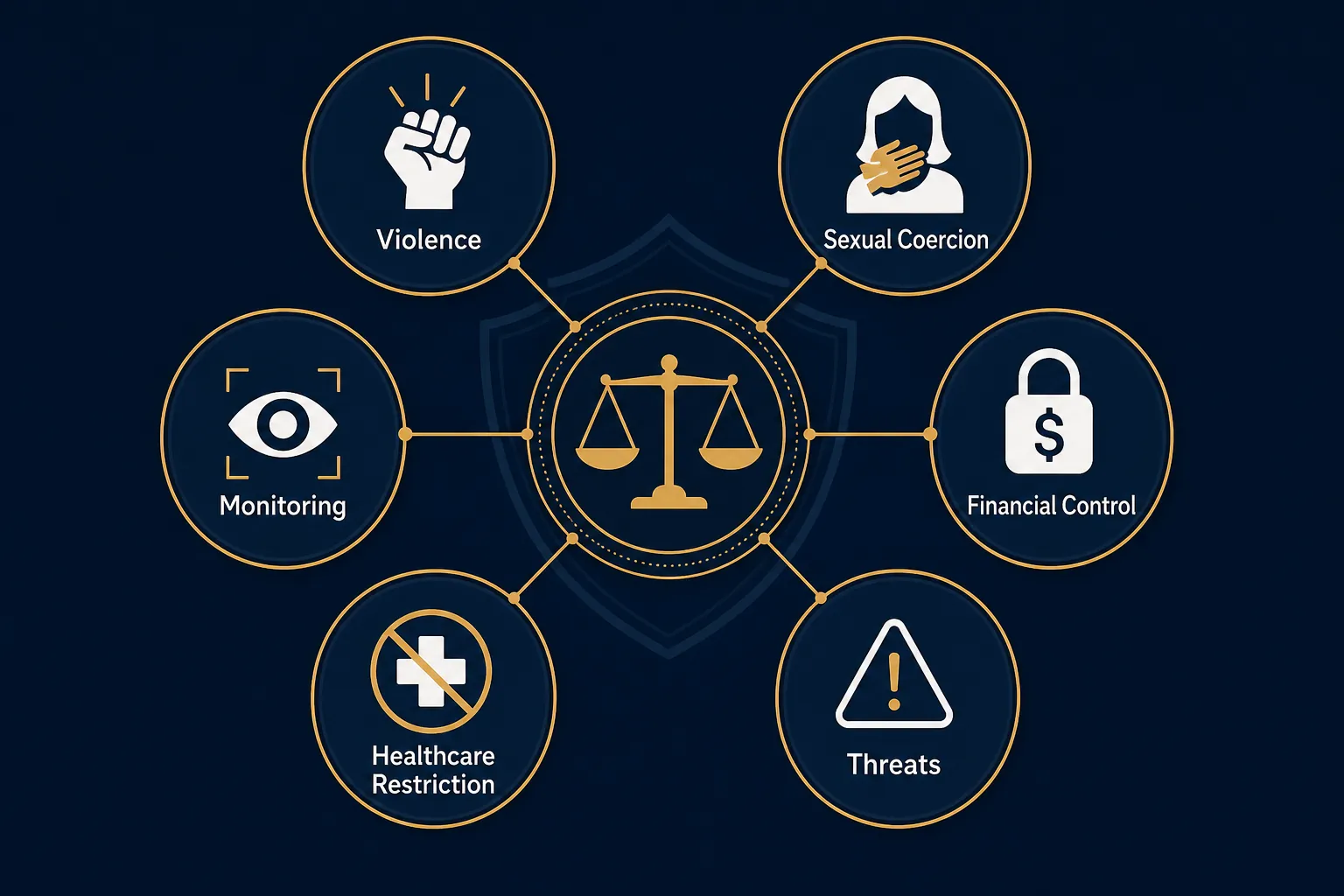
The statutory framework identifies six categories of conduct that can form part of the pattern:
- Using, attempting to use, or threatening to use violence against the intimate partner, their child, an animal, or another person known to the intimate partner.[2]
- Coercing or attempting to coerce sexual activity.[2]
- Controlling, attempting to control, or monitoring the intimate partner’s finances, economic resources, or ability to obtain or use them.[2]
- Controlling, attempting to control, or monitoring the intimate partner’s movements, communications, activities, social relationships, employment, education, or other ordinary activities.[2]
- Restricting, attempting to restrict, or monitoring access to health services, including reproductive health services, medication, assistive devices, or other supports.[2]
- Threatening to die by suicide or self-harm, or to cause harm to oneself, where that conduct forms part of the prohibited pattern.[2]
The list is important because it resists an old evidentiary habit: treating intimate partner abuse as legally serious only when it culminates in a discrete assault, threat, or property offence. Financial deprivation, monitoring, movement control, interference with health care, and sexual coercion can be legally intelligible as part of the same course of conduct.
It is equally important not to flatten the provision into a general offence for bad relationship behaviour. The Crown will have to prove a pattern, qualifying conduct, the required mental element, and the safety-related consequence set out in the provision. That architecture is why the implementation gap matters: the statutory words are not self-executing, and they are not self-limiting in practice.
The Pattern Requirement Solves One Problem and Creates Another
The federal Charter Statement presents the pattern requirement as a constraint on overbreadth. In the government’s analysis, the offence is directed at repeated conduct within an intimate relationship rather than isolated acts, and that pattern requirement helps confine the provision to coercive control rather than ordinary interpersonal conflict.[3]
That is the clean version. The courtroom version is messier. The Canadian Bar Association’s submission flags the absence of temporal limits on what counts as a pattern, insufficient guidance on frequency, concern that a recklessness standard could over-criminalize conduct, and the particular risk of criminalizing threats of suicide or self-harm where mental health is genuinely in issue.[4]
Those are not academic quibbles. “Pattern” becomes a disclosure issue when police compile old texts, bank restrictions, location tracking, custody exchanges, family court emails, and witness accounts across months or years. “Recklessness” becomes a live issue when the accused says they did not appreciate the safety impact of the conduct. Suicide or self-harm threats become especially difficult when the same evidence can look like coercion, crisis, manipulation, disability-related vulnerability, or some combination of all four.
The provision’s design assumes that training will help police, prosecutors, and judges distinguish coercive patterns from non-criminal relationship conflict. The delay assumes that distinction cannot safely be left to instinct.
Why “Not Yet Enforceable” Still Changes the File
Until s. 264.01 is proclaimed in force, a person should not be arrested, charged, or convicted under that section. But the conduct described in s. 264.01 can still matter through existing legal channels. This is where the transition period creates avoidable professional risk.
Bail and Release Planning
In a bail hearing on an existing charge, coercive control language can influence how risk is framed. A fact pattern involving monitoring, financial restriction, interference with health care, or threats tied to separation may be argued as relevant to public safety, complainant protection, no-contact terms, residence conditions, device access, or third-party supervision. The pending offence does not create a charge, but it may sharpen the vocabulary used to describe risk.
Peace Bonds and Preventive Orders
Peace bond negotiations are also likely to absorb the new framework. Counsel may see proposed terms dealing with geolocation, financial access, third-party contact, shared accounts, pets, workplace attendance, health appointments, and digital communications. The statutory categories give parties a vocabulary for risk, but they do not eliminate the need to connect each requested condition to evidence and proportionality.
Police Screening and Crown Review
During the delay, police services and Crown offices will be building templates, training materials, intake questions, and triage practices. That work will affect current files even if the new count is unavailable. A complainant’s statement may be taken with more attention to money, monitoring, sexual coercion, and health care. A Crown may screen an existing assault, harassment, mischief, threat, or breach file with the pending offence in mind.
Defence Advice
Defence counsel need two tracks in the same client conversation. First, the client cannot be charged today under s. 264.01 if the provision has not been proclaimed. Second, conduct after Royal Assent may still be documented, relied on in existing proceedings, or become relevant once the offence is in force depending on the facts and any transitional law questions that arise. A reassurance that stops at “not in force” is too thin.
Law-Firm Knowledge Management
The partner-facing briefing note should not say simply that coercive control is now a Canadian criminal offence. It should separate Royal Assent, general commencement, the delayed in-force date for s. 264.01, the maximum implementation window, and the provisions already live. Intake forms and precedent letters should do the same. A single wrong sentence in a client memo can turn a commencement issue into a credibility issue.
The Family-Law Crossover Is Already Here
Family law does not have to wait for s. 264.01. The Divorce Act already treats coercive and controlling behaviour as part of family violence analysis, and family-law commentary on Bill C-16 has warned that a criminal charge or acquittal can be used strategically in parenting disputes.[5] Even before any s. 264.01 charge is available, the new Criminal Code language may change how parties draft affidavits, frame settlement positions, and argue decision-making responsibility or parenting time.
That does not mean every parenting dispute with controlling allegations becomes a criminal-law file. It means counsel should expect vocabulary to migrate. A family affidavit that once described “controlling behaviour” in general terms may now mirror the statutory categories: monitoring communications, restricting money, interfering with employment, isolating a partner, controlling health care, or using self-harm threats to influence separation decisions.
The migration cuts both ways. Luke’s Place supports recognition of coercive control as a serious form of intimate partner violence, but its Bill C-16 analysis also raises concerns about weaponization, training adequacy, and differential impacts on marginalized women.[6] Those concerns are not solved by adding a Criminal Code section number. They are the facts that later become affidavit disputes, expert evidence, cross-examination, and appeals.
A lawyer representing a survivor may find that the new offence helps name a pattern that older incident-based pleadings obscured. A lawyer representing the other party may need to test whether the allegation is particularized, whether the described conduct fits the statutory categories, whether it is being used to repackage ordinary parenting conflict, and whether criminal-law terminology is being deployed for bargaining leverage. Both tasks require more precision than “coercive control” as a label.
Implementation Risk Is Not a Footnote
The two-year delay is itself an acknowledgment that coercive control is hard to operationalize. If the offence were only a symbolic recognition provision, training would be less urgent. But police will have to identify patterns without turning every relationship history into a criminal file. Prosecutors will have to decide when the evidence supports a reasonable prospect of conviction. Judges will have to manage trials where the alleged conduct may be cumulative, contextual, digital, financial, sexual, and psychological.
Professor Janet Mosher’s submission against a Criminal Code coercive control offence presses hardest on that implementation problem. Her public summary cites UK data indicating that six of seven coercive control cases were discontinued and that the conviction rate was 5%, and warns that the proposed Canadian law “would do little to protect women and children.”[7] Those figures should be handled cautiously because the underlying study details were not independently verified in the materials reviewed here, but the warning is still relevant to Canadian risk analysis: enactment does not prove prosecutorial durability.
Healthy Debate also reports a 5% UK conviction rate and captures the evidentiary problem in a survivor’s quoted line: “I wish he would have just hit me.”[8] The sentence is blunt because the proof problem is blunt. The conduct that defines coercive control is often cumulative and privately documented, while criminal procedure still demands particulars, admissible evidence, fair notice, and proof beyond a reasonable doubt.
Policy Options frames criminalization as “necessary but not enough,” a useful caution during the delayed rollout.[9] Training can improve recognition, but criminal law alone cannot provide housing, income security, immigration stability, mental-health care, child-care support, or safe separation planning. Files will keep arriving with those gaps folded into the legal record.
The Ambiguities to Track Before June 2028
The highest-value monitoring between now and proclamation is not broad reform commentary. It is the small print that will determine how the offence is charged, defended, and pleaded around.
- Commencement: the two-year delay is a maximum, not a fixed launch date; the offence may come into force before June 2028.[2]
- Pattern: guidance is still needed on how far back the Crown may reach and what frequency of conduct will be treated as sufficient.[4]
- Mens rea: intent and recklessness will create different evidentiary fights, especially where the accused disputes awareness of the complainant’s perceived safety threat.[2][4]
- Self-harm threats: mental-health evidence may complicate the line between coercive conduct and crisis-related behaviour.[2][4]
- Family-law use: criminal-law language may affect parenting litigation even before any s. 264.01 prosecution is available.[5][6]
- Review timeline: the Charter Statement identifies a statutory review provision tied to June 2031, meaning early implementation issues may persist for years before formal parliamentary review.[3]
Advocacy submissions from the CBA, Luke’s Place, and Professor Mosher are not binding on courts. They are still useful because they identify the pressure points most likely to become litigation points: overbreadth, proof of pattern, uneven training, weaponization, marginalized complainants and accused persons, evidentiary attrition, and the practical limits of criminalization.
For Q3 2026, the risk posture is narrow and concrete. Femicide-related reforms, criminal harassment amendments, deepfake offences, and victim-rights changes are already in force. Section 264.01 is enacted but not yet enforceable. Its definitions can still influence bail, peace bonds, police screening, Crown review, defence advice, family pleadings, and internal knowledge systems. Until the in-force date is announced and training is complete, counsel should treat Bill C-16 as a live definitional framework, a pending charging risk, and a source of contested interpretation rather than an immediately prosecutable offence.
References
- Major Criminal Code reforms to protect Canadians are now law, Justice Canada, July 18, 2026.
- Bill C-16: An Act to amend the Criminal Code and the Canada Evidence Act, Justice Canada.
- Charter Statement - Bill C-16: An Act to amend the Criminal Code and the Canada Evidence Act, Justice Canada.
- Bill C-16, Protecting Victims Act, Canadian Bar Association.
- Bill C-16 and the Criminalization of Coercive Control: What the Proposed Criminal Code Offence Means for Family Law, Cozen O’Connor.
- Understanding Bill C-16 and what it means for survivors of intimate partner violence (IPV), Luke’s Place.
- Professor Janet Mosher recommends against Criminal Code provision on coercive control in Justice Canada submission, Osgoode Hall Law School.
- Criminalizing coercive control in domestic abuse, Healthy Debate, February 2025.
- Coercive control law, Policy Options, March 2026.
Related records
Tool profile
Browse tool evaluations →Governing regulation
Browse the obligations tracker →Preventive workflow
Browse verification workflows →
Report a correction or tip
Spotted an outdated figure, a misstated fact, or a ruling this case record should reflect? Public comments are disabled for this content given the professional cost of a misreported case outcome, penalty amount, or rule text — use the structured correction channel instead.
Report a correction or tip for this record →