
Georgia Teen's Capitol Grounds Plea: A § 1752 Benchmark
This entry documents the Carter Camacho guilty plea under 18 U.S.C. § 1752(b)(1) for possessing a loaded firearm on Capitol grounds, and explains what the 8-year recommended sentence, the USCP threat data, and the prosecution strategy mean for legal practitioners tracking federal weapons enforcement.
- Jurisdiction
- US Federal
- Court
- U.S. District Court for the District of Columbia
- Judge
- Amit Mehta
- AI tool named
- None
- Ruling date
- Jul 27, 2026
- Source document
- View primary court order ↗
- Last verified
- Jul 30, 2026
Lex Machina Review is an independent risk-tracking and reference resource. Nothing on this site is legal advice, and using it does not create an attorney-client relationship. Every record is reviewed against primary sources but may not reflect the most current status of a matter — always verify directly against the cited court order, rule text, or a licensed attorney before relying on it.
Companion explanation — secondary to the source document above
The Capitol grounds weapons-possession plea by Georgia teenager Carter Camacho is already a sentencing benchmark, even though sentencing has not happened yet. Carter Camacho, 18, pleaded guilty on July 27, 2026, to two federal felonies: unlawful firearm possession on Capitol grounds under 18 U.S.C. § 1752 and receipt/distribution of child pornography. Sentencing is set for Dec. 8, 2026, before U.S. District Judge Amit Mehta, and the firearm count carries a statutory maximum of 10 years. The government is reportedly recommending eight years, described in the Yahoo/WUSA9 reporting as the bottom of the guideline range; that recommendation does not bind the judge. [1][2]
That is the useful starting point for practitioners. The reported exposure did not turn on a fired shot, an assault, or a completed breach of the Capitol building. It turned on the charged presence of a loaded firearm in a restricted area, with aggravating facts gathered around that presence.
| Record point | What is known from the current record |
|---|---|
| Defendant | Carter Camacho, 18, from Georgia. [1] |
| Plea date | July 27, 2026. [1] |
| Firearm count | Unlawful firearm possession on Capitol grounds, charged under § 1752(a)(1) with the § 1752(b)(1) dangerous-weapon/firearm enhancement. [1][3] |
| Maximum exposure on § 1752(b)(1) | 10 years. [3] |
| Other felony plea | Receipt/distribution of child pornography, with aggravating details reported by Yahoo/WUSA9 and not independently verified here from a court order. [2] |
| Sentencing | Dec. 8, 2026, before Judge Amit Mehta. [1] |
| Reported recommendation | Eight years, described as the bottom of the guideline range; the court is not bound by it. [2] |
The statutory lever: § 1752(b)(1), not completed violence
Section 1752 is the charging mechanism that gives this plea its force. A basic restricted-building-or-grounds violation under § 1752(a) is generally punishable by up to one year. The enhancement in § 1752(b)(1) changes the case when the defendant uses or carries a deadly or dangerous weapon or firearm during the offense, raising the maximum to 10 years. [3]
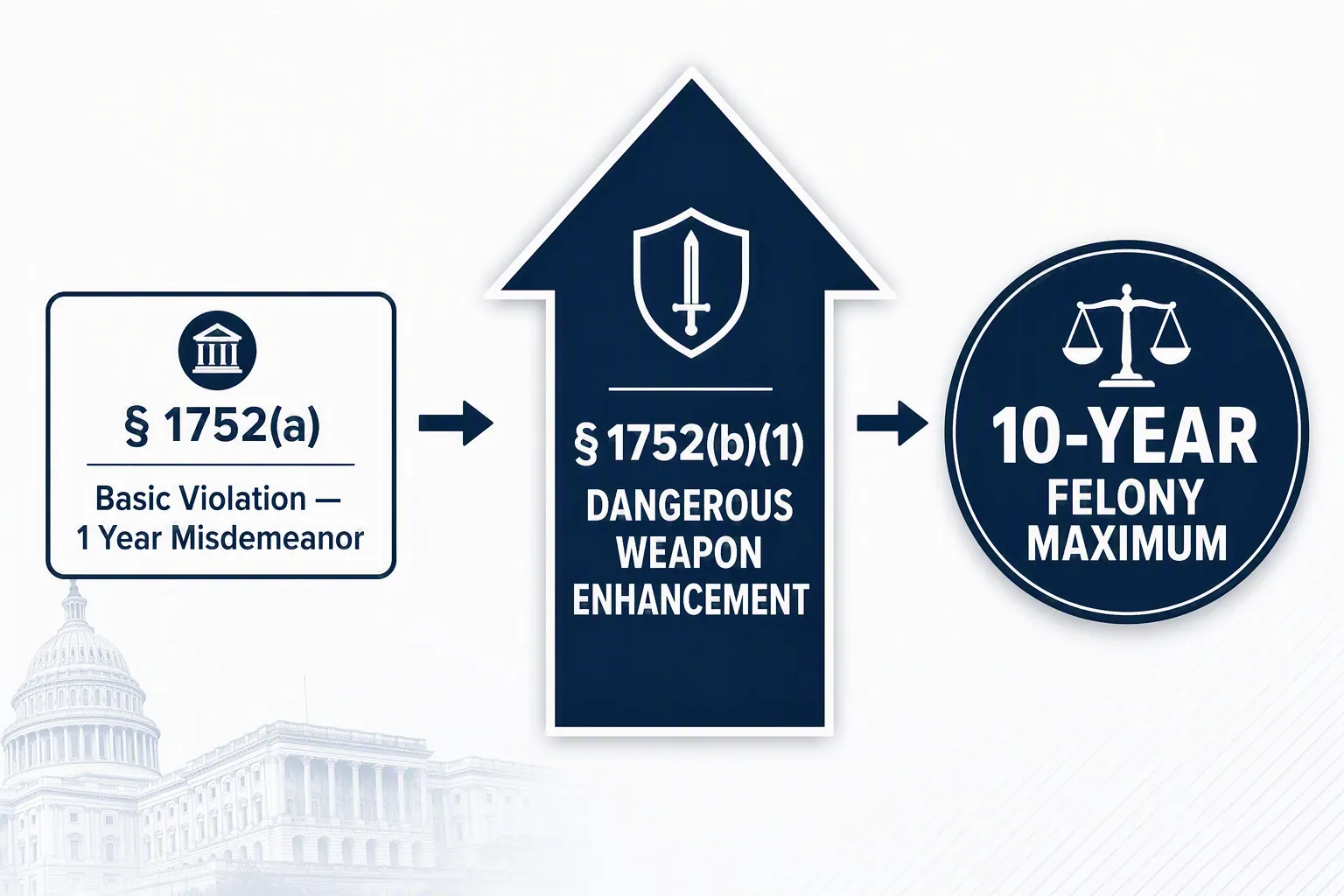
That distinction matters because it explains why the absence of injury does not collapse the case into a minor trespass or a weapons-policy infraction. The government did not need to prove that Camacho entered the Capitol, fired the Mossberg, pointed it at a specific member, or forced a door. For § 1752(b)(1), the firearm’s presence in the restricted area is the legal multiplier.
There is also a statutory comparison worth keeping straight. The separate Capitol Grounds and Buildings provision, 40 U.S.C. § 5104(e)(1), includes firearm-related restrictions with a five-year cap for firearms conduct. CRS has described § 1752’s dangerous-weapon enhancement as a separate route that can produce the 10-year exposure practitioners now see in Camacho’s plea. [4]
From the Lower West Terrace to a 10-year felony
The reported facts of Feb. 17, 2026 are not complicated, but they are physically serious. Camacho allegedly drove from Georgia to Washington, D.C., parked a white Mercedes on the Capitol’s Lower West Terrace, and exited with a loaded Mossberg Model 88 shotgun. WJLA, citing court documents, reported that the shotgun’s safety was off, and that Camacho was wearing body armor and camouflage. [5]
The U.S. Capitol Police announced that day that officers arrested an armed man on Capitol grounds. [6] The later plea reporting added the details that make the charging posture easier to understand: a long drive from Georgia, the loaded shotgun, the safety-off condition, the protective gear, and the restricted location. No single fact had to carry the whole case. Together they gave prosecutors a clean path from presence to dangerous-weapon enhancement.
The reported statements matter as well. WJLA reported, again citing court documents, that Camacho told officers he wanted to “scare” members of Congress and had considered breaching a Capitol door. [5] Those statements do not have to be treated as proof of a completed plan to be useful to the government at plea and sentencing. They supply context for why officers on the scene had to treat the encounter as an active, immediate threat.
Why the eight-year recommendation is plausible without making it inevitable
The reported eight-year recommendation should be read as a negotiated sentencing position, not as the sentence itself. Yahoo/WUSA9 reported that the government is recommending eight years at the bottom of the guidelines. The same reporting notes that Camacho had no prior record, and that his mother claimed he has autism; that mitigation claim is reported and unverified, not an established clinical finding in the materials available here. [2]
The aggravation is more concrete. A loaded shotgun with the safety off is not the same sentencing fact as an unloaded firearm locked in a trunk. Body armor and camouflage are not the same facts as ordinary street clothes. A reported statement about wanting to scare members of Congress is not the same as confused wandering. A reported consideration of breaching a Capitol door moves the case closer to perimeter security and member-protection concerns. Those facts are the kind prosecutors aggregate when arguing that armed presence created a higher risk than the bare statutory elements require.
The child-pornography plea also affects the posture, but it should not be used loosely. Yahoo/WUSA9 reported plea details involving more than 600 images and victims under 12. Those details are relevant to why the global sentencing recommendation could rise, but they come from that reporting and have not been independently verified here from a guidelines worksheet or sentencing memorandum. [2]
For defense counsel, the caution is straightforward: the absence of shots fired is not the same as low exposure once § 1752(b)(1) is in play. For prosecutors, the plea shows how surrounding facts can support an eight-year recommendation while still leaving the court room to evaluate age, lack of record, mental-health mitigation if properly substantiated, and the actual guideline calculation.
The Capitol threat environment makes the plea a signal
The Camacho plea lands in a threat environment that Capitol Police have described in sharply escalating terms. USCP said its Threat Assessment Section investigated 14,938 cases in 2025, up from 9,474 in 2024. The recent line is uneven but unmistakably elevated: 8,613 in 2020, 9,625 in 2021, 7,501 in 2022, 8,008 in 2023, 9,474 in 2024, and 14,938 in 2025. [7]
That is threat-assessment data, not charging data. It should not be misread as a count of prosecutions or weapons arrests. Its relevance is institutional: officers and federal prosecutors are operating in an environment where threats against members and protected spaces are no longer treated as background noise. USCP also reported that formal law-enforcement partnership agreements for member protection grew from roughly 115 to more than 350 agencies in 2025. [7]
There is also an established prosecution baseline around weapons on Capitol grounds. CRS has reported that at least 180 January 6 defendants were charged with carrying or using a dangerous weapon on Capitol grounds. [4] Camacho is not a January 6 case, and the facts are not interchangeable. But the statutory and physical setting is familiar to DOJ: restricted Capitol space, officer response, dangerous weapons, and sentencing arguments built around risk before completed injury.
State capitol rules are patchier; the federal Capitol posture is not
The federal enforcement signal is easier to see when contrasted with state capitol rules. NCSL’s 2025 State Capitol Security Overview reported that 27 states prohibit firearms in state capitols, while six do not. [8] That fragmented state landscape is not the operating model on the federal Capitol grounds described in Camacho’s case.
The practical benchmark is narrow but important. Camacho’s case is not final sentencing precedent; Judge Mehta has not imposed sentence, and the reported eight-year recommendation remains a recommendation. Still, the plea already shows DOJ’s position on armed presence at the Capitol: § 1752(b)(1) can carry the prosecution without proof of fired shots, injury, or building entry, and tactical preparation plus stated intent can move the case toward an eight-year sentencing ask.
References
- ABC News/AP wire report on Carter Camacho guilty plea, ABC News/AP, July 27, 2026.
- Yahoo News/WUSA9 report on Carter Camacho plea details, Yahoo News/WUSA9, July 27, 2026.
- 18 U.S. Code § 1752 - Restricted building or grounds, Cornell Legal Information Institute.
- Federal Criminal Law: January 6, 2021, Unrest at the Capitol, Congressional Research Service.
- WJLA/7News report on Carter Camacho court documents, WJLA/7News.
- USCP press release on Feb. 17, 2026 Capitol grounds arrest, United States Capitol Police, Feb. 17, 2026.
- USCP threat assessment press release, United States Capitol Police, Jan. 2026.
- State Capitol Security Overview, National Conference of State Legislatures, Sept. 2025.
Related records
Tool profile
Browse tool evaluations →Governing regulation
Browse the obligations tracker →Preventive workflow
Browse verification workflows →
Report a correction or tip
Spotted an outdated figure, a misstated fact, or a ruling this case record should reflect? Public comments are disabled for this content given the professional cost of a misreported case outcome, penalty amount, or rule text — use the structured correction channel instead.
Report a correction or tip for this record →