
Which Cetirizine Batch Numbers Carry Legal Liability
The FDA recall of cetirizine hydrochloride tablets over ranitidine cross-contamination affects four specific lots (GY825029–GY825032, NDC 16571-401-10). This record lists the batch numbers and analyzes the legal exposure under strict liability, failure-to-warn, and post-recall negligence theories, noting that no adverse events have been reported as of July 2026.
- Jurisdiction
- US-Federal
- Court
- U.S. Food and Drug Administration
- AI tool named
- Cetirizine Hydrochloride Tablets
- Ruling date
- Jul 20, 2026
- Source document
- View primary court order ↗
- Last verified
- Jul 25, 2026
Lex Machina Review is an independent risk-tracking and reference resource. Nothing on this site is legal advice, and using it does not create an attorney-client relationship. Every record is reviewed against primary sources but may not reflect the most current status of a matter — always verify directly against the cited court order, rule text, or a licensed attorney before relying on it.
Companion explanation — secondary to the source document above
Start With the Bottle, Not the Lawsuit
The cetirizine recall batch numbers that matter are GY825029, GY825030, GY825031, and GY825032. Each is tied to Cetirizine Hydrochloride Tablets USP 5 mg, NDC 16571-401-10, with an expiration date of 10/2028. Unique Pharmaceutical Laboratories, a division of J.B. Chemicals & Pharmaceuticals Ltd., issued the voluntary nationwide recall after potential cross-contamination with ranitidine was identified in the product lots.[1]
| Product | NDC | Lot number | Expiration | Recall issue |
|---|---|---|---|---|
| Cetirizine Hydrochloride Tablets USP 5 mg | 16571-401-10 | GY825029 | 10/2028 | Potential ranitidine cross-contamination |
| Cetirizine Hydrochloride Tablets USP 5 mg | 16571-401-10 | GY825030 | 10/2028 | Potential ranitidine cross-contamination |
| Cetirizine Hydrochloride Tablets USP 5 mg | 16571-401-10 | GY825031 | 10/2028 | Potential ranitidine cross-contamination |
| Cetirizine Hydrochloride Tablets USP 5 mg | 16571-401-10 | GY825032 | 10/2028 | Potential ranitidine cross-contamination |
That table is the legal intake screen. If a bottle does not match the NDC and one of the four lot numbers, this particular recall notice does not supply the factual bridge for a product-liability claim. If it does match, the analysis moves from ordinary OTC allergy medication use to a narrower question: what legal consequences follow from a potentially contaminated lot?
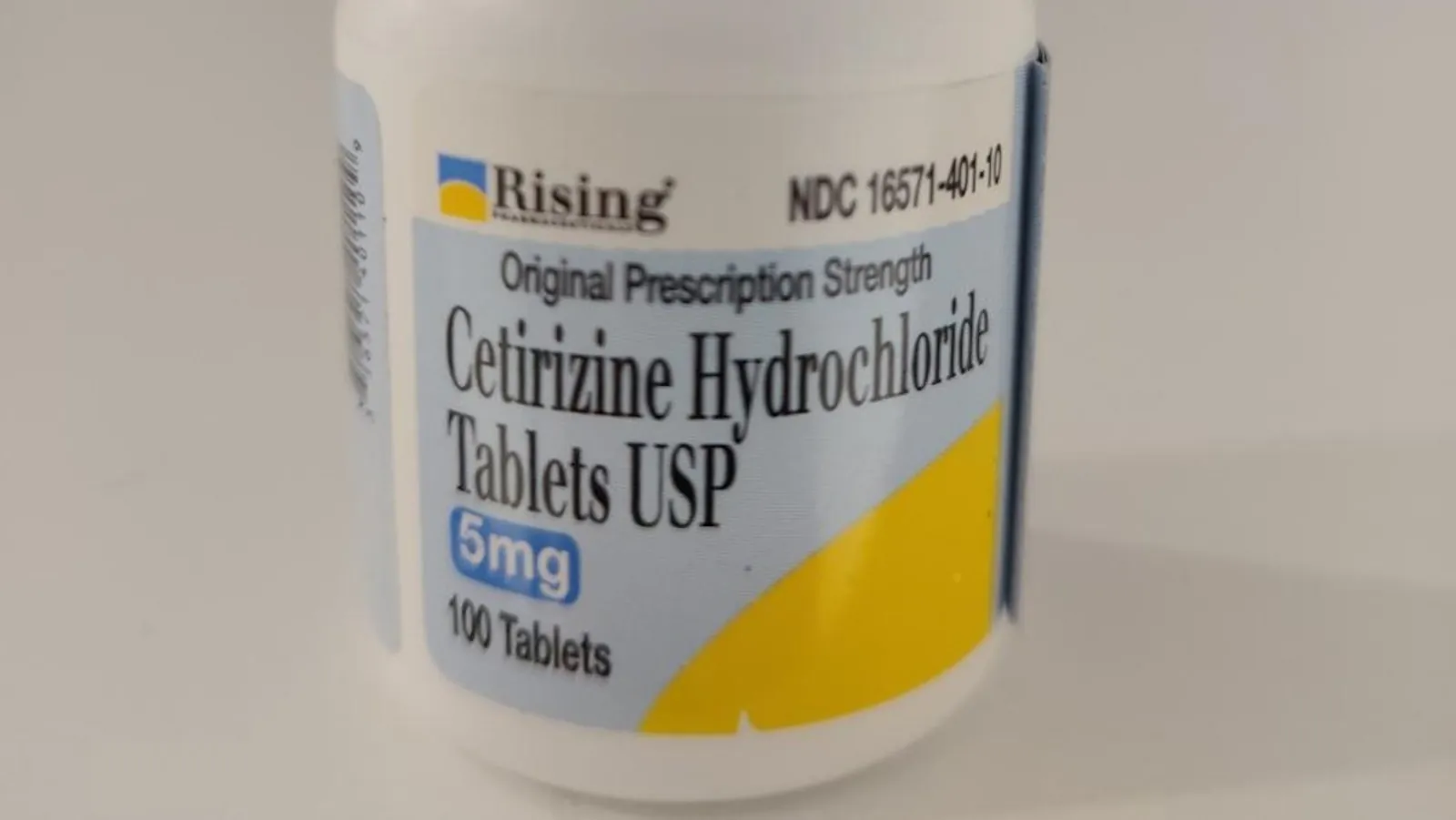
The defect signal was not a lab abstraction at the point of discovery. The FDA notice says the issue was detected after a pharmacy technician observed red-dot discoloration in tablets from the affected product. That observation matters because it shows the recall chain beginning with a visible product deviation, then moving into the manufacturer’s investigation and public notice.[1]
The known health risk is also narrower than the word “ranitidine” may suggest. The recall notice identifies a risk of anaphylaxis for individuals hypersensitive to ranitidine. It does not report a cancer-risk finding, and it does not say consumers were injured. As of the FDA publish date, no adverse events had been reported, and the FDA had not assigned a Class I, Class II, or Class III recall classification.[1]
Why These Four Lots Carry a Manufacturing-Defect Theory
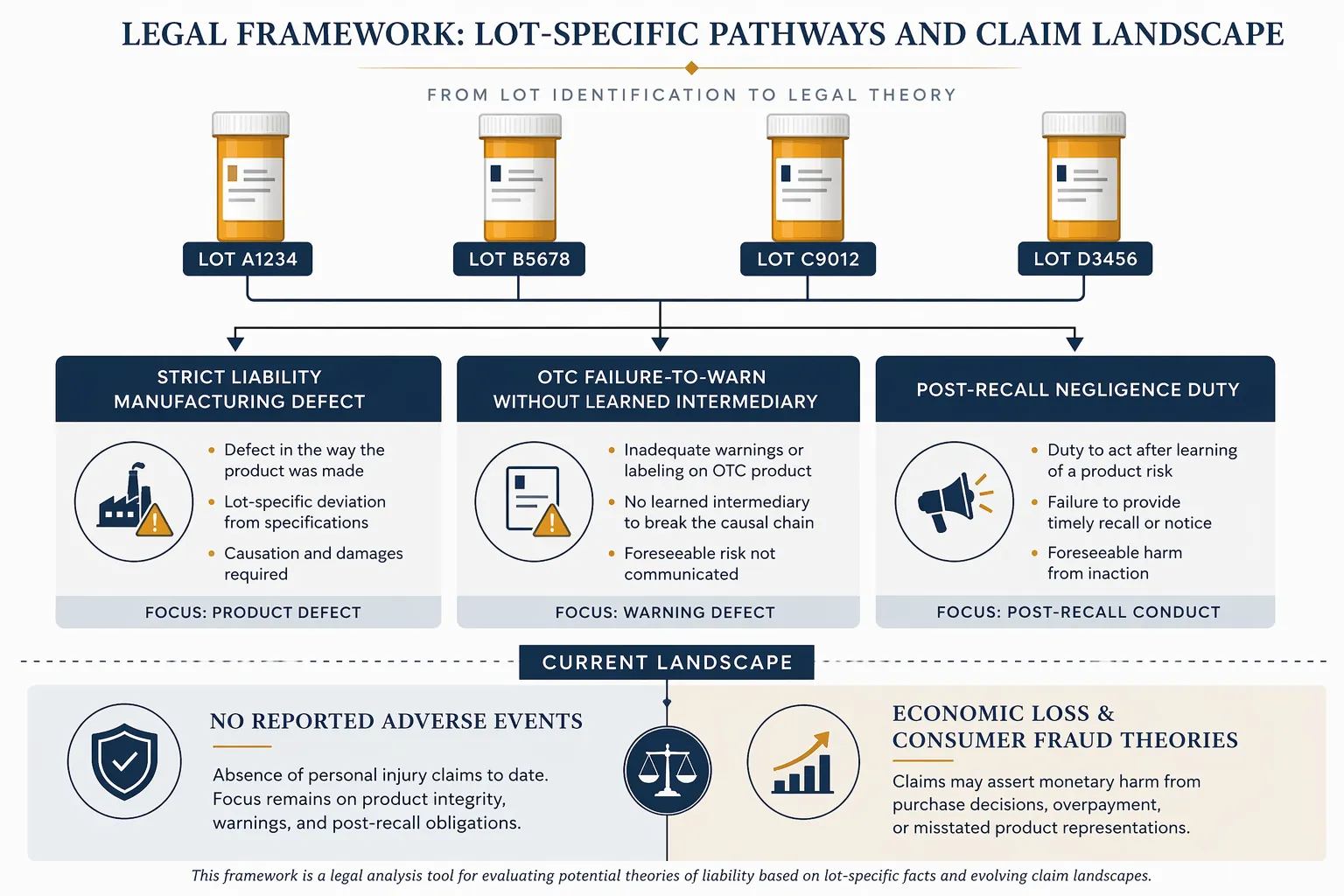
Cross-contamination is the cleanest liability theory in the record because it fits the basic manufacturing-defect frame: a product unit allegedly departed from the condition in which that medication was supposed to be sold. Cetirizine tablets are not supposed to contain ranitidine residue. If one of the recalled bottles did, the legal problem is not that cetirizine is inherently unsafe; it is that a specific production run may have produced tablets different from the intended product.
That distinction is doing real work. Under the strict-liability approach associated with Restatement (Second) of Torts §402A, a plaintiff does not have to prove that the manufacturer acted carelessly in order to plead that a defective product reached the consumer. The recalled batch number supplies the first necessary sorting fact. The missing fact, for a personal-injury case, would still be injury and causation: exposure to a recalled bottle, a medically recognized adverse reaction, and a plausible link between the contaminant and the harm.
A paralegal building an intake spreadsheet would not need to start with broad ranitidine litigation labels. The first columns would be more prosaic: NDC, lot number, expiration date, purchase location, remaining tablets, photographs of the label, whether any tablets show discoloration, whether the consumer used the product, whether the consumer has ranitidine hypersensitivity, and whether any medical care followed. Without those fields, the recall remains a search result, not a claim file.
The OTC Warning Problem Is Different From a Prescription-Drug Case
Cetirizine’s OTC status changes the warning analysis. In many prescription-drug cases, manufacturers argue that warnings run through the prescribing physician under the learned intermediary doctrine. That argument is less protective when the product is sold over the counter, because the consumer may choose and use the medication without a prescribing professional standing between the manufacturer and the user.
For these lots, the failure-to-warn theory would not be that ordinary cetirizine labels failed to warn about ordinary cetirizine risks. It would be that consumers could not evaluate a ranitidine cross-contamination risk from the product presentation available to them before the recall. A person buying OTC allergy tablets has no practical way to inspect for trace contamination or to know that a lot may expose ranitidine-hypersensitive users to anaphylaxis.
State law still matters. Some jurisdictions apply learned intermediary principles broadly; others treat OTC products differently or focus closely on the specific route by which the warning would have reached the consumer. The useful point for present risk assessment is more limited: OTC status makes a direct-to-consumer warning theory more plausible than it would be in a conventional prescription-drug case.
Recall Conduct Becomes Its Own File
A voluntary recall does not close the liability question. It opens a second operational file: whether the recall was conducted reasonably. Under the approach reflected in Restatement (Third) of Torts §11, recall conduct can matter when a manufacturer undertakes a recall and must carry it out with reasonable care.
For this cetirizine recall, the practical questions are ordinary but important. Did the notice identify the product clearly enough for pharmacies, retailers, and consumers to act? Were the lot numbers, NDC, expiration date, and defect reason stated in usable form? Were downstream sellers able to remove affected stock? Did consumers receive a realistic path to stop use, return product, or seek medical advice if they had relevant hypersensitivity?
Those questions should not be treated as proof of negligence. They are the subjects of a post-recall negligence inquiry. A well-executed recall can reduce exposure by getting product out of circulation and creating a record of reasonable action. A confused or slow recall can make a preventable post-notice exposure more legally significant.
Do Not Import the Zantac Cancer Theory
Ranitidine has its own litigation history, but this recall should not be folded into that history without care. GSK announced in October 2024 that it had reached settlement agreements resolving about 80,000 Zantac ranitidine state-court cases for up to $2.2 billion.[2] An April 2026 Delaware ruling also dismissed 80,000 cases against Boehringer Ingelheim. Those are boundary markers, not ready-made analogies.
The injury mechanism in this cetirizine recall is not NDMA-induced cancer. The FDA notice identifies potential ranitidine cross-contamination and a risk of anaphylaxis in individuals hypersensitive to ranitidine.[1] A complaint that borrows the vocabulary of Zantac cancer litigation without tying the claim back to these lots, this contaminant pathway, and this health risk would be vulnerable at the first serious review.
For a more adjacent treatment of ranitidine contamination theories, the better comparison is narrow product-risk analysis, not mass-tort scale. The earlier Risk Digest record on the cetirizine cross-contamination recall and the California-focused analysis of ranitidine-cetirizine legal risks are closer to the right frame than broad Zantac settlement reporting.
What Claims Look Viable Now
The current record supports a meaningful defect theory but a restrained damages assessment. A recalled-lot purchaser may have an economic-loss theory: the consumer bought OTC allergy medication that was allegedly not what it was represented to be because it may have been cross-contaminated. Depending on state law and the purchase facts, consumer-fraud theories may also be easier to plead than personal injury because they focus on sale, representation, product condition, and loss of benefit of the bargain.
Personal-injury claims require more. A bottle from lot GY825029, GY825030, GY825031, or GY825032 can establish that the consumer possessed product inside the recall perimeter. It does not establish that the consumer ingested contaminated tablets, suffered anaphylaxis, or can medically connect symptoms to ranitidine hypersensitivity. The FDA’s statement that no adverse events had been reported as of the publish date is therefore not incidental; it is the line between plausible product-defect exposure and presently unsupported injury valuation.[1]
- Most useful intake facts: NDC 16571-401-10, one of the four recalled lot numbers, 10/2028 expiration, photographs of the bottle and tablets, purchase proof, and whether tablets remain available.
- Most useful medical facts: ranitidine hypersensitivity history, timing of use, symptoms, treatment records, and whether any clinician connected the event to possible ranitidine exposure.
- Most useful recall-conduct facts: when the consumer, pharmacy, or retailer received notice; what instructions were given; and whether affected stock was removed or dispensed after notice.
- Least useful shortcut: treating any cetirizine purchase, any ranitidine reference, or any allergy symptom as enough to support a personal-injury claim.
The four lot numbers are legally salient because they connect a verified recalled product to a plausible manufacturing-defect theory, a less insulated OTC warning theory, and a post-recall duty analysis. On the present record, with no reported adverse events as of July 2026, the stronger near-term claims are economic-loss and consumer-fraud claims. Personal-injury suits need facts the recall notice itself does not yet provide.
References
- Unique Pharmaceutical Laboratories (Div. J. B. Chemicals & Pharmaceuticals Ltd.) Issues Voluntary Nationwide Recall of Cetirizine Hydrochloride Tablets USP 5 mg Due to Potential Cross Contamination With Ranitidine, FDA, July 20, 2026.
- Statement: Zantac (ranitidine) litigation settlement agreements reached, GSK, October 2024.
Related records
Tool profile
Browse tool evaluations →Governing regulation
Browse the obligations tracker →Preventive workflow
Browse verification workflows →
Report a correction or tip
Spotted an outdated figure, a misstated fact, or a ruling this case record should reflect? Public comments are disabled for this content given the professional cost of a misreported case outcome, penalty amount, or rule text — use the structured correction channel instead.
Report a correction or tip for this record →