
How a Supreme Court ruling triggered the Ceuta border crisis
This Risk Digest entry traces how Spain's Supreme Court judgment 814/2026 dismantled the legal basis for maritime border enforcement at Ceuta, enabling the July 30 mass crossing of over 1,500 migrants. It documents the ruling's doctrinal innovation, the resulting enforcement vacuum, and the ongoing Schengen suspension threat from Italy.
- Jurisdiction
- Spain
- Court
- Spanish Supreme Court
- AI tool named
- Drones
- Ruling date
- Jun 29, 2026
- Source document
- View primary court order ↗
- Last verified
- Jul 31, 2026
Lex Machina Review is an independent risk-tracking and reference resource. Nothing on this site is legal advice, and using it does not create an attorney-client relationship. Every record is reviewed against primary sources but may not reflect the most current status of a matter — always verify directly against the cited court order, rule text, or a licensed attorney before relying on it.
Companion explanation — secondary to the source document above
Spain’s Ceuta border crisis became a legal risk event before it became a crowd-control emergency. On June 29, 2026, the Spanish Supreme Court issued Judgment 814/2026, concerning the Tenth Additional Provision of Ley Orgánica 4/2000, the provision commonly associated with immediate rejection at the borders of Ceuta and Melilla. The ruling, as analyzed by Desislava Dimitrova in EJIL Talk, drew a decisive line between physical “containment elements” and technological “surveillance elements,” and rejected the use of that provision as authority for summary return of migrants intercepted at sea.[1] One month later, on July 30, thousands of people entered or attempted to enter Ceuta from Morocco by moving around the Tarajal breakwater, producing the first large-scale test of the post-judgment enforcement environment.[2]
The record remains incomplete in one important respect: the judgment text itself has not been directly reviewed here. The operative account of the ruling comes from Dimitrova’s legal analysis, not from a direct quotation of the court’s official judgment. That caveat matters because the force of the event lies in legal classification. If the court’s distinction is accurately reported, Judgment 814/2026 did not simply criticize a border practice; it changed which tools could lawfully trigger immediate return.
| Risk field | Current record |
|---|---|
| Jurisdiction | Spain |
| Court | Spanish Supreme Court |
| Ruling | Judgment 814/2026 |
| Ruling date | June 29, 2026 |
| Instrument affected | Tenth Additional Provision, Ley Orgánica 4/2000 |
| Immediate consequence alleged | Loss of summary-return authority for maritime interceptions at Ceuta |
| First major operational test | July 30, 2026 Ceuta crossing |
| Verification caveat | Judgment text not directly reviewed; doctrinal account attributed to EJIL Talk analysis |

The legal distinction that changed the work on the water
The important move in Judgment 814/2026 was not the familiar proposition that border control must respect rights at the frontier. The practical force came from a narrower classification. According to Dimitrova’s analysis, the Supreme Court treated the Tenth Additional Provision as tied to “containment elements” at the land border: fences, barriers, and comparable physical infrastructure. It did not extend that authority to “surveillance elements” such as drones, thermal cameras, sensors, or other tools used to detect people before they reach a physical barrier.[1]
That distinction looks technical until it reaches Ceuta’s coastline. At the land fence, a border officer can identify the statutory architecture that authorizes immediate rejection in a defined border zone. At sea, the sequence is different. A person may be detected by a camera, drone, patrol, or thermal device while swimming or moving around a breakwater. If those instruments are legally classified as surveillance rather than containment, detection does not itself place the person within the statutory mechanism for summary return.
The Government Attorney Office argued for a broader reading, again according to Dimitrova’s account: that maritime surveillance around Ceuta and Melilla should be treated as functionally connected to the border-control system and therefore capable of supporting rejection at the border. The Supreme Court rejected that approach. The result was a doctrinal answer with operational consequences: a tool that helped officers find people at sea did not become a legal gateway for sending them back.[1]
For counsel, the risk point is the conversion of classification into instruction. A patrol may still detect. It may still rescue. It may still identify. What becomes doubtful, on the reported reasoning, is the immediate return pathway that previously attached to interceptions near Ceuta’s maritime edge. A rule written for a physical border encounter does not automatically travel with a drone or thermal camera into the water.
The broken workflow at Ceuta
Before the ruling, the enforcement logic at Ceuta’s maritime perimeter was relatively direct. Authorities detected movement toward the enclave, attempted interception before or at entry, and relied on the immediate-return framework where they treated the encounter as part of the border-control operation. The system depended on speed. Its legal value, from the state’s perspective, was that it prevented the interception from becoming a full inland reception, identification, and removal file.
Judgment 814/2026 appears to have interrupted that sequence at the point where operational detection used to become legal removal. If the statutory “hot return” mechanism is confined to physical containment elements, then a person intercepted while swimming around the Tarajal breakwater is not in the same legal posture as a person stopped while scaling or crossing a land fence. The officer at sea is left with duties that are heavier than the authority available: maritime safety, reception, identification, and ordinary immigration processing, but not the same summary-return instrument.
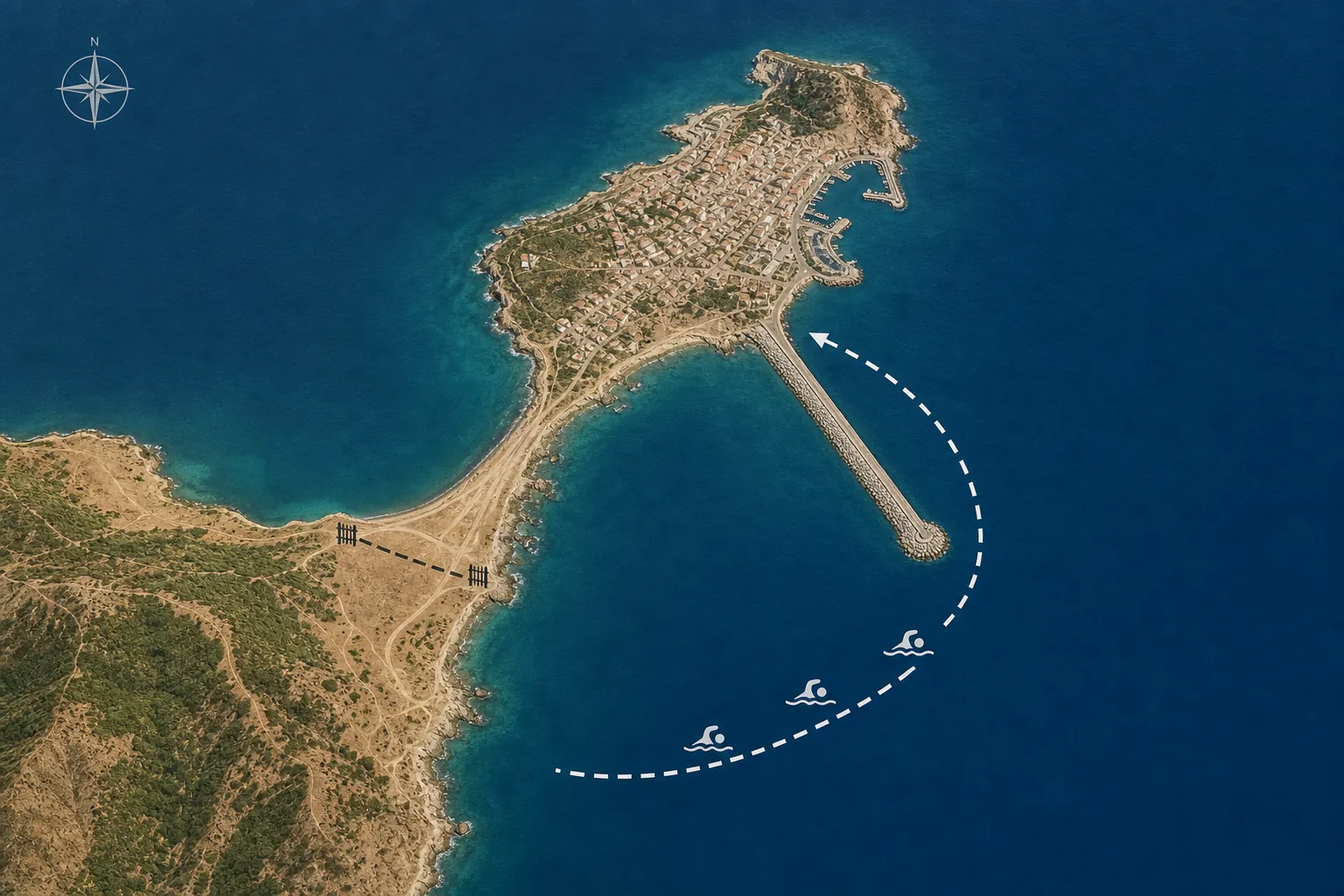
That matters because the Tarajal route is not an abstract gap in a statute. It is the place where the land border’s physical architecture meets the sea. A person who cannot lawfully or practically pass through the fenced border may try to move around its maritime edge. Once the court separated physical containment from surveillance and maritime interception, the breakwater became more than geography. It became the edge of the old legal workflow.
This is also why the July 30 crossing should not be treated as merely a sudden mass event. It was temporally close to a ruling that reportedly removed the state’s main summary-return basis at sea. The legal system did not create the desire to enter Ceuta. It changed the expected consequence of choosing one route over another.
July 30 was the first public stress test
The July 30 reporting describes a large movement into Ceuta from Morocco by sea and around the border area. The Guardian reported that thousands entered the Spanish enclave and cited Spain’s public broadcaster TVE for a figure of 2,000 to 3,000 people.[2] Al Jazeera reported that 1,500 to 2,000 people had crossed into Ceuta and that local authorities called for an emergency declaration.[3] Those figures should not be collapsed into a single clean number. They reflect different reports, attribution chains, and likely time windows on the same day, with no single Interior Ministry total confirmed in the materials reviewed.
The discrepancy does not weaken the legal point. Whether the July 30 figure is stated as 1,500 to 2,000 or as 2,000 to 3,000, the event was far beyond routine handling at Ceuta. The legally relevant fact is not the last digit in the count. It is that a mass maritime-edge crossing occurred within weeks of a judgment reported to have disabled summary return at that same operational point.
The Guardian quoted a Civil Guard spokesperson describing the pattern as “a slow trickle since the ruling, today an explosion.”[2] That sentence is useful precisely because it does not require embellishment. It links the ruling to officer-level experience without pretending to be a judicial finding of causation. It is an institutional account of how the changed legal environment was felt on the ground.
The same reporting said Spain deployed military personnel to Ceuta during the crisis.[2] Al Jazeera reported pressure on the enclave’s reception capacity, including overflow at the CETI reception center.[3] The military deployment and reception overflow are not separate storylines; they are the downstream signs of a border process losing its fast-return valve.
Reception capacity turned the legal gap into institutional strain
Ceuta’s reception system was already operating close to or above its designed limits before July 30. Al Jazeera reported the CETI center’s capacity as 512 and said it was housing more than 800 people during the July crisis.[3] InfoMigrants had reported earlier in 2026 that the same center, with a capacity of 512, was housing around 1,000 occupants in February.[4] Those figures come from different dates and should be kept separate, but both point to the same operational vulnerability: ordinary processing space was not built for a sudden mass transfer from sea interception into reception.
The annual context is also relevant, but only in proportion. AP reported that Ceuta recorded 3,523 arrivals in all of 2025 and nearly 3,000 arrivals by July 15, 2026.[5] That does not prove that Judgment 814/2026 caused every increase in movement toward Ceuta. It does show that the enclave entered late July with a higher-pressure baseline than the prior full-year comparison suggests, making the loss of a rapid maritime enforcement pathway more consequential.
The January 2026 regularization decree sits in the background of the political debate. Ceuta’s president and Italian officials cited regularization as a pull factor in the reporting reviewed, but those statements do not displace the narrower legal mechanism at issue here. The decree may have shaped perceptions and incentives. The Supreme Court ruling appears to have changed the enforceable consequence at the maritime border.
What remained operable after the ruling
The ruling did not leave Spain without immigration law, border officers, maritime safety powers, or ordinary removal procedures. It appears to have removed a particular shortcut: the use of the Tenth Additional Provision for immediate rejection where the encounter occurs through maritime surveillance and interception rather than at a physical containment element. That difference is enough to alter the whole file.
- Detection remains possible through patrols, cameras, drones, and other surveillance tools, but detection alone does not answer the return question.
- Rescue and safety obligations remain central where people are in the water or exposed to maritime danger.
- Ordinary identification, reception, asylum screening, and removal processes may still apply, but they require time, capacity, and review.
- Summary return at the physical land border may remain a separate question where the statutory conditions are met.
- The status of maritime-edge encounters is the live risk point because the reported ruling separates surveillance from containment.
This is the difference between a border incident and an immigration docket. A summary-return pathway keeps the matter at the perimeter. Once that pathway is unavailable, the same person must be received, counted, screened, and processed. The receiving institution, not the patrol boat, becomes the bottleneck.
The Schengen threat is prospective, but it is not trivial
The Ceuta episode escalated beyond Spain because Italy treated it as a Schengen integrity problem. Euronews reported that Italian Foreign Minister Antonio Tajani threatened suspension of the Schengen Agreement with Spain and that Prime Minister Giorgia Meloni also criticized Spain’s handling of the situation; Spain responded by summoning the Italian ambassador.[6] That is a diplomatic threat, not a completed legal suspension. The distinction should be kept clean.
Still, the threat matters because it shows how a national court ruling can travel. Judgment 814/2026 concerned Spanish statutory authority at Ceuta and Melilla. The immediate operational consequence appeared at Ceuta’s maritime perimeter. The political consequence reached another Schengen state, where officials framed Spain’s border-management change as a risk to the common travel area.
That does not mean Schengen is now suspended, or that Italy’s position would survive EU-law scrutiny, or that Spain’s court produced the entire July movement by itself. It means the legal risk is no longer local. A Spanish rule about what counts as a border “containment” mechanism has become part of a wider argument about whether one member state’s reception burden can become another member state’s internal-border concern.
Current risk posture
The cleanest record is this: Ceuta entered 2026 with rising arrival pressure compared with the prior full-year benchmark; the Spanish Supreme Court then issued Judgment 814/2026 on June 29, 2026; the ruling is reported to have confined the Tenth Additional Provision’s summary-return mechanism to physical containment elements and excluded maritime surveillance-based interceptions; and within roughly a month, Ceuta experienced a mass crossing around the maritime edge of the border.[1][2][3][5]
The July 30 surge is documented. The precise number remains unsettled across the reporting reviewed. CETI overflow is documented, with capacity figures consistently showing a center designed for 512 people and operating above that level during 2026.[3][4] Military deployment is reported. Italy’s Schengen suspension threat is documented as a threat, not as an implemented measure.[2][6]
The remaining legal question is narrower and more important than the political noise around it: after Judgment 814/2026, what lawful instrument permits rapid return of people intercepted at Ceuta’s maritime edge before ordinary reception and processing obligations attach? On the materials reviewed, that question is not settled migration policy. It is active legal risk.
References
- The Spanish Supreme Court on Rejection at the Borders of Ceuta and Melilla: What About Human Rights at Sea?, EJIL Talk, July 30, 2026
- Thousands enter Spanish enclave Ceuta from Morocco in Africa, The Guardian, July 30, 2026
- Spanish enclave of Ceuta raises alarm as thousands cross Morocco border, Al Jazeera, July 30, 2026
- In Ceuta, every day migrants try to enter the Spanish enclave, InfoMigrants
- Spain, Morocco and immigration in the European Union, AP News
- Spain and Morocco agree urgent return of latest Ceuta migrants, Euronews, July 30, 2026
Related records
Tool profile
Browse tool evaluations →Governing regulation
Browse the obligations tracker →Preventive workflow
Browse verification workflows →
Report a correction or tip
Spotted an outdated figure, a misstated fact, or a ruling this case record should reflect? Public comments are disabled for this content given the professional cost of a misreported case outcome, penalty amount, or rule text — use the structured correction channel instead.
Report a correction or tip for this record →