
Why CFO Stock Sales Before FDA Meetings Risk Insider Trading
This article examines the legal framework governing insider trading when a CFO sells company stock ahead of an FDA regulatory event, synthesizing SEC enforcement actions, materiality standards, and the SEC-FDA data-sharing partnership to help counsel assess risk.
- Jurisdiction
- U.S. Federal
- Ruling date
- Mar 1, 2025
- Source document
- View primary court order ↗
Lex Machina Review is an independent risk-tracking and reference resource. Nothing on this site is legal advice, and using it does not create an attorney-client relationship. Every record is reviewed against primary sources but may not reflect the most current status of a matter — always verify directly against the cited court order, rule text, or a licensed attorney before relying on it.
Companion explanation — secondary to the source document above
The hard question is not whether a CFO selling stock before an FDA meeting looks bad. It usually does. The harder clearance question is whether the sale sits inside Rule 10b-5: nonpublic FDA information, a duty to shareholders, materiality under the probability-and-magnitude standard, and evidence that the CFO knew enough at the time of the trade.
That distinction matters because life sciences companies often live in the interval between a regulatory signal and a public securities-law conclusion. The regulatory team may know the FDA has asked unusually pointed questions. Clinical staff may understand that an advisory committee briefing document is worse than expected. Management may not yet have drafted a Form 8-K, press release, or risk-factor update. None of that automatically means a CFO cannot trade. It does mean the legal department should not treat “we do not have the final FDA letter” as the same thing as “we do not have material information.”
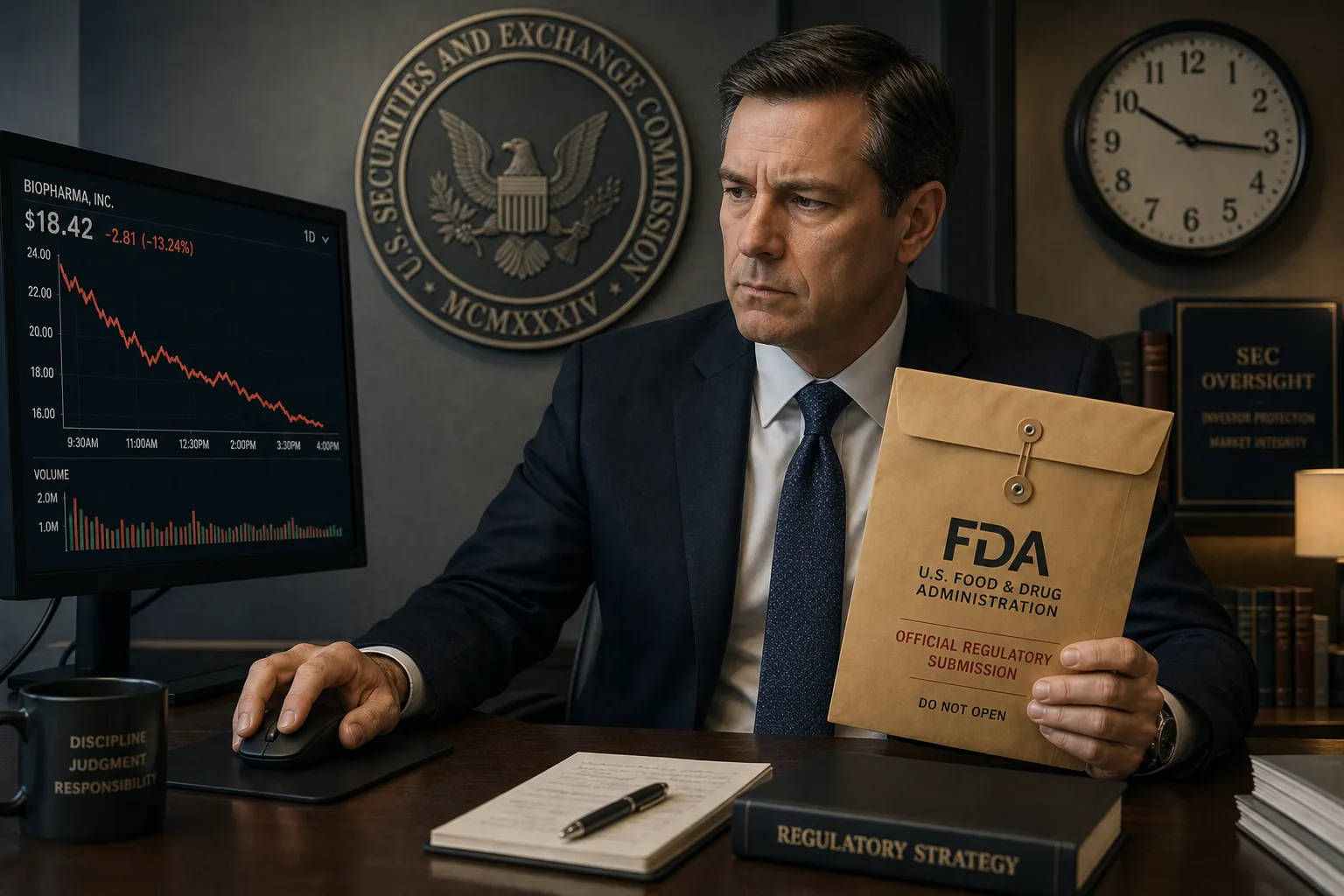
There is also a useful caveat at the start: no publicly reported case exactly matches a CFO personally selling company stock before an FDA advisory committee meeting. The closest public examples have to be assembled carefully. George Demos is the strongest personal-sale example involving a senior pharmaceutical executive trading before an adverse FDA regulatory outcome, but he was a vice president, not a CFO. Usama Malik supplies the CFO anchor, but his case was a tipping case, not a personal-sale case. Cheng Yi Liang widens the frame beyond company insiders to FDA personnel, showing that FDA decision information has long been treated as capable of supporting insider trading liability.
The Practical Rule For Clearance
A defensible clearance analysis starts with the transaction, but it cannot stay there. Counsel has to identify the FDA event, determine what the CFO actually knew, decide whether the information was public, and then ask whether a reasonable investor would have considered the information important in light of both the probability of the event and the magnitude of its impact.
| Clearance Question | Why It Matters |
|---|---|
| What FDA event is pending? | An advisory committee meeting, clinical hold, trial resumption, complete response letter, or label expansion can carry very different probability and magnitude. |
| What did the CFO know? | Emails, meeting notes, trading-window certifications, and internal forecasts can show whether the CFO knew only process timing or understood the likely regulatory consequence. |
| Was the information public? | A fact may be known inside the company and still unavailable to the market in a form investors can evaluate. |
| Would a reasonable investor care? | Materiality depends on the regulatory event’s likelihood and its expected effect on the company, not on whether the FDA has issued final wording. |
| What evidence will reconstruct the timeline? | SEC-FDA referrals, trading records, internal communications, and surveillance tools can turn a vague clearance concern into a provable chronology. |
For a CFO selling company stock, the main path is classical insider trading: a corporate insider trades the issuer’s securities while owing duties to the company’s shareholders. Misappropriation theory is different. It reaches someone who trades by misusing confidential information owed to another source, such as an FDA employee or an outside consultant using regulatory information for personal trading. The theories are distinct, but FDA information can matter under both.
This article is a risk analysis, not legal advice. In practice, the answer turns on specific facts, company policies, trading-plan documents, board approvals, and the precise regulatory communications in the file.
Demos Shows The Personal-Sale Mechanics
The Demos case is worth reading because it avoids abstraction. The SEC alleged that George Demos, a vice president of drug safety at Acadia Pharmaceuticals, sold company stock after learning nonpublic information that gave him “increasing confidence” the FDA would reject proposed labeling for a drug. The SEC said his sales avoided approximately $1.3 million in losses, and the March 2025 resolution included a five-year officer-and-director bar.[1]
That is not a CFO case. It is also not an advisory committee case. But for the legal department reviewing a senior officer’s proposed trade, Demos is uncomfortable in the right way. The alleged information was not simply that the FDA process was ongoing. It was an internal assessment of the likely regulatory result before the market received the news. That is exactly the kind of distinction that can disappear in casual clearance conversations.
Demos also shows why “the FDA had not yet acted publicly” is not a safe stopping point. Insider trading liability does not require a final public agency action before a company insider can possess material nonpublic information. If the internal record shows that management had moved from ordinary uncertainty to a concrete, nonpublic view of a likely FDA outcome, the clearance question changes.
Malik Supplies The CFO Anchor, But Not The Whole Case
Usama Malik, the former chief financial officer of Immunomedics, is the obvious CFO reference point, but the case should not be stretched beyond its facts. The SEC said Malik learned in 2020 that the FDA had allowed a clinical trial to resume, then tipped his then-girlfriend and certain family members before the company announced the news. Immunomedics’ stock nearly doubled after the public announcement, and Malik later pleaded guilty to securities fraud.[2]
Malik matters because the information was squarely FDA-related and the insider was a CFO. It also matters because the regulatory development was positive, not negative. Insider trading risk is not confined to selling before bad news. Buying, tipping, or enabling others to trade before favorable FDA information can present the same basic Section 10(b) and Rule 10b-5 problem.
But Malik cannot be used as if it were a published court ruling on a CFO’s personal sale before an advisory committee vote. The cleaner lesson is narrower: when a CFO receives nonpublic FDA information capable of moving the company’s stock, prosecutors and the SEC may treat trading by the CFO or by the CFO’s tippees as securities fraud.
FDA Information Can Be Material Before The Final Agency Communication
The materiality analysis is where many bad answers start. A pending FDA event is not automatically material merely because it appears on a regulatory calendar. A routine meeting about a diversified company’s minor supplemental issue may not move the needle. A meeting that can determine the fate of a single-product company may be different.
The Supreme Court’s probability-and-magnitude framework asks courts to weigh both the likelihood that the event will occur and the anticipated magnitude of the event in light of the company’s activity. The point is not to demand certainty. It is to prevent companies and insiders from hiding behind the fact that future events are probabilistic when the event would plainly matter if it happened.[3]
In the FDA setting, magnitude can be unusually concentrated. A regulatory hold can delay a trial that supports the company’s lead asset. A complete response letter can reset a commercialization timeline. An advisory committee vote can reshape market expectations even though the FDA is not legally bound by it. A label expansion can change the addressable market. For a company whose valuation depends heavily on one asset, the magnitude side of the analysis may be large even when the probability side remains uncertain.
Probability requires more discipline. Counsel should separate ordinary regulatory noise from nonpublic information that changes the odds. The fact that an FDA meeting is scheduled is usually not enough if the market already knows the schedule. Internal knowledge that FDA reviewers raised concerns, that the company’s response failed to resolve them, or that executives now have increasing confidence in a rejection may be different. The same is true on the positive side when a clinical hold has been lifted or a trial may resume before the market knows.
That is why a clearance file should avoid generic labels such as “FDA update” or “regulatory issue.” They are too blunt. The relevant question is what the update says about probability and magnitude: more likely approval, more likely rejection, likely delay, narrowed label, expanded population, resumed trial, or a changed commercial timeline.
Liang Explains Why The Source Of The Information Does Not End The Inquiry
Cheng Yi Liang’s case sits outside the corporate-officer fact pattern, but it explains why FDA decision information receives such close attention. Liang, an FDA chemist, traded ahead of 27 drug approval decisions and generated approximately $3.6 million in illicit profits. He was sentenced to 60 months in prison.[4]
Liang is a misappropriation case. The duty did not arise because he was an officer of the issuer whose stock he traded. It arose because he allegedly misused confidential government information for personal trading. For a CFO selling the company’s own stock, the route is usually classical theory. Still, Liang is a reminder that the securities-law system does not treat FDA information as too technical, too preliminary, or too regulatory to be tradeable material information.
The Detection Environment Is More Concrete Than The Rumor Mill
The practical enforcement risk is not just that a disappointed investor complains after the stock drops. Since 2004, the SEC and FDA have had a formal information-sharing arrangement under which the FDA may share nonpublic regulatory information with the SEC and refer suspected insider trading directly to the Commission.[5]

That matters for timeline reconstruction. An enforcement lawyer does not have to infer the FDA sequence solely from market rumors or the company’s press release. The SEC can compare trading records against FDA communications, internal company documents, broker records, and emails. If the issue reaches subpoena territory, the question becomes less theatrical and more mechanical: who knew what, when did they know it, and what trade followed?
The SEC’s Market Abuse Unit and its ARTEMIS surveillance environment are part of that same practical picture. Academic and practitioner commentary has described how the agency uses data analytics, including machine-learning tools, to detect suspicious trading around market-moving events, including FDA announcements.[6]
This does not mean every suspicious chart becomes a case. It does mean a clearance decision should assume that an unusual executive trade close to a regulatory event may be analyzed against a detailed event timeline rather than judged only by how it looked to the general market at the time.
Do Not Overstate The Current Enforcement Climate
There is a temptation to describe every recent SEC case as part of a broad crackdown. The record is more calibrated. Gibson Dunn’s July 2025 mid-year update described insider trading as still a stated SEC priority under the Atkins administration, while also noting the administration’s preference for restraint in novel enforcement theories and a lower pace of insider trading filings in the first half of 2025 than is typical.[7]
For clearance purposes, that restraint cuts only so far. A CFO trading before a known, high-magnitude FDA development is not a creative theory in the way some frontier enforcement theories are creative. The closer the file looks to established classical insider trading—corporate insider, issuer stock, nonpublic information, foreseeable market reaction, suspicious timing—the less comfort there is in a general deregulatory mood.
Recent enforcement catalogs also show that FDA-adjacent and life sciences trading cases remain in the mix. Ballard Spahr’s August 2025 review discussed several matters involving alleged trading around regulatory or clinical developments, including Ou with approximately $1.5 million in disgorgement, Bhandari with approximately $163,000, Allarity with approximately $2.5 million, and Demos with approximately $1.3 million in avoided losses.[8]
The better phrasing is not “the SEC is cracking down on every FDA trade.” It is that FDA-linked trading remains detectable, understandable to regulators, and capable of fitting conventional insider-trading elements when the internal knowledge is strong.
Options Activity Adds Context, Not A Presumption
Empirical work on market activity before FDA advisory committee meetings adds another reason to be careful, but it should not be misused. Borochin, Golec, and Wu found abnormal options trading before approximately 32% of FDA advisory committee meetings in their 2022 study.[9]
That finding does not prove that a particular CFO trade is illegal. It does not even prove that every abnormal trade in the sample was based on inside information. It does show why surveillance around FDA events is a rational regulatory focus. Markets often move before formal announcements, and options activity can draw attention to the people whose trades line up too neatly with later regulatory news.
Trading Plans Help Only If They Are Real Barriers
A Rule 10b5-1 plan can be a legitimate liquidity tool for a CFO, especially in a sector where personal wealth may be heavily concentrated in company equity. The plan is not magic. If the plan was adopted, modified, canceled, or used opportunistically while the CFO possessed material nonpublic FDA information, the same core questions return.
The clearance issue becomes sharper when a proposed trade is outside a plan, shortly before a known FDA event, or inconsistent with the executive’s ordinary pattern. Counsel should look at the adoption date, cooling-off period, modification history, discretion retained by the executive, and whether the plan was in place before the regulatory information became significant. The paperwork should show more than formal eligibility. It should show that the trade decision was insulated from the later FDA knowledge.
What Counsel Should Document Before Approving Or Deferring The Sale
A good clearance note is not written for a world where nothing happens. It is written for the world where the FDA news later moves the stock and someone asks why the CFO was allowed to sell.
- Identify the FDA event precisely: advisory committee, hold, resumption, labeling decision, complete response, safety signal, or other regulatory communication.
- Record what the CFO knew, including whether the information came from board materials, regulatory updates, forecasts, draft disclosures, or private management discussions.
- Separate public facts from nonpublic interpretation; a public meeting date is different from a nonpublic internal view that rejection has become likely.
- Apply probability and magnitude to the company’s actual business, not to FDA events in the abstract.
- Check trading-plan status, blackout periods, prior trading patterns, and any recent plan amendments or cancellations.
- Assume regulators can reconstruct the chronology from FDA communications, company records, broker data, and electronic messages.
There will be close cases. A CFO may know only that a meeting is scheduled, that the agency asked ordinary questions, or that management is preparing for multiple outcomes. A sale in that setting may be poor optics without being a Rule 10b-5 violation. The risk rises when the CFO knows nonpublic regulatory facts, or an internal probability assessment, that a reasonable investor would use to value the company.
That is the defensible assessment standard: identify the FDA event, document what the CFO knew, test materiality through probability and magnitude, analyze duty and scienter, and make the clearance decision as if the SEC and FDA can later put the same timeline back together.
References
- SEC Charges Former Acadia Pharmaceuticals Executive with Insider Trading, U.S. Securities and Exchange Commission, March 2025, link
- Former Immunomedics CFO Charged with Insider Trading, U.S. Securities and Exchange Commission, 2021, link
- Basic Inc. v. Levinson, Legal Information Institute, 1988, link
- SEC Charges FDA Chemist with Insider Trading Ahead of Drug Approval Announcements, U.S. Securities and Exchange Commission, 2011, link
- SEC and FDA Announce Initiative to Detect and Deter Insider Trading in Securities of Pharmaceutical Companies, U.S. Securities and Exchange Commission, 2004, link
- Insider Trading in FDA Regulated Industry, Indiana Health Law Review, 2023, link
- 2025 Mid-Year Securities Enforcement Update, Gibson Dunn, July 2025, link
- SEC Continues Focus on Insider Trading in Life Sciences Companies, Ballard Spahr, August 2025, link
- Trading Around FDA Advisory Committee Meetings, Borochin, Golec & Wu, 2022, link
Related records
Tool profile
Browse tool evaluations →Governing regulation
Browse the obligations tracker →Preventive workflow
Browse verification workflows →
Report a correction or tip
Spotted an outdated figure, a misstated fact, or a ruling this case record should reflect? Public comments are disabled for this content given the professional cost of a misreported case outcome, penalty amount, or rule text — use the structured correction channel instead.
Report a correction or tip for this record →