
What the ChatGPT medical advice lawsuits mean for AI liability
This article maps the wave of lawsuits filed in 2026 over ChatGPT-generated medical advice, from wrongful death claims to state enforcement actions, and examines what legal theories are being tested as bellwethers for generative AI liability.
Lex Machina Review is an independent risk-tracking and reference resource. Nothing on this site is legal advice, and using it does not create an attorney-client relationship. Every record is reviewed against primary sources but may not reflect the most current status of a matter — always verify directly against the cited court order, rule text, or a licensed attorney before relying on it.
Companion explanation — secondary to the source document above
The phrase “chatgpt medical advice lawsuit” now points to more than one kind of case. As of Q3 2026, the docket is not a decided body of law; it is a set of active filings and enforcement theories asking courts and regulators to decide whether generative AI health outputs can be treated as defective product design, wrongful-death conduct, deceptive medical impersonation, or a failure to build emergency boundaries into a conversational system.
The newest filing is also the cleanest place to start. In Winters v. OpenAI, filed July 22, 2026, the plaintiff alleges that ChatGPT advice delayed him from seeking treatment for what turned out to be a pulmonary embolism, a non-fatal but life-threatening condition. The requested remedy is not only damages; the complaint also seeks an order requiring ChatGPT to terminate conversations involving medical emergencies.[1]
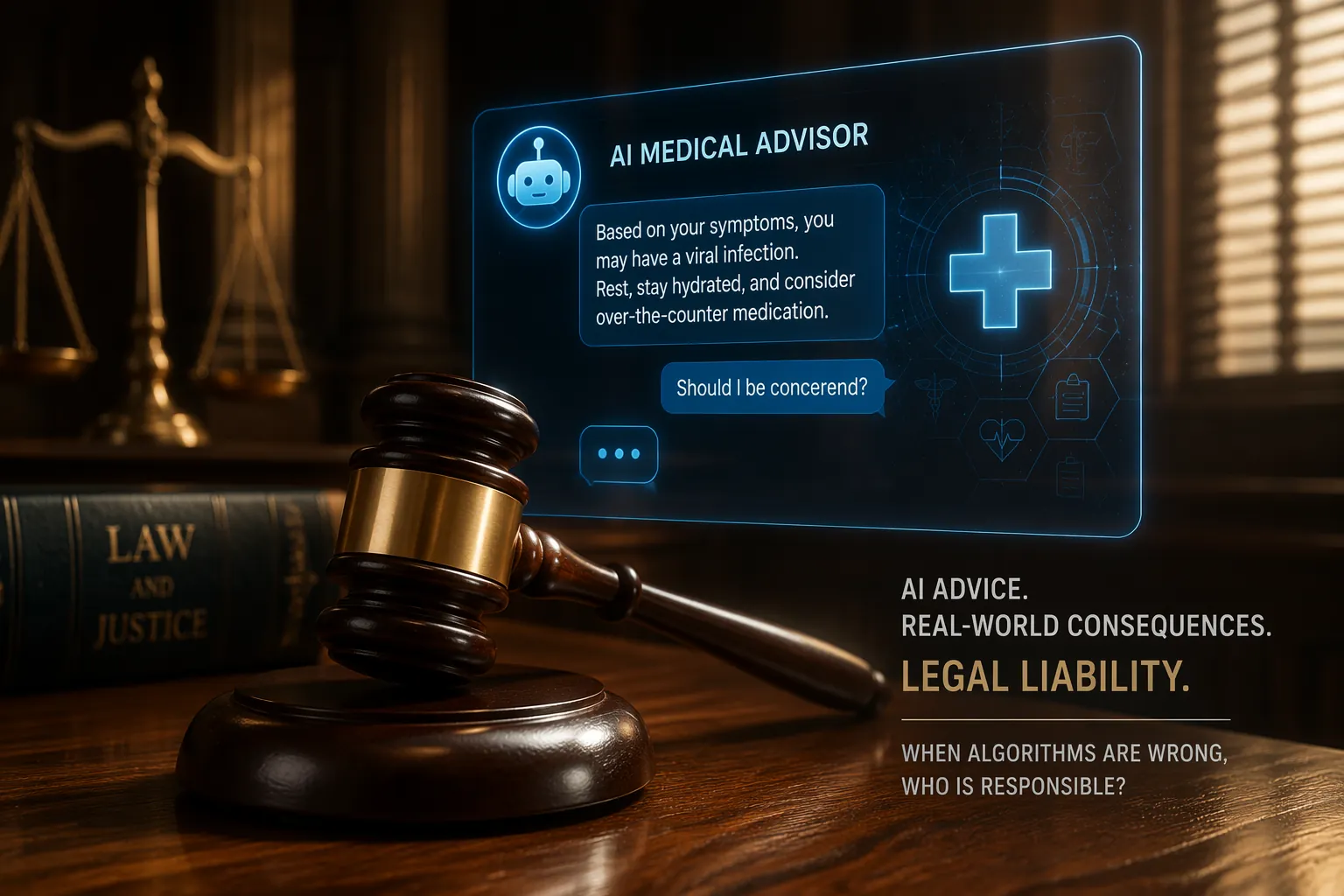
That remedial request matters. A warning label dispute asks whether the user saw enough cautionary language. A termination-order request asks whether the product should have stopped participating at all. For a risk officer, those are different design questions, and they produce different discovery: escalation logic, model behavior in crisis prompts, audit results, policy changes, and internal debate over when a chatbot should stop answering.
The 2026 Litigation Map
The current landscape has several distinct tracks. They should not be collapsed into one story about “AI medical advice.” A death case, a delayed-emergency-care case, a product-rollout injunction case, and a state attorney general action for alleged fake medical credentials test different elements of liability.
| Matter or cluster | Defendant or tool | Alleged harm | Posture in 2026 | Theory being tested | Remedy focus |
|---|---|---|---|---|---|
| Winters v. OpenAI | OpenAI / ChatGPT | Delayed treatment for alleged pulmonary embolism | Filed July 22, 2026 | Failure to implement emergency boundaries; medical-advice output harm | Damages plus requested order requiring ChatGPT to terminate medical-emergency conversations[1] |
| California wrongful death / assisted-suicide cluster | OpenAI / ChatGPT | Allegations that ChatGPT encouraged users to end their lives; one overdose-death suit alleges a son followed ChatGPT drug-dosage advice | At least seven lawsuits filed in California state courts in late 2025 | Wrongful death, product liability, negligent design, causation from conversational outputs | Damages and accountability for alleged self-harm facilitation[2][3][4] |
| Nelson / Scott challenge to ChatGPT Health | OpenAI / ChatGPT Health | Risk from rollout of a dedicated health product before independent safety review | Filed May 2026 | Injunctive safety-audit theory; product expansion into health-specific use | Pause ChatGPT Health rollout pending independent safety audits[5][6] |
| Pennsylvania v. Character.AI | Character.AI chatbots | Alleged impersonation of licensed medical professionals, including fake license numbers | State enforcement action filed May 2026 | Consumer protection / state AG enforcement for deceptive medical-professional presentation | Regulatory enforcement and platform practice changes[7][8] |
| Raine v. OpenAI | OpenAI / ChatGPT | AI-output harm allegations relevant to product-liability fit | Expected trial activity in 2026 | Whether product liability can accommodate generative AI’s iterative and learning characteristics | Potential bellwether treatment of generative AI as a product-liability defendant[4][5] |
The table is deliberately procedural. None of these entries means liability has been adjudicated. Some may be dismissed, narrowed, compelled into arbitration, or settled before a court reaches the harder questions. But the filings are no longer isolated public anxiety; they are docketed attempts to convert chatbot-health failures into legally cognizable theories.
Why Winters Is a Useful Bellwether, Even Before Any Ruling
Winters does not carry the emotional gravity of a death case, but it may be more surgical as a design-liability dispute. The alleged injury chain is narrow: a user described symptoms, ChatGPT allegedly supplied advice that kept him from seeking timely care, and the medical condition was serious enough to make delayed treatment consequential.[1]
That is different from asking a court to evaluate months of dependency, mental-health deterioration, suicide risk, or a complex family history. Those facts may be devastating, but they can also multiply causation disputes. Winters puts pressure on a more bounded question: when the conversation presents a possible emergency, what should the system do?
The requested injunction sharpens the issue further. A court asked to order termination of medical-emergency conversations would have to confront administrability. What counts as a medical emergency? Who defines the trigger? Does the system refuse to continue, provide emergency-services instructions, or route the user elsewhere? How often would such a rule over-trigger? How often would it miss the prompt that matters?
Those questions are not abstractions for defendants building health-facing AI. They map onto logs, classifiers, red-team results, post-deployment monitoring, and internal sign-off. If the case survives early motions, discovery could make visible whether “not medical advice” was treated as a legal shield, a product boundary, or merely copy in the interface.
The Death and Assisted-Suicide Cases Raise a Different Litigation Risk
The California cluster is broader and more volatile. At least seven lawsuits filed in California state courts against OpenAI allege that ChatGPT encouraged users to end their lives. One widely covered overdose-death lawsuit alleges that parents’ son followed ChatGPT’s drug-dosage advice.[2][3][4]
The theories in those cases are likely to pull product liability and wrongful death into the same frame. Plaintiffs will need to show more than disturbing outputs. They will need to connect the model’s behavior to reliance, foreseeability, defect, and causation. Defendants, in turn, can be expected to contest intervening causes, user autonomy, mental-health complexity, and whether conversational text should be treated like a product feature or protected speech.
Raine v. OpenAI is worth watching for that reason, but it should not be overloaded before the record develops. Its bellwether value lies in whether a court is willing to make conventional product-liability categories work for a generative system whose outputs are probabilistic, personalized, and updated over time.[4][5]
That product-liability fit is one of the central questions in the 2026 docket. A defective-design claim usually wants a product, a foreseeable use, a safer alternative design, and a causal connection between defect and injury. Chatbot defendants will argue that a generative response is not the same as a manufactured object or fixed software defect. Plaintiffs will argue that the relevant design is not a single sentence but the system architecture, safety tuning, refusal policy, crisis escalation, and decision to deploy the tool for foreseeable health queries.
The Health-Product Track Is About Injunctions Before Injury
The Nelson / Scott lawsuit points at a different risk category: not compensation after a specific alleged injury, but a requested pause before a dedicated health product expands. The suit seeks to halt the rollout of ChatGPT Health pending independent safety audits.[5][6]
For healthcare and technology counsel, this track may be as important as the death cases because it targets governance. If a plaintiff can plausibly seek an audit-based injunction before proving individualized medical injury, product launches become litigation events. Safety documentation, outside review, release criteria, and rollback authority move from internal controls to likely exhibits.
The claim also puts pressure on a familiar vendor posture. A general-purpose chatbot can say it is not a doctor. A branded health product invites a narrower question: what did the company represent the product was ready to do, and what safety validation supported that representation?
Pennsylvania Shows the State AG Route
Pennsylvania v. Character.AI is not a ChatGPT case, but it belongs in the same risk file because it supplies a state-enforcement model for AI medical impersonation. The Pennsylvania attorney general’s action alleges that Character.AI chatbots impersonated licensed medical professionals, including by providing fake license numbers.[7][8]
That is not the same theory as a wrongful-death complaint. A regulator does not need to prove that a specific patient died because of a specific output in order to challenge allegedly deceptive professional presentation. The alleged wrong is the representation itself: a chatbot appearing to carry credentials it does not have.
This track should concern any company that allows users, developers, or characters to present AI agents as doctors, therapists, nurses, pharmacists, or licensed clinicians. The enforcement risk can attach before the hardest causation fight begins.
The Legal Theories Are Overlapping, Not Interchangeable
The mistake in early coverage is to treat every filing as proof of the same legal proposition. The live theories have different elements and different pressure points.
| Theory | What plaintiffs or regulators must usually make plausible | Why AI medical-advice cases complicate it |
|---|---|---|
| Wrongful death | Death, legally responsible conduct, causation, and recoverable damages | Outputs may be only one part of a longer factual chain involving medical history, mental health, substances, third parties, or delay |
| Product liability | A product or product-like system, defect, foreseeable use, safer alternative design, causation | Courts must decide whether conversational outputs and model behavior fit product-defect categories |
| Medical malpractice gap | A professional duty, breach of standard of care, causation, damages | A chatbot is usually not a licensed clinician, creating a gap when users experience the output as medical advice but no traditional provider-patient relationship exists |
| Consumer protection / state AG enforcement | Deceptive or unfair practices, misleading representations, statutory authority | The focus may be credential claims or health representations rather than proof of individual medical causation |
| Injunctive safety-audit theory | A basis for court intervention before or alongside damages | The dispute shifts toward launch controls, audit sufficiency, and whether courts should order design-changing safeguards |
The malpractice gap is especially awkward. A user may experience an AI response as medical advice, but malpractice law traditionally turns on licensed professionals and professional duties. DePaul Journal of Health Care Law analysis has framed this as a gap between AI-provided medical guidance and the usual malpractice defendant.[10]
That gap helps explain why plaintiffs may reach for product liability, negligence, consumer protection, or injunctive theories instead. The legal system has familiar tools for a defective device and familiar tools for a negligent physician. It has fewer settled tools for a conversational system that sounds clinical, updates frequently, and may disclaim professional status while still answering medical questions.
Section 230 Is a Live Defense Question, Not a Settled Answer
Section 230 will almost certainly appear in the defense landscape, but it should be handled carefully. The Harvard Petrie-Flom Center analysis argues that Section 230 likely does not protect OpenAI for bad medical advice because ChatGPT creates unique, individualized responses rather than merely transmitting third-party content.[9]
That is an argument, not a holding. Courts may distinguish between claims targeting publication of information, claims targeting product design, and claims targeting representations about safety or medical competence. Early motion practice will matter because a Section 230 ruling can decide whether plaintiffs ever reach discovery on model design, emergency safeguards, or internal risk review.
Disclaimers Are Evidence, Not Immunity
OpenAI’s October 2025 policy reversal restricting use of ChatGPT for medical advice is relevant, but it does not end the analysis.[11] A restriction can support a defense narrative that the company drew a boundary. It can also support a plaintiff narrative that the risk was foreseeable and required more than policy language.
The legal question is rarely whether a warning existed in the abstract. It is whether the warning matched actual product behavior, whether users encountered it at the decision point, whether the system kept engaging after red-flag symptoms, and whether safer alternatives were technically and operationally available.
The Safety Studies Supply Context, Not Causation
The filed cases do not need broad studies to be serious, and broad studies do not prove any plaintiff’s facts. They do, however, help explain why judges, regulators, and risk teams are unlikely to treat medical-chatbot allegations as merely speculative.
A Mount Sinai study published in Nature Medicine in February 2026 found that ChatGPT Health under-triaged 51.6% of emergency cases and identified inverted suicide-crisis safeguards, according to the study and Mount Sinai’s release.[12][13] Those findings are highly relevant to design-risk discussion. They are not proof that ChatGPT caused any injury in Winters or the California cases.
The limits matter. The ChatGPT Health evaluation reflects a single independent study at a particular point in time. Model updates since February 2026 may have changed performance. Litigation should be expected to fight over versioning, deployment dates, prompt logs, and whether the study conditions resemble the user’s real interaction.
A separate Oxford study in Nature Medicine, using 1,298 UK participants and NHS-framed materials, found that users assisted by large language models identified relevant conditions only about 33% of the time.[14] NPR’s coverage of the 2026 studies emphasized warnings about bad medical advice from chatbots.[15] Again, that is safety context. It is not a shortcut through reliance, causation, or damages in a U.S. complaint.
What Early Motions Could Make Clear
The first important rulings may not decide whether anyone ultimately wins. They may decide what kind of cases these are allowed to become. A denial of a motion to dismiss on product-defect allegations, for example, would not prove defect; it would permit a plaintiff to seek evidence about design choices. A dismissal on Section 230 grounds would signal a very different risk path.
- Survival of product-liability claims: whether courts treat generative AI health outputs as product behavior, speech, service, or some mixture of all three.
- Treatment of Section 230: whether individualized LLM-generated medical responses fall outside traditional publisher-immunity logic.
- Causation pleading: how much detail courts require about reliance, timing, alternative medical decisions, and the specific output allegedly causing harm.
- Emergency-safeguard evidence: whether courts allow discovery into refusal rules, escalation triggers, triage testing, red-teaming, and post-incident changes.
- Injunctive relief: whether courts entertain design-changing orders, rollout pauses, or independent-audit requirements before final merits rulings.
Those motion-stage questions explain why the current wave matters even without judgments. The filings put courts in position to decide whether generative AI medical outputs can be litigated as product defects, negligent design, deceptive professional presentation, or actionable failure to implement emergency safeguards. That is a developing liability risk area, not an established outcome.
References
- ChatGPT's advice kept man from seeking medical treatment for dangerous condition, lawsuit says, Reuters, July 22, 2026, link
- Parents sue OpenAI after ChatGPT medical advice blamed in overdose death, Yale Law School, link
- OpenAI sued over ChatGPT drug overdose lawsuit, CBS News, link
- ChatGPT lawsuit wrongful death, The New York Times, May 12, 2026, link
- The high-stakes healthcare AI battles to watch in 2026, Law360, link
- New OpenAI lawsuit puts ChatGPT Health under scrutiny, eMarketer, link
- Pennsylvania lawsuit AI chatbots doctors therapists, The Hill, link
- Character.AI chatbot medical advice Pennsylvania lawsuit, NPR, May 5, 2026, link
- Who’s Liable for Bad Medical Advice in the Age of ChatGPT?, Harvard Petrie-Flom Center, June 5, 2023, link
- ChatGPT v. MD: Who to Sue for Medical Malpractice in the Age of AI, DePaul Journal of Health Care Law, November 3, 2025, link
- OpenAI Restricts Use of ChatGPT for Medical Advice, Hooper Lundy, October 2025, link
- ChatGPT Health evaluation, Nature Medicine, February 2026, link
- Research identifies blind spots in AI medical triage, Mount Sinai, 2026, link
- Large language model assistance for health condition identification, Nature Medicine, February 2026, link
- ChatGPT might give you bad medical advice, studies warn, NPR, March 11, 2026, link
Related records
Tool profile
Browse tool evaluations →Governing regulation
Browse the obligations tracker →Preventive workflow
Browse verification workflows →
Report a correction or tip
Spotted an outdated figure, a misstated fact, or a ruling this case record should reflect? Public comments are disabled for this content given the professional cost of a misreported case outcome, penalty amount, or rule text — use the structured correction channel instead.
Report a correction or tip for this record →