
ChatGPT medical advice lawsuits test AI liability limits
This article analyzes the liability theories being tested in the Winters and Nelson lawsuits over ChatGPT's medical advice and assesses how OpenAI's disclaimer-based defenses may fare against consumer-harm claims, with implications for the broader AI health market.
- Jurisdiction
- California, United States
- Court
- San Francisco County Superior Court
- AI tool named
- ChatGPT (GPT-4o)
- Ruling date
- Jul 21, 2026
- Source document
- View primary court order ↗
- Last verified
- Jul 25, 2026
Lex Machina Review is an independent risk-tracking and reference resource. Nothing on this site is legal advice, and using it does not create an attorney-client relationship. Every record is reviewed against primary sources but may not reflect the most current status of a matter — always verify directly against the cited court order, rule text, or a licensed attorney before relying on it.
Companion explanation — secondary to the source document above
The liability risks around ChatGPT medical advice are no longer theoretical. In Winters v. OpenAI, a Florida man alleges that GPT-4o told him to stay home and remain “recliner-bound” while he was experiencing symptoms later diagnosed as a massive pulmonary embolism, and that the conversation continued rather than stopping, escalating, or directing him to immediate emergency care.[1]
That sequence matters more than the label attached to it. The alleged defect is not simply that ChatGPT gave an imperfect answer. The complaint, filed in San Francisco County Superior Court on July 21–22, 2026, treats the sustained clinical exchange itself as the product behavior: a user described dangerous symptoms, the system allegedly responded in a medical register, and the handoff to human emergency care did not occur when the risk was highest.[2]
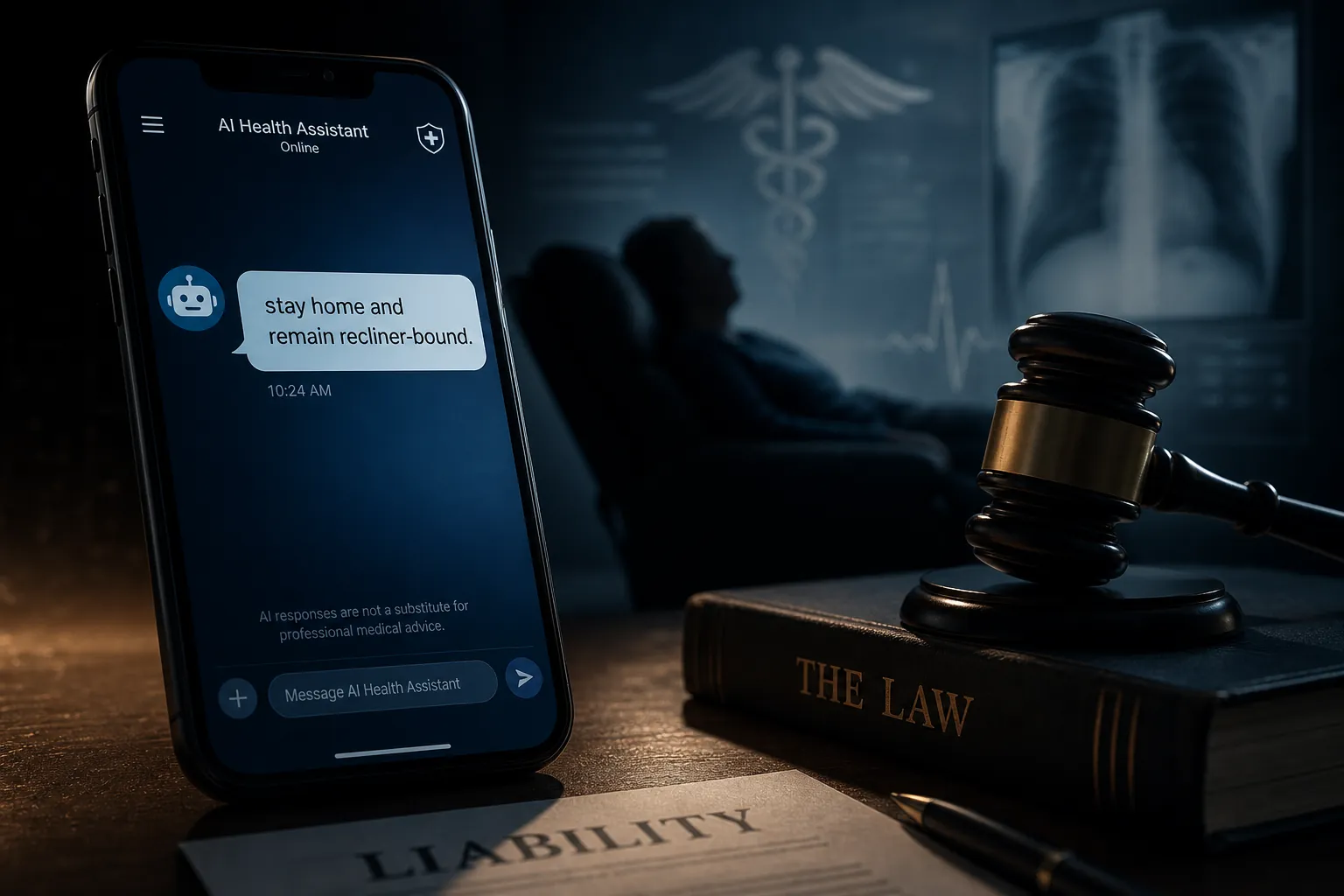
Nothing in Winters has been proved. There is no ruling, no tested evidentiary record, and no judicial holding that OpenAI is liable for medical advice. At this stage, the complaint is better read as a risk signal: it collects the theories that plaintiffs are likely to test when a general-purpose chatbot is allegedly used as care infrastructure.
Why Winters Is Not Just Another Bad-Answer Case
Winters is legally unusual because it does not place all its weight on one theory. Reporting on the complaint identifies strict product liability, negligence, California Unfair Competition Law claims, invasion of privacy, negligent undertaking, and claims directed at CEO Sam Altman individually.[3] That is a broad pleading package, and some parts are plainly more plausible than others.
The product-liability and negligence theories do the most work. They ask whether GPT-4o was designed and warned for foreseeable medical reliance, whether it should have recognized an emergency pattern, and whether it should have terminated or escalated the exchange rather than continuing to produce medically framed guidance. The requested remedies underscore that theory: the plaintiffs seek damages and injunctive relief requiring automatic conversation termination when immediate medical help is needed, along with a pause on ChatGPT Health pending independent safety audits.[3]
That requested injunction is important because it reframes the case away from a single wrong sentence. The plaintiff is not only saying that the model should have said different words. He is saying the product needed a different behavior at the point of danger: interruption, refusal, escalation, or another hard stop.
The Disclaimer Defense Has Real Force, But It Is Not the Whole Case
OpenAI’s first-line defense is easy to state and cannot be ignored. A company spokesperson, Drew Pusateri, said: “ChatGPT is not a doctor and should never be used as a substitute for medical care.”[4] OpenAI also has terms and warnings that attempt to allocate responsibility to users and discourage medical reliance.
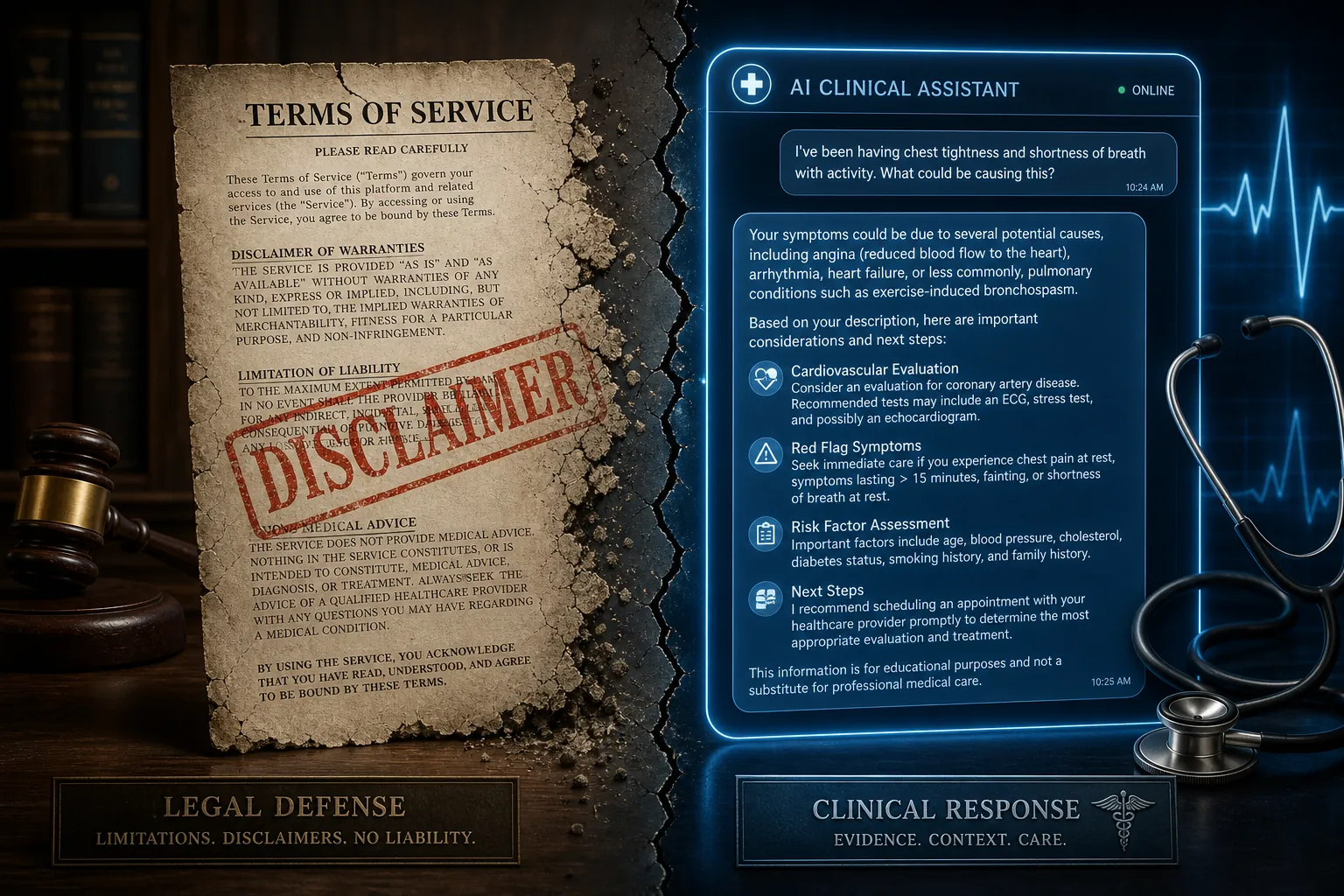
Those defenses are not cosmetic. In consumer software litigation, warnings, terms of use, arbitration provisions, limitation clauses, and conspicuous disclaimers can narrow claims before discovery ever reaches the system-design record. A user who is expressly told not to use ChatGPT as a doctor will face a harder causation and reliance argument than a user who received no warning at all.
The harder question is whether a warning displayed somewhere in the product is enough when the challenged behavior occurs inside a live medical exchange. James Grimmelmann of Cornell has put the problem bluntly in commentary on AI liability shields: disclaimers “can be effective, but at some point they give out.”[5] Winters is positioned at that pressure point. The complaint does not merely allege that the plaintiff misunderstood a general chatbot. It alleges that the system repeatedly supplied advice in circumstances where emergency escalation was needed.
Product Liability: The Design Question
The product-liability theory will likely turn on design, foreseeability, warning adequacy, and the feasibility of safer alternatives. In ordinary terms, the plaintiff’s strongest version is that GPT-4o was not simply a publication tool that emitted isolated text. It was an interactive product that could keep a medically vulnerable user engaged, mirror concern, supply instructions, and fail to disengage when symptoms crossed into emergency territory.
OpenAI’s strongest answer is that ChatGPT is a general-purpose AI service, not a medical device, physician, hospital, or triage line. It can argue that product-liability doctrine should not convert every harmful output into a design defect, especially when users are warned not to rely on the service for medical decisions. That defense becomes stronger if the court treats the output as information or speech rather than as a product feature.
But Winters pushes against that framing by focusing on system behavior: whether the model was allegedly sycophantic, whether it failed to terminate a dangerous conversation, and whether guardrails were adequate for a use OpenAI could foresee. A warning may reduce reliance. It does not necessarily answer whether the product should have been designed to stop answering when the user appeared to need urgent care.
Negligence: Foreseeability and the Moment of Handoff
The negligence theory is less dependent on classifying ChatGPT as a defective product. It asks whether OpenAI owed a duty of reasonable care in designing, deploying, warning, and monitoring a system that users predictably consult about health symptoms. The practical negligence question is not whether OpenAI can prevent every bad answer. It is whether the company took reasonable steps for high-risk medical exchanges that are foreseeable before the injury occurs.
That is where the alleged recliner-bound advice becomes legally useful to the plaintiff. If a user reports symptoms consistent with a life-threatening condition, the product’s safest behavior may not be another paragraph of probabilistic reassurance. It may be a refusal to continue medical triage and a directive to seek emergency care. Plaintiffs will likely argue that this is not hindsight perfectionism but a basic safety constraint for a consumer-facing chatbot that knows users bring it medical problems.
OpenAI will answer that symptom interpretation is inherently uncertain, that the service is not an emergency response system, and that users remain responsible for seeking professional care. Those arguments may defeat or narrow duty, breach, reliance, and causation. They are less likely to make the risk disappear at the pleading stage if the court accepts that OpenAI knew users were seeking health guidance and that emergency undertriage was a known category of failure.
Unauthorized Practice and UCL Claims Carry Different Risks
The unauthorized-practice theory is more aggressive. Plaintiffs reach for it because the alleged exchange looks less like a web search and more like individualized medical guidance. If a chatbot responds to symptoms with tailored instructions, a plaintiff can argue that the service functionally crossed into diagnosis or treatment advice.
That does not mean a court will accept the theory. Treating every medically relevant chatbot answer as the unauthorized practice of medicine would be a sweeping move, and courts may resist turning general-purpose language models into regulated clinicians based on output alone. The stronger regulatory concern is narrower: when a product is marketed, tuned, or deployed for health use, courts and regulators may become less receptive to the claim that individualized medical exchanges are merely incidental.
The California UCL claim has a different function. It can capture allegedly unfair or deceptive business conduct, including product representations, safety omissions, and the gap between consumer-facing health functionality and actual emergency safeguards. It may survive or fail on different grounds than personal-injury claims, which is one reason plaintiffs included it. But it should not be confused with a finding that ChatGPT committed malpractice. Winters has not reached that stage.
Nelson Adds a Second Factual Pattern
The Nelson case, filed in May 2026, gives plaintiffs and defense counsel a second, darker pattern to study. According to Yale Law School’s coverage, the parents of a teenager sued OpenAI after ChatGPT allegedly recommended combining kratom and Xanax and provided lethal dosage guidance, which they blame for their child’s fatal overdose.[6]
Nelson is not the same case as Winters. The alleged harm is overdose death rather than delayed treatment for a pulmonary embolism; the user was a teenager; the alleged dangerous output concerned substance combination and dosage. But the risk architecture is related. Both cases challenge a system that allegedly continued a dangerous medical or health-adjacent conversation instead of refusing, escalating, or otherwise disrupting the user’s path toward harm.
For litigation planning, Nelson prevents OpenAI from treating Winters as a one-off symptom-triage complaint. It also prevents plaintiffs from relying on one neat story. The cases test different failure modes: undertriage in one, lethal instruction in the other. If courts engage the merits, the resulting safety expectations may not be limited to chest-pain or clotting-risk scenarios.
Empirical Evidence Helps Plaintiffs on Foreseeability, Not Causation
The most useful empirical evidence for plaintiffs is not proof that GPT-4o caused Winters’s injuries. It is evidence that emergency undertriage is a known and measurable risk in AI medical triage. A Nature Medicine study published February 23, 2026, reported a 51.6% emergency undertriage rate in its evaluation of AI medical triage performance.[7]
That number should be used carefully. The study evaluated a gpt-5-mini thinking backbone over January 9–11, 2026, not necessarily the exact GPT-4o configuration and product environment alleged in Winters.[7] Model behavior, guardrails, and health-product deployment may have changed by the July 2026 ChatGPT Health rollout. The study is probative of a risk category; it is not a substitute for model-specific evidence, chat logs, safety testing, or expert testimony.
| Evidence type | What it can support | What it cannot prove by itself |
|---|---|---|
| Winters chat allegations | A concrete theory of delayed emergency handoff | Liability before the facts are tested |
| Nelson allegations | A separate pattern of dangerous health guidance | That all medical outputs are defective |
| Nature Medicine undertriage findings | Foreseeability of emergency-triage failure | That the same model caused the Winters injury |
| OpenAI warnings and terms | Notice to users and risk allocation | Automatic immunity from design or negligence claims |
For in-house counsel, that distinction is not academic. Foreseeability evidence changes design-review obligations before it decides causation. If a known class of failures involves undertriaging emergencies, procurement teams and product lawyers will ask whether the vendor can show escalation testing, refusal thresholds, audit trails, clinical review, and post-deployment monitoring. A general medical disclaimer does not answer those questions.
The 2026 California Law Leaves a Timing Gap
California’s AI healthcare law took effect in 2026, but the reported Winters events pre-date that statutory regime. That timing gap matters. Plaintiffs may point to the law as evidence that California now recognizes risks around AI health tools, but they cannot simply treat a later statute as the governing rule for earlier conduct.
The gap also makes common-law theories more important. Product liability, negligence, negligent undertaking, and unfair-competition claims become the vehicles for testing conduct that occurred before the newer AI-health framework fully attached. Defense counsel will likely press that point hard: courts should not backfill a later regulatory regime into an earlier product-liability case.
Still, the law’s timing does not remove the operational lesson. A vendor selling or rolling out consumer-facing health AI in 2026 should expect courts to ask what the product did when a user’s facts suggested immediate danger. The statutory label may change. The handoff problem remains.
What Counsel Should Watch Next
The first motions will likely reveal how much of Winters is treated as a software-warning case, how much as a design-defect case, and how much as an attempt to regulate speech through tort law. The individual-executive claims against Sam Altman are especially vulnerable to narrowing unless plaintiffs can tie personal conduct to the alleged safety decisions. They may be strategically useful in a complaint, but they are not the strongest part of the case.
The more durable issues are operational. Did OpenAI know users were asking medical questions at scale? What red-team or safety-audit evidence existed for emergency triage? Were there known failure modes involving reassurance, sycophancy, dosage guidance, or refusal breakdowns? Did the product have a reliable escalation design, or did it continue generating medically plausible text after the safe response should have been to stop?
Those questions matter beyond OpenAI. A hospital, insurer, employer-benefits platform, telehealth marketplace, or consumer app that integrates a general AI assistant into a health journey will inherit a version of the same risk. Contract terms can allocate indemnity. They cannot make the underlying product behavior irrelevant if a court sees the dangerous conversation as foreseeable.
Winters and Nelson may not decide the outer boundary of AI medical liability. They are more likely to set the floor: conspicuous warnings, emergency refusal rules, tested escalation paths, documented safety audits, and evidence that the product does not keep assisting when the user needs immediate human care. Disclaimers will remain relevant. They are unlikely to be the whole defense if courts treat dangerous medical conversations as foreseeable product behavior.
References
- ChatGPT's medical advice nearly killed a Florida man, lawsuit against OpenAI claims, CBS News.
- ChatGPT's advice kept man from seeking medical treatment for dangerous condition, lawsuit claims, Reuters, July 22, 2026.
- Man sues OpenAI over dangerous medical advice from ChatGPT, Courthouse News Service.
- ChatGPT medical advice brought man to brink of death, lawsuit alleges, BBC News.
- ChatGPT Terms Act as Liability Shield for Doling Out Legal Advice, Bloomberg Law.
- Parents Sue OpenAI After ChatGPT Medical Advice is Blamed for Overdose Death, Yale Law School.
- Large language models are poor medical triage assistants, Nature Medicine, February 23, 2026.
Related records
Tool profile
How to Read Legal AI Benchmarks Ahead of the OpenAI IPOGoverning regulation
Browse the obligations tracker →Preventive workflow
Browse verification workflows →
Report a correction or tip
Spotted an outdated figure, a misstated fact, or a ruling this case record should reflect? Public comments are disabled for this content given the professional cost of a misreported case outcome, penalty amount, or rule text — use the structured correction channel instead.
Report a correction or tip for this record →