
The Hidden Legal Risk in China's DUV Semiconductor Rules
Complying with US DUV export controls may trigger Chinese countermeasures under Beijing's new April 2026 regulations. This analysis maps the direct legal conflict for multinational semiconductor firms operating in both jurisdictions and identifies the unresolved compliance risk.
- Jurisdiction
- United States
- Court
- Chinese People's Courts (potential)
- AI tool named
- None
- Ruling date
- Apr 1, 2026
- Source document
- View primary court order ↗
- Last verified
- Jul 29, 2026
Lex Machina Review is an independent risk-tracking and reference resource. Nothing on this site is legal advice, and using it does not create an attorney-client relationship. Every record is reviewed against primary sources but may not reflect the most current status of a matter — always verify directly against the cited court order, rule text, or a licensed attorney before relying on it.
Companion explanation — secondary to the source document above
A multinational semiconductor equipment company does not need to make a geopolitical statement to create legal risk under China’s DUV semiconductor export-control response. It may only need to do what its export-control file already says: screen a Chinese customer, identify a US-law restriction, deny shipment of deep ultraviolet equipment, refuse a service visit, suspend a software update, or decline parts support. The hard question is whether that same denial, routine under US compliance practice, can be characterized in China as an improper extraterritorial measure or discriminatory disruption of a supply chain.
That question became more immediate in April 2026, when China issued two regulations analyzed by Mayer Brown as the Counter-Extraterritorial Jurisdiction Regulations and the Industrial/Supply Chain Security Regulations. Both took effect immediately, with no transition period.[1] For companies already applying US DUV controls, the absence of a grace period matters. There is no comfortable interval in which headquarters can first rewrite global policies, regional teams can test customer communications, and China-facing counsel can wait for official implementation guidance.
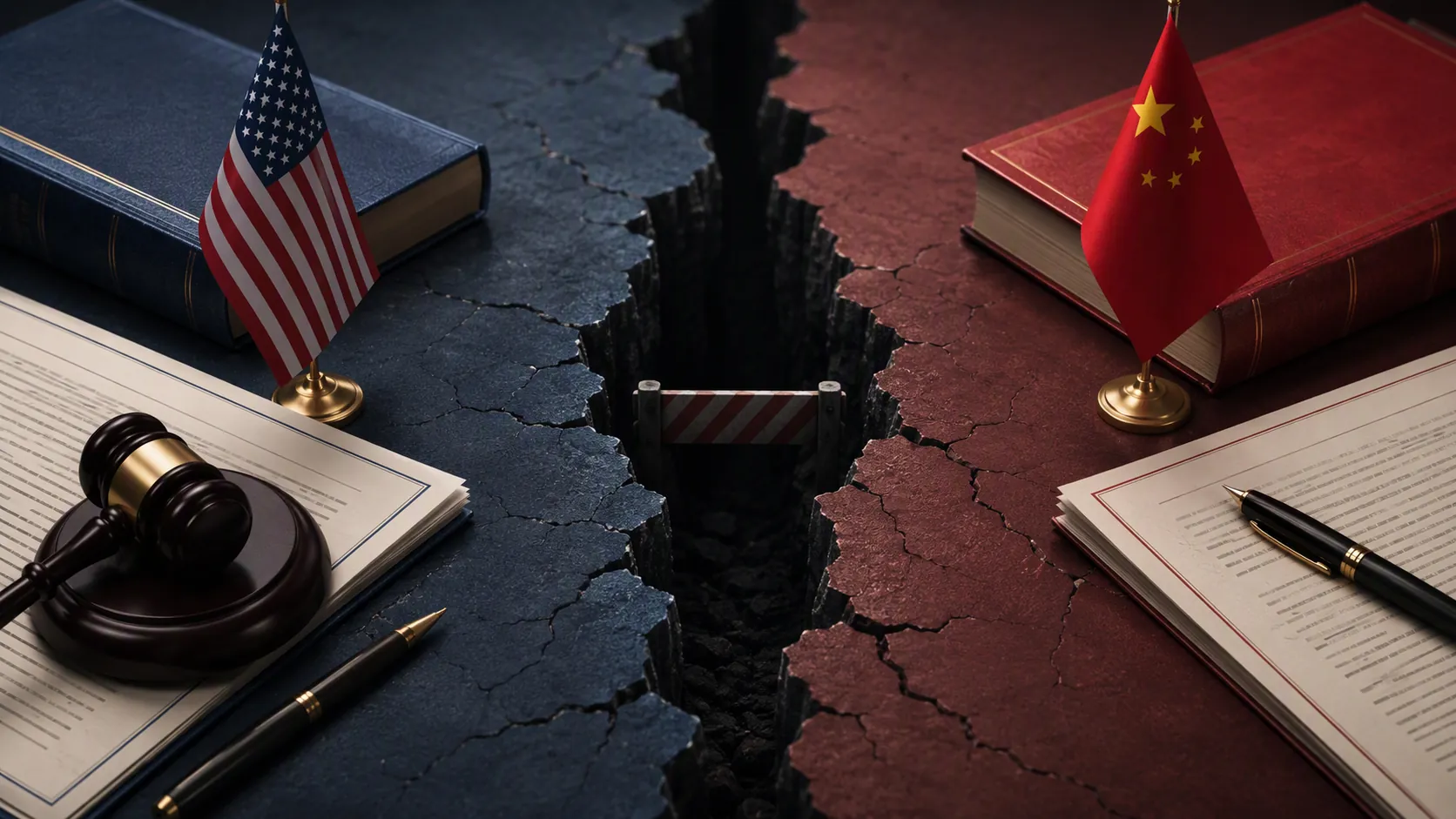
The trap is not that US law and Chinese law express different policy preferences. Companies can often live with that. The trap is that one legal system may require the company to deny a Chinese party access to equipment, services, data, technology, or support, while the other may treat the denial itself as sanctionable conduct. The commercial act is the same. The legal file reads differently depending on which regulator opens it.
The Denial Is Where the Conflict Starts
In a DUV transaction, the decision point is rarely abstract. A sales team wants to know whether it can quote. A field engineer wants to know whether a service call is permitted. A spare-parts desk wants to know whether a replacement component can ship. A China subsidiary wants to know whether it may continue training a customer’s operators. Legal and compliance then ask a familiar US-law sequence: Is the item subject to the EAR? Is the customer or end user restricted? Does the Foreign Direct Product Rule matter? Is there an OFAC sanctions issue? Does any license exception or authorization apply?
If the answer leads to a hold or denial, US compliance usually expects the record to show discipline: screening results, classification analysis, escalation notes, customer communications, and a defensible business instruction. Under China’s April 2026 framework, that same record may also supply the evidence that the company took action because of a foreign measure targeting a Chinese counterparty. That is why the risk is not solved by saying the company did not intend to discriminate. The issue is how the denial is legally characterized.
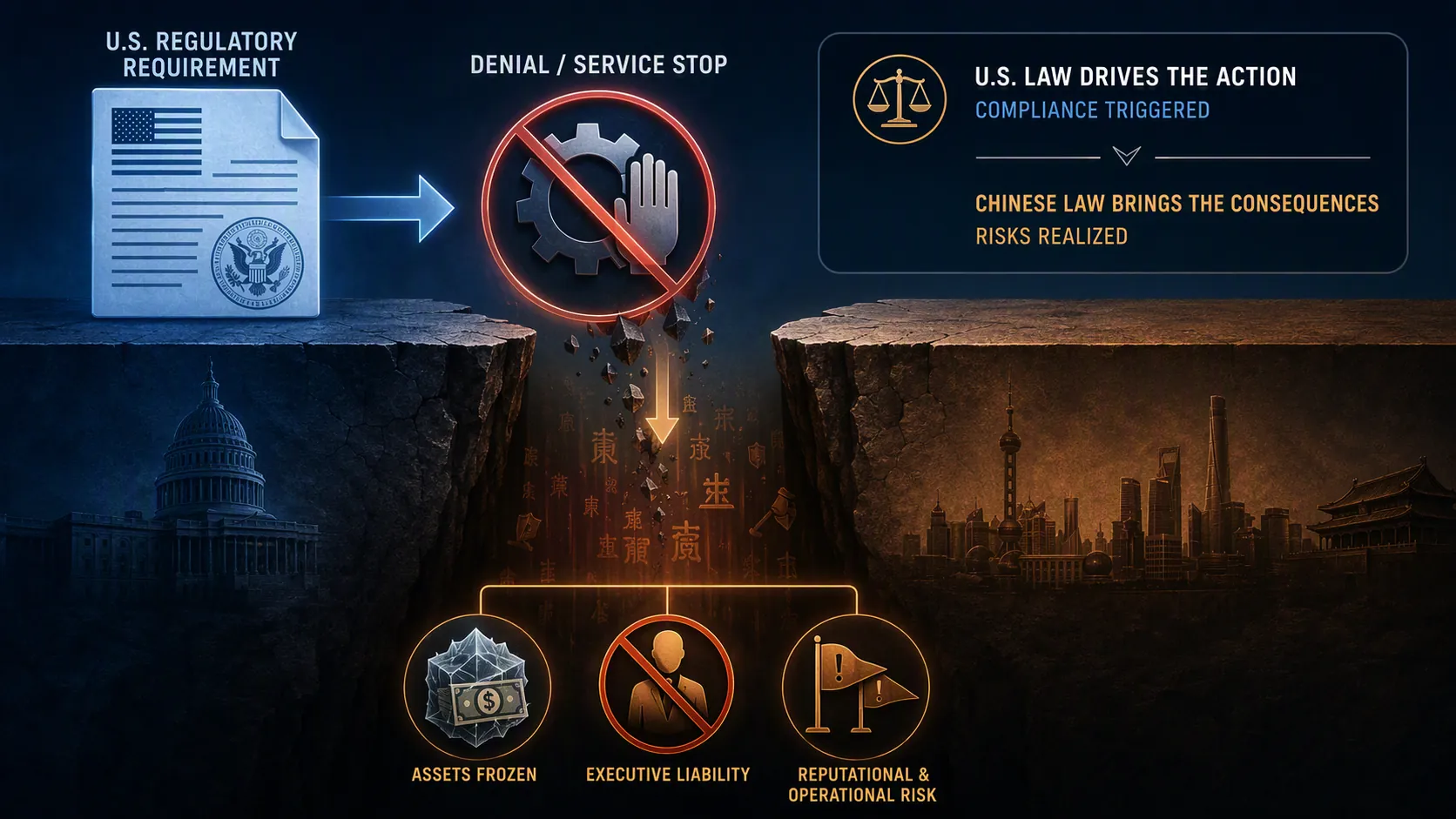
Mayer Brown’s analysis identifies serious potential consequences under the Counter-Extraterritorial Jurisdiction Regulations, including placement on a Malicious Entity List and countermeasures such as trade restrictions, investment prohibitions, data transfer bans, asset freezes, and entry restrictions. The alert also notes that consequences may extend beyond the company to corporate personnel and outside advisers.[1] That last point should not be treated as decorative. In a real export-control escalation, named individuals approve customer notices, advise on denials, and explain the decision to regional management.
| Operational act | US-law compliance reason | China-law exposure point |
|---|---|---|
| Denying DUV equipment to a Chinese customer | Entity List, FDPR, license, or sanctions restriction | Potential characterization as discriminatory or improper extraterritorial compliance |
| Refusing service, parts, updates, or training | Avoiding prohibited support or technology transfer | Potential supply-chain disruption or market-transaction issue |
| Blocking data transfer or technical access | Controlling technology, software, or sanctioned-party exposure | Potential data-transfer or countermeasure trigger under Chinese rules |
| Documenting the denial and its legal basis | Creating an auditable US compliance record | Creating a record that may show reliance on a foreign restrictive measure |
Articles 14 and 15 Create the Supply-Chain Hook
The Industrial/Supply Chain Security Regulations are especially important because they move the issue beyond classic blocking-statute language. Mayer Brown describes Article 14 as authorizing state countermeasures against foreign measures that “improperly disrupt” supply chains, while Article 15 prohibits commercial conduct that violates “normal market transaction principles.”[1] Those phrases are not narrow export-control terms. They are open-textured standards that can reach commercial behavior, not only government action.
That is where ordinary screening becomes uncomfortable. A supplier that refuses a restricted customer because BIS rules require it may believe it is applying neutral legal controls. A Chinese regulator could instead ask whether the supplier departed from normal market transaction principles because of a foreign measure with an insufficient connection to China. The company’s defense may be strong, weak, or fact-dependent; the present problem is that the regulation does not yet tell companies where the line is.
The uncertainty is not only about shipment of tools. DUV equipment relationships include installation, maintenance, upgrades, spare parts, software, technical assistance, and sometimes remote or regional support channels. A denial of an initial sale is easy to spot. A refusal to send an engineer, release a patch, provide training, or transfer diagnostic data may carry the same practical effect for the customer. If the Chinese rule is read through supply-chain continuity rather than formal title transfer, the risk map widens.
US DUV Controls Supply the Mandatory Act
The US side of the conflict does not need to be overstated. For many semiconductor companies, the relevant workflow is already familiar: classify the item, identify applicable US jurisdictional hooks, screen the party, review end use and end user, consider Entity List implications, analyze FDPR exposure where relevant, and check sanctions restrictions. When that review produces a prohibition or licensing requirement that cannot be satisfied, the company stops the transaction.
What changes after April 2026 is not the existence of US export controls. It is the legal meaning that China may attach to compliance with them. A DUV-related denial can be simultaneously mandatory for US purposes and vulnerable under Chinese counter-extraterritorial or supply-chain language. The sequence “comply with US law first, then manage China communications later” is not a reliable legal answer if the China risk attaches to the denial itself.
The suspended BIS Affiliates Rule illustrates why this conflict remains live rather than settled. The rule, adopted in September 2025, is suspended through November 2026 pending US-China diplomatic negotiations, and its future status affects whether exporters would face added ownership-based due diligence obligations.[1] If revived, it could increase the number of transactions that require deeper screening and potential denial. If it remains suspended, the April 2026 China-law problem still exists for denials already required under current US controls.
The proposed MATCH Act should be treated with the same restraint. As of Q3 2026, the proposed countrywide DUV ban remains proposed legislation. If enacted, it could change the architecture of DUV controls by eliminating some node-based distinctions. Until then, it is an uncertainty, not a current rule.
The Undefined Terms Are Not a Comfort
There are no publicly docketed enforcement actions under the April 2026 regulations as of July 2026.[1] That fact matters. It means no company can point to decided cases showing how China will apply “improper extraterritorial measures,” “appropriate connection,” or “normal market transaction principles” in the DUV context. It also means risk assessment must be text-and-commentary-based rather than precedent-based.
But the absence of enforcement precedent does not remove the operational risk. It removes certainty. For in-house teams, that distinction is not academic. A regional business unit may ask whether it can tell a customer, in writing, that service is denied because of a US-law restriction. A headquarters export-control team may ask whether to name BIS restrictions in the denial rationale. An outside adviser may be asked to bless the wording. If Chinese countermeasures can reach corporate personnel and potentially outside advisers, the sign-off chain becomes part of the risk analysis.[1]
Undefined terms also change the drafting problem. A carefully written memo can document why US law required the denial, but it cannot conclusively prove that China will view the act as outside the April 2026 framework. A vague memo may reduce discoverable admissions but leave the company unable to defend its US compliance decision. Neither option is clean. The practical task is conflict mapping, not wordsmithing the conflict out of existence.
- Identify the actor: parent company, China subsidiary, distributor, field-service team, sales office, or outside adviser.
- Identify the required US-law act: deny shipment, stop service, block software, withhold technical data, or suspend training.
- Identify the China-law hook: improper extraterritorial measure, supply-chain disruption, discriminatory conduct, or violation of normal market transaction principles.
- Identify the consequence: Malicious Entity List risk, trade restrictions, investment prohibition, data-transfer ban, asset freeze, entry restriction, or personal exposure.
- Identify the unresolved term that prevents a safe answer, rather than treating the gap as permission to proceed without escalation.
China’s Broader Toolkit Makes the April Rules Harder to Dismiss
The April 2026 regulations do not sit alone. Kim & Chang’s April 2026 analysis discusses March 2026 amendments to China’s Foreign Trade Act that enhanced sanctions authority, along with China’s broader trade-law toolkit.[2] WilmerHale’s December 2024 analysis described earlier Chinese measures responding to US export restrictions, including restrictions involving gallium, germanium, and antimony and use of existing countermeasure mechanisms.[3] Those materials do not prove how the new DUV-related conflict will be enforced. They do show that the April regulations fit within an expanding countermeasure architecture rather than appearing as isolated text.
That distinction matters for legal risk. A newly effective rule with no precedent can be treated as symbolic only if the surrounding system gives reason to think it will remain symbolic. The available materials point the other way: China has been adding tools that can respond to foreign restrictions, and the April 2026 rules are written broadly enough to reach private commercial conduct connected to those restrictions.[1][2][3]
What Ordinary Compliance Sequencing Cannot Solve
A standard multinational compliance sequence assumes that conflicts can be routed: first determine the mandatory rule, then document the decision, then manage local-law consequences. That sequence works when the second jurisdiction regulates procedure, notice, employment, privacy, or contract termination after the main legal act has been decided. It works less well when the second jurisdiction may punish the legal act itself.
For DUV equipment companies and semiconductor suppliers with China exposure, the April 2026 rules therefore require more than an update to customer-screening checklists. They require escalation protocols that recognize a denial may be both compulsory and sanctionable, depending on the jurisdiction. The business team needs to know who can approve a stop, who can communicate it, whether the China subsidiary should participate, whether technical support should be frozen immediately or staged, and whether the legal rationale will be recorded in a way that can be defended on both sides.
This is not an argument for violating US law, and it is not advice to soften required export-control decisions. It is a warning against treating the China side as a postscript. Once a company denies DUV equipment, parts, service, software, or technical support because of US restrictions, the Chinese-law issue may already have been created. No later communications plan can fully separate the customer-facing act from the legal reason behind it.
As of Q3 2026, the most defensible conclusion is narrow but serious: multinational semiconductor firms cannot resolve this conflict by ordinary compliance sequencing. The same DUV-related denial may be required under US export-control or sanctions rules and potentially sanctionable under China’s untested April 2026 counter-extraterritoriality and supply-chain framework. Until enforcement practice defines the operative terms, the legal risk sits inside the transaction decision itself.
References
- China Expands Its Playbook: New Industrial/Supply Chain and Counter-Extraterritoriality Regulations Create Direct Compliance Conflicts for Multinationals, Mayer Brown, May 5, 2026
- China Strengthens Export Control and Sanctions Regime Through Amendments to Foreign Trade Act, Kim & Chang, April 22, 2026
- China Imposes Series of Measures to Counter U.S. Export Restrictions, WilmerHale, December 26, 2024
Related records
Tool profile
Browse tool evaluations →Governing regulation
Browse the obligations tracker →Preventive workflow
Browse verification workflows →
Report a correction or tip
Spotted an outdated figure, a misstated fact, or a ruling this case record should reflect? Public comments are disabled for this content given the professional cost of a misreported case outcome, penalty amount, or rule text — use the structured correction channel instead.
Report a correction or tip for this record →