
Chris Brown Pleads Guilty to Affray Over London Nightclub Attack
A structured case record of Chris Brown's July 2026 affray guilty plea at Southwark Crown Court, covering the CCTV-driven evidence, plea negotiation dynamics, £5M bail, and sentencing exposure under the Sentencing Council guideline. The record explains why affray carries a maximum 3-year sentence and how the dropped charges reduced Brown's maximum exposure from ~16 years.
- Jurisdiction
- United Kingdom
- Court
- Southwark Crown Court
- Judge
- Tony Baumgartner
- AI tool named
- None
- Ruling date
- Jul 24, 2026
- Source document
- View primary court order ↗
- Last verified
- Jul 26, 2026
Lex Machina Review is an independent risk-tracking and reference resource. Nothing on this site is legal advice, and using it does not create an attorney-client relationship. Every record is reviewed against primary sources but may not reflect the most current status of a matter — always verify directly against the cited court order, rule text, or a licensed attorney before relying on it.
Companion explanation — secondary to the source document above
Chris Brown’s London nightclub affray case now has a narrower legal shape than the original charging package suggested. On July 24, 2026, Brown pleaded guilty at Southwark Crown Court to affray under section 3 of the Public Order Act 1986, with sentencing listed for October 26, 2026, before Judge Tony Baumgartner. His co-defendant, Omololu Akinlolu, entered the same plea. The Crown Prosecution Service described the conviction as one for using unlawful violence after an attack at Tape nightclub in Mayfair on February 19, 2023.[1]
That plea did not make the case small. It made it procedurally different. The prosecution accepted a conviction on affray while dropping charges of attempted grievous bodily harm with intent, assault occasioning actual bodily harm, and possession of an offensive weapon. On the figures reported for the original package, Brown moved from exposure of roughly 16 years across the charged offenses to an affray count with a statutory maximum of three years.[1][2]
What the Crown Still Had
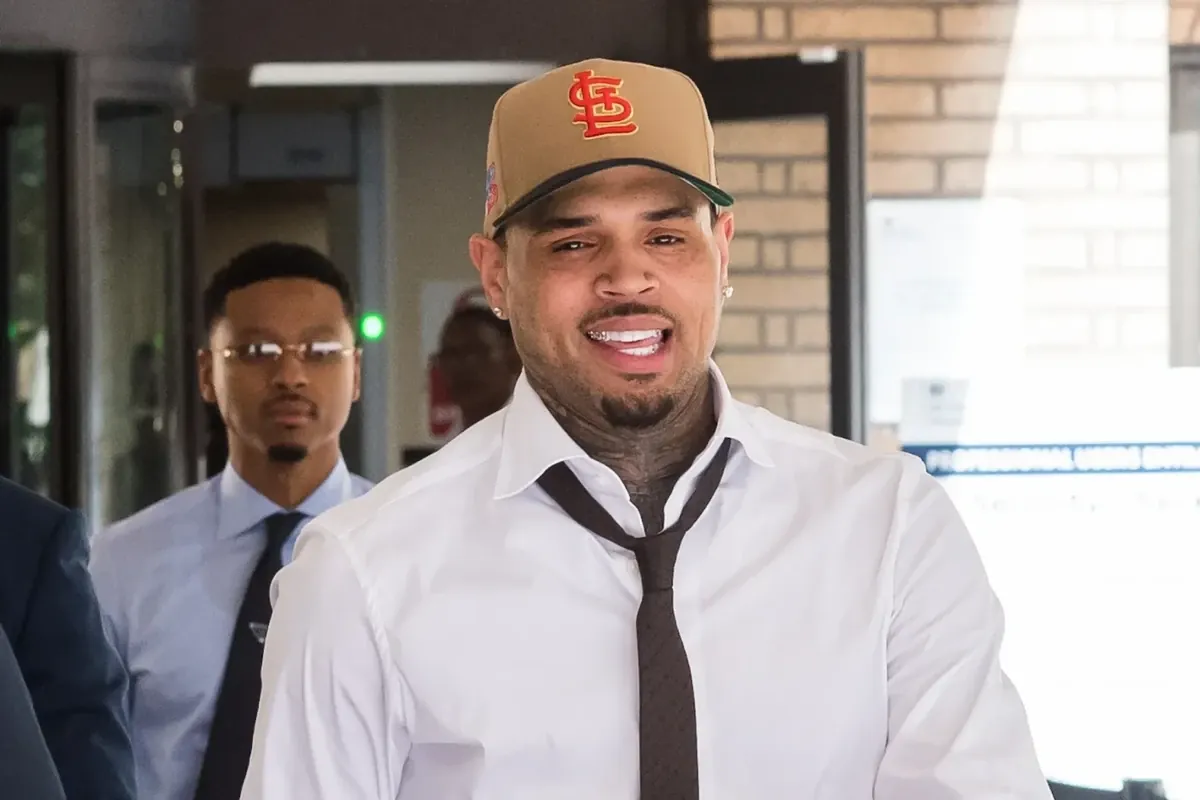
The factual allegation was not a vague disturbance in a club. Prosecutors said Brown struck music producer Abe Diaw twice over the head with a bottle at Tape nightclub, then pursued him and kicked him while he was on the floor. The CPS said the incident was captured on CCTV.[1]
That matters because video evidence changes the bargaining environment. A defendant can challenge identification, context, intent, injury, admissibility, or the interpretation of movement on a recording. But a jury seeing alleged bottle strikes followed by pursuit and kicking a person on the floor is different from a jury hearing only a disputed account of a late-night confrontation. The Crown’s leverage was not that Brown was famous; it was that the prosecution said it had a visual record of violence.
The public attention around the case followed Brown because of his career, his tour, and his existing reputation. Legally, those facts sit at the edge of the file unless they bear on bail, attendance, or risk. The central record is a violent-conduct allegation supported by CCTV, followed by a negotiated guilty plea to a public-order offense.
How the Charges Moved
The procedural arc began with the alleged February 19, 2023, incident and moved slowly until Brown’s arrest in Manchester. He was arrested at about 2 a.m. on May 15, 2025, at the Lowry Hotel under a warrant issued in connection with the London allegation. He spent six days in custody at HMP Forest Bank before bail was granted on May 21, 2025.[2][3]
Brown initially pleaded not guilty in 2025. The July 2026 plea reversal therefore came after the parties had lived with the indictment, the evidence, the court calendar, and the practical consequences of taking a high-profile foreign defendant to trial. Reports described the guilty plea as one to a lesser charge, but that shorthand can obscure what was preserved: a conviction for unlawful violence.[2][4]
| Stage | Legal Significance |
|---|---|
| Original case theory | Attempted grievous bodily harm with intent, assault occasioning actual bodily harm, and possession of an offensive weapon exposed Brown to a substantially higher sentencing ceiling. |
| Evidence posture | The Crown said CCTV captured the bottle strikes, pursuit, and kicking, making trial risk concrete rather than abstract. |
| Final plea | Affray secured a criminal conviction while reducing the statutory maximum to three years. |
| Sentencing posture | The plea leaves punishment unresolved until October 26, 2026. |
For the defense, the avoided risk was obvious. Attempted grievous bodily harm with intent is qualitatively different from affray because it centers on an alleged intent to cause very serious injury and carries a maximum of life imprisonment. The additional counts of assault occasioning actual bodily harm and possession of an offensive weapon carried reported maxima of five years and four years respectively. Together, the abandoned charges created an approximate 16-year exposure profile.[1][2]
For the Crown, the compromise retained a conviction that fits the public-order character of the alleged footage. Affray is committed where a person uses or threatens unlawful violence toward another, and the conduct would cause a person of reasonable firmness present at the scene to fear for personal safety. The offense can be committed in private as well as public, and it carries a maximum sentence of three years on indictment.[5]
That statutory definition is why “lesser charge” is only half the story. Affray does not require the court to sentence as though the conduct was merely noisy or disorderly. It allows the court to punish unlawful violence by reference to culpability, harm, aggravation, mitigation, and any credit for plea.
Why the Three-Year Cap Still Leaves Custody in Play
No sentence has been imposed. The October 26, 2026, hearing is the point at which the judge will decide where the case sits within the guideline and what credit, if any, applies for the plea. Anything firmer than exposure analysis would overstate the record.
The Sentencing Council guideline for affray divides cases by culpability and harm. Category A culpability includes, among other factors, use of a weapon, high level of violence, or sustained attack. Category 1 harm includes serious injury, a substantial risk of serious injury, or serious fear and distress throughout an incident. For a Category A / Category 1 case, the guideline gives a starting point of two years’ custody, with a category range from one year six months to two years nine months’ custody.[6]
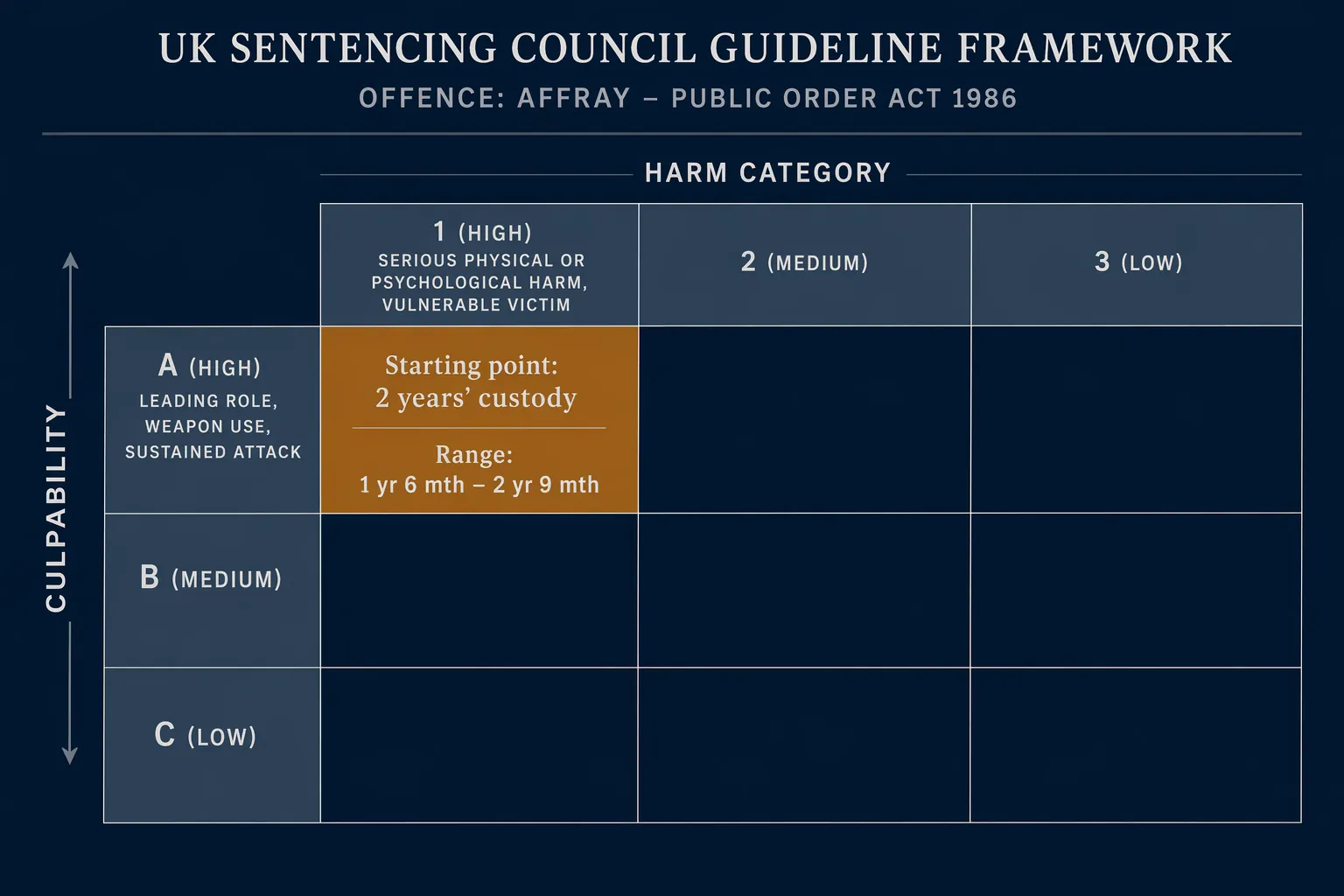
On the known allegations, the conduct maps plausibly to Category A culpability and Category 1 harm: bottle strikes to the head, pursuit, and kicking a person on the floor are the facts that make that mapping serious. But that is an application of the published guideline to reported facts, not a judicial finding. The sentencing judge could classify culpability or harm differently after hearing the parties.
The court will also have to deal with the timing of the plea. Brown did not plead guilty at the first practical opportunity in 2025; he entered the affray plea in July 2026 after earlier not-guilty pleas. The available record does not establish what credit the court will allow. It only establishes that the plea came before trial and after the case had already moved through a substantial procedural history.[2][4]
The Bail Package as Risk Control
The bail history is unusually instructive for international clients. After six days in Forest Bank, Brown was released on a £5 million security, reported by U.S. outlets at about $6.7 million to $6.75 million depending on exchange rate. The bail order allowed him to continue the Breezy Bowl XX world tour, but it did not treat touring as a reason to remove controls.[2][3][4]
The passport condition is the detail to notice. Brown was required to surrender his passport except when traveling to countries listed for tour purposes. That structure addressed flight risk while preserving a controlled form of mobility. Money helped make release possible, but only inside a court-managed framework of security, route-specific permission, and continuing jurisdiction.[3][4]
For a foreign defendant, the lesson is practical rather than glamorous. The court can permit work travel and still impose conditions that make each movement legally consequential. A missed return, unauthorized destination, or condition breach can turn a managed prosecution into a custody problem.
The Civil Dismissal Does Not Dispose of the Criminal Case
Diaw also brought a civil claim over the incident, reported in U.S. coverage as a $16 million lawsuit and elsewhere as approximately £12 million. That lawsuit was dismissed with prejudice in July 2025.[7]
That fact should stay in its lane. A civil dismissal with prejudice ends that civil claim; it is not an acquittal, a sentencing finding, or a determination that the criminal allegation lacked merit. The criminal case continued, and the Crown later obtained the affray guilty plea.
What Remains Open Until October
The remaining uncertainty is not whether Brown has a conviction on this case; he does. The uncertainty is sentence. Judge Tony Baumgartner will have to sentence for affray, not for the dropped counts, while still evaluating the facts that make up the admitted unlawful violence. The prosecution and defense may disagree about culpability, harm, aggravating features, mitigation, and plea credit.[2][6]
Akinlolu’s identical plea also matters procedurally, though the available record does not support assuming identical sentences. Co-defendants can plead to the same offense and still receive different outcomes depending on role, prior history, mitigation, and the judge’s assessment of participation.
Brown secured a materially narrower conviction than the original charges exposed him to. He did not secure a symbolic disposal. In a UK public-order prosecution, strong video evidence can drive a late plea to a lower count while still leaving a foreign defendant facing custody, passport controls, and substantial financial security until the court reaches sentence.
References
- Singer Chris Brown convicted of using unlawful violence following attack in London nightclub, Crown Prosecution Service
- Chris Brown: US singer pleads guilty to affray over 'vicious' nightclub attack in London, BBC News
- US singer Chris Brown pleads guilty to brawling at London nightclub, CNN, July 24, 2026
- Singer Chris Brown pleads guilty to affray over London club confrontation, The Guardian, July 24, 2026
- Public Order Act 1986, Section 3, legislation.gov.uk
- Affray, Sentencing Council
- Chris Brown Pleads Guilty to Lesser Charge in 2023 London Club Assault, Billboard
Related records
Tool profile
Browse tool evaluations →Governing regulation
Browse the obligations tracker →Preventive workflow
Browse verification workflows →
Report a correction or tip
Spotted an outdated figure, a misstated fact, or a ruling this case record should reflect? Public comments are disabled for this content given the professional cost of a misreported case outcome, penalty amount, or rule text — use the structured correction channel instead.
Report a correction or tip for this record →