
Chris Brown affray: sentencing analysis under 2026 law
Applying the UK Sentencing Council affray guideline to Chris Brown's guilty plea produces a starting point of two years, reduced to approximately 16 months after guilty-plea credit. That headline sentence exceeds the Sentencing Act 2026's 12-month presumption-of-suspension threshold, meaning the court retains discretion on whether to impose immediate custody or a suspended sentence, with the defendant's 2009 US assault conviction as a key aggravating factor.
- Jurisdiction
- United Kingdom
- Court
- Southwark Crown Court
- Judge
- Tony Baumgartner
- AI tool named
- None
- Ruling date
- Jul 24, 2026
- Source document
- View primary court order ↗
- Last verified
- Jul 25, 2026
Lex Machina Review is an independent risk-tracking and reference resource. Nothing on this site is legal advice, and using it does not create an attorney-client relationship. Every record is reviewed against primary sources but may not reflect the most current status of a matter — always verify directly against the cited court order, rule text, or a licensed attorney before relying on it.
Companion explanation — secondary to the source document above
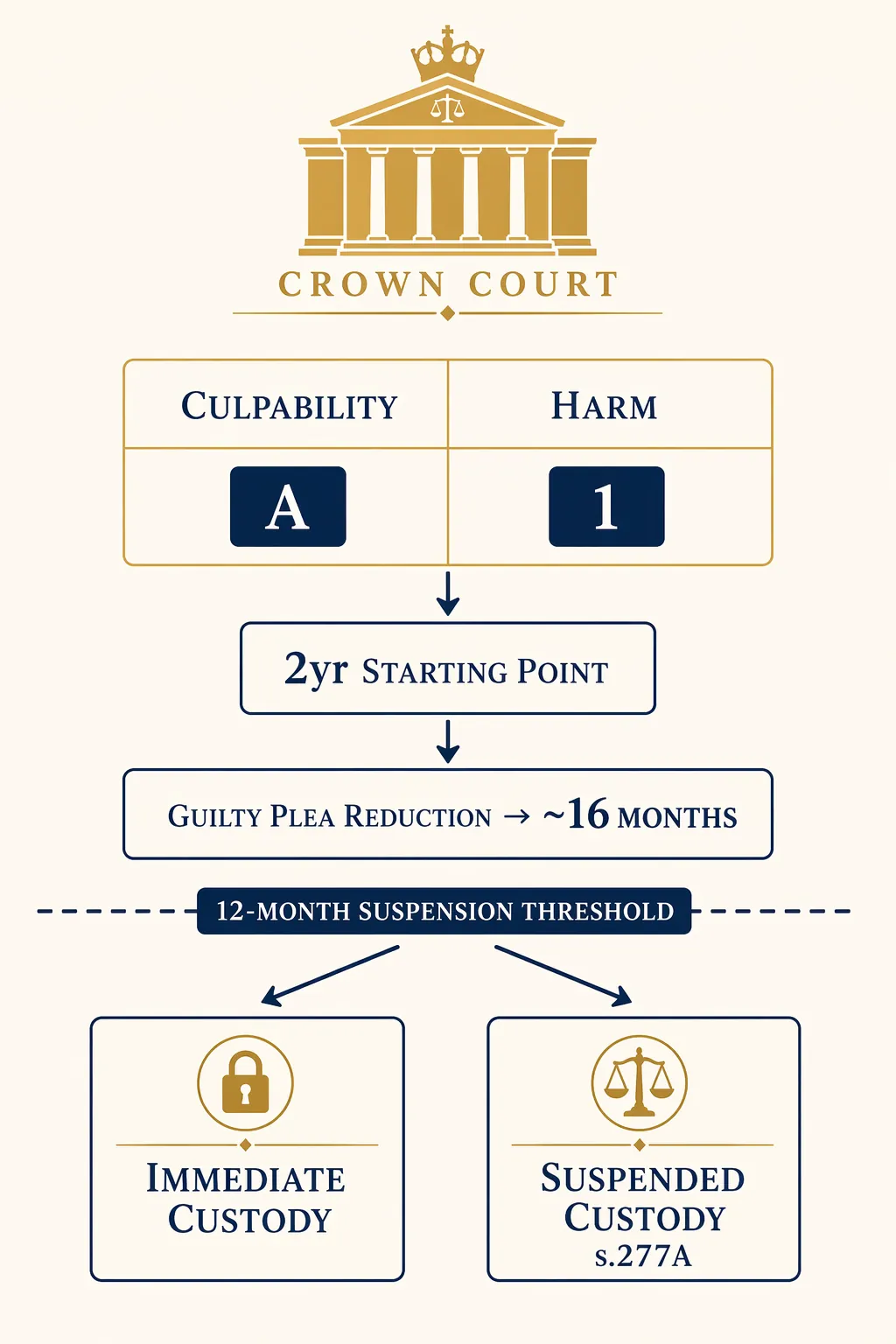
The useful starting estimate after Chris Brown’s affray guilty plea is not “prison” or “no prison.” It is this: on the publicly reported facts, the Sentencing Council affray guideline points to Culpability A and Harm Category 1, with a two-year starting point and a range of 18 months to two years and nine months.[1] If the court gives the full one-third reduction for a guilty plea at the first reasonable opportunity, the headline sentence falls to about 16 months.[2]
That number matters because the Sentencing Act 2026 did not simply make short custody disappear. The new presumption that custodial sentences of 12 months or less should be suspended, subject to exceptions, took effect on 22 March 2026.[3] A sentence around 16 months sits above that threshold. The court may still suspend it under the enlarged 2026 suspended-sentence power, but Brown does not get there by the automatic route.
The plea fixes the route, not the result
Brown pleaded guilty to affray at Southwark Crown Court on 24 July 2026. Sentencing is scheduled for 26 October 2026 before Judge Tony Baumgartner. The CPS statement reported by the BBC described the attack as “vicious and unprovoked.”[4] That language is not just atmospheric. In a public-order violence case, it points directly toward the seriousness assessment the sentencing judge must make.
The earlier bail history is less important for sentence. Brown was arrested on 15 May 2025, released from Forest Bank prison after about six days, and granted bail on 21 May 2025 with £5 million security.[4] Those facts explain why the case has had a long public tail. They do not set the custody threshold, aggravate harm, or substitute for the guideline exercise.
Why affray is the operative charge
Affray is not measured by whether spectators on social media were alarmed. The CPS charging standard applies the statutory “hypothetical bystander” test: whether a person of reasonable firmness present at the scene would fear for their personal safety. The same CPS guidance also warns against overcharging merely to encourage a plea.[5]
That matters because the sentencing court is not sentencing a generalized celebrity assault narrative. It is sentencing the public-order offence admitted by the plea. The violence, the alleged weapon use, the setting, and the prosecutor’s description all matter only insofar as they place the offending within the affray guideline.
The guideline category is doing most of the work
The Sentencing Council affray guideline separates culpability from harm. Culpability A covers the highest seriousness in the guideline, including cases involving a weapon or equivalent high culpability features. Harm Category 1 covers the most serious harm bracket, including cases involving serious disorder or substantial impact.[1] On the known public facts, the combination of an allegedly violent, unprovoked attack and the prosecution account supports analysis in that top category pairing.
| Guideline step | Application on known facts | Effect |
|---|---|---|
| Culpability | Culpability A | Highest culpability bracket under the affray guideline |
| Harm | Harm Category 1 | Highest harm bracket under the affray guideline |
| Starting point | 2 years | Before plea credit and case-specific adjustment |
| Category range | 1 year 6 months to 2 years 9 months | The normal range before adjustment for aggravating and mitigating factors |
| Full guilty-plea reduction | Approximately 16 months from a 2-year starting point | Above the 12-month presumption-of-suspension threshold |
The table is not a prediction of the final order. It is the disciplined midpoint before the case-specific arguments start. The judge may move within the range after aggravating and mitigating factors, and the court is not bound to preserve the two-year starting point if the facts proved or accepted at sentence justify a different placement. But if the case remains in Culpability A / Harm Category 1, the published starting point is two years.[1]
That is why low-level affray comparisons are unhelpful. The category range for this placement starts at 18 months.[1] A sentence has to travel some distance downward before the 2026 12-month presumption becomes directly engaged.
The guilty plea reduces the sentence, but not enough to control suspension
The guilty plea is still significant. Under the Sentencing Council guilty-plea guideline, the maximum reduction is one third where the plea is entered at the first reasonable opportunity.[2] Applied arithmetically to a two-year starting point, that gives roughly 16 months.
The arithmetic is simple, but the assumption behind it is not. Public reporting establishes the guilty plea date. It does not by itself establish that the plea came at the first reasonable opportunity for guideline purposes. If the court gives less than one-third credit, the headline sentence rises. If the court moves below the two-year starting point before applying credit, the headline falls. Those are sentencing decisions, not media arithmetic.
For exposure analysis, the full one-third figure is still the cleanest benchmark. It shows that even on the most favorable standard plea discount, the projected sentence remains above 12 months. The plea narrows the custody question; it does not answer it.
What the Sentencing Act 2026 changes
The 2026 Act changed the suspension architecture in two distinct ways. First, it inserted a presumption that custodial sentences of 12 months or less must be suspended unless an exception applies, including where there is a significant risk of serious harm from further offending. Second, it introduced a new power allowing suspension of custodial sentences up to three years.[3]
Those two changes should not be collapsed. A 16-month sentence is outside the 12-month presumption, so the court is not starting from mandatory suspension subject to exceptions. But because the new suspended-sentence power reaches up to three years, Judge Baumgartner would still have the statutory capacity to suspend a sentence in the projected range.[3]

The practical consequence is a narrower but more important question: not whether the new Act automatically saves Brown from immediate custody, but whether the court treats immediate custody as necessary after applying the guideline, the plea credit, the aggravating material, and the new suspension power.
The prior US conviction is aggravating, not conclusive
Brown’s 2009 US felony-assault conviction is legally relevant, but it is not a sentencing trump card. Section 65(4A) of the Sentencing Act 2020 permits courts in England and Wales to treat foreign convictions as aggravating factors. Sentencing Council guidance also recognizes that older convictions may carry reduced weight, depending on their age and relevance.[6]
That creates the hard edge of the case. The prior conviction is for violence and is plainly capable of mattering. It is also 17 years old. A court may regard that history as increasing the need for punishment, deterrence, or protection of the public. It may also give the conviction less weight because of the time elapsed. Both positions are available within orthodox sentencing reasoning.
The same tension feeds into the 2026 Act analysis. The exception for a “significant risk of serious harm from further offending” is central to the presumption-of-suspension scheme, but there is no settled body of case law yet explaining how that exception should operate under the new Act.[3] A court dealing with Brown after March 2026 is therefore applying a fresh statutory structure to familiar sentencing concerns.
Where the sentencing exposure lands
On the presently public facts, the clean guideline route is: Culpability A, Harm Category 1, two-year starting point, full guilty-plea credit to about 16 months, then a custody-versus-suspension decision under the post-22 March 2026 statutory framework.[1][2][3]
That route does not place the case in the low-level affray territory where the new 12-month suspension presumption would obviously do most of the work. It places the case above that threshold, while still within the new three-year suspended-sentence power. The decisive margin is therefore evaluative: how the court assesses the seriousness of the affray, how much weight it gives the 17-year-old foreign conviction, and whether immediate custody is necessary.
That is as far as the law safely takes the prediction. The guideline supplies the starting point; the plea supplies the reduction; the 2026 Act supplies a new suspension architecture. The final order remains for the sentencing judge, on reasons stated in open court. This is sentencing analysis, not legal advice and not a forecast of the order that will be imposed.
References
- Affray, Sentencing Council.
- Reduction in sentence for a guilty plea, Sentencing Council.
- Sentencing Act 2026: What You Need to Know, Mountford Chambers.
- Chris Brown pleads guilty to assaulting music producer in London nightclub, BBC.
- Public Order Offences incorporating the Charging Standard, Crown Prosecution Service, 1 April 2026.
- Sentencing Act 2020, section 65, legislation.gov.uk.
Related records
Tool profile
Browse tool evaluations →Governing regulation
Browse the obligations tracker →Preventive workflow
Browse verification workflows →
Report a correction or tip
Spotted an outdated figure, a misstated fact, or a ruling this case record should reflect? Public comments are disabled for this content given the professional cost of a misreported case outcome, penalty amount, or rule text — use the structured correction channel instead.
Report a correction or tip for this record →