
What Happens Legally When an AI Data Center Trips the Grid?
AI data center UPS systems can silently trip over a gigawatt off the grid in milliseconds, yet no contract, statute, or regulatory standard assigns liability for the resulting disturbance. This analysis maps the novel legal exposures—negligence, products liability, SLA disputes, and FERC enforcement—for data center operators, AI companies, and utilities before the first precedent-setting case.
- Jurisdiction
- US-Federal
- Court
- NERC
- AI tool named
- Data center UPS/ATS
- Ruling date
- Jul 25, 2026
- Source document
- View primary court order ↗
- Last verified
- Jul 25, 2026
Lex Machina Review is an independent risk-tracking and reference resource. Nothing on this site is legal advice, and using it does not create an attorney-client relationship. Every record is reviewed against primary sources but may not reflect the most current status of a matter — always verify directly against the cited court order, rule text, or a licensed attorney before relying on it.
Companion explanation — secondary to the source document above
The fault is already clearing. Voltage is recovering. The transmission system is doing the thing it was designed to do. Then, before an operator can pick up a phone or a contract notice period can begin to matter, the data center’s own protection equipment decides the incoming power is not good enough and drops the load.
That is the uncomfortable starting point for AI data center grid disturbance liability. The legal problem is not simply that artificial intelligence needs large quantities of electricity. It is that a customer-side device meant to protect uptime can remove a gigawatt-scale load in milliseconds, turning an ordinary reliability event into a dispute over design choices, interconnection assumptions, contract carveouts, and regulatory jurisdiction.
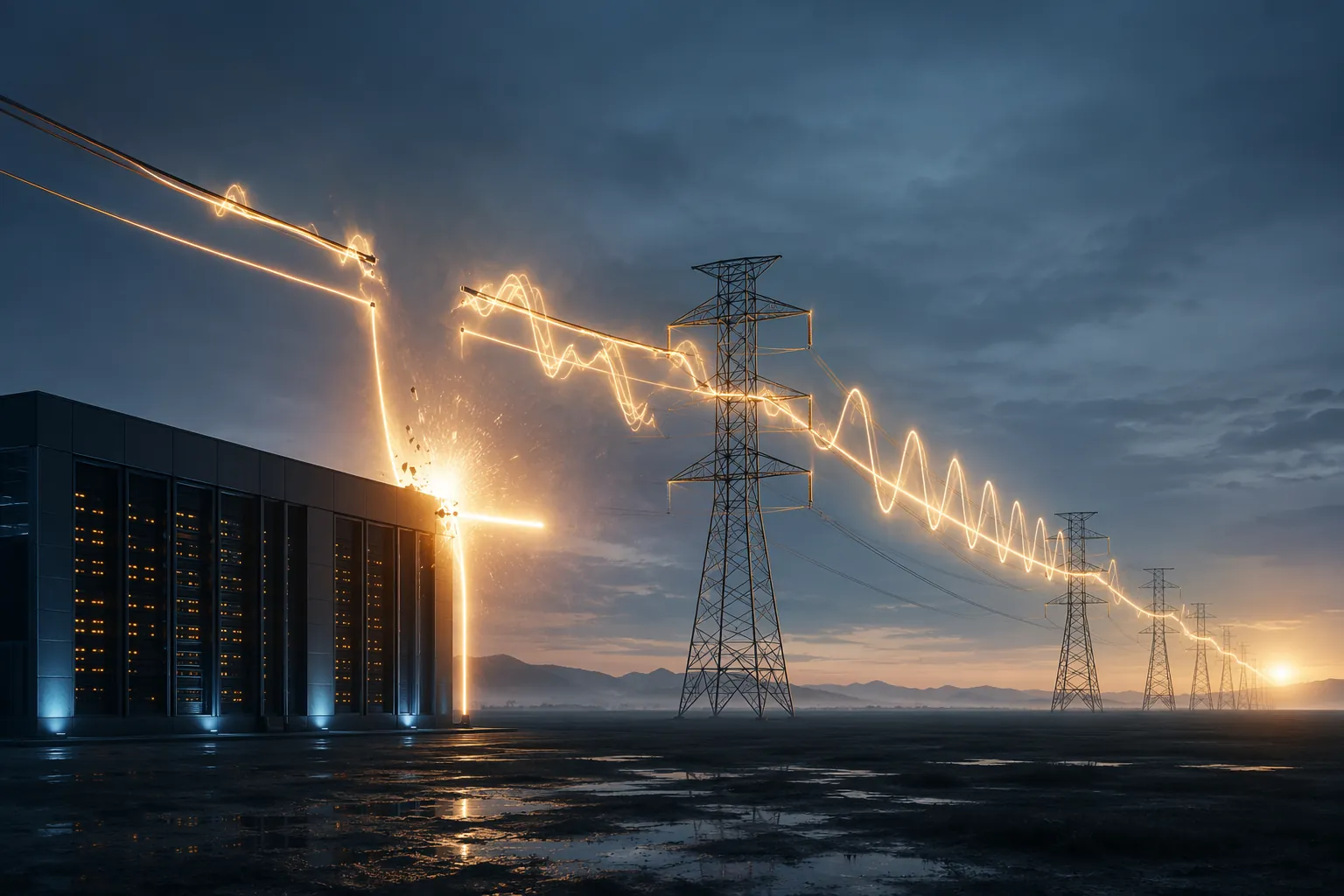
NERC’s 2026 reliability materials, as reported in TechTimes, describe a February 2025 Eastern Interconnection event in which 1,800 MW of load disconnected in a fraction of a second, the largest documented single load-loss event from a non-forced outage and a loss exceeding the output of two typical coal plants. The same reporting identifies additional 2025 Customer-Initiated Load Reduction events of 428 MW, 227 MW, 540 MW, and 1,300 MW, plus nine ERCOT events above 100 MW. The 1,800 MW figure should not be treated as raw courtroom-grade telemetry here; the publicly available reporting does not independently verify the measurement method behind the number. But even with that caution, the pattern is no longer hypothetical. [1]
The Disturbance Is Customer-Side Before It Is a Lawsuit
NERC’s Level 3 Alert describes the mechanism in practical terms: large-load facilities, including data centers, may use uninterruptible power supply systems and automatic transfer switching logic that senses voltage sags from transmission faults and trips before voltage recovery completes. The equipment is not waiting for a regional blackout. It is reacting to a transient condition and disconnecting load as a protection response. [2]
That distinction matters because most legal vocabulary around outages assumes a cleaner separation. The utility supplies power. The customer consumes power. The equipment protects the customer’s facility. A force majeure clause excuses performance when outside events prevent performance. A reliability standard governs registered grid actors. CILR events disturb those boundaries. The grid event may originate outside the facility, but the scale and speed of the load loss may be determined inside the facility.
NERC did not treat this as a curiosity. On May 4, 2026, it issued a Level 3 Alert and related reliability guidance focused on large-load challenges, with responses due August 3, 2026. NERC also stated in its March 2026 white paper that “existing Reliability Standards and existing processes related to BPS planning, operations, and security are inadequate to address the risks posed by emerging large loads.” That sentence will matter later because it is both a warning and an admission: the risk is now documented, but the rulebook is still catching up. [2]
Morgan Lewis described the same alert as moving data centers from emerging risks into planning obligations. That is a useful way to read it, provided the word “obligations” is not overstated. The alert is not yet a finished computational-load liability code. It is, however, the kind of document that later appears in discovery when someone asks what a data center operator, utility planner, reliability coordinator, or AI customer knew in Q3 2026. [3]
Why Ordinary Outage Language Is Too Slow
Milliseconds are not just engineering color. They are the fact that makes familiar legal machinery look late. Notice-and-cure provisions assume a party can be told about a problem and given time to fix it. Operational-control language assumes someone has meaningful discretion before the loss occurs. Mitigation duties assume there is a post-breach interval in which conduct can reduce harm. In a CILR event, the most important operational decision may have been embedded in UPS ride-through settings, transfer-switch logic, commissioning tests, interconnection studies, and modeling assumptions long before the voltage sag.
That is why the legal analysis should not begin with a broad claim that “the grid failed.” It should begin with a narrower chain: a transmission fault occurred; the grid’s voltage was recovering; the facility’s protection logic interpreted the condition; load disconnected at extraordinary scale; the resulting disturbance propagated into a reliability, commercial, or loss-allocation problem. Each link has a different actor, a different document trail, and a different standard of care.

The Liability Vacuum Is Not Empty; It Is Overcrowded
No current NERC Reliability Standard directly governs data center load-trip behavior as a category. NERC’s PERC1 model, the Level 3 Alert, and the seven Essential Actions described in the alert materials are interim measures rather than a mature liability framework. NERC’s Project 2026-02 process may produce a formal Reliability Standard, but the target is later than the present risk window. [2]
That does not mean no one has exposure. It means the exposure will be argued through older channels: negligence, products liability, contract interpretation, insurance coverage, interconnection duties, state utility oversight, and FERC/NERC enforcement. Each channel asks a slightly different version of the same question: who had a reasonably knowable risk, a reasonably available control, and a document or rule that placed the consequence somewhere other than the courthouse floor?
Negligence Starts With Foreseeability, Not With Blame
A negligence claim would not need to prove that a data center caused the original grid fault. It would frame the alleged breach differently: by 2026, was it reasonably foreseeable that UPS or automatic transfer switch settings at a very large computational-load facility could disconnect load during a cleared or clearing transmission disturbance? If so, what ride-through capability, modeling, commissioning, utility coordination, or operational procedure was reasonable?
The difficulty for plaintiffs is that “reasonable” will not be self-defining. A data center operator may argue that protection logic was configured to prevent equipment damage, preserve critical IT operations, or comply with manufacturer specifications. A utility may argue that interconnection studies did not capture customer-side tripping behavior at the relevant scale. An AI customer may argue it bought uptime, not power-system engineering. Those defenses do not eliminate negligence exposure, but they show why CILR litigation will likely turn on pre-event records rather than post-event rhetoric.
The NERC alert changes that record. After May 2026, it becomes harder for a sophisticated actor to say the phenomenon was unknowable. The harder question is whether the actor had enough control to do anything useful before formal standards arrived.
Products Liability Is a Narrower but Sharper Theory
Products liability would shift attention from the operator’s conduct to the equipment’s design. A claimant could argue that UPS or transfer-switch logic was defectively designed because it failed to ride through foreseeable voltage sags or because warnings did not adequately disclose system-scale disconnection risk at large-load facilities. KTSL’s 2026 alert identifies products liability, negligence, contract, and regulatory theories as plausible pathways for AI data center energy disputes, but plausibility is not the same as an adjudicated rule. [4]
The manufacturer’s response would likely be equally technical: the device protected the load it was designed to protect; the customer selected the settings; the facility integrated the system; the utility supplied the grid conditions; and no binding standard required a different ride-through profile for computational load. A design-defect case becomes stronger if discovery shows that the vendor knew its settings could create gigawatt-scale disconnection under common disturbance conditions and treated the issue as a customer-side configuration detail.
The Contract Fight Will Arrive Before the Tort Law Settles
The first expensive disputes may not look like public reliability cases. They may look like uptime claims, service credits, indemnity demands, construction-delay claims, curtailment disputes, or business-interruption coverage fights after an AI workload goes offline and everyone discovers that the contract describes ordinary outages better than customer-initiated grid disturbances.
Quinn Emanuel’s June 2026 client alert focuses on force majeure allocation in AI data center contracts, while Data Center Dynamics has separately examined who pays when a multibillion-dollar data center goes down. The common pressure point is familiar: high-availability arrangements often promise extremely high uptime and include force majeure carveouts, but they may not expressly address a grid-originated disturbance amplified or triggered by the facility’s own protection systems. [5][6]
That ambiguity is not academic. If the outage is characterized as an external grid event, a provider may invoke force majeure or an SLA exclusion. If it is characterized as a failure of facility design, commissioning, or protection coordination, the customer may call it a service failure. If both are true, the clause may not have been drafted for the mixed-causation problem at all.
Standard force majeure analysis usually asks whether the event was beyond the affected party’s reasonable control, unforeseeable or not reasonably preventable under the contract’s wording, and causally responsible for nonperformance. CILR complicates each element. The initiating fault may be external, but the trip logic is internal. The voltage sag may be unavoidable, but ride-through behavior may be configurable. The outage may be sudden, but the risk may have been visible in NERC materials, interconnection modeling, vendor documents, and commissioning records.
No cited source establishes that a court has already resolved whether a CILR-triggered outage is force majeure, breach, excused nonperformance, or shared causation. That uncertainty is the point. Counsel should expect parties to litigate the labels because the labels decide service credits, termination rights, indemnity, consequential damages exclusions, and insurance notice positions.
The AI Customer Is Not Always a Bystander
An AI company leasing or buying capacity from a data center will often prefer the simplest story: the facility failed to deliver uptime. That may be commercially sensible, but the litigation record may be less tidy. Large AI customers can influence redundancy requirements, power architecture, site selection, commissioning priorities, curtailment rights, and acceptance criteria. If the customer negotiated aggressive uptime commitments while resisting costs for ride-through capability or grid coordination, the provider will not ignore that history.
The same point runs in the other direction. A data center operator cannot assume that an AI workload’s importance converts every disturbance into excused nonperformance. If the operator represented that the facility could support mission-critical compute through ordinary grid events, a customer will ask whether the CILR event was exactly the kind of power-quality condition the architecture was supposed to survive.
FERC and NERC Do Not Need a Perfect New Rule to Create Immediate Risk
The most immediate regulatory work in Q3 2026 is not waiting for a final computational-load standard. It is responding to NERC’s Level 3 Alert, preserving the basis for planning assumptions, and understanding how existing Reliability Standards may be used around the edges of a CILR event. The alert response deadline of August 3, 2026, gives counsel a live document-production problem, not a future-policy abstraction. [2]
Steptoe’s April 2026 analysis of NERC’s proposed registration requirements for computational-load customers identifies proposed criteria of at least 20 MW aggregate load, connection at 60 kV or above, and at least 1 MW of computational load, with comments due May 15, 2026. Those criteria remained proposed as of that analysis, so they should not be treated as final jurisdictional triggers. But they show the regulatory direction: large computational load is being pulled toward the registered reliability system rather than left as ordinary retail consumption. [7]
Steptoe also identifies potential FERC penalties reaching $17.5 million for computational-load entities found responsible for gigawatt-scale CILR events under a specific Penalty Guidelines scenario. That figure is not a universal tariff for tripping the grid. Actual penalties would depend on the violation, severity, entity characteristics, cooperation, compliance history, and mitigation credit. Still, the scenario is large enough to affect board-level risk assessments before any court has spoken. [7]
Existing standards also matter because enforcement rarely waits for the doctrinally perfect category. FAC-001 and FAC-002 can put pressure on interconnection requirements and facility-connection studies. TPL-001 can raise planning questions if large-load behavior was not modeled realistically. PRC-002 and PRC-006 can become relevant to disturbance monitoring and underfrequency load-shedding interactions. A computational-load rule may later make the framework cleaner, but a serious event before then would still be investigated through the standards already on the shelf.
White & Case’s analysis of FERC orders requiring grid operators to revise or justify interconnection rules for data centers underscores that the interconnection process is already being forced to confront large-load behavior more directly. For counsel, that means the interconnection file is not just engineering background. It is where foreseeability, modeling assumptions, utility knowledge, customer disclosures, and allocation of upgrade responsibility may first appear in written form. [8]
Insurance Will Follow the Causation Fight
Insurance coverage will not solve the classification problem; it will inherit it. A property policy, cyber policy, technology errors-and-omissions policy, utility service interruption endorsement, or business-interruption provision may respond differently depending on whether the event is framed as physical loss, equipment malfunction, power supply interruption, design error, operator negligence, regulatory action, or excluded grid disturbance.
The hardest coverage disputes are likely to involve mixed causation. A transmission fault creates the voltage sag. Customer-side equipment trips. The facility loses load. Downstream AI services miss contractual commitments. A regulator investigates. The insured tenders costs under multiple policies. Each carrier asks whether the covered cause or excluded cause did the legally relevant damage.
Coverage lawyers will care about the same pre-event record as everyone else: whether the risk had been identified, whether the insured represented the facility’s resilience in underwriting materials, whether exclusions refer to utility failure broadly or equipment design specifically, and whether regulatory defense costs are covered before a formal penalty is assessed.
The Better Record Is Being Created Now
The important legal documents are not only the contracts signed after a headline event. They are being created now: responses to the NERC Level 3 Alert, interconnection study assumptions, power-quality modeling, UPS specifications, relay coordination materials, commissioning reports, incident-response procedures, insurance submissions, customer diligence requests, and board materials discussing large-load reliability risk.
A utility planner who asked for ride-through data and was refused will have a different record from one who never asked. A data center operator that tested customer-side transfer behavior against realistic voltage-sag profiles will have a different record from one that treated UPS settings as a vendor default. An equipment manufacturer that warned operators about grid-scale consequences will have a different record from one that documented the issue internally and left customers to discover it during a disturbance. An AI customer that negotiated only uptime credits will have a different record from one that reviewed the power architecture supporting those credits.
This analysis is limited to U.S. NERC, FERC, state public utility commission, contract, tort, and insurance frameworks. It does not address Canadian, European, or other international reliability regimes. It also does not assume that proposed computational-load registration criteria will become final in their current form, or that the largest reported CILR figure will survive every evidentiary challenge unchanged. Those cautions matter. They do not make the risk remote.
CILR is legally dangerous because it sits between categories that normally have separate rulebooks: customer load, grid reliability, equipment protection, AI uptime, and force majeure. Courts and regulators do not need a perfect new doctrine to allocate the first major loss. They will use the documents that exist when the event occurs. In 2026, the NERC alert response, the interconnection file, the ride-through decision, and the contract carveout are becoming the pre-precedent record that will later decide who should have acted first.
References
- AI Data Centers Triggered 1,800 MW Grid Drop: NERC Issues Highest Alert, TechTimes, July 4, 2026
- NERC Issues Level 3 Alert, Reliability Guideline Focused on Large Load Challenges, NERC
- NERC Alert Moves Data Centers From Emerging Risks to Planning Obligations, Morgan Lewis, May 2026
- AI Data Centers and the Looming Energy Crisis, KTSL Law, January 2026
- Client Alert: Force Majeure and the AI Data Center Buildout, Quinn Emanuel, June 3, 2026
- Who pays when a multi-billion-dollar data center goes down?, Data Center Dynamics
- NERC Releases Proposed Registration Requirements for 'Computational Load' Customers, Signaling Major Shift in Data Center Regulatory Risk, Steptoe, April 2026
- FERC orders grid operators to promptly revise or justify interconnection rules, White & Case
Related records
Tool profile
Browse tool evaluations →Governing regulation
Browse the obligations tracker →Preventive workflow
Browse verification workflows →
Report a correction or tip
Spotted an outdated figure, a misstated fact, or a ruling this case record should reflect? Public comments are disabled for this content given the professional cost of a misreported case outcome, penalty amount, or rule text — use the structured correction channel instead.
Report a correction or tip for this record →