
Massachusetts Impoundment Rule Behind Blocked Clancy Trial Evidence
The Clancy impoundment order illustrates how Massachusetts URIP Rule 8's 'good cause' balancing test requires narrow, category-by-category tailoring. Litigators can use this ruling to structure impoundment motions with the specificity courts demand.
- Jurisdiction
- Massachusetts
- Court
- Plymouth Superior Court
- Judge
- William F. Sullivan
- AI tool named
- None
- Ruling date
- Jul 24, 2026
- Source document
- View primary court order ↗
- Last verified
- Jul 25, 2026
Lex Machina Review is an independent risk-tracking and reference resource. Nothing on this site is legal advice, and using it does not create an attorney-client relationship. Every record is reviewed against primary sources but may not reflect the most current status of a matter — always verify directly against the cited court order, rule text, or a licensed attorney before relying on it.
Companion explanation — secondary to the source document above
The useful question in the “lindsay clancy trial graphic evidence blocked” coverage is not whether a Massachusetts judge protected painful material from public dissemination. It is why Judge William F. Sullivan reportedly protected only some of it.
As of July 25, 2026, the written order itself has not been available from the materials reviewed here. The ruling details are reconstructed from multiple news reports describing the July 24 order in Plymouth Superior Court. Those reports agree on the operative split: Patrick Clancy’s motion, filed through separate counsel, was granted as to the 911 call and autopsy photographs of the three children, and denied as to crime scene photographs, pre-death photographs of the children, and the children’s clothing.[1][2][3][4][5]
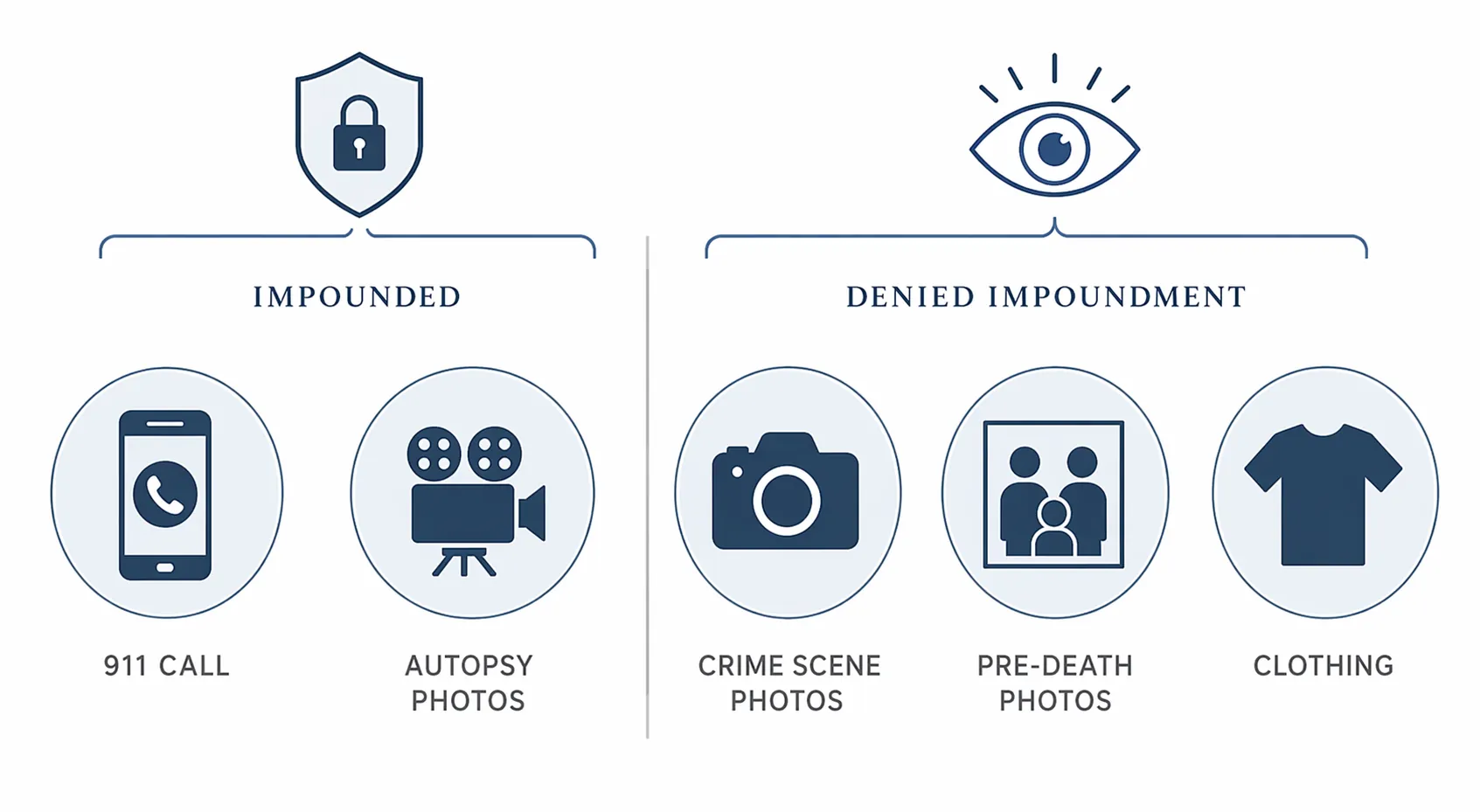
That 2-3 split matters. It keeps the ruling from becoming a loose privacy gesture. It shows the court applying impoundment as a category-specific remedy under the Massachusetts Uniform Rules on Impoundment Procedure, rather than treating all emotionally difficult trial exhibits as if they raise the same access problem.
The trial posture also matters, but only up to a point. Reports state that 18 jurors had been seated, opening statements were scheduled for July 27, 2026, and Patrick Clancy was expected to testify as the prosecution’s first witness.[2] Retired Judge James Barretto called the timing of the motion “a bit unusual,” because the parties had long known the evidence would be used.[3] That is a real procedural wrinkle. It is not the center of the ruling.
Rule 8 Required More Than Sympathy
URIP Rule 8(a) states that an order of impoundment may enter “only upon written finding of good cause.” Rule 8(c) adds the limiting instruction that an impoundment order “shall be no broader than necessary” to protect the interest that justifies impoundment.[6]
Those two clauses do different work. The first asks whether the asserted interest is strong enough to overcome public access. The second asks whether the remedy stops where that interest stops. In the Clancy ruling as reported, the second clause is doing visible work: the same motion did not produce the same answer for every exhibit category.
Some reports describe the court as finding a substantial likelihood of harm if the 911 recording and autopsy photos were publicly disseminated.[1] That phrase should be handled carefully. URIP Rule 8 itself speaks in terms of a written finding of good cause and an order no broader than necessary; the “substantial likelihood of harm” formulation appears in the reported description of the court’s reasoning and related privacy analysis, not as the verbatim text of Rule 8.
For motion practice, that distinction is not pedantic. A lawyer who quotes only the harm language risks skipping the rule’s actual architecture. The moving paper still has to identify the record, the interest, the harm, the affected persons, and the narrow form of relief requested.
The Balancing Test Has a Shape
The Supreme Judicial Court’s decision in New England Internet Café describes the good-cause inquiry as a balancing of relevant factors, including the nature of the parties and controversy, the type of information and privacy interests involved, the community interest in access, constitutional rights, and the reason impoundment is sought.[7] That framework fits the Clancy categories more precisely than the headline version of the ruling.
| Evidence category requested | Reported ruling | Why the category matters under Rule 8 |
|---|---|---|
| 911 call recording | Impounded | A recording of a surviving parent’s immediate reaction raises a distinct privacy and dignity interest tied to the nonparty speaker and the children. |
| Autopsy photographs | Impounded | Postmortem images of children carry a strong privacy and family-interest claim, especially if public dissemination adds little to courtroom transparency. |
| Crime scene photographs | Not impounded | The court reportedly found this category did not meet the good-cause threshold, despite its connection to charged conduct. |
| Pre-death photographs of the children | Not impounded | The category may be emotionally significant, but the reported ruling did not treat that fact alone as enough for impoundment. |
| Children’s clothing | Not impounded | The denial suggests the court required a category-specific harm showing, not a general association with child victims. |
H.S. Gere & Sons gives privacy more bite than a casual access presumption might suggest: a legitimate expectation of privacy may ordinarily be enough to establish good cause.[8] But Prescott supplies the counterweight. Potential embarrassment, annoyance, or a generalized fear of publicity is not sufficient by itself.[9] Read together, those cases help explain why the Clancy result is uneven rather than contradictory.
The 911 call is not merely another trial exhibit in that analysis. It is reported to capture Patrick Clancy’s screams upon discovering the children.[1] Public access to a criminal trial does not automatically require public rebroadcast of a nonparty parent’s most immediate recorded reaction. A judge could find that the privacy harm from broad dissemination is acute while still allowing the evidence to be used in court under controlled conditions.
Autopsy photographs present a similar but not identical concern. Their evidentiary value at trial may be significant, but Rule 8(c) asks a different question: whether public dissemination beyond what is necessary for the proceeding should be restricted. When the subjects are children, and the images are postmortem, the privacy and dignity interests are not abstract.
The denials are just as important. Crime scene photographs, pre-death photographs, and clothing were not swept into the order simply because they are painful or connected to the same alleged events.[2][4] That is where Prescott still has force. Publicity costs are real, but the rule requires more than the fact that disclosure would be upsetting.
Patrick Clancy’s Role Was Procedural, Not Merely Personal
The motion also cannot be understood as an ordinary prosecution or defense request. Patrick Clancy was not a party to the criminal case. Reports describe him as separately represented and seeking protection as an interested nonparty under URIP Rule 6.[5]
That posture explains the motion’s legal significance. A nonparty may be the person most directly burdened by public dissemination even though he does not control either side’s trial presentation. The criminal case belongs to the Commonwealth and the defendant; the privacy cost of a recording or image can fall on someone else.
URIP practice gives that person a procedural vehicle, but not a veto. The distinction is central. Interested nonparty status allows the court to hear the claimed harm. It does not convert the nonparty’s preference into an access ruling. Judge Sullivan’s reported category-by-category order reflects that separation: Patrick Clancy could ask; the court still had to test each category against good cause and narrow tailoring.
This is why the ruling should not be flattened into a victim-protection headline. The court reportedly protected the 911 call and autopsy photos because those categories carried a particular harm theory. It refused to impound other categories because the motion did not clear the same threshold for them. The sympathy is visible, but it is not the rule.
What the Five Categories Teach Motion Drafters
The practical lesson is not “file to block graphic evidence.” It is to draft the motion so the judge can write a narrow order without doing the lawyer’s work.
- Separate the exhibits into real categories, not one emotional bundle.
- Identify whose privacy interest is at stake, especially when the burden falls on a nonparty.
- State the specific harm expected from public dissemination, not just courtroom use.
- Explain why ordinary public access is outweighed for that category.
- Propose relief that is no broader than necessary under Rule 8(c).
A weak motion asks the court to protect “sensitive evidence” and relies on the subject matter to do the rest. A stronger motion tells the court why a 911 recording is different from a photograph, why an autopsy image is different from clothing, and why the requested restriction targets dissemination rather than suppressing evidence from the trial itself.
The distinction between use and dissemination deserves its own sentence in any serious motion. Evidence may be admissible, shown to jurors, or discussed in open court, yet still raise a separate question about copying, broadcasting, or public release. Rule 8 is concerned with impoundment of court records and materials; it is not a substitute for an evidentiary objection.
The Clancy ruling also suggests that counsel should give the court a proposed order with stopping points. If the request covers five categories, the proposed order should make it easy to grant two, deny three, or draw a different line. A judge who has to choose between total exposure and total sealing may choose neither, or may write a narrower order than the movant anticipated.
The Verification Caveat Still Matters
There is one uncomfortable limit on the analysis: the written order has not been obtained from the record materials available for this article. The docket number was also not available from the reports reviewed here. The reported outcome is consistent across CBS Boston, WCVB, MassLive, the Patriot Ledger, and NewsNation, but the court’s exact wording, any quoted findings, and any limits on who may view or handle the impounded materials should be checked against the order itself when it becomes available.[1][2][3][4][5]
That caveat does not make the ruling unusable. It sets the boundary for what can responsibly be said. On the present record, the reliable lesson is procedural: a Massachusetts impoundment motion under URIP Rule 8 needs itemized categories, specific harm theories, attention to affected nonparties, and a proposed restriction no broader than necessary. The Clancy order is instructive precisely because the court reportedly said yes here and no there.
References
- Patrick Clancy request to keep 911 call, autopsy photos private at ex-wife's murder trial approved by judge, CBS Boston
- Lindsay Clancy trial updates: Judge limits public access to dramatic evidence, WCVB
- Judge blocks broadcast of 911 call from night of Clancy children's deaths at mother's trial, MassLive
- Judge limits who will see evidence in Lindsay Clancy murder trial, Patriot Ledger
- Lindsay Clancy trial: Patrick Clancy motion seeks to block 911 call, kids' photos, NewsNation
- Uniform Rules on Impoundment Procedure Rule 8: Order of impoundment, Mass.gov Trial Court Rules
- New England Internet Café, LLC v. Clerk of the Superior Court for Criminal Business, 462 Mass. 76, Supreme Judicial Court of Massachusetts, 2012
- H.S. Gere & Sons, Inc. v. Frey, 400 Mass. 326, Supreme Judicial Court of Massachusetts, 1987
- George W. Prescott Publishing Co. v. Register of Probate, 395 Mass. 274, Supreme Judicial Court of Massachusetts, 1985
Related records
Tool profile
Browse tool evaluations →Governing regulation
Browse the obligations tracker →Preventive workflow
Browse verification workflows →
Report a correction or tip
Spotted an outdated figure, a misstated fact, or a ruling this case record should reflect? Public comments are disabled for this content given the professional cost of a misreported case outcome, penalty amount, or rule text — use the structured correction channel instead.
Report a correction or tip for this record →