
Why Colin Gray's Sentence Is 15 Years, Not 180
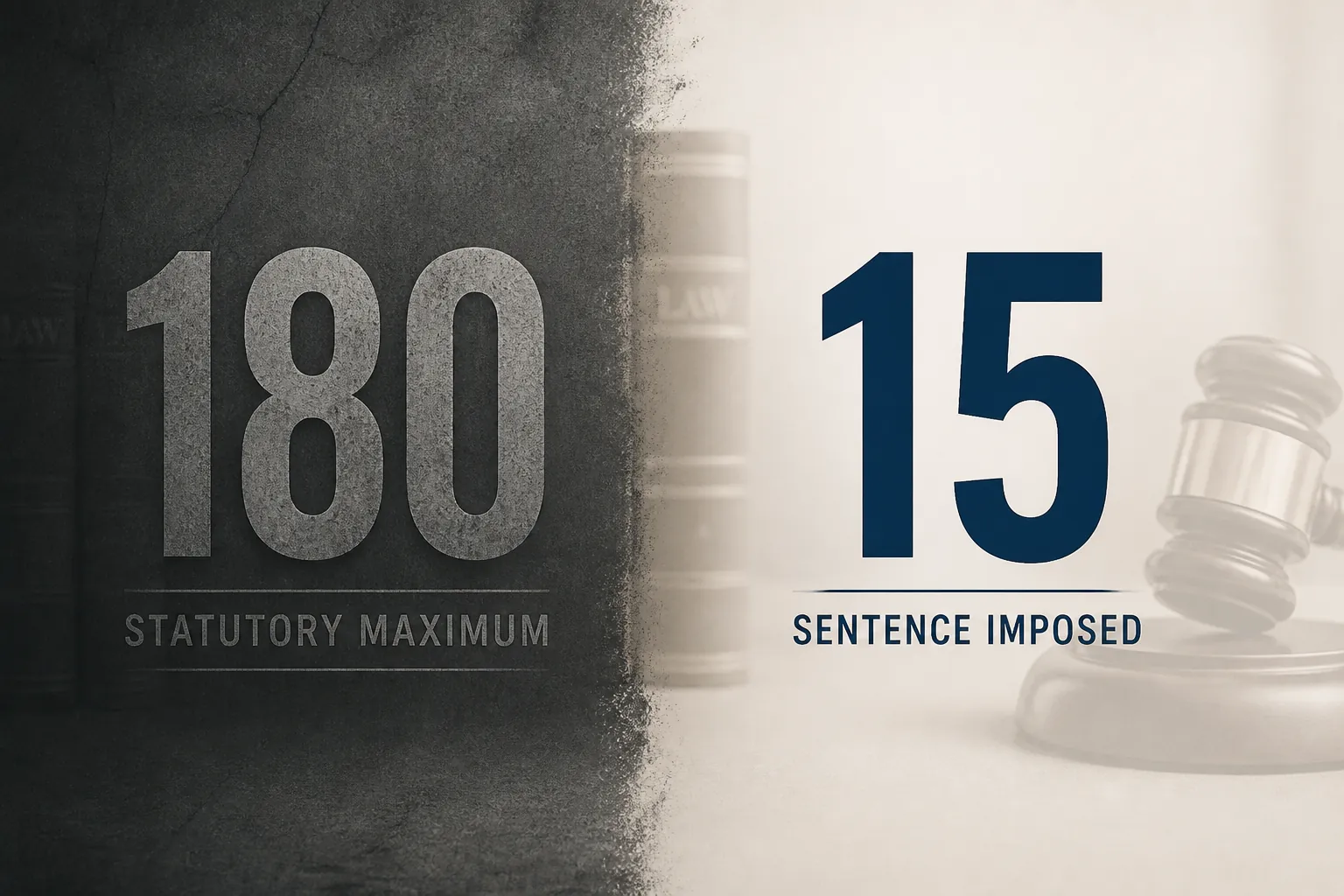
The claim that Colin Gray received a 180-year prison sentence is incorrect; he was sentenced to 15 years concurrent on 27 counts. This article explains how the 180-year figure—the statutory maximum across all charges—was mistaken for the actual sentence and what legal professionals should learn about verifying case facts from primary sources.
- Jurisdiction
- Georgia, USA
- Court
- Barrow County Superior Court
- Judge
- Nicholas Primm
- AI tool named
- none
- Ruling date
- Jul 30, 2026
- Source document
- View primary court order ↗
- Last verified
- Jul 31, 2026
Lex Machina Review is an independent risk-tracking and reference resource. Nothing on this site is legal advice, and using it does not create an attorney-client relationship. Every record is reviewed against primary sources but may not reflect the most current status of a matter — always verify directly against the cited court order, rule text, or a licensed attorney before relying on it.
Companion explanation — secondary to the source document above
Colin Gray was not sentenced to 180 years. On July 30, 2026, Barrow County Superior Court Judge Nicholas Primm sentenced him to 15 years in prison, to run concurrently, after Gray was convicted on 27 counts connected to the Apalachee High School shooting committed by his son, Colt Gray.[1]
The 180-year number belongs somewhere else in the file. It was the statutory maximum Gray faced across the charges, not the sentence the court imposed.[2] That distinction is not a technical courtesy. It is the difference between a lawful outer boundary, a charging consequence, and the judgment a court actually entered.
NBC News reported the 15-year concurrent sentence. BBC, PBS, ABC News, and CBS News Atlanta also reported the same sentencing result on July 30, 2026.[1][3][4][5][6] The correction is therefore not that “180 years” was invented from nothing. The correction is narrower and more important: a real maximum was detached from its qualifier and repeated as if it were the imposed sentence.
The Three Numbers That Cannot Be Treated as One
The phrase “colin gray sentenced 180 years father criminal case” compresses several legal facts into one search-shaped sentence. A reader sees the defendant’s name, the father relationship, the criminal case, and a large number that sounds final. But the file contains at least three distinct quantities.
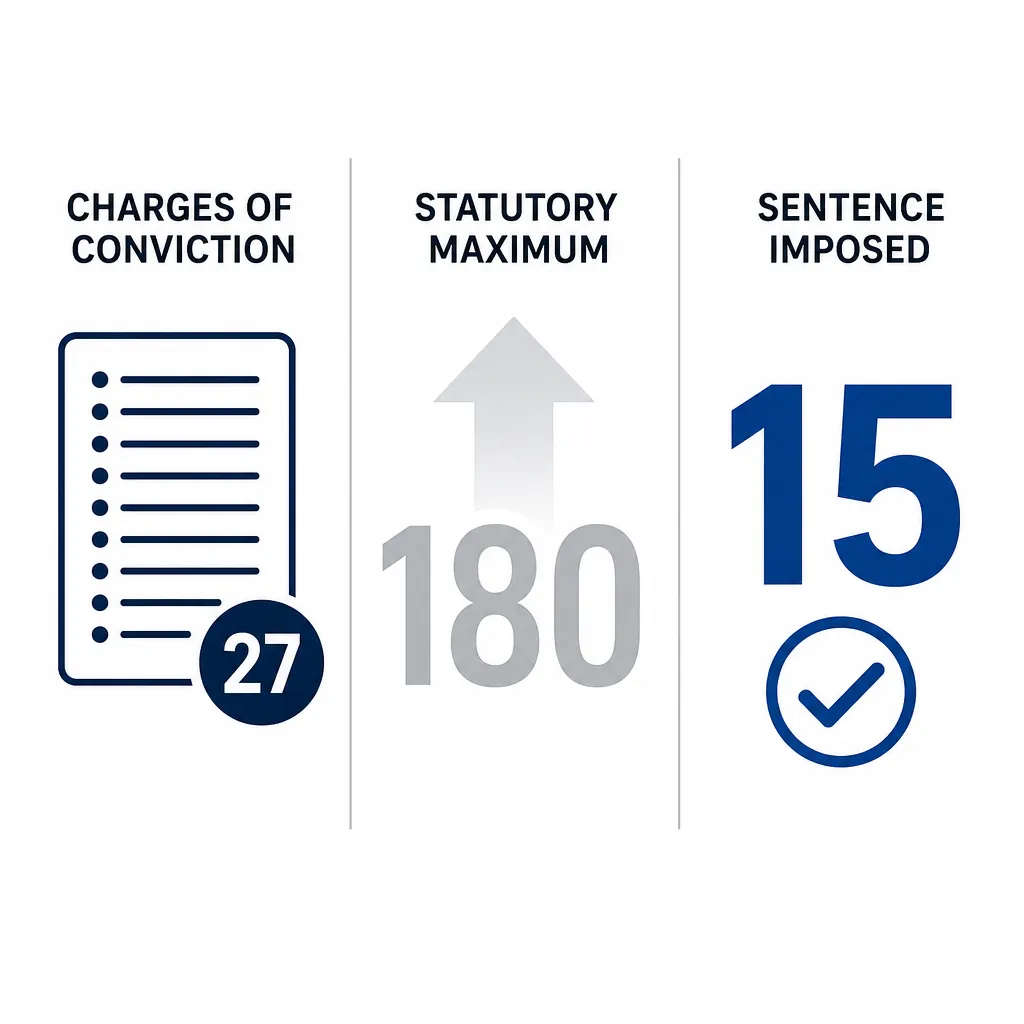
| Legal quantity | What it means in this case | Why it matters |
|---|---|---|
| Charges of conviction | Gray was convicted on 27 counts: 2 counts of second-degree murder, 2 counts of involuntary manslaughter, 18 counts of cruelty to children, and 5 counts of reckless conduct. | This describes what the jury found, not the final prison term. |
| Statutory maximum | The total maximum exposure was reported as 180 years across all charges. | This describes the ceiling the law allowed, not what the judge imposed. |
| Sentence imposed | Judge Nicholas Primm sentenced Gray to 15 years concurrent. | This is the operative sentencing result that should be used in briefs, articles, alerts, and databases. |
Gray’s conviction came on March 3, 2026, after a jury deliberated for under two hours, and NBC described it as the first conviction of a parent for second-degree murder in a U.S. school-shooting case.[1] Those facts help explain why the case drew national attention. They do not change the sentence.
Concurrent sentencing is one reason the error is easy to make. A defendant may be convicted on many counts, and each count may carry its own possible penalty. If the judge orders the terms to run concurrently, the sentences overlap rather than stack end to end. In Gray’s case, the reported result was 15 years concurrent, not a consecutive sentence totaling the outer maximum.
That is why “27 counts” does not automatically become “180 years,” and “180 years maximum” does not automatically become “180 years sentenced.” A maximum-exposure figure may be useful before sentencing, especially in a trial report or a preview of what the court could impose. After sentencing, it must be labeled as the maximum unless the judgment actually imposed it.
How an Accurate Fragment Became a False Sentence
The likely path is not mysterious. A large statutory maximum is reported accurately. Later references shorten the phrasing. Search snippets and social posts reward the largest number because it is the most legible part of the story. A reader who arrives after the correction sees “Colin Gray,” “180 years,” and “sentenced” close enough together that the qualification disappears.
This is one of the less glamorous failure modes in legal information work. It does not require a fake docket, a fabricated quotation, or an invented case citation. It requires only a true number in the wrong field. Once that happens, the mistake can look more authoritative than a vague correction because it has the shape of legal precision.
Professional readers should be especially wary of that shape. “Faced up to 180 years,” “maximum sentence of 180 years,” “exposure of 180 years,” and “sentenced to 180 years” are not interchangeable. The difference may affect a client alert, a sentencing memo, a press explainer, a litigation-risk note, or a public-facing case summary. It may also affect trust inside a team: the associate who checks the order should not have to spend the next hour unwinding a partner note built from a search result.
What the Sentencing Reports Actually Support
The supported statement is short: Colin Gray was sentenced to 15 years in prison, concurrent, on July 30, 2026.[1] The supported context is also clear: he had been convicted on 27 counts, including second-degree murder, involuntary manslaughter, cruelty to children, and reckless conduct.[1] The supported maximum-exposure statement is separate: he faced a statutory maximum of 180 years across all charges.[2]
Those three statements can appear in the same article. They cannot collapse into one. If a database field asks for “sentence,” the answer is not 180 years. If a case note asks what maximum he faced before sentencing, 180 years may be relevant with the right label. If a headline or social post says he was sentenced to 180 years, it is wrong.
The case also included a related but distinct sentencing event. Colt Gray, the shooter, received life without parole on July 24, 2026, for 55 counts connected to the Sept. 4, 2024, Apalachee High School shooting, which killed four people and wounded nine.[7] That sentence should not be used as a shortcut for describing the father’s sentence either. The same family name and the same underlying tragedy do not create a shared sentencing result.
Why the Error Had Traction
Gray’s prosecution was unusual enough to make readers receptive to a severe number. NBC reported that his conviction was the first conviction of a parent for second-degree murder in a U.S. school-shooting case.[1] The case followed public attention to parental liability after the Michigan prosecutions of Jennifer and James Crumbley, who were convicted of involuntary manslaughter in 2024 for the Oxford High School shooting, but Gray’s Georgia conviction involved a different legal theory and a different offense label.[8]
That context matters only because it explains why a maximum figure could feel plausible. A case described as unprecedented, emotionally grave, and legally expansive gives a large number more staying power. Readers may not pause over whether the number is a maximum, a recommendation, a sentence on one count, a consecutive total, or a concurrent term. The story’s seriousness does some of the work that verification should have done.
There is a newsroom version of this problem and a law-office version. In the newsroom version, a rushed aggregation turns a maximum exposure into an imposed sentence. In the law-office version, a lawyer or knowledge-management editor pulls the same number into a memo because several secondary pages repeat it. In both versions, the immediate mistake is small enough to look like phrasing and large enough to change the legal meaning.
The Verification Move Is Specific
The fix is not to distrust every secondary source. Secondary reporting is often how legal professionals first learn that a sentencing event occurred. The fix is to stop treating snippets, roundups, and repeated social language as the final source for the operative legal fact.
- Check whether the number is labeled as a charge, maximum, recommendation, sentence on one count, consecutive total, or concurrent term.
- Use the sentencing order, judgment, docket entry, transcript, or the most direct court record available before repeating the number in professional work.
- When relying on news coverage, prefer reports that identify the judge, date, sentence structure, and counts rather than pages that only repeat the largest figure.
- Preserve both fields when both are relevant: “statutory maximum: 180 years” and “sentence imposed: 15 years concurrent.”
- Correct the record with the distinction, not just the replacement number, so the same error does not reappear in the next summary.
A hypothetical internal note on this case would therefore not say, “Gray received 180 years.” It would say: “Gray was convicted on 27 counts and faced a reported statutory maximum of 180 years; the court imposed a 15-year concurrent prison sentence.” That wording is longer because the law made the categories longer. Cutting the sentence down by removing the category labels is how the error returns.
Why This Belongs in a Legal-Information Risk File
This is not an AI sanctions case. It is not a hallucinated-citation order, and there is no need to pretend otherwise. Its relevance is more ordinary: legal professionals increasingly encounter case facts through automated summaries, search snippets, and secondary reporting before they see the underlying record. Those tools can preserve a true fragment while losing the field name that made it true.
For Colin Gray, the durable correction is simple. “180 years” should be recorded as the statutory maximum. “15 years concurrent” should be recorded as the sentence imposed. Any professional use of the case should be checked against the sentencing order or the most direct court record available before the number is repeated.
References
- “Apalachee High School shooter's father sentenced to 15 years,” NBC News, July 30, 2026.
- “Colin Gray, who bought Georgia school shooter a gun, is sentenced to 15 years,” The Washington Post, July 30, 2026.
- “Father of Georgia school shooter sentenced to 15 years,” BBC, July 30, 2026.
- “Father who gave his son the gun used in a Georgia high school shooting to be sentenced,” PBS NewsHour, July 30, 2026.
- “Father sentenced for murder in Georgia high school shooting by son,” ABC News, July 30, 2026.
- “Sentencing hearing begins for Colin Gray, father who gave gun to Apalachee High School shooter,” CBS News Atlanta, July 30, 2026.
- “2024 Apalachee High School shooting,” Wikipedia.
- “Parental Liability in the Era of School Shootings,” ABA, 2026.
Related records
Tool profile
Browse tool evaluations →Governing regulation
Browse the obligations tracker →Preventive workflow
Browse verification workflows →
Report a correction or tip
Spotted an outdated figure, a misstated fact, or a ruling this case record should reflect? Public comments are disabled for this content given the professional cost of a misreported case outcome, penalty amount, or rule text — use the structured correction channel instead.
Report a correction or tip for this record →