
The Colorado River Water Crisis Could Trigger a Compact Call Lawsuit
The 1922 Colorado River Compact's unresolved Article III(d) delivery clause, combined with Reclamation's April 2026 release cut and near-record-low spring runoff, makes a compact call lawsuit almost certain by 2027. This article details the specific legal theories, forum, timeline, and state-by-state preparedness for the first-ever litigation over the Compact, which would land directly in the Supreme Court's original jurisdiction with no controlling precedent.
- Jurisdiction
- US Federal
- Court
- U.S. Supreme Court
- AI tool named
- Not applicable
- Ruling date
- Jul 28, 2026
- Source document
- View primary court order ↗
- Last verified
- Jul 28, 2026
Lex Machina Review is an independent risk-tracking and reference resource. Nothing on this site is legal advice, and using it does not create an attorney-client relationship. Every record is reviewed against primary sources but may not reflect the most current status of a matter — always verify directly against the cited court order, rule text, or a licensed attorney before relying on it.
Companion explanation — secondary to the source document above
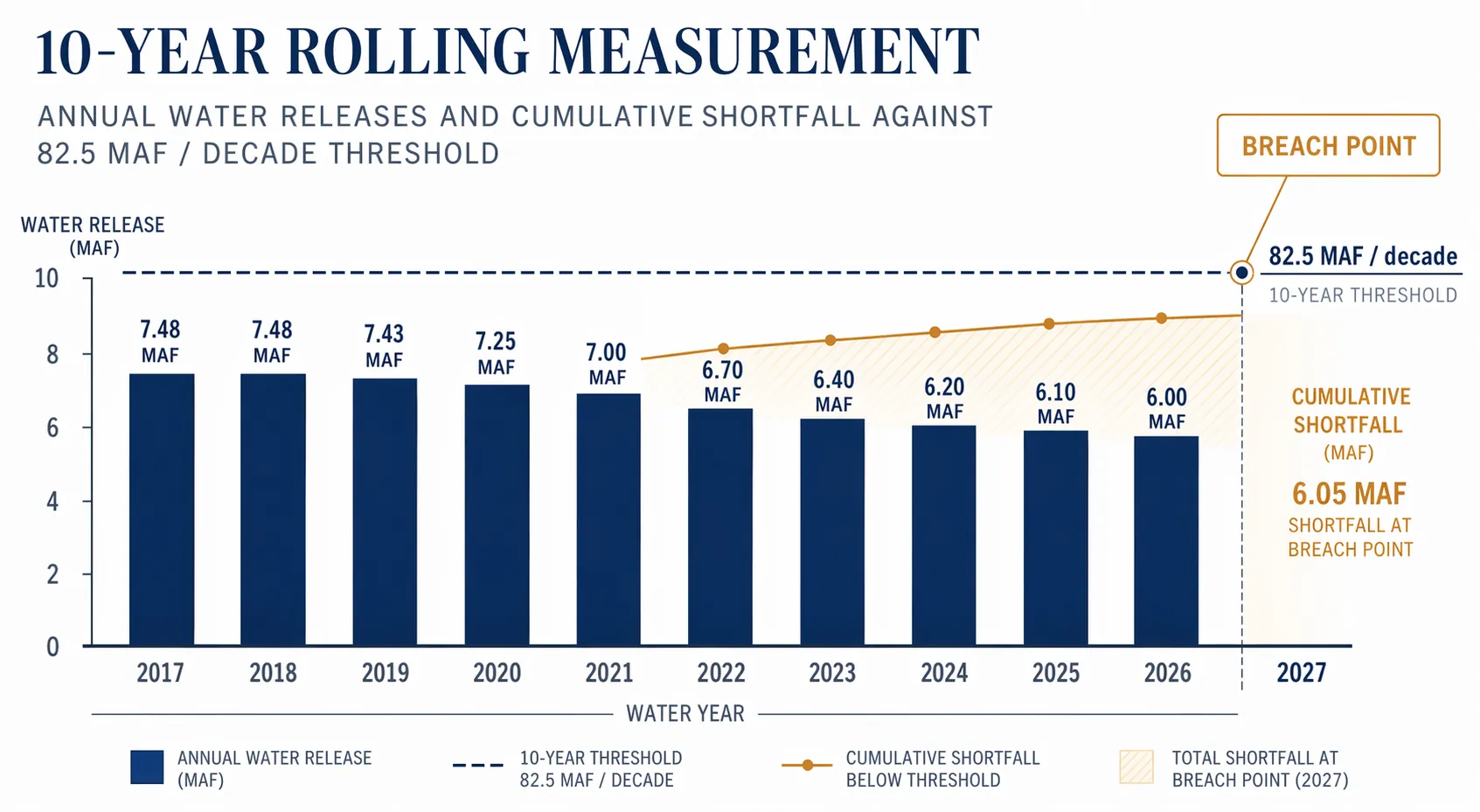
The operative fact is not another dry-year description. It is the April 15, 2026 federal operating decision that reduced annual Glen Canyon Dam releases from 7.48 million acre-feet to 6 million acre-feet while Lake Powell stood at 24% capacity and spring inflow was 13% of normal.[1]
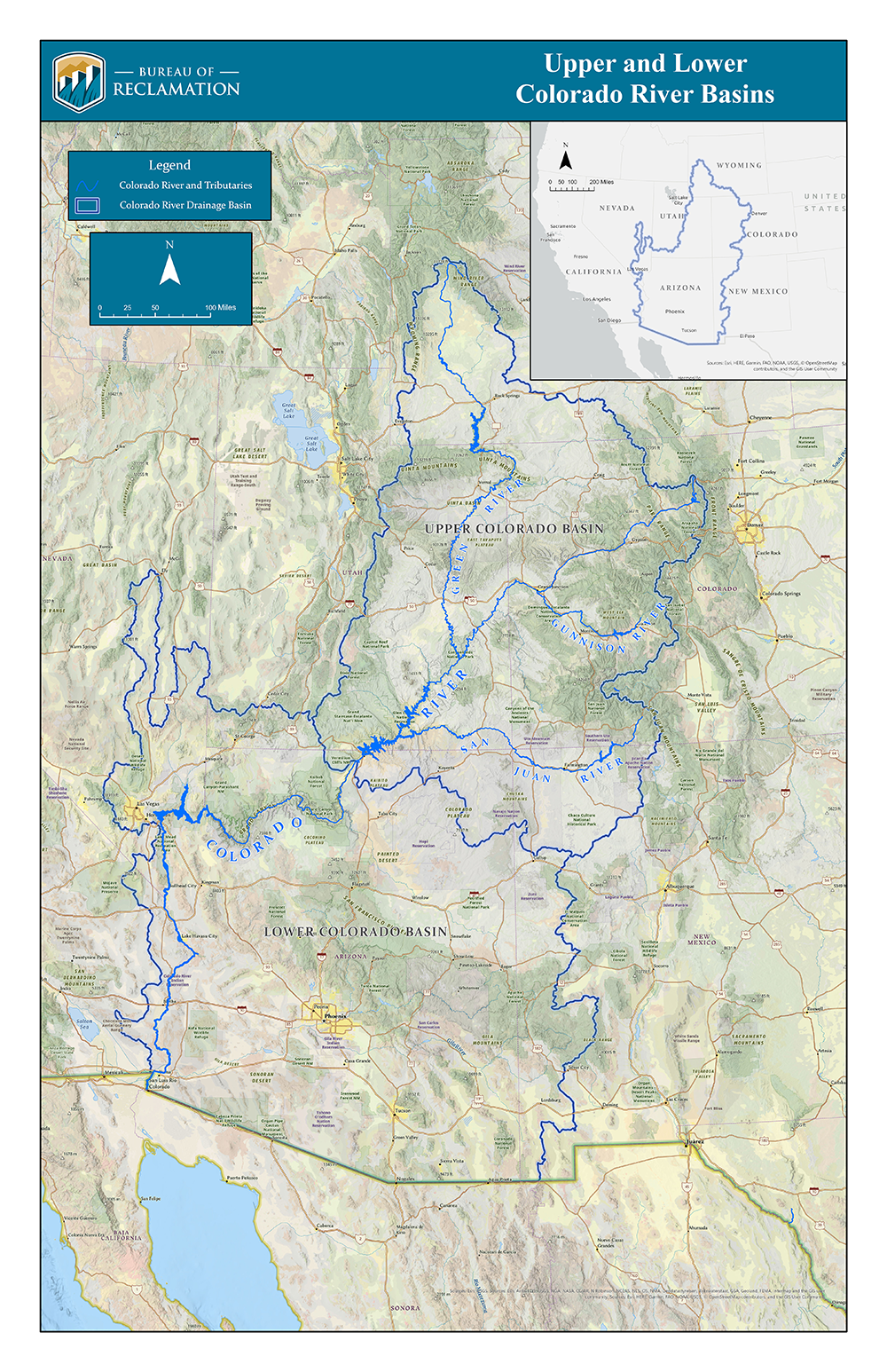
That release cut matters because it drops into an unresolved clause of the 1922 Colorado River Compact. The Lower Basin treats Article III(d) as requiring 82.5 million acre-feet over a rolling 10-year period. The Upper Basin reads the same clause as a non-depletion obligation. The phrase “compact call” appears nowhere in the Compact, and no court has defined it.[2] Arizona’s water director has said the rolling 10-year calculation could breach the Lower Basin’s 82.5 million acre-foot threshold as soon as 2027.[3]
The release cut turns Article III(d) into a filing question
Reclamation’s April 2026 action does not itself adjudicate a Compact violation. It is an operating decision. But it changes the litigation posture because the delivery math is no longer comfortably buffered by hydrology or reservoir storage. A clause that could remain abstract when releases were higher becomes a pleading candidate when the 10-year total approaches the Lower Basin’s asserted line.
The legal problem is unusually clean and unusually dangerous: the same words support two basin-wide theories, neither has been tested in court, and the consequence of choosing one theory over the other would not be confined to one irrigation district or one reservoir operation.
| Issue | Lower Basin position | Upper Basin position | Why counsel should care |
|---|---|---|---|
| Article III(d) obligation | A firm 82.5 million acre-foot delivery requirement over a rolling 10-year period | A non-depletion obligation rather than a fixed delivery guarantee | The same accounting period can look like an enforceable breach or a disputed hydrologic condition |
| “Compact call” | Used as shorthand for an enforcement demand | Not accepted as a defined Compact mechanism | The term may appear in public debate, but a complaint would still need a legal theory and remedy |
| Judicial interpretation | No controlling interpretation of Article III(d) | No controlling interpretation of Article III(d) | Risk assessments cannot rely on a settled remedial sequence |
That last column is where the client problem sits. A municipal supplier, agricultural user, tribal entity, or wholesale water district does not need to know whether “compact call” is good political shorthand. It needs to know what happens if a state files an original action and asks the Supreme Court to impose a delivery interpretation that has never been judicially adopted.
The missing phrase is not a technicality
Because “compact call” is absent from the Compact text, it should not be treated as though the document contains a self-executing enforcement switch. There is no agreed notice provision, no agreed cure period, no agreed formula for allocating shortage if the Lower Basin theory prevails, and no agreed judicial remedy that automatically follows from a below-threshold decade.
But absence from the text does not make the risk empty. Legal systems often acquire shorthand before pleadings harden. Once states begin calculating cumulative delivery totals, retaining outside counsel, and reserving litigation money, the shorthand has practical force even if it still lacks doctrinal content.
The forum is the Supreme Court, not a district court
An interstate compact dispute would go directly to the U.S. Supreme Court under its original and exclusive jurisdiction. The practical consequence is that the case would not begin with a district judge managing discovery under ordinary trial-court routines. The Court would likely appoint a special master to supervise fact development in a trial-like proceeding, receive evidence, manage legal arguments, and issue recommendations to the justices.[4]
That procedural route affects timing and leverage. A state contemplating suit must prepare a record that can survive special-master scrutiny. A water user exposed to state-level implementation must assume that the factual record may be built around reservoir operations, hydrologic accounting, compact history, state administration, and federal operating choices at the same time.
Nebraska v. Colorado is useful only as a procedural parallel. The Supreme Court granted Nebraska leave to file an original action against Colorado over the South Platte River Compact on June 29, 2026, illustrating the original-jurisdiction path for interstate compact disputes. It does not decide what Article III(d) of the Colorado River Compact means.[4]
Arizona v. California is closer geographically and institutionally, but it is not the controlling answer either. That litigation addressed the Boulder Canyon Project Act, not a first interpretation of the Colorado River Compact’s Article III(d) delivery clause.[4] It may influence how parties brief the broader “Law of the River,” but it does not supply a ready-made rule for a compact-call dispute.
The remedial gap is the exposure
The absence of precedent is not just an academic inconvenience. It means counsel cannot confidently tell clients what a successful Lower Basin claim would require the Upper Basin, Reclamation, or individual water users to do. A court could be asked to declare the meaning of Article III(d), compel operations consistent with one accounting theory, shape prospective relief, or require some form of curtailment framework. The present record does not support saying which remedy would be granted.
That uncertainty changes pre-filing advice. Litigation exposure is not limited to named state defendants. Water districts, municipal systems, agricultural users, and tribal entities may need to preserve records, model supply effects, review contract dependencies, and understand whether state litigation positions could later become administrative directives. The question is not whether every user will be sued. It is whether a state-to-state case could produce operational consequences that move through state systems, federal reservoir rules, contracts, and shortage-sharing arrangements.
Preparedness is already visible in budgets and counsel retention
Arizona has reportedly appropriated at least $9 million and retained outside counsel for Colorado River litigation preparation. That cumulative figure should be treated with some verification caution because it may reflect appropriations across multiple budget cycles, including an initial $3 million, $1 million from HB 2116, and an additional $6 million.[5]
The point is not the exact accounting label on every dollar. The point is that Arizona is not merely issuing statements about negotiation leverage. It is funding legal capacity in advance of a possible original action.
Other signals point the same way. New Mexico requested $5 million, and the Metropolitan Water District of Southern California has been expanding its legal war chest as basin negotiations deteriorate.[3] Those actions do not prove a complaint will be filed on a particular date. They do show that major public entities are treating Compact litigation as a budgetable risk, not an abstract law-school hypothetical.
The 2026–2027 window is where negotiation language may become pleading language
The near-term calendar has two tracks. One is the rolling delivery calculation that Arizona’s water director says could fall below the Lower Basin’s asserted 82.5 million acre-foot threshold as soon as 2027.[3] The other is the federal operating framework after 2026. Reclamation’s post-2026 Record of Decision is expected after the current draft environmental impact statement comment period ends in October 2026.[6]
Those tracks interact but should not be merged. Reclamation’s operating choices may affect release volumes and incentives. They do not, by themselves, resolve the Compact’s meaning. Similarly, a state’s interpretation of Article III(d) may frame a litigation claim, but it does not control Reclamation operations unless adopted through the relevant legal process.
The draft alternatives also matter because they present different legal vulnerabilities. A “Basic Coordination” approach is described as implementable under existing law, while a “Supply Driven” approach would require new congressional authority.[6] That distinction is the kind of detail that can determine whether a party attacks a federal operating decision, sues another state under the Compact, waits for congressional action, or uses the threat of one forum to shape another.
Political pressure is real, but it is not the jurisdictional rule
Senator Mike Lee of Utah publicly threatened to withhold federal appropriations from states that sue over Colorado River operations.[5] That threat belongs in any practical risk assessment because federal funding pressure can affect negotiation posture, state appetite for suit, and public messaging.
It does not answer the legal question. It does not define Article III(d), create or eliminate a compact-call mechanism, change the Supreme Court’s original-jurisdiction route, or provide a remedial framework. It is pressure around the courthouse door, not the rule that a court would apply once a case is filed.
What the litigation risk now requires
The safest legal advice is not that a compact-call lawsuit is certain on a set date. The better advice is narrower and more useful: if the post-2026 operating framework or basin negotiations do not materially alter the delivery trajectory, the central risk for Colorado River counsel is how soon Article III(d)’s unresolved meaning becomes an original-action complaint.
That means the relevant preparation is not limited to watching federal announcements. Counsel should be asking which state records support their client’s reliance position, which contracts assume particular reservoir operations, which shortage provisions activate under state or district rules, which technical experts can explain delivery accounting, and which public statements may later be cited as admissions about Compact interpretation.
The legal system has not yet supplied a controlling rulebook for Article III(d). The basin is now close enough to the Lower Basin’s asserted threshold that the absence of that rulebook is itself the risk.
References
- Colorado River Developments and Potential Compact Litigation, KTS Law, April 2026.
- Dwindling water supply, legal questions push Colorado River into wildly uncharted territory, Aspen Journalism, 2026.
- Colorado River negotiations failing, Los Angeles Times, February 5, 2026.
- SCOTUS Allows Nebraska to File Original Action Against Colorado Over South Platte River Compact, Somach Law.
- Federal Water Tap, June 15, 2026: With threat to withhold funding, Colorado River debate gets political, Circle of Blue, June 15, 2026.
- Colorado River states aim for peace but brace for legal war, E&E News, 2026.
Related records
Tool profile
Browse tool evaluations →Governing regulation
Browse the obligations tracker →Preventive workflow
Browse verification workflows →
Report a correction or tip
Spotted an outdated figure, a misstated fact, or a ruling this case record should reflect? Public comments are disabled for this content given the professional cost of a misreported case outcome, penalty amount, or rule text — use the structured correction channel instead.
Report a correction or tip for this record →