
Comey's '86 47' Indictment Tests the True-Threat Doctrine
An analysis of the First Amendment vulnerabilities in the federal indictment of James Comey for a single ambiguous Instagram post, examining why the true-threat doctrine and Counterman recklessness standard may bar prosecution under the current public record.
- Jurisdiction
- US Federal
- Court
- U.S. District Court
- AI tool named
- None
- Ruling date
- Apr 28, 2026
- Source document
- View primary court order ↗
- Last verified
- Jul 28, 2026
Lex Machina Review is an independent risk-tracking and reference resource. Nothing on this site is legal advice, and using it does not create an attorney-client relationship. Every record is reviewed against primary sources but may not reflect the most current status of a matter — always verify directly against the cited court order, rule text, or a licensed attorney before relying on it.
Companion explanation — secondary to the source document above
Last verified: July 28, 2026. This is a public-record legal analysis, not legal advice and not a prediction about evidence that may later be unsealed or disclosed in motion practice. The analysis is limited to the indictment and public reporting now available: the Department of Justice announced on April 28, 2026, that a federal grand jury indicted former FBI Director James Comey under 18 U.S.C. § 871 and § 875(c) for alleged threats to harm President Trump.[1] Section 871 addresses threats against the President, and § 875(c) addresses interstate communications containing threats to kidnap or injure another person.[2][3]
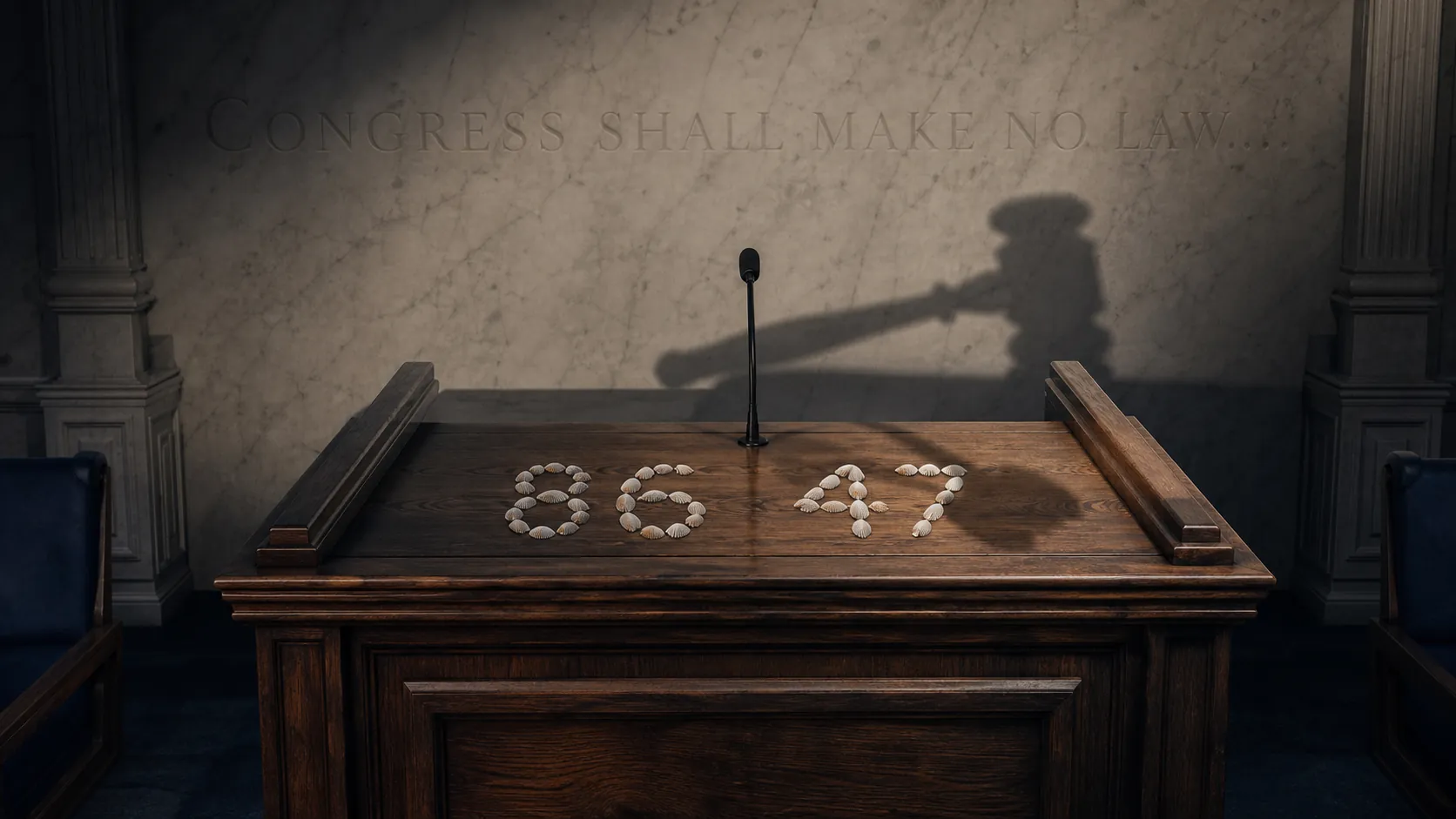
The charge against James Comey starts with one narrow object: an Instagram post showing seashells arranged to spell “86 47.” The government’s problem, at least on the public record, is not that ambiguous political speech can never be prosecuted. It is that a threat prosecution after Counterman cannot rest only on how a reasonable recipient might understand the words or symbols. The government ultimately must prove that Comey consciously disregarded a substantial risk that the post would be understood as a threat.
The indictment turns on a very small set of public facts
As publicly described, the indictment alleges that Comey communicated a threat through the “86 47” shell arrangement. The public record also reflects four facts that matter more than the political noise around the case: the communication was a single post; it contained no accompanying verbal threat; Comey deleted it the same day; and he publicly denied any intent to threaten anyone the same day.[1]
Those facts do not end the case. A threat need not be artfully worded, and coded speech can be threatening when surrounding evidence supplies the missing meaning. But they do define the evidentiary gap visible from the public charging materials. If the government has only the shell image, it has to convert a contested phrase into proof of a culpable mental state. That is a harder task than showing that some viewers, especially in a polarized political environment, heard menace in the post.
Acting Attorney General Blanche has said the case is based on more than the shell photo, and that caveat deserves weight.[4] Undisclosed evidence could change the analysis materially. A private message, a prior explanation of the phrase, coordination with someone else, or other proof that Comey understood and ignored the risk of a threatening interpretation would present a different record. The current question is narrower: whether the indictment as publicly pleaded has enough constitutional footing without that evidence.
What § 871 and § 875(c) add—and what they do not
The statutes identify the charged offenses, but they do not displace the First Amendment inquiry. Section 871 criminalizes, among other things, knowingly and willfully making a threat to take the life of, kidnap, or inflict bodily harm upon the President.[2] Section 875(c) criminalizes transmitting in interstate or foreign commerce a communication containing a threat to kidnap or injure another person.[3]
Both statutes can reach serious threats. Neither statute permits conviction for protected political hyperbole merely because the words are ugly, reckless in the colloquial sense, or likely to alarm the President’s supporters. The constitutional category is the “true threat,” and the Supreme Court’s modern cases make the speaker’s mental state part of the analysis, not an afterthought.
The true-threat cases cut against a bare reasonable-recipient theory
The useful path through the doctrine runs from Watts to Elonis to Counterman. SCOTUSblog’s explainer on the Comey indictment frames the inquiry as a two-part problem: whether the communication can objectively be treated as a serious expression of intent to harm, and whether the defendant had the constitutionally required mental state.[5]
Watts protects political hyperbole even when it names the President
Watts v. United States is the obvious starting point because it involved a statement about the President and a prosecution under § 871. The Supreme Court reversed the conviction, treating the statement in context as crude political hyperbole rather than a true threat.[6] That does not mean every violent-sounding political statement is immune. It means context matters, especially when the statement appears in political dissent and lacks the features that would make it a serious expression of intent to harm.
That point matters here because “86 47” is not a sentence saying “I will kill the President.” It is a numeric phrase displayed through shells. The government can argue that “47” refers to Trump as the 47th President and that “86” can mean kill. But Watts warns against collapsing offensive or provocative political expression into a criminal threat without close attention to setting, wording, and seriousness.
Elonis rejected conviction based only on how others would hear the communication
Elonis v. United States is especially important because it interpreted § 875(c), one of the two statutes charged here. The Court rejected instructions that allowed conviction based on what a reasonable person would regard as a threat, holding that the statute required more than a negligence-style assessment of the communication’s effect on listeners.[7]
That is where the Comey indictment looks exposed. A reasonable-recipient theory may help establish that a communication was capable of threatening meaning. It does not, by itself, establish that Comey possessed the required culpable mental state. The difference is not technical. It is the difference between punishing the dangerous meaning a speaker consciously risked and punishing a meaning that others later supplied.
Counterman requires conscious disregard of a substantial risk
Counterman v. Colorado set the constitutional floor for true-threat prosecutions: the state must show that the speaker acted at least recklessly, meaning the speaker consciously disregarded a substantial risk that the communication would be understood as threatening.[8] That standard does not require proof that the defendant specifically intended to carry out violence. It does require proof about what the defendant understood and chose to disregard.
On the current public record, the government’s strongest visible point is objective: some viewers could understand “86 47” as a call to eliminate or kill Trump. Its weakest visible point is subjective: the same public materials do not yet show that Comey knew of that threatening meaning and consciously disregarded a substantial risk that his post would be understood that way. Deletion and disavowal do not conclusively negate recklessness, but they are awkward facts for a charging theory that has not disclosed more.
The “86” definition helps show ambiguity, but it cannot decide the case
The dictionary point is useful, within limits. PBS NewsHour reported that Merriam-Webster’s entry gives “86” a primary sense of ejecting or refusing service, while the “kill” sense is described as recent and sparse.[9] That supports the defense argument that “86” is not a settled one-way signal of violence.
But ambiguity is not a constitutional force field. A phrase with multiple meanings can become threatening in context. The better defense argument is not simply “86 can mean eject.” It is that the indictment must show Comey consciously disregarded a substantial risk that this particular image, in this particular setting, would be understood as a threat to kill or injure the President. A sparse secondary meaning makes that proof more difficult; it does not make it impossible.
The public analogues look more explicit than this indictment
The comparison cases reported by ABC News are important because they test whether the government is charging an ordinary threat case or stretching threat doctrine around an ambiguous symbol. The cases cited in that coverage involved more explicit, repeated, unretracted, or conduct-backed threats, including allegations involving weapons or travel intent.[10]
| Feature | Comey public record | Reported comparison cases |
|---|---|---|
| Form of communication | Single Instagram image of shells spelling “86 47”[1] | More direct threatening statements or communications[10] |
| Verbal specificity | No accompanying words such as “kill,” “shoot,” or “harm” in the post as publicly described[1] | Threats described in more explicit terms[10] |
| Repetition | No public showing of repeated threatening messages | Some reported cases involved repeated communications[10] |
| Conduct evidence | No public showing of weapons, travel, or steps toward an attack | Some reported cases included weapons-related facts or travel intent[10] |
| Retraction or disavowal | Same-day deletion and public denial of threatening intent[1][9] | Reported analogues did not present the same combination of ambiguity, deletion, and disavowal[10] |
That comparison does not prove selective treatment, and it does not establish that the Comey indictment must be dismissed. It does show why the case is doctrinally unusual. Many threat prosecutions become easier because the speaker repeats the threat, describes the contemplated violence, identifies means, contacts the target, travels toward the target, or pairs words with weapons. Those facts help bridge the gap between alarming speech and culpable threat. The public Comey record, so far, does not disclose that bridge.
Legal experts see the same weakness
Bloomberg Law reported that several named legal experts and former federal prosecutors described the case as thin or vulnerable on First Amendment grounds, including Geremy Kamens, Cheryl Bader, Michael Gerhardt, and Jimmy Gurulé.[4] Their reactions are not a substitute for the court’s ruling, but they are useful for one reason: they focus on the evidentiary and doctrinal problem rather than on whether the post was wise, tasteless, or politically inflammatory.
That distinction is easy to lose in public commentary. A post can be irresponsible and still constitutionally protected. A post can be ambiguous and still become criminal when the government proves the required mental state. The charge lives or dies in the space between those propositions.
Where the indictment is most vulnerable
A motion to dismiss would likely press two related points. First, the alleged communication is not plainly a serious expression of intent to harm when viewed as a single image containing an ambiguous phrase, without accompanying threatening language. Second, even if a reasonable recipient could understand the post as threatening, Elonis and Counterman require more than that objective reaction.
The government’s likely answer is that context supplies both meaning and culpability: “47” refers to Trump, “86” can mean kill, Comey was a sophisticated public official, and a former FBI Director would understand how the phrase would land. That is not a frivolous theory. It is also not enough unless the government can tie those propositions to conscious disregard of a substantial risk. Sophistication can support an inference; it cannot replace evidence.
The same-day deletion and public disavowal cut both ways. Prosecutors might argue that deletion shows Comey recognized the threatening interpretation after posting. The defense would answer that recognition after public reaction is not the same as conscious disregard at the time of posting, and that prompt deletion is inconsistent with an effort to threaten. The timing evidence is therefore not useless to the government, but it is not the missing mental-state proof by itself.
Selective prosecution is procedural backdrop, not the central defect
Selective- or vindictive-prosecution claims may appear in the case, given the political setting and the identity of the defendant. Those arguments have their own demanding proof requirements. They are not the cleanest way to assess the indictment’s public-record weakness. The narrower and stronger objection is that the charged speech, as disclosed, does not yet satisfy the First Amendment true-threat framework.
The current risk assessment
On the public record as of July 28, 2026, the indictment is unlikely to survive serious First Amendment scrutiny if it depends only on a reasonable-recipient interpretation of the “86 47” image. Watts protects political hyperbole; Elonis rejects a bare negligence-style recipient test under § 875(c); and Counterman requires proof that Comey consciously disregarded a substantial risk that the post would be understood as a threat.
That assessment should remain conditional. If the government later discloses evidence showing that Comey knew the phrase would likely be understood as a threat to kill or injure Trump and posted it anyway, the case changes. Without that kind of evidence, the indictment looks less like an ordinary presidential-threat case than a constitutionally vulnerable prosecution built around an ambiguous image, a disputed slang term, deletion, and disavowal.
References
- Federal Grand Jury Indicts Former FBI Director James Comey for Threats to Harm President Trump, U.S. Department of Justice, Apr. 28, 2026.
- 18 U.S.C. § 871, Cornell Legal Information Institute.
- 18 U.S.C. § 875, Cornell Legal Information Institute.
- Protected Speech Hurdle Complicates Charges Against Comey (2), Bloomberg Law, Apr. 29, 2026.
- True threats, James Comey, and the Supreme Court: an explainer, SCOTUSblog, May 12, 2026.
- Watts v. United States, Justia.
- Elonis v. United States, Justia.
- Counterman v. Colorado (2023), Free Speech Center.
- James Comey indicted in probe over online post officials say constituted Trump threat, PBS NewsHour, Apr. 28, 2026.
- How does James Comey's threat compare to other defendants charged by DOJ?, ABC News.
Related records
Tool profile
Browse tool evaluations →Governing regulation
Browse the obligations tracker →Preventive workflow
Browse verification workflows →
Report a correction or tip
Spotted an outdated figure, a misstated fact, or a ruling this case record should reflect? Public comments are disabled for this content given the professional cost of a misreported case outcome, penalty amount, or rule text — use the structured correction channel instead.
Report a correction or tip for this record →