
Comey Motion to Dismiss Highlights Prosecutorial Independence Risk
The November 2025 dismissal of the James Comey prosecution exposed a procedural vulnerability: an unlawfully appointed interim U.S. Attorney acting as a stalking horse for a presidential vendetta. This record traces the suppressed declination memo, grand-jury irregularities, and court findings that transform a theoretical risk into a concrete factor for law-firm and client risk assessment.
- Jurisdiction
- US Federal - EDVA
- Court
- U.S. District Court for the Eastern District of Virginia
- Judge
- Cameron McGowan Currie
- AI tool named
- None
- Ruling date
- Nov 24, 2025
- Source document
- View primary court order ↗
- Last verified
- Jul 30, 2026
Lex Machina Review is an independent risk-tracking and reference resource. Nothing on this site is legal advice, and using it does not create an attorney-client relationship. Every record is reviewed against primary sources but may not reflect the most current status of a matter — always verify directly against the cited court order, rule text, or a licensed attorney before relying on it.
Companion explanation — secondary to the source document above
Record posture, last verified July 30, 2026: the federal prosecution of James Comey was dismissed on Nov. 24, 2025, after Judge Cameron McGowan Currie concluded that interim U.S. Attorney Lindsey Halligan “has been unlawfully serving” since Sept. 22, 2025. The dismissal was without prejudice, and the Department of Justice appeal filed on Feb. 9, 2026 should be checked directly against the Fourth Circuit docket before anyone treats the appellate posture as current. This article is legal-risk analysis, not legal advice. [1]
The useful entry point is not the familiar Comey-Trump history. It is Judge Michael Nachmanoff’s question at the Nov. 19, 2025 hearing: was Halligan a “stalking horse or a puppet”? Michael Dreeben’s answer for Comey was equally direct: Halligan “did what she was told.” For anyone searching “james comey trump vendetta motion to dismiss charges,” that exchange captures the operational issue better than the political shorthand does: whether the charging decision was made by an officer with lawful authority and independent prosecutorial judgment, or by someone installed to carry out an executive demand. [2][3]

The appointment clock is the first risk control
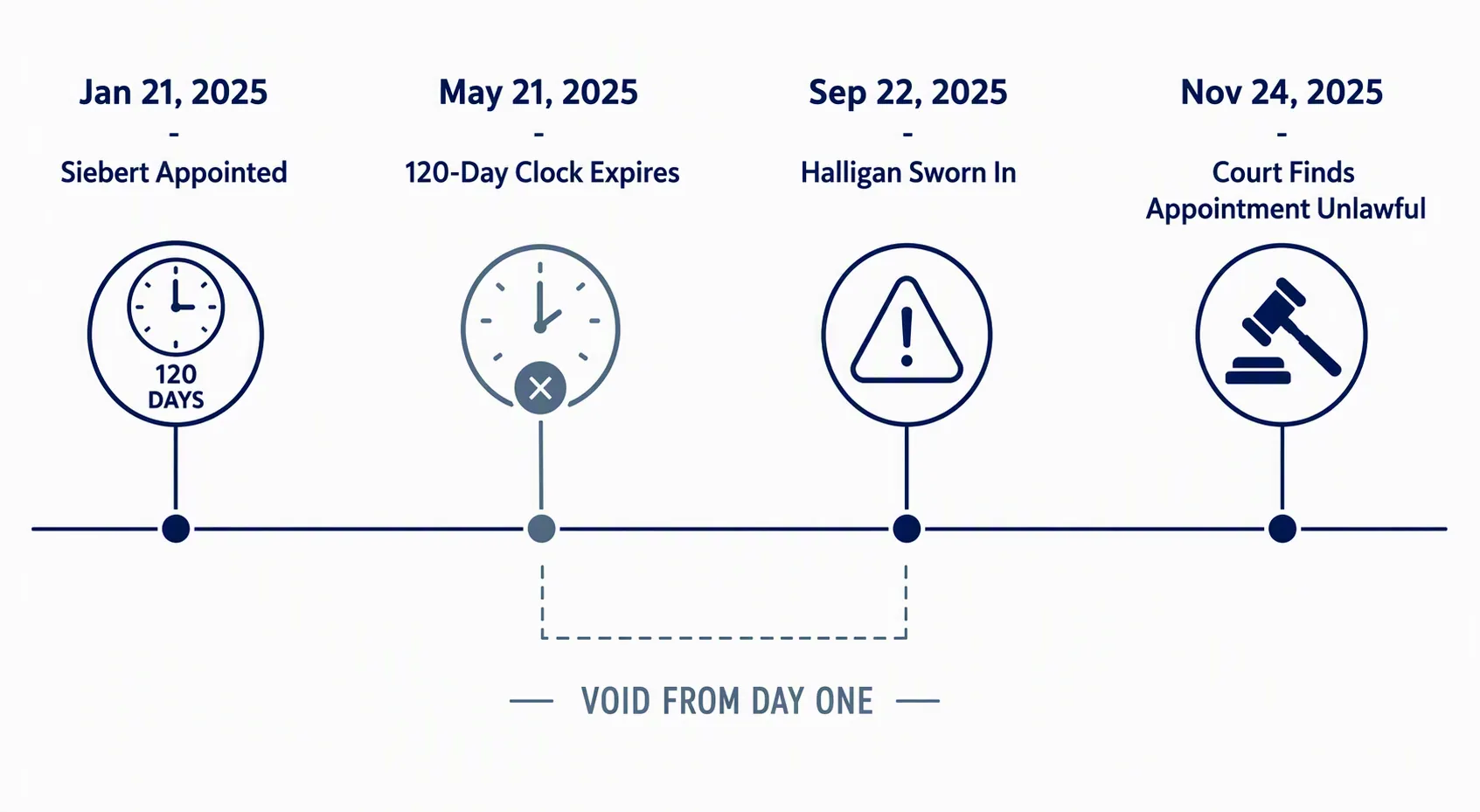
The cleanest part of the Comey record is also the easiest to miss in public commentary: the 120-day clock under 28 U.S.C. § 546. Erik Siebert was appointed interim U.S. Attorney for the Eastern District of Virginia on Jan. 21, 2025. The 120-day period expired on May 21, 2025. Halligan was sworn in on Sept. 22, 2025. Judge Currie’s ruling treated that gap as decisive, finding Halligan’s appointment invalid from the start of her claimed service. [1][4]
That is why the case matters beyond Comey. A defective appointment does not merely create a personnel footnote. It raises the question whether later prosecutorial acts—grand-jury presentations, indictments, supervision decisions, plea positions, declination reversals, conflict reviews—were taken by someone who had authority to take them. In a litigation-risk note, that moves the issue from “political dispute” to “screen every matter touched by the same officeholder during the invalid-service window.”
Section 546 is not obscure to the lawyers who manage federal criminal matters. The Attorney General may appoint an interim U.S. Attorney, but that appointment is time-limited; after expiration, the district court’s role becomes central. The practical risk is not that every expired appointment automatically voids every act in every matter. The risk is that a defendant, target, witness, regulated entity, or counterparty now has a concrete threshold question: who signed, authorized, presented, supervised, or ratified the act, and on what date?
| Date | Record event | Why it matters for matter screening |
|---|---|---|
| Jan. 21, 2025 | Erik Siebert appointed interim U.S. Attorney | Starts the § 546 120-day clock |
| May 21, 2025 | 120-day period expires | Marks the date after which authority becomes contested absent a valid follow-on appointment |
| Sept. 22, 2025 | Lindsey Halligan sworn in | Judge Currie later found she was unlawfully serving from this date |
| Nov. 24, 2025 | Comey indictment dismissed | Appointment defect becomes case-dispositive at the district-court level |
The defect became more serious because of the charging record
A vacancy statute problem can be technical. This record was not only technical. The prosecution followed a sequence that would make later defense counsel ask whether ordinary charging controls had failed before the indictment reached the grand jury.
Siebert, the prior interim U.S. Attorney, had declined to charge Comey and resigned after refusing to bring the case. Filings reported by POLITICO described a declination memorandum by career prosecutors recommending against indictment, along with an instruction from Deputy Attorney General Todd Blanche that prosecutors should neither confirm nor deny the memo’s existence. [5]
For risk purposes, the declination history matters because it creates a before-and-after comparison. The question is no longer simply whether a new prosecutor reached a different judgment. Prosecutors do sometimes revisit charging decisions. The more sensitive question is what changed: the evidence, the law, the limitations deadline, supervisory instructions, or the person occupying the office.
The public sequence also included President Trump’s Sept. 20, 2025 Truth Social demand that “JUSTICE MUST BE SERVED, NOW!!!” shortly before Halligan took office and obtained the indictment. The court did not resolve whether that made Halligan a legal “stalking horse” for a vindictive prosecution theory. But the timing gave the appointment challenge a surrounding factual pattern that was unusually concrete. [2][3]
That distinction is important. The dismissal order did not hold that a president’s public pressure, by itself, invalidated the prosecution. It held that Halligan lacked lawful authority to serve as interim U.S. Attorney. The pressure evidence remains relevant because it helps explain why practitioners should not classify the appointment defect as harmless office administration. In the Comey record, the allegedly invalid officer was not passively occupying a title; she was the person who carried the declined case into the grand jury.
Grand-jury mechanics turned authority into contamination risk
The grand-jury record is where the appointment issue becomes harder to cabin. Public hearing accounts and filings described several irregularities: Halligan allegedly told grand jurors that Comey had no Fifth Amendment right, presented the final indictment only to the foreperson rather than to the full panel, and worked jurors past normal hours. [2][3]
Those details should not be overstated. The appointment ruling, not a merits ruling on every grand-jury objection, disposed of the indictment. But the details matter to anyone evaluating related matters because they identify where the same defect may have consequences: not only at signature, but inside the charging process itself.
- If an unlawfully serving official signed an indictment, the signature date matters.
- If that official personally presented to the grand jury, the transcript and attendance record matter.
- If career prosecutors had previously declined the case, the declination memo and any instruction about its disclosure matter.
- If the government later attempted a retroactive appointment repair, the timing and statutory basis matter.
Attorney General Pam Bondi attempted to cure the problem by designating Halligan retroactively as a “Special Attorney.” Judge Currie rejected that repair. The court warned that accepting the government’s position “would mean the Government could send any private citizen off the street — attorney or not — into the grand jury room to secure an indictment.” [1][6][7]
That passage is the most useful line in the order for institutional risk teams. It translates the appointment problem into a control failure: if authority can be supplied after the fact, the gatekeeping function of the appointment statute loses force at the very stage where prosecutorial power is least visible to outsiders.
What the dismissal did not decide
The vindictive-prosecution motion was not decided. That is the point most likely to be lost when the case is summarized as either vindication or revenge. The district court did not announce a freestanding rule that an interim U.S. Attorney becomes a “stalking horse” whenever a president publicly demands prosecution. Nor did it decide the full causal chain between Trump’s statements, Siebert’s resignation, Halligan’s appointment, and the indictment.
Robert Jackson’s 1940 warning that “the prosecutor who acts from malice is one of the worst forces in our society” remains a useful normative frame, and commentators invoked it for that reason. But a risk assessment cannot stop at Jackson. The legal work begins with the statute, the appointment dates, the order, the transcript, the docket, and the specific prosecutorial acts taken during the challenged tenure. [8][9]
The dismissal was also without prejudice. On paper, that leaves room for the government to seek a new indictment through a properly authorized prosecutor. In practical terms, the reported Sept. 30, 2025 limitations date likely made re-indictment difficult or unavailable once the Nov. 24 dismissal issued. That difference matters: the order’s formal posture was not an acquittal or a merits exoneration, but the timing may have made the dismissal functionally final. [1]
The vulnerability was not confined to one district
The Comey ruling landed against a broader set of disputes over interim U.S. Attorney appointments. Public reporting and legal analysis identified similar unlawful-interim-appointment rulings involving Alina Habba in New Jersey, Sigal Chattah in Nevada, and a California ruling. [6][7]
Those matters should not be collapsed into the Comey facts. Each district has its own appointment history, local court action, case posture, and remedial question. The common risk is narrower and more useful: when DOJ relies on contested interim appointment mechanics, every matter touched by that official during the disputed period may need an authority map.
| Screening question | Why it matters | Where to look first |
|---|---|---|
| Was the U.S. Attorney or acting official inside a valid appointment period? | Authority defects can become threshold challenges | Appointment orders, § 546 dates, district-court appointment records |
| Did the official personally approve or present the indictment? | The remedy may turn on the act taken and by whom | Indictment signature page, grand-jury transcript, docket entries |
| Was there a prior declination or career-prosecutor objection? | A reversal under pressure changes how the record will be read | Declination memoranda, supervisory emails, privilege logs, motion exhibits |
| Did the government attempt a retroactive cure? | A repair effort may confirm that authority was recognized as vulnerable | Special Attorney designation, ratification filing, opposition brief |
| Is limitations timing material? | A dismissal without prejudice may still be practically case-ending | Offense dates, tolling arguments, limitations memoranda |
How to classify the risk in related matters
For law-firm risk teams and in-house counsel, the Comey dismissal is best treated as a procedural-integrity flag, not as a universal defense template. The first classification should be mechanical: identify the officeholder, appointment source, appointment date, expiration date, and the official act being challenged. Only after that should the team evaluate pressure evidence, declination history, grand-jury conduct, and possible prejudice.
A matter deserves heightened review when several features appear together: an interim official serving after an expired statutory clock, visible executive pressure to charge a named adversary, a career declination followed by a reversal, irregular grand-jury handling, and an attempted retroactive appointment cure. Any one feature may have an innocent or non-dispositive explanation. Together, they change the risk profile.
The Comey order does not prove a freestanding stalking-horse doctrine. It does show that appointment validity can become the decisive issue when the charging record already suggests a breakdown in ordinary prosecutorial process. The dismissal was without prejudice, but the limitations posture likely made a new indictment practically barred. That is enough for related matters to be screened as procedural-integrity risks rather than dismissed as political noise.
References
- United States v. Comey, Memorandum Opinion and Order, U.S. District Court for the Eastern District of Virginia, Nov. 24, 2025.
- Comey Hearing Transcript Coverage, Lawfare, Nov. 2025.
- United States v. Comey Court Transcript and Filing Coverage, Democracy Docket, Nov. 2025.
- CRS Report LSB11380, Congressional Research Service.
- Comey Filing Coverage on Declination Memo, POLITICO, Oct. 20, 2025.
- Comey Prosecution Dismissal Coverage, AP News, Nov. 2025.
- Comey Case and Interim U.S. Attorney Appointment Coverage, BBC News, Nov. 2025.
- Federal Prosecutor Independence Commentary, Brennan Center for Justice.
- Rory Little Commentary on the Comey Prosecution, SCOTUSblog.
Related records
Tool profile
Browse tool evaluations →Governing regulation
Browse the obligations tracker →Preventive workflow
Browse verification workflows →
Report a correction or tip
Spotted an outdated figure, a misstated fact, or a ruling this case record should reflect? Public comments are disabled for this content given the professional cost of a misreported case outcome, penalty amount, or rule text — use the structured correction channel instead.
Report a correction or tip for this record →