
What a Compact Call Means for Lake Mead Water Rights
This article explains the compact-call mechanism under the 1922 Colorado River Compact, why the 2026 hydrology is likely to trigger it, and what legal arguments and procedural consequences Arizona, the Upper Basin states, and the federal government face as the first-ever Supreme Court test of Article III(d) approaches.
- Jurisdiction
- US-Federal
- Court
- U.S. Supreme Court
- AI tool named
- Not applicable
- Ruling date
- Apr 15, 2026
- Source document
- View primary court order ↗
- Last verified
- Jul 28, 2026
Lex Machina Review is an independent risk-tracking and reference resource. Nothing on this site is legal advice, and using it does not create an attorney-client relationship. Every record is reviewed against primary sources but may not reflect the most current status of a matter — always verify directly against the cited court order, rule text, or a licensed attorney before relying on it.
Companion explanation — secondary to the source document above
Risk Digest posture, verified for Q3 2026: this is legal-risk analysis, not legal advice, and it treats 2026 flow consequences as projected until final accounting closes. The primary anchors are Reclamation’s April 2026 operating action, Article III(d) litigation analysis, and Supreme Court precedent on federal Colorado River operations—not scenic reservoir commentary.
The legal implications of the Lake Mead water crisis for water rights now turn on a specific operational act. On April 15, 2026, Reclamation’s Drought Response Operations Plan reduced planned Lake Powell-to-Lake Mead releases for water year 2026 from 7.48 million acre-feet to about 6 million acre-feet, a 1.48 MAF reduction meant to protect the Colorado River system during historic drought conditions.[1] That release cut is likely to push the Lee Ferry 10-year accounting below the threshold that has long sat inside the Colorado River Compact as an untested legal hinge.[2]
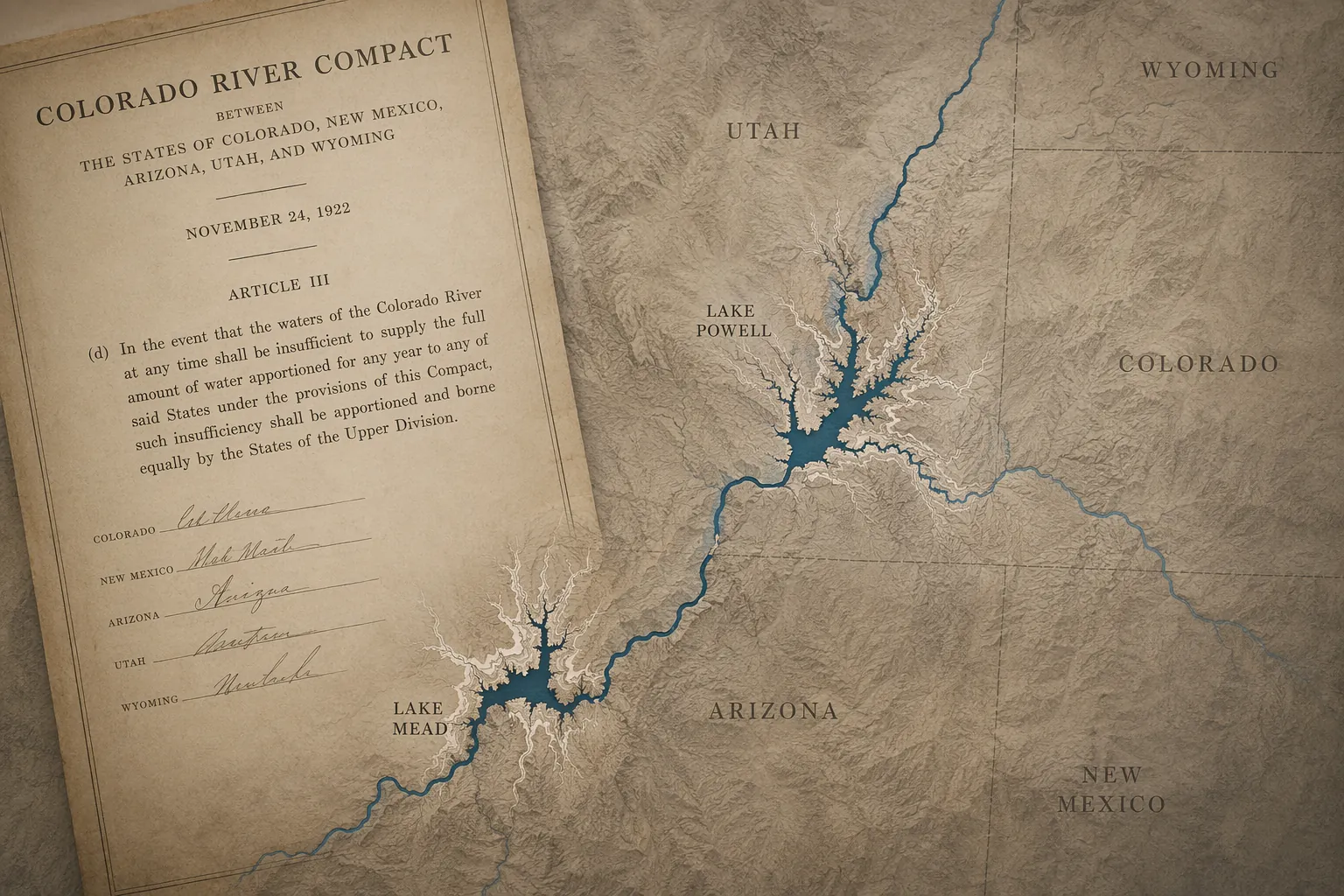
That is why the phrase “compact call” has stopped sounding academic. It is not a reservoir photo caption. It is the procedural name for a claim that the Upper Basin has failed, or is about to fail, a compact obligation measured at Lee Ferry. Once the accounting line is crossed, the fight moves from shortage management to breach theory.
The compact call mechanism
The Colorado River Compact divides the river system around Lee Ferry, the point that separates the Upper Basin from the Lower Basin for compact accounting. Article III(d) is the clause now doing the work. In the litigation posture described by current legal alerts, the critical measure is whether flows at Lee Ferry satisfy an 82.5 MAF requirement over a rolling 10-year period.[2]
A compact call would not be a self-executing courtroom judgment. It would be a demand, likely by a Lower Basin state, that the Upper Basin has breached the Compact and must take corrective action. The legal consequence depends on what Article III(d) means. The operational consequence is immediate: Upper Basin water users, Lower Basin contractors, reservoir operators, municipal suppliers, agricultural districts, and tribal clients all need advice before any court has said which reading controls.
| Element | Why it matters legally |
|---|---|
| Lee Ferry | The accounting point where the Upper Basin’s alleged obligation is measured. |
| Rolling 10-year total | The period over which compliance is evaluated, rather than a single-day reservoir elevation. |
| 82.5 MAF threshold | The number now expected to frame the breach allegation. |
| 2026 Powell-to-Mead release cut | The operational decision likely to move the accounting from warning to justiciable dispute. |
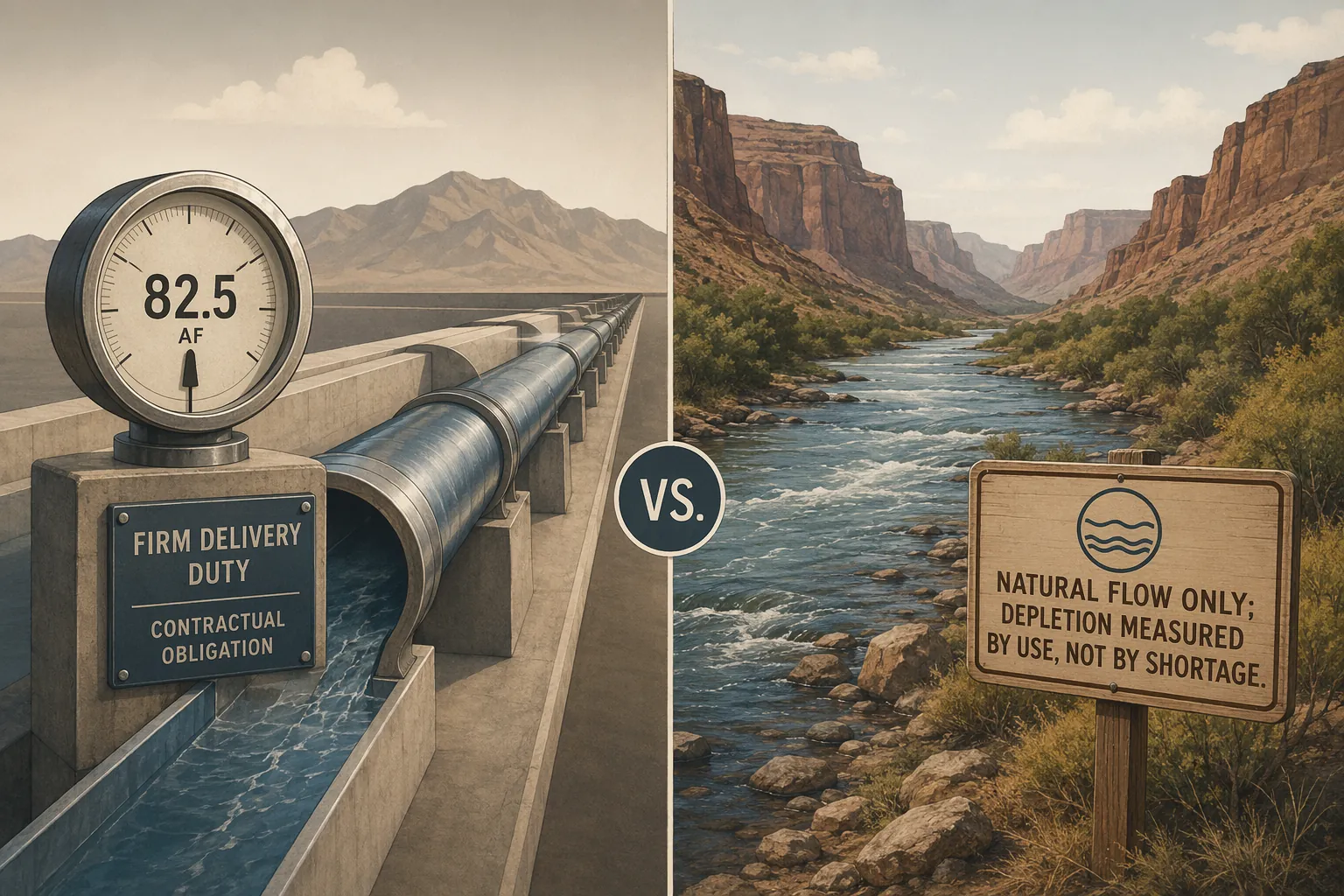
| Article III(d) | The unresolved compact text: firm delivery duty or non-depletion standard. |
Lake Mead’s visible decline matters politically and financially, but the compact-call case would not be litigated as a claim about bathtub rings. It would be litigated around text, accounting, causation, and remedy.
Why the 2026 operation changes the litigation posture
The April 2026 Reclamation action matters because it connects reservoir protection to compact accounting. Reclamation reported Lake Powell at 3,526 feet in April 2026, about 24% of capacity, and forecast that the reservoir could fall below the 3,490-foot minimum power pool by August 2026.[1] Protecting Powell therefore meant reducing releases to Mead. Reducing releases to Mead, in turn, increases the likelihood that Lee Ferry accounting will fall below the 10-year compact threshold.[1][2]
That chain is the litigation trigger. Reclamation did not declare a compact breach. It changed operations under drought-response authority. But the changed operation supplies the factual predicate Lower Basin lawyers need: less water passing downstream, a cumulative accounting problem at Lee Ferry, and a plausible claim that the Upper Basin has not met the obligation the Lower Basin says Article III(d) imposes.
The caution is not decorative. The 2026 flows are still projections. Late-season hydrology can change final accounting, and the legal effect of any shortfall depends on causation, not merely arithmetic. Still, for advice purposes, the relevant fact is not whether every number is final today. It is that Reclamation’s operating decision has moved the dispute close enough to filing posture that clients can no longer treat Article III(d) as a seminar problem.
The two Article III(d) readings
The Lower Basin theory: firm delivery
Arizona and Lower Basin-aligned advocates are expected to argue that Article III(d) requires the Upper Basin to ensure that the required volume passes Lee Ferry over any rolling 10-year period. On that reading, the Compact creates a firm delivery duty. If the accounting falls short, hydrology may explain why compliance became difficult, but it does not erase the duty.[2]
The appeal of that theory is procedural clarity. It gives the court a number, a measuring point, and a breach date. It also gives Lower Basin users a theory that does not require them to prove, project by project, which upstream uses caused which downstream shortage. If 82.5 MAF over 10 years is the enforceable obligation, the case becomes a dispute over compliance and remedy.
The Upper Basin theory: non-depletion
The Upper Basin response is not simply “there is no water.” It is a textual argument about causation. The Upper Basin is expected to argue that Article III(d) prohibits the Upper Basin states from causing Lee Ferry flows to be depleted below the compact measure through consumptive use. Under that reading, natural shortage is not itself a compact breach. The legal question is whether Upper Basin use caused the shortfall, not whether the river failed to produce enough water in a dry period.[2]
That theory gives hydrology legal significance, but it does not make hydrology a complete shield. If the Upper Basin reading controls, the litigation shifts toward proof: natural flow, consumptive use, reservoir operations, accounting conventions, and what “cause” means when a century-old compact is applied to a river system managed through federal infrastructure.
No Supreme Court decision has squarely resolved that delivery-duty-versus-non-depletion question under Article III(d).[2] That is the uncomfortable point for rights holders. Both sides can brief serious textual arguments. Neither side can honestly sell its preferred interpretation as settled operating law.
Arizona is preparing as if the claim will be filed
Arizona’s posture matters because compact litigation does not become imminent merely because lawyers can imagine it. It becomes imminent when a state funds the fight, hires counsel, and says publicly when it may sue.
In February 2026, Arizona lawmakers unanimously advanced a bipartisan measure boosting a legal fund for a Colorado River fight.[3] Public reporting has described different dollar figures—$1 million in one account and $3 million in another—which likely reflects appropriation timing and supplemental funding rather than a clean factual contradiction.[2][3] In March 2026, Arizona retained outside counsel for the anticipated Colorado River dispute.[4] Kilpatrick Townsend’s April 2026 alert reported that the Arizona governor’s office had indicated suit could be filed “as soon as the Compact is breached, which could occur in the coming months.”[2]
That sequence changes client counseling. A city, irrigation district, developer, lender, tribe, or industrial user does not need certainty about the merits before it has exposure to litigation-driven operational risk. It needs to know that one state is already budgeting for the case and that the relevant accounting event may arrive before post-2026 operating rules are settled.
Forum and procedure: why Arizona v. California only answers part of the question
A compact-call suit between states would be expected to proceed in the U.S. Supreme Court’s original jurisdiction. That does not mean a quick merits answer. Original actions often involve a motion for leave to file, appointment of a special master, factual proceedings, exceptions, briefing, and eventual Supreme Court review. The forum is direct; the process is not fast.
Arizona v. California will matter, but not because it already resolves Article III(d). In 1963, the Supreme Court confirmed the Secretary of the Interior’s broad authority over Lower Basin mainstream operations under the Boulder Canyon Project Act framework.[5] That precedent is highly relevant to what Reclamation may operate, allocate, and administer in the Lower Basin. It is less useful on the central Compact question now approaching: whether Article III(d) imposes a firm delivery obligation on the Upper Basin or only a non-depletion obligation tied to causation.
That distinction matters for remedy. If the case is framed mainly as a compact breach by Upper Basin states, Arizona v. California does not hand the Court a prewritten decree. If federal operations are also challenged or implicated, the Secretary’s authority becomes central. Those are related issues, not the same issue.
The procedural delay is not a side concern. Nevada’s top Colorado River negotiator, John Entsminger, has warned that Supreme Court litigation could produce “multi-decadal, grinding non-answers.”[6] That warning is useful because it punctures the assumption that a compact call would promptly stabilize markets, contracts, or capital plans. Litigation may clarify the parties’ theories long before it clarifies everyone’s rights.
What water-rights holders should treat as legally live
For existing rights holders, the near-term risk is not that every entitlement vanishes on the date a complaint is filed. The risk is that operating assumptions become conditional. A contract, decree, service-area plan, crop-financing package, tribal settlement implementation schedule, or infrastructure bond model may depend on water deliveries whose legal foundation is being tested in a forum that moves slowly and speaks narrowly.
Municipal suppliers face a different exposure profile from agricultural users. A city may be able to spread shortage through rates, conservation programs, groundwater portfolios, or capital sequencing, but it also has public-health and growth-management obligations. Irrigation districts may have more direct acreage and crop-cycle consequences. Tribal clients may have settlement rights, unresolved claims, federal trust dimensions, or infrastructure constraints that make “paper water” and wet-water delivery materially different advisory questions.
The finance consequences are already visible enough that municipal-market coverage has treated Colorado River litigation risk as relevant to water infrastructure planning and credit analysis.[7] That does not prove a particular legal outcome. It does show that the compact-call issue has moved outside specialist doctrine and into the assumptions used to fund pipes, treatment capacity, conservation programs, and replacement supplies.
The 1944 Mexican treaty also sits in the background, but the immediate Article III(d) dispute is a U.S. compact and Supreme Court original-jurisdiction problem. Treating the treaty as a passing footnote is not a view about its importance; it is a boundary on the present legal question.
The practical advice posture is narrow. The compact call is imminent enough to affect drafting, diligence, disclosure, settlement strategy, and operational contingency planning. It is too unsettled for any rights holder to rely safely on either side’s Article III(d) theory as though it were controlling law. Existing water-rights holders, municipal suppliers, agricultural users, and tribal clients are entering a period in which reservoir operations, Supreme Court procedure, and compact interpretation may move faster than doctrine.
References
- Reclamation acts to protect Colorado River system during historic drought — Reclamation, April 17, 2026
- Colorado River Developments and Potential Compact Litigation — Kilpatrick Townsend, April 2026
- Lawmakers prepare for Colorado River water fight with unanimous vote boosting legal fund — AZ Mirror, February 3, 2026
- Arizona hires high-powered law firm, setting the stage for a legal battle over Colorado River water — Maven’s Notebook, March 24, 2026
- Arizona v. California, 373 U.S. 546 — U.S. Supreme Court, 1963
- Colorado River states stare down the 'looming specter' of a Supreme Court battle — KUNC, February 19, 2025
- Colorado River Basin states gird for court battle over water — Bond Buyer, 2026
Related records
Tool profile
Browse tool evaluations →Governing regulation
Browse the obligations tracker →Preventive workflow
Browse verification workflows →
Report a correction or tip
Spotted an outdated figure, a misstated fact, or a ruling this case record should reflect? Public comments are disabled for this content given the professional cost of a misreported case outcome, penalty amount, or rule text — use the structured correction channel instead.
Report a correction or tip for this record →