
Contra Costa Therapist Charged with Grooming Teen
A tort claim against Contra Costa County alleges that multiple county agencies failed to detect or report a therapist's grooming of a 14-year-old probation client over two years, raising supervisory liability and mandated reporter exposure for public entities.
- Jurisdiction
- California, USA
- Court
- Contra Costa County Superior Court
- AI tool named
- none
- Ruling date
- Jul 27, 2026
- Source document
- View primary court order ↗
- Last verified
- Jul 29, 2026
Lex Machina Review is an independent risk-tracking and reference resource. Nothing on this site is legal advice, and using it does not create an attorney-client relationship. Every record is reviewed against primary sources but may not reflect the most current status of a matter — always verify directly against the cited court order, rule text, or a licensed attorney before relying on it.
Companion explanation — secondary to the source document above
Verified posture: a criminal case and a public-entity claim are moving on separate tracks
This Contra Costa County therapist grooming case is outside the usual AI-filing lane: no AI tool, generated filing, hallucinated citation, or sanctions order is involved. It belongs here as a risk-digest exception because it presents a professional-responsibility and institutional-liability pattern that lawyers and public-agency risk staff should recognize. The verified criminal-case identity is this: Sofia Ann-Buitron Drotts, 28, of San Francisco, was a behavioral health clinician at John A. Davis Juvenile Detention Center in Martinez, employed through Seneca Healthcare under contract with Contra Costa County. The Contra Costa County District Attorney’s Office says she is charged with seven felony counts, including unlawful intercourse with a minor, multiple counts of oral copulation of a minor, sexual penetration by foreign object, sending harmful matter to a minor, and possession of child pornography. [1]
The charges are allegations. The family’s Government Claims Act filing is also an allegation document, not a finding. As of the latest public reports available in the research materials, dated July 27–29, 2026, Drotts had not entered a plea, and the materials did not include an official court docket or publicly available arraignment date. [2][3] Nothing in this article is legal advice, and nothing here resolves the criminal allegations.
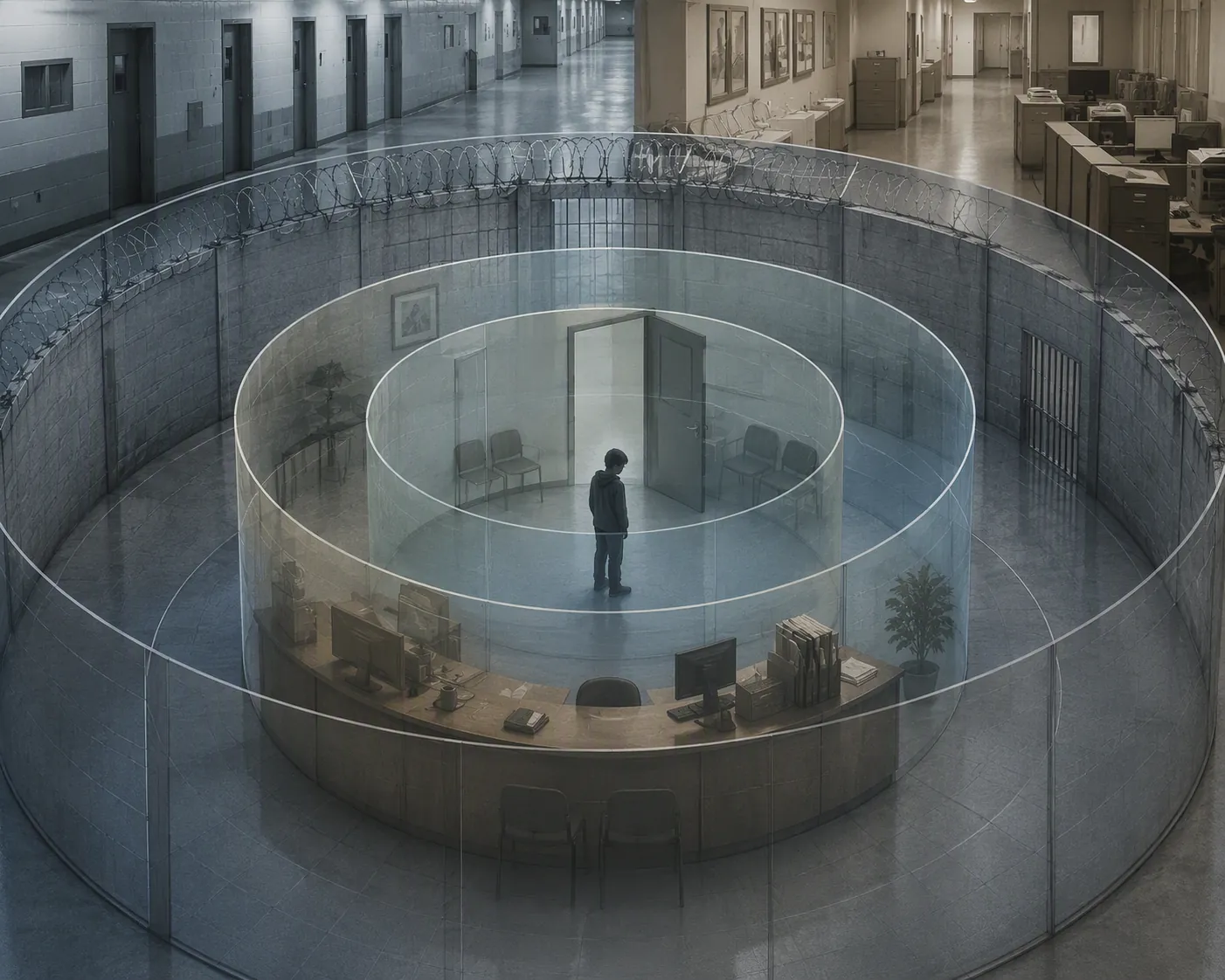
The institutional question begins before any civil complaint is filed. If the victim was simultaneously a minor, a therapy client, a juvenile-hall patient, and a probation client, then the supervision record is not a single office’s file. It is a chain of handoffs. The family’s claim asks whether those handoffs left each agency able to describe itself as only a partial actor while the child experienced the county system as one continuous system.
What the alleged timeline adds to the criminal complaint
Local reports describe the alleged victim as a boy who was 14 to 16 years old during the relevant period and on juvenile probation. He allegedly met Drotts when she was assigned as his therapist at juvenile hall. After his release, the relationship allegedly continued off-site for roughly three and a half months, from April 1 through July 14, 2026. [2][3]
That sequence matters because the civil exposure is not confined to whether a therapist committed charged crimes. The family’s claim, filed by attorney John Burris on July 27, 2026, frames the case as an alleged two-year grooming and supervision failure, with the post-release period becoming the point at which county probation supervision, home monitoring, and contracted behavioral-health services should have intersected more visibly. [4][5]
The strongest civil-liability facts now in the public record are not the most graphic allegations. They are the ordinary supervision facts: a clinician allegedly transporting the teen in her personal vehicle; alleged curfew violations or probation-condition problems; the teen allegedly disappearing from home for hours; and alleged changes in probation officers after release. [4][5] Those are the facts that convert a private-abuse narrative into an institutional notice question.
One allegation needs careful handling. The family’s claim and Patch coverage say the teen’s probation officer changed at least four times after release, but the research materials do not include independent confirmation of that point through court records. [5] If later records confirm repeated officer changes, that fact would not prove abuse by itself. It would, however, become relevant to whether supervision continuity failed at the exact moment when unusual adult access, curfew problems, and family concerns allegedly required follow-up.
The warning signs were bureaucratic before they were legal
Personal-vehicle transportation is the kind of detail that risk managers tend to treat as a policy question and families tend to experience as a loss of control. If a court-connected clinician is driving a probation minor outside ordinary channels, someone may need to know who authorized it, who logged it, and whether any supervisor reviewed it. If nobody had that full picture, the gap is not merely clerical.
Curfew problems and hours-long absences carry a different significance in a probation setting than they would for a child with no court involvement. A probation condition is not just a family rule. It is part of a supervision architecture. If the child was missing for hours, the relevant question becomes who received that information, whether it was treated as noncompliance, whether it triggered a welfare concern, and whether any mandated reporter considered the possibility of exploitation.
That is why the claim’s agency map matters. The alleged facts sit across Contra Costa Health, Contra Costa County Behavioral Health Services, the Probation Department, John A. Davis Juvenile Detention Center, Seneca Healthcare as the contracted provider, and other named entities. Mercury News and NBC Bay Area reported that the claim names Contra Costa County, Contra Costa Health, Contra Costa County Behavioral Health Services, the Probation Department, John A. Davis Juvenile Detention Center, the California Department of Health Care Services, and Seneca Healthcare. [6][7]
Duty mapping: the claim is really about who had the power to interrupt access
The claim’s pleaded theories include negligence, negligent hiring, negligent supervision, negligent retention, failure to prevent sexual abuse, and civil rights violations. It seeks damages exceeding $100,000. [4][5] Those theories do not all ask the same question. Some look backward at hiring and retention. Some look at supervision while the therapist was assigned to minors. Some ask whether public actors had a constitutional or statutory duty to protect a known vulnerable child from a foreseeable danger. The practical inquiry is narrower: which institutional layer allegedly had enough knowledge, authority, and contact with the minor to detect or report the conduct?
| Institutional layer | Publicly reported role | Civil-duty question |
|---|---|---|
| Behavioral health / clinician assignment | Drotts was reported as a behavioral health clinician assigned to the teen at John A. Davis Juvenile Detention Center. | Who supervised the therapeutic relationship, reviewed contact boundaries, and monitored post-release contact with a former juvenile-hall patient? |
| Contracted provider | Seneca Healthcare is described as Drotts’s employer under contract with Contra Costa County. | What hiring, training, boundary, reporting, and retention duties applied to clinicians serving detained or probation-involved minors? |
| Probation supervision | The teen was reported to be on juvenile probation after release. | Who received curfew or absence information, who documented violations, and who was positioned to notice unauthorized adult access? |
| Juvenile detention setting | The initial therapist-client contact allegedly began at John A. Davis Juvenile Detention Center. | What rules governed staff access to minors, transport, communications, and transition planning after release? |
| County health and behavioral health agencies | Contra Costa Health and Behavioral Health Services are named in the claim. | Which agency controlled policies, supervision, incident review, and mandated reporting channels for behavioral-health staff working with minors? |
The table is not a liability finding. It is the route a civil case will likely travel if it moves past the claim stage. Public entities and contractors rarely defend these cases by saying no one had any duty at all. More often, the fight is over allocation: the therapist acted outside scope; the contractor controlled employment; the county controlled placement; probation only saw compliance data; detention only controlled the custodial period; health administrators did not receive the right information. Each of those defenses can be partly true and still leave a child without a functioning reporting pathway.
Negligent hiring and retention will turn on what Seneca Healthcare, county contracting officials, or supervising agencies knew or should have known before and during Drotts’s assignment. The current public materials do not identify prior complaints, background-check failures, disciplinary history, or internal red flags. Without those records, negligent hiring remains a pleaded theory rather than a supported factual conclusion.
Negligent supervision is more immediately connected to the public record because it follows the alleged pattern after the therapist-client relationship began: ongoing access to a minor, alleged off-site contact, alleged personal-vehicle transport, and alleged probation-condition issues. The supervision question is not whether every agency knew everything. It is whether each agency’s own role gave it enough information and authority to ask the next question.
The civil-rights theory, including a possible 42 U.S.C. § 1983 route, raises a higher and more technical question: whether a public actor’s conduct amounted to a constitutional violation rather than ordinary negligence. The present materials do not establish that. They do, however, show why plaintiffs would plead beyond ordinary negligence when a minor was under juvenile justice supervision and allegedly harmed by a professional placed in his path through that system.
Mandated reporter exposure is separate from whether the therapist is convicted
California’s Child Abuse and Neglect Reporting Act, Penal Code §§ 11164–11174.4, imposes reporting duties on professionals who work with minors, including behavioral health clinicians and probation-related personnel. Penal Code § 11166.01 makes failure to report a misdemeanor, and in civil litigation a statutory reporting failure can be pleaded as negligence per se if the plaintiff can connect the statutory breach to the harm.
That framework changes the institutional analysis. A mandated reporter does not need a criminal conviction before reporting suspected abuse. The trigger is suspicion within the statutory role, not courtroom proof. If a probation officer, clinician supervisor, detention employee, or health-agency administrator allegedly saw enough to suspect exploitation, the legal question becomes whether a report should have been made then, not whether prosecutors can later prove every charged count beyond a reasonable doubt.
This is where the family’s alleged warning signs carry their weight. Personal-vehicle transport, unexplained absences, and curfew violations do not automatically equal sexual abuse. In a juvenile probation setting, though, they can create a duty to investigate, document, escalate, or report—especially when the adult with access is also a therapeutic professional whose relationship with the child began inside a county detention environment.
The Government Claims Act posture controls the next civil step
The July 27, 2026 filing is a Government Claims Act claim, not yet a civil lawsuit against the public entities. [4][5] Under the California Government Claims Act, Gov. Code §§ 810–996.6, a claimant generally must present a claim to a public entity before suing it. Gov. Code § 911.2 requires presentation within six months for this kind of injury claim; the alleged off-site abuse period ran from April 1 to July 14, 2026, and the claim was filed on July 27, 2026. [2][4]
For public-entity counsel and risk staff, the timing is routing information. The named public entities have 45 days to respond. If the claim is denied, Gov. Code § 945.6 generally gives the claimant six months from denial to file suit. That process will determine when pleaded allegations become a complaint, when defendants must appear, and when public records, contracts, supervision files, and internal reporting documents may become central.
Contra Costa Health declined to comment because of active litigation, according to NBC Bay Area. [7] That is unsurprising, but it leaves a large factual gap. At this stage, there are no released internal investigation findings, no public supervision review, and no official record in the materials showing who received which warnings when.
What can be said now, and what cannot
The criminal case and the institutional-liability case are related, but they do not rise or fall on exactly the same proof. Prosecutors must prove the charged offenses against Drotts. A civil plaintiff pursuing public entities or contractors will focus on duty, notice, supervision, causation, statutory reporting obligations, and whether any failure by an institution contributed to the harm. A conviction would matter, but the absence of one at this stage does not end the civil inquiry.
Nor does the existence of a tort claim establish county liability. The current record is still built from a DA release, local reporting, and the family’s claim. The most consequential records are not public in the materials: assignment records, transport policies, communications logs, probation notes, mandated-reporter documentation, contract terms, training materials, supervisor reviews, and any internal investigation.
- No plea by Drotts was reported in the available July 27–29, 2026 materials.
- No official court docket or arraignment date was publicly available in the research materials.
- No internal investigation findings have been released.
- Contra Costa Health declined comment because of active litigation.
- The allegation that probation officers changed at least four times appears in the family’s claim and Patch coverage, but has not been independently confirmed through court records.
The defensible risk lesson is narrower than a verdict and more useful than outrage. When a minor is simultaneously under behavioral-health care, juvenile detention transition, and probation supervision, each institutional layer may have its own duty to detect, interrupt, or report suspected grooming behavior. The therapist’s guilt remains unproven. The public-entity exposure arises from a separate question: whether several mandated reporters and supervisors each had enough of the picture to act before the child was left to carry the whole system’s alleged failure alone.
References
- DA Charges Juvenile Hall Therapist with Sexual Abuse of Minor, Contra Costa County District Attorney’s Office, link
- Family accuses former Contra Costa County juvenile hall therapist of grooming, sexually abusing teen boy, ABC7, link
- Contra Costa County juvenile hall therapist charged in teen sexual abuse, CBS News San Francisco, link
- Contra Costa Therapist Sexual Abuse Lawsuit, Davis Vanguard, July 2026, link
- Family Of Teen Files Claim Over Alleged Therapist Sexual Abuse: Report, Patch, link
- Concord sex abuse: Family of victim sues Contra Costa County, The Mercury News, July 27, 2026, link
- Sex abuse claim filed against Contra Costa County therapist, NBC Bay Area, link
Related records
Tool profile
Browse tool evaluations →Governing regulation
Browse the obligations tracker →Preventive workflow
Browse verification workflows →
Report a correction or tip
Spotted an outdated figure, a misstated fact, or a ruling this case record should reflect? Public comments are disabled for this content given the professional cost of a misreported case outcome, penalty amount, or rule text — use the structured correction channel instead.
Report a correction or tip for this record →