
Corey Ruiz Shooting Investigation: The Body Camera Evidence Gap
The July 22 police shooting of Corey Ruiz in Madison, Wisconsin, exposes a critical evidence gap: Madison PD operates without body cameras, forcing reliance on bystander video. This entry documents the tools available for AI-assisted video analysis (JusticeText, Truleo), their unvalidated accuracy claims, and the evidentiary framework under State v. Puloka that would govern any AI enhancement of that footage.
- Jurisdiction
- Washington
- Ruling date
- Mar 29, 2024
- Source document
- View primary court order ↗
Lex Machina Review is an independent risk-tracking and reference resource. Nothing on this site is legal advice, and using it does not create an attorney-client relationship. Every record is reviewed against primary sources but may not reflect the most current status of a matter — always verify directly against the cited court order, rule text, or a licensed attorney before relying on it.
Companion explanation — secondary to the source document above
The Corey Ruiz Madison police shooting investigation is still in its first days, and that matters. Ruiz was identified after a fatal July 22, 2026, police shooting in Madison, Wisconsin; by July 24, his family had hired attorney Ben Crump, while the officer’s name, Wisconsin DOJ findings, and any charging decision had not been publicly reported in the materials available for this update.[1][2] PBS described the incident as involving a man with a knife, but the public record remains preliminary, not litigated fact.[3]
This is not an AI failure case. No public source says JusticeText, Truleo, or any other AI video-analysis product was used in the Ruiz investigation. The legal issue is narrower and more practical: Madison police officers were not wearing department body cameras, so the most useful official source recording may never have existed. Once that happens, later software can search, summarize, transcribe, or enhance only what someone else happened to capture.
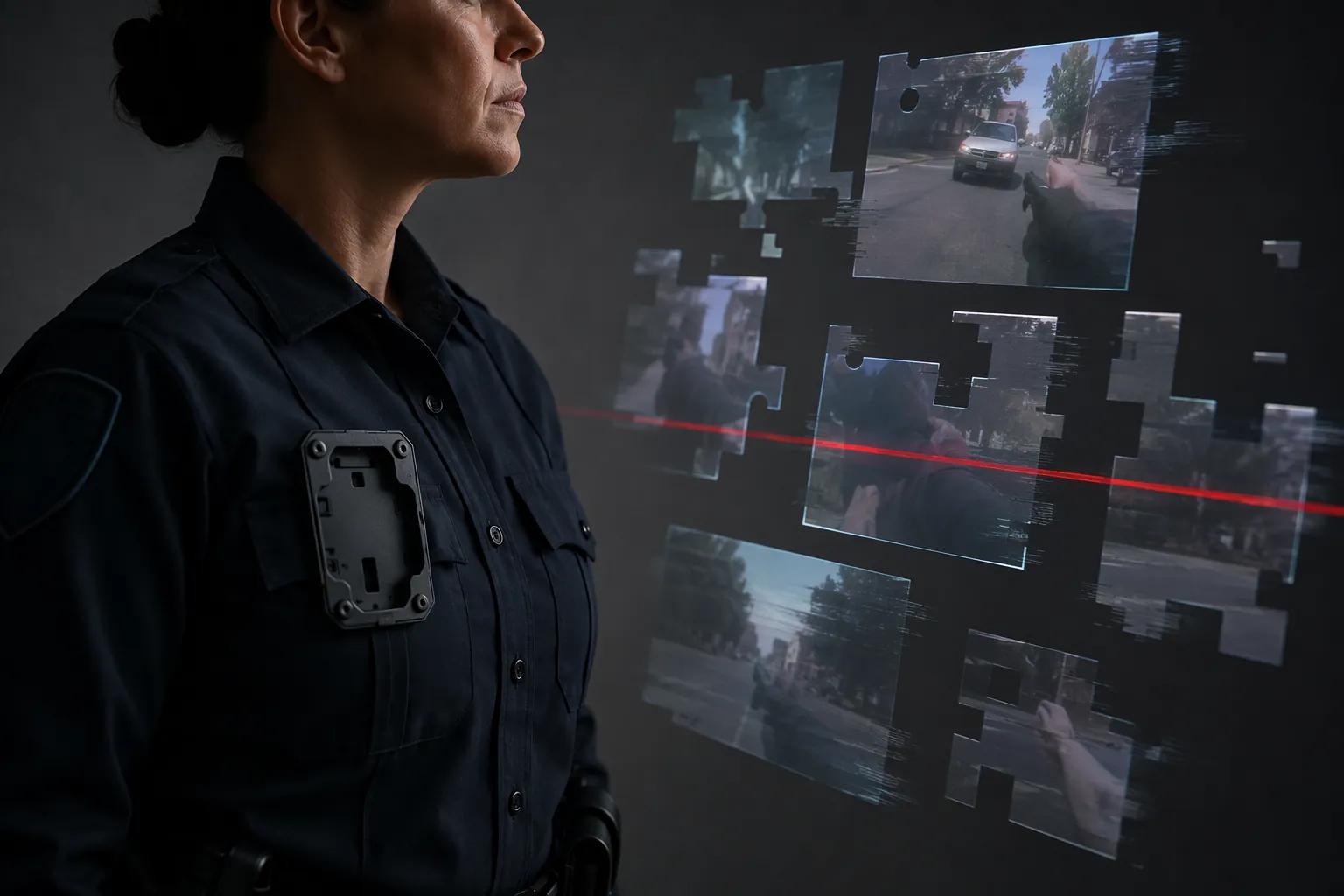
Madison’s body-camera gap is not a small administrative detail. A November 2025 City of Madison budget amendment described a phased plan to begin body-worn camera deployment in 2027 and attached an estimated $400,000 budget request; available sources also identify Madison as one of the largest Midwest police departments still operating without body cameras.[4] For a department of roughly 500 officers, that means a police shooting can move immediately into a thinner evidence lane: radio traffic, officer and witness statements, forensic evidence, dispatch records, surveillance footage if it exists, and bystander video if someone recorded from the right angle.
Wisconsin law requires outside investigation of officer-involved deaths, but an outside investigative structure does not create missing footage.[5] It can collect what exists, interview witnesses, preserve records, and send findings forward. It cannot reconstruct an unrecorded field of view from an officer’s chest, the seconds before a weapon was seen, the distance between people, or the sound quality that a body-worn microphone might have captured.
The Evidence Gap Comes Before the Software Question
Body-camera footage is not magic evidence. It can be obstructed, badly angled, muted, activated late, or misunderstood. But when it exists, lawyers at least have a source recording to test. They can compare timestamps, ask whether the camera was activated under policy, check whether the audio begins before the visible encounter, and press witnesses against the same underlying record.
When the source recording never exists, the legal work changes. A public defender trying to reconstruct an encounter may have to work from a phone video shot from across the street. A prosecutor may have fewer angles to corroborate an officer statement. A family may be told that there is no official video because the city had not yet deployed cameras. A procurement officer, months later, may hear a vendor promise that AI can make video review faster and more complete. That promise needs to be tested against the Ruiz problem: faster review of what?
If the only recording is bystander video, AI can help locate speech, sharpen a timeline, flag a possible contradiction, or organize clips for a lawyer. It cannot turn that bystander recording into a missing body camera. The distinction is not philosophical; it affects charging decisions, plea posture, suppression litigation, trial exhibits, and civil review.
What JusticeText Appears to Help Defenders Do
JusticeText is the more relevant tool for defender offices because its value proposition starts where public defense pain is real: hours of audiovisual discovery, little staff time, and a need to find the one statement that changes the case. Thomson Reuters Institute reported that JusticeText was used by more than 70 public defender agencies and more than 300 law firms, and that the company reported a 50% time reduction in video review.[6]
The strongest JusticeText examples are not broad claims about AI transformation. They are workflow outcomes. In one Florida case described by Thomson Reuters Institute, JusticeText surfaced contradictions between officer and witness statements, and a second-degree murder charge was reduced to manslaughter.[6] In California, the same article described Racial Justice Act findings tied to officer language flagged in body-camera transcripts.[6] In Nevada, it described 19 hours of video reviewed in 2 hours, with Fourth, Sixth, and Fourteenth Amendment issues surfaced.[6]
Those are meaningful examples. They show how a tired defense team might get to a contradiction, constitutional issue, or language pattern sooner. They do not establish a systematic transcription error rate, a demographic performance profile, or a courtroom-grade benchmark for the tool’s labeling decisions. A product can be genuinely useful in discovery and still unvalidated for a criminal evidentiary fight.
| Question | JusticeText Material Supports | What Remains Unproven |
|---|---|---|
| Can it reduce review time? | The vendor-reported figure is a 50% reduction in video review time, with published examples of faster review. | Independent, case-type-specific time studies are not identified in the public materials. |
| Can it help find contradictions or legal issues? | Published examples describe officer-witness contradictions, Racial Justice Act language findings, and constitutional issue flags. | The examples do not provide a general false-positive or false-negative rate. |
| Is it accurate enough to rely on in court? | The materials show operational usefulness. | No independently published systematic accuracy benchmark is identified for transcription or labeling. |
For a defender office, that difference affects purchasing language. A contract that says the tool helps attorneys search and triage discovery is one thing. A procurement memo that treats the tool’s outputs as independently reliable evidence is another. If the office later has to explain why a missed phrase, mistranscribed statement, or mislabeled speaker affected plea advice, the documented validation record will matter more than the demo.
Truleo Has Stronger Behavioral Evidence, Not a Public Accuracy Audit
Truleo sits on the law-enforcement side of the market. MIT Technology Review reported in 2024 that Truleo was being used by more than 30 agencies and that pricing for small departments was about $36,000 per year.[7] The company’s public pitch has included an “over 90% accuracy” claim, but available public sources identify that as self-reported, with no third-party public audit of the transcription and labeling engine.[7]
Truleo also has something JusticeText does not have in the available public record: a peer-reviewed randomized controlled trial reporting behavioral effects. The Adams et al. study, published in Criminology & Public Policy in April 2026, found a 36% use-of-force reduction in Alameda, a 57% reduction in unprofessionalism in Aurora, and highly professional behavior that nearly doubled in Richland County.[8]
That deserves attention. If automated review and feedback change officer behavior, the result is not just a back-office efficiency claim. It can mean fewer force incidents, fewer complaint triggers, and more usable records. But a behavioral RCT does not answer every evidentiary question. It can show that a program changed measured conduct without independently proving the engine’s word-level transcription accuracy, speaker identification accuracy, demographic performance, or legal sufficiency for contested courtroom use.
The procurement risk is easy to miss because “peer reviewed” sounds like a single reliability stamp. Here, it should be read more carefully: peer-reviewed evidence supports reported behavioral outcomes in specified agencies; the public materials do not show an independent third-party accuracy audit of the underlying transcription and labeling system.
| Tool | Best-Supported Use | Evidence Caution |
|---|---|---|
| JusticeText | Defense-side discovery triage, transcript search, contradiction spotting, and issue flagging. | No independently published systematic accuracy benchmark is identified in the materials. |
| Truleo | Law-enforcement body-camera review and officer feedback tied to reported behavioral changes. | The peer-reviewed behavioral findings do not independently validate the self-reported accuracy claim. |
The Ruiz Investigation Shows the Boundary Both Tools Share
JusticeText and Truleo both assume there is audiovisual material to process. That is their shared boundary. They can organize recordings; they cannot supply the missing official recording. In a department without body cameras, a tool that performs well on body-camera review has nowhere to operate unless other video exists.
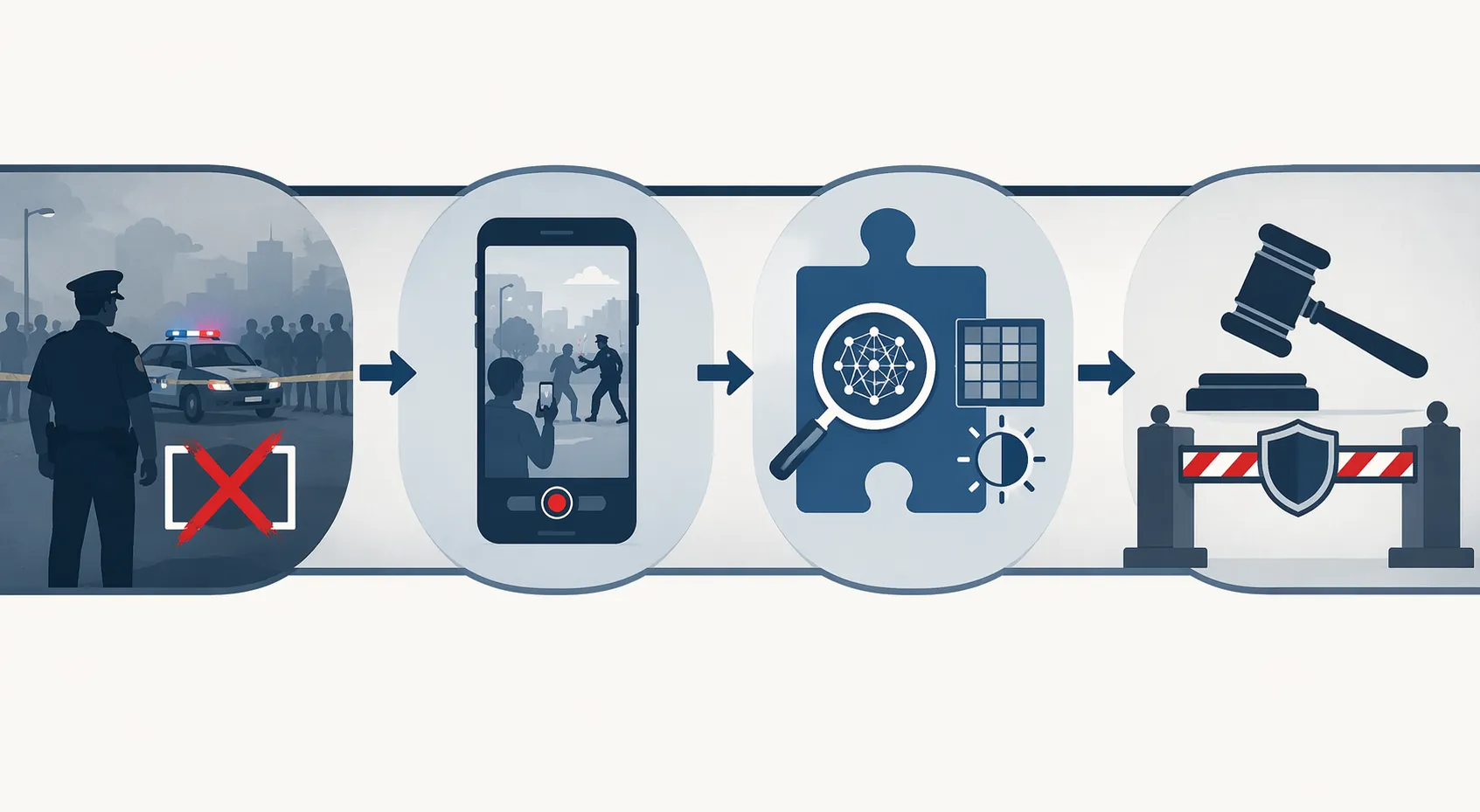
That boundary is especially important in the Corey Ruiz investigation because the public record, as of July 24, 2026, does not support treating the case as a test of AI review. The better legal update is about source evidence. If a bystander video becomes central, lawyers may use ordinary forensic methods to authenticate it, compare it with dispatch and witness accounts, and test whether it fairly depicts the relevant moments. But if either side tries to improve the video through generative AI enhancement, a different evidentiary problem appears.
Puloka Is the Courtroom Stop Sign
State v. Puloka is not a Wisconsin appellate rule, and it should not be overstated as binding law for a Madison prosecution or civil case. It is still important because it is a published trial-court ruling squarely confronting generative-AI-enhanced video. On March 29, 2024, the King County Superior Court in Washington excluded generative-AI-enhanced video under the Frye standard.[9]
Frye asks, in plain terms, whether the scientific or technical method has gained general acceptance in the relevant field. The Puloka court was not simply asking whether the enhanced video looked clearer. It was asking whether the method used to create that apparent clarity was reliable enough for a jury to see it as evidence. Greenberg Traurig described the ruling as rejecting a novel use of AI-enhanced video in trial, and Criminal Legal News later framed the concern bluntly: AI may invent pixels rather than recover them.[10][11]
That distinction matters for any bystander footage in the Ruiz investigation. Enlarging, stabilizing, slowing, or clarifying video through accepted forensic processes is not the same as using a generative system to create a visually improved version whose added detail may not have existed in the original recording. A lawyer offering the enhanced clip would need to explain the method, the inputs, the validation, the error risks, and the way the output differs from the source. A lawyer opposing it would ask whether the jury is being shown evidence or a machine-generated interpretation.
As of mid-2026, Puloka had no reported appellate reversal.[11] That does not make it controlling Wisconsin law. It does make it a warning for prosecutors, defenders, civil litigators, and procurement staff who are tempted to treat AI enhancement as a cure for poor or missing footage.
What Buyers Should Verify Before Purchase
A city, defender office, or oversight board does not need to reject AI review tools to take reliability seriously. It needs to stop buying broad confidence and start buying verifiable performance. The December 2024 DOJ report on AI in criminal justice recommends demographic bias assessment and training-data documentation for AI forensic tools; available public sources do not identify published compliance by JusticeText or Truleo.[12]
- Ask for model cards that identify the model version, intended use, prohibited use, known failure modes, and update history.
- Require test-date-specific accuracy studies instead of evergreen accuracy claims that survive model changes.
- Demand separate error rates for transcription, speaker labeling, event labeling, search retrieval, and summarization.
- Require demographic bias assessment where voice, dialect, accent, race-linked language patterns, gender presentation, age, or disability may affect outputs.
- Document training-data sources, exclusion rules, and whether local agency footage, defender files, or client-sensitive records can be used for model improvement.
- Run local validation before reliance: use known recordings, known transcripts, and jurisdiction-specific workflows before the tool is used in live charging, plea, discipline, or trial preparation decisions.
Those are procurement safeguards, not magic legal shields. They help a buyer know what the tool does, what it misses, and who bears the consequence when the output is wrong. They also create a record for later review: what the vendor claimed, what the buyer tested, what changed after updates, and whether staff were trained to treat the output as a lead rather than a fact.
For Madison, the harder lesson sits upstream of procurement. If there is no body-camera footage of the Ruiz shooting, no AI platform can review that missing view. If bystander video becomes central and someone tries to enhance it with generative AI, Puloka gives the opposing lawyer an obvious reliability objection. The evidentiary gap begins at the moment the official recording was not made; software enters later, with narrower powers and heavier verification duties.
References
- Family of Corey Ruiz hires attorney Ben Crump after deadly Madison police shooting — WMTV, July 24, 2026.
- Officials identify man in fatal Madison shooting as Corey Ruiz — Milwaukee Journal Sentinel, July 23, 2026.
- Police officer's fatal shooting of man with knife roils Madison, Wisconsin — PBS NewsHour, July 23, 2026.
- Amendment to Actively Begin Phase-in of Body Worn Camera Technology — City of Madison, Nov. 11, 2025.
- Wisconsin Statute § 175.47 — Officer-involved death investigation requirements.
- JusticeText: Bringing AI audiovisual analysis to the public defender's office — Thomson Reuters Institute.
- AI was supposed to make police bodycams better. What happened? — MIT Technology Review, Apr. 16, 2024.
- AI, body‐worn cameras, and a potential civilizing effect for officers: Evidence from the Arizona Truleo study — Criminology & Public Policy, Apr. 2026.
- State of Washington v. Puloka, No. 21-1-04851-2-KNT (King Cnty. Super. Ct. Mar. 29, 2024) — NACDL, Mar. 29, 2024.
- Washington Court Rejects Novel Use of AI-Enhanced Video in Trial — Greenberg Traurig, May 2024.
- When AI Invents the Pixels: Challenging AI-Enhanced Video Evidence in Criminal Cases — Criminal Legal News, Jan. 2026.
- DOJ December 2024 report on AI in criminal justice — U.S. Department of Justice, Dec. 2024.
Related records
Tool profile
Browse tool evaluations →Governing regulation
Browse the obligations tracker →Preventive workflow
Browse verification workflows →
Report a correction or tip
Spotted an outdated figure, a misstated fact, or a ruling this case record should reflect? Public comments are disabled for this content given the professional cost of a misreported case outcome, penalty amount, or rule text — use the structured correction channel instead.
Report a correction or tip for this record →