
No criminal charges yet in Corey Ruiz police shooting
As of July 26, 2026, no criminal charges have been filed against any officer in the Corey Ruiz shooting. This Risk Digest record presents the DCI investigation timeline, Wisconsin deadly-force statutes, and historical charging patterns so practitioners can assess the procedural path and expected timeline.
- Jurisdiction
- Wisconsin, United States
- Court
- Dane County Circuit Court
- AI tool named
- None
- Ruling date
- Jul 22, 2026
- Source document
- View primary court order ↗
- Last verified
- Jul 26, 2026
Lex Machina Review is an independent risk-tracking and reference resource. Nothing on this site is legal advice, and using it does not create an attorney-client relationship. Every record is reviewed against primary sources but may not reflect the most current status of a matter — always verify directly against the cited court order, rule text, or a licensed attorney before relying on it.
Companion explanation — secondary to the source document above
As of July 26, 2026, no criminal charges have been filed against any officer in the Corey Ruiz police shooting, no charging decision has been announced, and the officer who fired has not been publicly named. The matter remains in the Wisconsin Department of Justice Division of Criminal Investigation stage, not in a completed Dane County District Attorney charging-review posture. Madison Police Chief Shon Barnes has described the shooter as a veteran officer, and AP reported that the officer was placed on administrative leave along with three other responding officers after the July 22 shooting.[1]
That status matters for anyone searching for a Corey Ruiz police shooting criminal charges update. Four days after an officer-involved death is too early to treat the absence of charges as either exoneration or refusal. Wisconsin has a statutory independent-investigation structure for officer-involved deaths, and the charging decision turns on a file that has not yet been delivered to Dane County District Attorney Ismael Ozanne.

Where the case sits procedurally
Wisconsin officials opened an investigation into Ruiz's death after the Madison police shooting, with the state Division of Criminal Investigation taking the lead.[2] That is not a courtesy review. Wisconsin law requires an outside investigation when an officer-involved death occurs, and the process is designed to separate the fact-gathering function from the employing agency whose officer used force.[3]
The practical sequence is straightforward, even if the evidence is not. DCI collects and organizes the investigative record; that record is then submitted to the local prosecutor; the prosecutor decides whether Wisconsin's criminal statutes and the provable facts support charges. Until that submission occurs, a district attorney may understand the public controversy, may see news video, and may receive calls for prosecution, but the formal charging analysis is still missing the investigative product it is supposed to rely on.
WMTV reported on July 25 that past Madison officer-involved shooting investigations took from 31 to 102 days from the incident to submission of the report, with an average of about 74 days.[4] That range is the most useful available benchmark for expectations, but it should be used carefully. The available sources do not include an audited case list behind the WMTV figure, and the range describes past Madison investigations, not a deadline imposed on the Ruiz investigation.
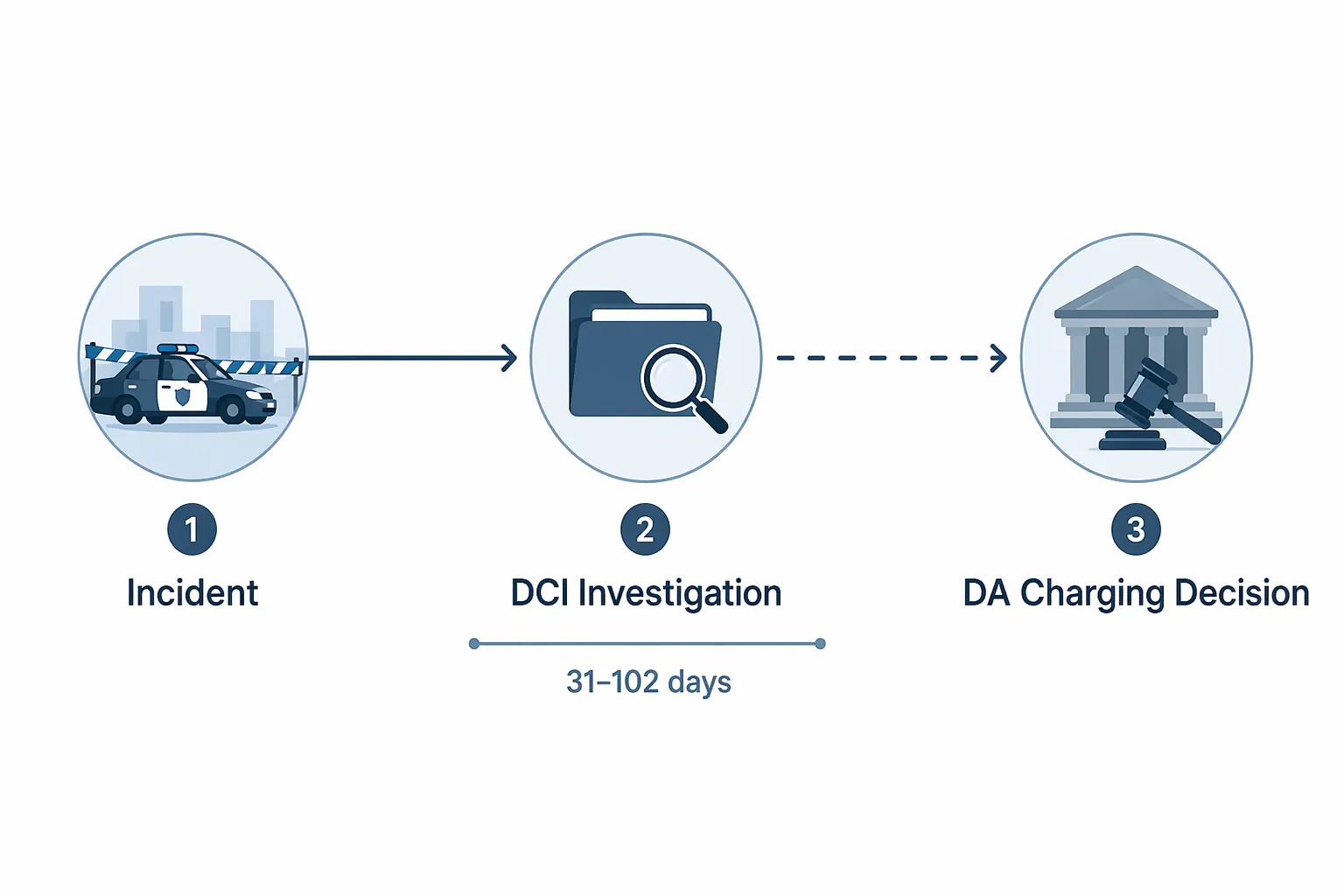
Still, the range disciplines the update. If the Ruiz investigation follows the reported historical pattern, the first meaningful procedural event is not an immediate charging announcement; it is DCI completing and submitting its file. On the low end of the reported range, that kind of submission would not be expected until roughly a month after the shooting. On the high end, it could take more than three months.[4]
| Stage | Current status as of July 26, 2026 | Why it matters |
|---|---|---|
| Incident | Ruiz was fatally shot by a Madison officer on July 22, 2026. | This starts the officer-involved death review process. |
| DCI investigation | Active and early; no public indication that the completed file has been sent to the DA. | DCI's file is the record the prosecutor will use for the charging analysis. |
| DA review | No announced charging decision by Dane County DA Ismael Ozanne. | This is where criminal charges would be filed or declined. |
The distinction between video review and charging review is especially important here. Bystander video can be central evidence, and it can change public understanding quickly. It is not, by itself, the completed investigative file. DCI will still need to address witness statements, officer statements if provided, scene evidence, dispatch and radio traffic, forensic evidence, medical examiner findings when available, and any camera evidence that exists. The available sources do not confirm whether dash-camera footage exists.
Why the charging question is difficult under Wisconsin deadly-force law
The central charging question is not whether Ruiz's death was disturbing to watch or whether the public is entitled to answers. It is whether prosecutors can prove beyond a reasonable doubt that the officer's use of deadly force was not legally justified. Wisconsin's privilege and self-defense statutes, including Wis. Stat. §§ 939.45 and 939.48, are the framework for that analysis. Cap Times reported that UW-Madison law professors Keith Findley Meyn and Ion Meyn Gross said charges were unlikely because a knife is treated as a deadly weapon under Wisconsin law.[5]
That does not make the knife allegation a complete answer. It makes it a legally significant fact. If the officer reasonably perceived an imminent threat of death or great bodily harm, Wisconsin law gives the defense a strong route to justification. If the investigation produces evidence that materially undermines that claimed perception - for example, evidence about distance, control of the knife, Ruiz's body position, timing between commands and shots, or whether the threat had already been neutralized - the analysis changes.
The publicly available evidence is incomplete. AP and Newsweek reported that Madison is among the large Wisconsin police departments without body cameras, leaving investigators and the public without the type of officer-perspective footage that often anchors use-of-force reviews.[1][6] In this case, outside video is doing more work than it would in a department with body-worn cameras.
ABC News said it verified and synchronized bystander footage and described the encounter as lasting roughly 28 seconds.[7] NBC News separately reported that witness video of the Madison police killing raised questions about why lethal force was used.[8] A short encounter can support competing arguments: an officer may argue that events unfolded too quickly for safer alternatives, while critics may argue that the same video shows a person on the ground when shots were fired. The charging file has to resolve what can be proven, not just what can be argued from a public clip.
That is where the expert commentary diverges. The Cap Times account points toward the legal obstacle prosecutors face when a knife is in the factual record.[5] The Milwaukee Journal Sentinel reported that some police experts were troubled by the shooting, particularly because Ruiz was reportedly on the ground when shots were fired.[9] Both reactions can be true in the limited sense that they identify different parts of the same problem: Wisconsin law may give the officer a substantial justification defense, while the particular timing and positioning shown on video may still require close scrutiny.
For charging purposes, the evidence that would matter most is evidence that contradicts the officer's claimed perception of imminent deadly threat. That could be a clearer angle on Ruiz's hands, forensic evidence inconsistent with the asserted threat sequence, witness accounts that converge against the officer's account, or recorded communications that undercut the timing or necessity of the shots. Public anger does not supply that evidence, but public video may point investigators toward it.
Ruiz's prior record is limited context, not a charging shortcut
Newsweek reported that Ruiz had more than 40 prior convictions, including offenses such as strangulation, robbery, and battery of a public safety worker.[6] That history may become relevant only in narrow ways, depending on what the officer knew before the shooting and what the rules of evidence would permit in a later proceeding. It should not become the moral center of the charging question.
Ruiz's family has pushed back on the implication that a record can justify a killing, and that objection is legally sound as far as it goes.[1] The criminal-law question remains focused on the officer's use of force at the moment it was used. A prior record does not answer whether deadly force was reasonable at that moment.
Ozanne's prior no-charge outcomes frame risk, not destiny
Dane County DA Ismael Ozanne's office has previously declined criminal liability in Madison officer-involved shooting matters. In a Jan. 31, 2025 release, the office announced no criminal liability for a City of Madison police officer involved in a Sept. 6, 2024 shooting incident.[10] Prior Madison cases, including the Tony Robinson shooting in 2015 and the Paul Heenan shooting in 2012, are also part of the local history of no-charge outcomes identified in the available sources.
Those outcomes are relevant because they show how difficult officer-shooting prosecutions have been in this jurisdiction. They do not decide the Ruiz matter. A prosecutor cannot decline charges in July 2026 simply because prior cases ended that way, and a public record should not imply that the result has already been written. The better use of that history is narrower: it helps practitioners assess baseline charging risk once deadly-force justification is in play.
Public pressure surrounds the process, but does not replace it
Civil-rights attorney Ben Crump, retained by Ruiz's family, said the officer who shot Ruiz should be charged.[1] The NAACP Legal Defense Fund called for transparency in the fatal shooting.[11] WISN reported that protests in Madison continued after Ruiz's death.[12] These facts matter because legitimacy in an officer-involved death investigation depends partly on public confidence that evidence is being preserved, reviewed, and disclosed where law permits.
They do not change the formal elements of the charging decision. DCI still has to complete its work. The DA still has to assess provable facts under Wisconsin law. If the file supports a justified-use-of-force analysis, public pressure will not cure the evidentiary gap. If the file contradicts the officer's account in a material way, public pressure will not be the reason charges become viable; the evidence will.
Next event to watch
The next meaningful procedural event is DCI submission of the investigative file to Dane County DA Ismael Ozanne. Until that happens, the most accurate criminal-charges update remains limited: no charges filed, no officer named publicly, no DA charging decision announced, and an early independent investigation still underway.
On the present record, charges remain unlikely unless the investigation produces evidence that contradicts the officer's claimed perception of an imminent deadly threat. The reported knife allegation and Wisconsin's deadly-force framework give the defense a substantial legal foothold; the absence of body-camera footage and the disputed bystander-video sequence are the areas most likely to determine whether that foothold holds.
References
- Attorney says officer who shot Corey Ruiz should be charged, AP News, July 24, 2026
- Wisconsin officials open investigation into police killing of Corey Ruiz, BBC News, July 23, 2026
- Wisconsin Law Mandates Independent Review of Officer-Involved Deaths, GRGB Law
- How long will the fatal police shooting in Madison take to investigate?, WMTV, July 25, 2026
- UW-Madison researchers question fatal shooting by Madison police, Cap Times, July 24, 2026
- Who Is Corey Ruiz? Man Shot by Officer in Madison, Wisconsin, Newsweek, July 23, 2026
- Deadly Wisconsin police shooting: A visual analysis, ABC News, July 24, 2026
- Witness video of Madison police killing raises questions of why lethal force was used, NBC News, July 24, 2026
- Some police experts troubled by Madison shooting of Corey Ruiz, Milwaukee Journal Sentinel, July 24, 2026
- No Criminal Liability for City of Madison Police Officer Involved in Shooting Incident on 9-6-2024, Dane County DA, Jan. 31, 2025
- LDF Calls for Transparency in Fatal Shooting of Corey Ruiz, NAACP LDF, July 24, 2026
- Protests in Madison continue after shooting death of Corey Ruiz, WISN, July 25, 2026
Related records
Tool profile
Browse tool evaluations →Governing regulation
Browse the obligations tracker →Preventive workflow
Browse verification workflows →
Report a correction or tip
Spotted an outdated figure, a misstated fact, or a ruling this case record should reflect? Public comments are disabled for this content given the professional cost of a misreported case outcome, penalty amount, or rule text — use the structured correction channel instead.
Report a correction or tip for this record →