
How Costco's $14M Settlement Changes Washington Email Marketing Liability
The Costco $14 million settlement under Washington's Commercial Electronic Mail Act provides a concrete benchmark for retailers' potential exposure from misleading email subject lines. This article explains the key legal changes and practical steps counsel should take to audit time-urgency email campaigns.
- Jurisdiction
- Washington
- Court
- King County Superior Court
- AI tool named
- None
- Ruling date
- Jun 23, 2026
- Source document
- View primary court order ↗
- Last verified
- Jul 27, 2026
Lex Machina Review is an independent risk-tracking and reference resource. Nothing on this site is legal advice, and using it does not create an attorney-client relationship. Every record is reviewed against primary sources but may not reflect the most current status of a matter — always verify directly against the cited court order, rule text, or a licensed attorney before relying on it.
Companion explanation — secondary to the source document above
The search phrase “costco class action settlement claim eligibility washington 2025” needs one correction before the risk analysis starts: the settlement is a 2026 development. The case was filed in 2025, and the reported class period runs from June 2, 2021 through July 7, 2026, which is why the date trail looks messy at first glance. The case is Aaland v. Costco Wholesale Corporation, No. 25-2-16392-0 SEA, in King County Superior Court in Washington. The reported settlement fund is $14 million. [1]
This article is for legal-risk and compliance analysis, not legal advice. It does not predict whether any individual consumer is eligible to make a claim, whether a claim will be accepted, or what any person might receive. Those answers depend on the court-approved notice process, claim volume, final fee approval, and the settlement administrator’s determinations.
| Item | Current reported status |
|---|---|
| Case | Aaland v. Costco Wholesale Corporation, No. 25-2-16392-0 SEA, King County Superior Court [1] |
| Gross settlement fund | $14 million [1] |
| Potential attorneys’ fees | Up to $4.62 million [1] |
| Reported litigation costs and service award | Approximately $16,500 in litigation costs and a $2,500 service award [1] |
| Approximate net amount before claim-volume effects | Roughly $9.36 million, depending on final court-approved deductions [1] |
| Reported class period | June 2, 2021 through July 7, 2026 [1] |
| Source status | Public reporting and settlement-notice coverage; final per-person payment is not knowable from these figures alone |
| Last verified for this article | July 27, 2026 |
The settlement number is the useful benchmark
For retail counsel, the Costco settlement matters less as a consumer claim event than as a damages benchmark. A $14 million gross fund gives Washington’s Commercial Electronic Mail Act a practical price tag. It also shows how a familiar marketing device—a deadline-driven subject line—can become a class-wide exposure theory when it is repeated across a large recipient base.
The reported fee request sharpens that point. If attorneys’ fees of up to $4.62 million, about $16,500 in litigation costs, and a $2,500 service award are approved, the net distribution figure would be roughly $9.36 million before the claim rate is known. [1] That is not a payout estimate. It is a reminder that statutory email cases do not need a large out-of-pocket consumer loss to create serious settlement leverage.
There is also a timing wrinkle worth keeping clean. ClassAction.org reported preliminary approval on June 23, 2026, while other consumer-facing coverage has referred to a July 2, 2026 approval date. [1][2] That discrepancy may reflect different procedural reference points, such as an order date versus notice dissemination, but it is not a detail to smooth over when advising a client. Settlement posture often turns on exactly which document was entered, when, and what it actually approved.
This is not a legal-AI case, and it sits a little outside the usual center of gravity for Lex Machina Review. It belongs here only as a cross-cutting litigation-risk record: a source-dependent liability event that legal professionals can use when assessing fast-moving statutory exposure.
What the Costco allegations say about “last day” copy
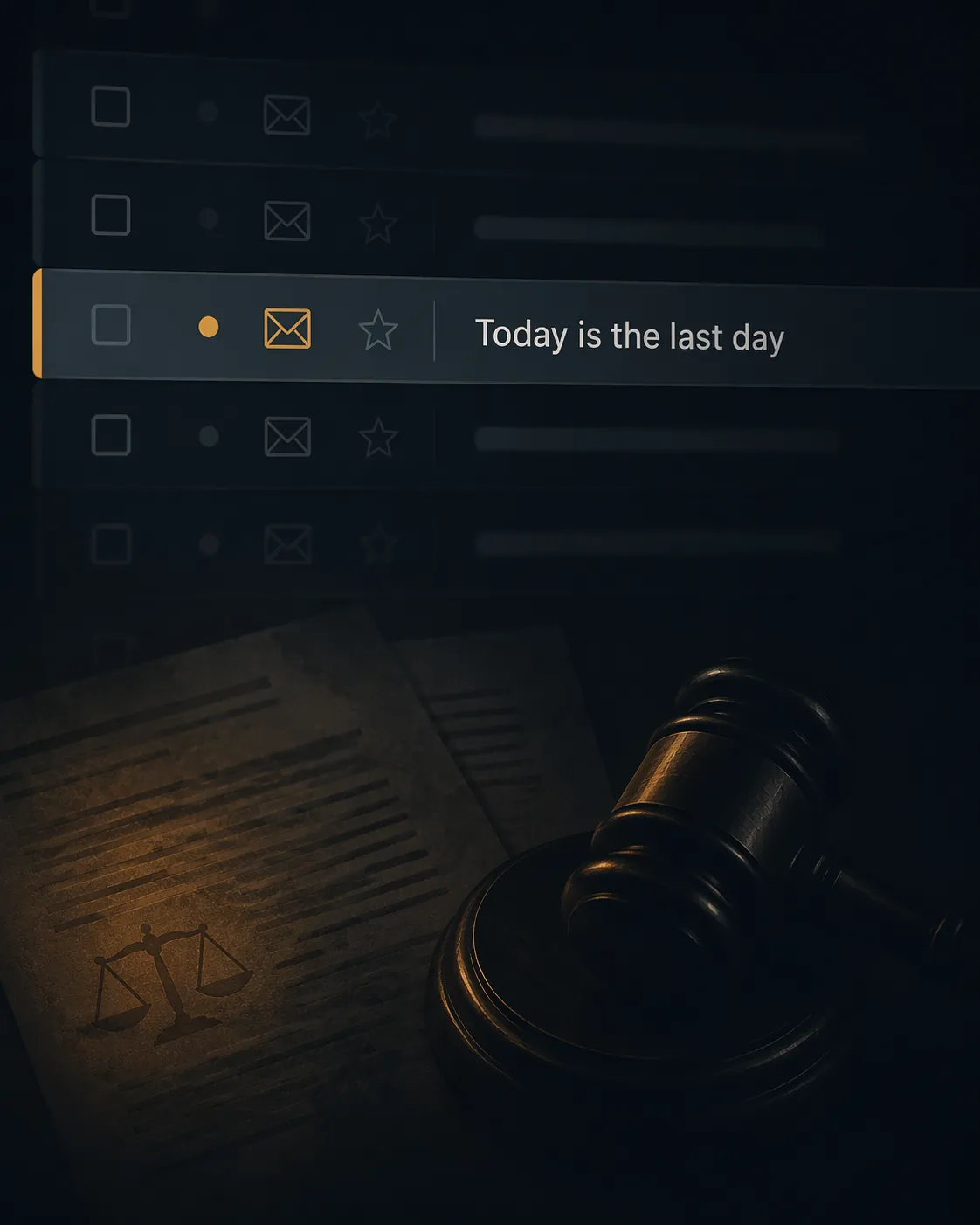
The challenged copy was not an exotic dark pattern. One reported Costco subject line was: “Today is the last day to access Member-Only Saving.” The allegation was that Costco sent deadline-based promotional emails while knowing the promotions would be extended beyond the stated deadline. [2]
That distinction matters. Urgency language is not automatically false merely because it is urgent. A subject line saying “last chance,” “ends tonight,” or “final day” can describe a real deadline. The risk changes when the sender’s own promotion calendar, extension practice, or campaign playbook shows that the deadline was not actually final at the time the email went out.
Retail marketing systems are especially exposed to this fact pattern because deadline copy often lives in reusable templates. A creative team may write one effective line. A lifecycle team may reuse it. A merchandising team may extend the offer. A CRM platform may keep sending segmented reminders. By the time counsel reviews the dispute, the evidence is no longer a single subject line; it is a campaign history.
The Costco settlement does not establish that every “today only” or “last day” email violates Washington law. A settlement is not an adjudication of liability. But it does identify the kind of factual record plaintiff-side lawyers are likely to test: deadline language, internal knowledge, recipient location, repeated sends, and later extensions.
Washington’s two-statute mechanism is what turns copy into leverage
The legal risk is not just that a customer may feel misled by a sale email. Washington’s framework ties commercial-email subject-line conduct to statutory remedies. DLA Piper describes the current exposure through two statutes: CEMA, codified at RCW 19.190, and Washington’s Consumer Protection Act, codified at RCW 19.86. A CEMA violation can operate as a per se CPA violation, opening the door to treble damages, attorneys’ fees, and injunctive relief. [3]
The 2025 Washington Supreme Court decisions are part of why the Costco settlement landed with force. K&L Gates summarized those decisions as increasing lawsuit risk for false or misleading email subject lines, and Arnold & Porter likewise described Washington courts as broadening CEMA liability beyond older, narrower sender-identification theories to subject-line misinformation. [4][5]
That broadening matters operationally. A legal review that only checks whether the sender name, routing information, and unsubscribe mechanics are clean may miss the claim theory now drawing attention. The subject line itself may be the alleged misrepresentation.
| Risk lever | Why counsel should care |
|---|---|
| CEMA subject-line theory | False or misleading commercial-email subject lines can create statutory exposure under Washington law. [3][4][5] |
| Per-email damages structure | The damages calculation can multiply by send volume rather than by individually proven consumer loss. [3] |
| CPA connection | A CEMA violation may become a per se Consumer Protection Act violation, adding potential treble damages, attorneys’ fees, and injunctive relief. [3] |
| Campaign repetition | Recurring urgency templates can convert a copy-review issue into an aggregate exposure issue. |
The 2026 amendment changes the math, not the risk category
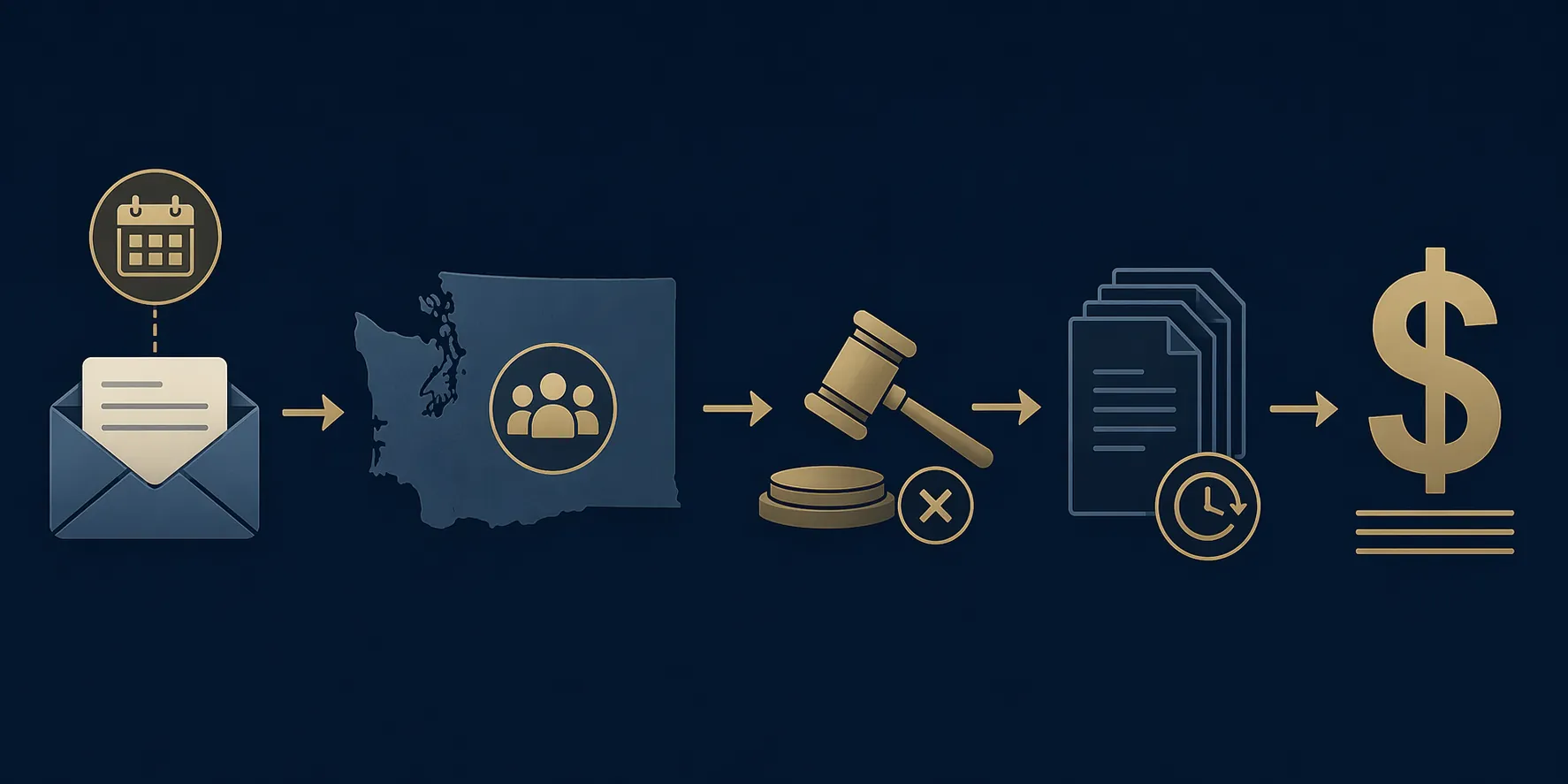
Washington amended CEMA through HB 2274, effective June 11, 2026, reducing the statutory damages amount from the previously discussed $500-per-email exposure to $100 per email. [6] That reduction matters. It should affect reserve analysis, settlement valuation, and early case assessment.
It should not be treated as a safe harbor. A $100-per-email cap still scales quickly for high-volume retail senders, especially where a promotion is sent repeatedly to Washington recipients across multiple waves. The Costco class period reportedly runs from June 2, 2021 through July 7, 2026, meaning it straddles the pre-amendment and post-amendment penalty regimes. [1][6]
That straddle is important for legacy exposure. Emails sent before June 11, 2026 may sit in a different damages environment than emails sent after the amendment’s effective date. Counsel reviewing current campaigns should not assume that the new cap answers older claim periods, and counsel reviewing older campaigns should map send dates before talking settlement value.
Claim eligibility is the smaller issue for this audience
Consumer-facing coverage has understandably focused on who qualifies and how to file. Kiplinger’s coverage frames the settlement around Costco email recipients and the claim process, while the reported class period remains June 2, 2021 through July 7, 2026. [1][2] For legal departments, however, the more durable lesson is not the eventual claim check. It is the class definition logic: recipients, dates, subject lines, and a Washington statutory hook.
Per-person recovery should not be guessed from the $14 million number. Final payments depend on approved deductions and the number of valid claims. A low claim rate and a high claim rate can produce very different individual outcomes from the same gross fund. That uncertainty is routine in class settlements, but it is precisely why the settlement’s better use for counsel is as an exposure benchmark rather than a consumer-recovery forecast.
What counsel should inspect before the next urgency campaign
The practical response is not to ban urgency language. It is to make deadline claims auditable. A lawyer or compliance reviewer should be able to look at a sent email and answer a narrow question: at the time this subject line went out, what made the deadline true?
- Recurring urgency templates: Identify subject lines using “last chance,” “last day,” “ends tonight,” “final hours,” “today only,” or similar phrasing. The concern is strongest where the same template is reused across campaigns without fresh deadline verification.
- Promotion-extension practices: Compare the stated deadline in each subject line with actual merchandising decisions. If extensions are routine, counsel should know who approved them and when.
- Campaign calendars: Preserve the planned start date, end date, extension date, and send date. The most useful evidence is often the calendar entry that existed before the email was sent.
- Washington-recipient segmentation: Determine whether the system can identify Washington recipients, suppress them from higher-risk copy, or route campaigns with Washington exposure through additional review.
- Approval records: Keep the approval trail for deadline language. A subject line approved by marketing without legal review is not automatically unlawful, but a missing record makes later defense harder.
- Substantiation at time of send: Avoid after-the-fact rationales. The question is not whether the promotion eventually ended; it is whether the subject line was accurate when the recipient received it.
One uncomfortable audit question is whether “last day” means the last day of that exact price, the last day of that exact coupon code, the last day of member-only access, or merely the last day before the promotion is refreshed under a new label. If the business cannot answer that internally, it should not expect the phrase to become clearer in litigation.
A simple review rule
For campaigns going into Washington, deadline language should receive legal or compliance review when three conditions appear together: a time-urgency subject line, a promotion that can be extended or renewed, and a recipient list large enough for per-email damages to matter. That rule will catch more than the eventual litigation set, but it is easier to narrow an approval queue than to reconstruct intent after a class complaint is filed.
The representative substitution is a procedural warning, not the main story
The Costco matter also included a class-representative substitution. Reporting identifies an initial representative, Joseph Zydel, whose Chapter 13 bankruptcy became relevant, and a later substitution to Michael Aaland. [1][7] For defense counsel, that is a reminder to examine representative adequacy, standing, bankruptcy disclosures, and claim ownership early.
It is not, however, the reason the case should be in a retail risk file. Representative issues can affect leverage and procedure. The bigger lesson is that a routine email program created enough alleged statutory exposure to support a $14 million settlement.
The posture after Costco
Costco does not prove that every urgency email is unlawful. It does not eliminate ordinary promotional deadlines, and it does not tell any retailer exactly how Washington courts will treat a different subject line, different extension practice, or different record.
It does change the conversation a careful lawyer should have with marketing. The reduced $100-per-email cap changes damages modeling, but it does not make high-volume sending harmless. A recurring “last day” campaign sent to Washington residents now deserves a record showing why the deadline was true when the email was sent. Without that record, a small line of promotional copy can become a large statutory arithmetic problem.
References
- $14M Costco Settlement Resolves Class Action Lawsuit Over Promo Emails with Allegedly Misleading Subject Lines, ClassAction.org
- Costco Email Settlement: Who Qualifies and How to File a Claim, Kiplinger
- Washington's Commercial Electronic Mail Act: Assessing Potential Retailer Exposure, DLA Piper, April 2026
- Washington Supreme Court Increases Risks of Lawsuits for False or Misleading Email Subject Lines, K&L Gates, August 7, 2025
- Washington Courts Broaden CEMA Liability, Arnold & Porter, October 2025
- RCW 19.190, Washington State Legislature
- Costco Customers Could Claim Cash From Settlement: Who Qualifies, Newsweek
Related records
Tool profile
Browse tool evaluations →Governing regulation
Browse the obligations tracker →Preventive workflow
Browse verification workflows →
Report a correction or tip
Spotted an outdated figure, a misstated fact, or a ruling this case record should reflect? Public comments are disabled for this content given the professional cost of a misreported case outcome, penalty amount, or rule text — use the structured correction channel instead.
Report a correction or tip for this record →