
Court Halts Travel Ban on Social Media Researchers
A federal court in Washington, D.C., has frozen a State Department policy that denied visas to non-citizen researchers based on their work studying disinformation and content moderation, finding the policy likely violates the First Amendment. The article outlines the ruling, the individuals affected, and what law firms need to know about the ongoing case and its chilling effect.
- Jurisdiction
- US Federal - District of Columbia
- Court
- District Court for the District of Columbia
- Judge
- James E. Boasberg
- AI tool named
- Content moderation algorithms
- Ruling date
- Jul 14, 2026
- Source document
- View primary court order ↗
- Last verified
- Jul 25, 2026
Lex Machina Review is an independent risk-tracking and reference resource. Nothing on this site is legal advice, and using it does not create an attorney-client relationship. Every record is reviewed against primary sources but may not reflect the most current status of a matter — always verify directly against the cited court order, rule text, or a licensed attorney before relying on it.
Companion explanation — secondary to the source document above
On July 14, 2026, Chief U.S. District Judge James E. Boasberg of the District Court for the District of Columbia granted a preliminary injunction in Coalition for Independent Technology Research v. Rubio, No. 25-0467, freezing a State Department visa-enforcement policy directed at non-citizen researchers who study disinformation, content moderation, platform accountability, and trust and safety.[1]
For law firms and legal departments, the immediate risk signal is narrow but important: enforcement is stayed under Section 705 of the Administrative Procedure Act while the case proceeds. The policy is not finally invalidated. It is temporarily frozen, and the government has 60 days from July 14 to file a notice of appeal.[1]
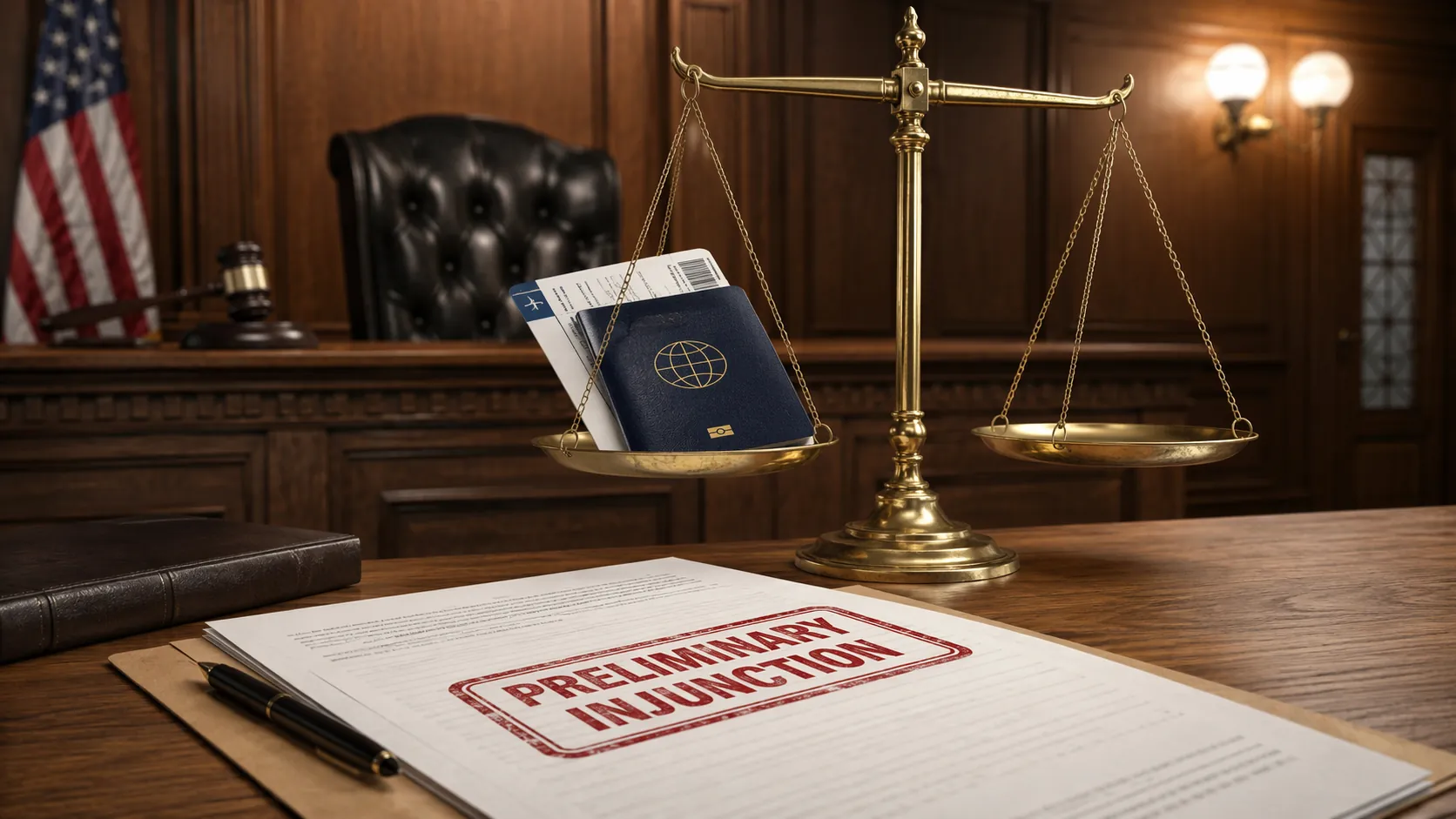
That distinction matters because the phrase “travel ban” can blur two different things. This case is not principally about a nationality-based entry restriction. It concerns an occupation- and viewpoint-linked visa policy: a federal instruction that treated certain research, advocacy, reporting, and association around platform moderation as “foreign censorship” and used immigration consequences against the people doing that work.
The Policy Path To The July 14 Injunction
The record developed quickly. Secretary of State Marco Rubio announced the policy in May 2025. Consular directives followed in December 2025. On December 23, 2025, five people were identified as targets: Imran Ahmed of the Center for Countering Digital Hate, Clare Melford of the Global Disinformation Index, Thierry Breton, Josephine Ballon, and Anna-Lena von Hodenberg.[2]
The Coalition for Independent Technology Research sued on March 9, 2026. The July 14 order granted preliminary relief, not final judgment. That procedural posture should stay visible in any employer communication about the case: affected employees may have a temporary protection against enforcement of this policy, but the litigation remains live.[1][2]
| Date | Event | Risk Significance |
|---|---|---|
| May 2025 | Secretary Rubio announced the policy targeting researchers studying platform harms. | Created the enforcement theory. |
| December 2025 | Consular directives were issued. | Moved the policy from announcement to implementation. |
| December 23, 2025 | Five named targets were designated. | Showed how the policy was being applied. |
| March 9, 2026 | CITR filed suit in D.D.C. | Put the First Amendment and APA challenges before the court. |
| July 14, 2026 | Chief Judge Boasberg granted a preliminary injunction and Section 705 stay. | Froze enforcement while litigation proceeds. |
Why The First Amendment Holding Carries Workplace Consequences
The court’s key constitutional concern was viewpoint discrimination. As quoted in multiple accounts of the ruling, Boasberg found that the policy “sweeps into the category of foreign censorship a substantial measure of the research, reporting, advocacy, and association through which CITR and institutions like it carry out their protected work, and it does so on the basis of viewpoint, in violation of the First Amendment.”[1][3]
That sentence does more than criticize a vague immigration policy. It identifies the constitutional defect as viewpoint-based selection: the government was not merely regulating entry procedures, but allegedly attaching immigration penalties to one side of a live policy debate. The opinion described the government as “press[ing] its enforcement thumb against one side of the scale: the view that platforms should do more to moderate content, label disinformation, restrict abuse, share data with researchers, or take responsibility for the harms their systems amplify.”[1]
For employers, that framing is what moves the case beyond a specialist immigration docket. Non-citizen staff working on platform integrity, election disinformation, AI safety, child-safety harms, recommender systems, or trust-and-safety enforcement may not hold the same visa category, job title, or publication record. But the operational question is similar: whether their ordinary professional work could be treated by the government as disfavored “foreign censorship” because of the viewpoint it expresses or supports.
The First Amendment issue also sits beside, not instead of, the APA posture. The court granted a Section 705 stay, which freezes agency action pending judicial review. That is a practical remedy with immediate effect, but it is not a final merits ruling that erases every downstream visa or enforcement problem created before the injunction.[1]
The Named Targets Show How The Policy Operated
The designated individuals were not random travelers caught in a broad entry screen. Imran Ahmed, a lawful U.S. permanent resident and CEO of the Center for Countering Digital Hate, was separately determined deportable under the policy, though another court temporarily blocked his arrest and detention. Clare Melford is CEO of the Global Disinformation Index. Thierry Breton was identified in connection with his European regulatory role. Josephine Ballon was described as a trust-and-safety researcher, and Anna-Lena von Hodenberg as a German journalist and fact-checker.[2][4]
Their inclusion matters because it shows the policy’s reach across institutional types: nonprofit advocacy, research organizations, journalism, platform-safety work, and public policy. For risk review, the useful lesson is not that every researcher in those fields faced the same likelihood of enforcement. The narrower point is that the government’s own target list tied immigration consequences to work and speech on content moderation and disinformation.
Chilling Effect Is Not An Abstract Litigation Phrase Here
The workplace effect alleged in the case is concrete. Reporting on the complaint described non-citizen members stopping work on research projects, declining conference invitations, limiting public engagement with CITR, and avoiding public speech.[2][3]
One member reportedly avoided traveling to CITR’s 2025 Berlin summit because of fear of being denied reentry to the United States, then shifted into a behind-the-scenes role out of concern about detention and deportation. An adjunct professor studying online harms to children left the United States. A permanent-resident content-moderation expert moved toward “politically neutral” topics and stopped international travel. A professor studying media and politics stopped publishing op-eds and cancelled book events out of fear of losing an H-1B visa.[2]
Those accounts come through complaint allegations as reported by news sources, not through a fully adjudicated factual record. Even with that caveat, they are the facts employers should read carefully. Immigration-adjacent risk rarely arrives only as a denial notice. It also appears when a researcher declines a conference, a policy analyst stops publishing, a trust-and-safety employee asks to be removed from a public report, or a supervisor quietly reallocates sensitive work to U.S. citizens because no one wants to trigger a visa problem.
That is the administrative drag created by viewpoint targeting. The cost is not limited to the person named in a federal designation. It spreads through travel approvals, outside-speaking review, publication clearance, client staffing, and conference participation. The July 14 injunction reduces that pressure for now, but it does not make the underlying employment-risk question disappear.
The Related AAUP Ruling Supports The Same Constitutional Direction
A related First Amendment reference point comes from AAUP v. Rubio, a District of Massachusetts ruling by Judge Young in September 2025. As summarized by the First Amendment Encyclopedia at MTSU, the court held that lawfully present non-citizens have the same free-speech rights as citizens under the First Amendment. Judge Young wrote: “Nothing in the text, history, or tradition of the First Amendment suggests that persons lawfully present here may be subject to adverse action based on their political speech” and “No law means no law.”[5]
That source is secondary, not the primary opinion. It should therefore be used cautiously. Still, it tracks the same constitutional concern visible in CITR: when lawfully present non-citizens are penalized for protected political or research speech, courts are not treating immigration status as a switch that turns the First Amendment off.
What Firms Should Treat As Live After The Injunction
The current legal position is temporary protection, not settled safety. Enforcement of the State Department policy is frozen pending litigation. The government may notice an appeal within 60 days of July 14, 2026. Individuals already affected, including Ahmed, may still have separate litigation or immigration proceedings to manage.[1][2]
For firms with non-citizen researchers, policy analysts, trust-and-safety employees, disinformation specialists, AI-safety staff, or content-moderation experts, the practical file note is straightforward: identify who may be working in the policy’s subject area, monitor the appeal window and any stay activity, and consider whether affected employees should be told through counsel that the July 14 order currently blocks enforcement of this specific policy.
That communication should not overstate the ruling. The court found a likelihood of unconstitutional viewpoint discrimination and froze enforcement under the APA. It did not issue a final merits judgment, did not resolve every visa consequence already triggered, and did not convert a politically exposed research area into a risk-free one.
References
- Coalition for Independent Technology Research v. Rubio — Knight First Amendment Institute
- CITR v. Rubio coverage — Courthouse News Service
- CITR v. Rubio coverage — Poynter
- CITR v. Rubio case materials — Protect Democracy
- AAUP v. Rubio — First Amendment Encyclopedia at MTSU
Related records
Tool profile
Browse tool evaluations →Governing regulation
Browse the obligations tracker →Preventive workflow
Browse verification workflows →
Report a correction or tip
Spotted an outdated figure, a misstated fact, or a ruling this case record should reflect? Public comments are disabled for this content given the professional cost of a misreported case outcome, penalty amount, or rule text — use the structured correction channel instead.
Report a correction or tip for this record →