
The Damietta port drone attack is presumptively unlawful
The July 29, 2026 drone strike on LNG carriers at Egypt's Damietta port is presumptively unlawful under the law of naval warfare: the vessels were civilian merchant ships, and the port sits in internal waters of a non-belligerent state. This record separates confirmed facts from reported attribution claims and anchors the analysis in the San Remo Manual's rules on military objectives, merchant vessels, and neutral waters.
- Jurisdiction
- Egypt
- Court
- None
- AI tool named
- Drone
- Ruling date
- Jul 29, 2026
- Source document
- View primary court order ↗
- Last verified
- Jul 31, 2026
Lex Machina Review is an independent risk-tracking and reference resource. Nothing on this site is legal advice, and using it does not create an attorney-client relationship. Every record is reviewed against primary sources but may not reflect the most current status of a matter — always verify directly against the cited court order, rule text, or a licensed attorney before relying on it.
Companion explanation — secondary to the source document above
As of July 31, 2026, the legal implications of the Damietta port drone attack have to be read from a short record, not from attribution headlines. Egypt has described the July 29 fire as a drone-caused incident after preliminary investigation, but no perpetrator has been formally confirmed, no court has ruled on the incident, and no formal legal determination or penalty has been issued.
| Status as of July 31, 2026 | What is in the record | Legal-risk use |
|---|---|---|
| Confirmed | Egypt’s cabinet said on July 30 that preliminary investigations found a drone caused the fire at Damietta port on July 29, and that no party had claimed responsibility. Reuters, BBC, and Al Jazeera reported the incident and Egypt’s account. [1][2][3] | Enough to analyze the place of attack, the vessel status, and the neutral-state problem; not enough to assign state responsibility. |
| Confirmed | The incident involved the Energos Winter FSRU and the Gaslog Salem LNG carrier at Egypt’s Damietta port; Seatrade described Energos Winter as Marshall Islands-flagged and U.S.-owned, and Gaslog Salem as Bermuda-flagged and Greek-owned. [4] | The vessels start the analysis as civilian merchant gas carriers unless facts show they had become military objectives. |
| Reported, not confirmed | Al Jazeera reported a Houthi denial of responsibility. [3] | Relevant to attribution screening, but it does not resolve who launched the drone. |
| Reported, not confirmed | Ynet and CNBC carried New York Times-sourced claims attributed to two Iranian officials that the strike was intended to show Iran could hit global energy supplies. [5][6] | Relevant to motive and possible state attribution, but still a reported claim through secondary accounts. |
| Reported, not confirmed | CNBC reported President Trump’s implication of Iran in connection with the strike. [6] | Politically important; not a substitute for evidence satisfying attribution standards. |
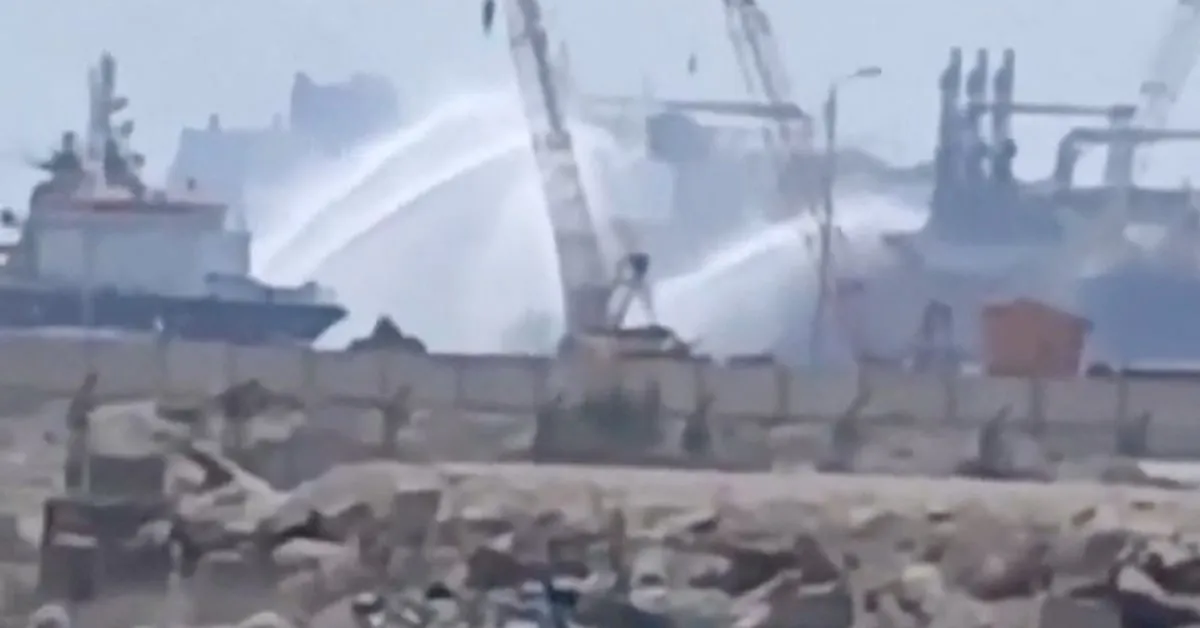
This is therefore a legal-risk synthesis, not a litigation record. The useful question for counsel is narrower than “who did it?” and more immediate than “what happens to energy markets?” On the present public record, two facts carry the legal analysis: civilian merchant gas carriers were hit, and they were hit inside a commercial Egyptian port.
The first cut is vessel status, not motive
The Energos Winter was identified in maritime reporting as a 138,250 cubic meter floating storage and regasification unit, and the Gaslog Salem as an LNG carrier at the same port. Euronews described the incident as the first attack on Egyptian soil and referred to the damaged vessel as U.S.-linked; Seatrade’s vessel details give the more specific flag-and-ownership descriptions used here. [4][7]
One ownership detail should remain marked for verification rather than polished into certainty. Reuters referred to Energos Infrastructure, while Euronews connected the vessel to New Fortress Energy through an Energos affiliate structure. [1][7] That discrepancy may matter for insurance notices, sanctions screening, and contractual representations, but it does not change the immediate law-of-targeting analysis: the public record describes merchant gas carriers at a commercial terminal, not naval auxiliaries or vessels integrated into military operations.
Civilian gas cargo does not automatically make a ship a military objective
The San Remo Manual’s starting point is not that economically important maritime assets are targetable. Rules 40 and 41 frame military objectives around objects that, by nature, location, purpose, or use, make an effective contribution to military action and whose destruction, capture, or neutralization offers a definite military advantage. Rules 59 and 60 address enemy merchant vessels and the circumstances in which they may lose protection; Rule 67 addresses neutral merchant vessels and requires specific conduct or contribution before attack is contemplated. [8]
Applied to the known Damietta facts, that test does real work. A gas carrier can be commercially valuable, strategically inconvenient, and politically symbolic without thereby making an effective contribution to military action. The public record cited above does not establish that either Energos Winter or Gaslog Salem was carrying military cargo, acting under military orders, transmitting military intelligence, resisting visit and search, or otherwise performing a role that San Remo treats as a basis for attack.
The harder argument is the “war-sustaining” theory: the idea that an object contributing to an enemy’s capacity to fund or sustain war may qualify as a military objective even where the connection is economic rather than operational. That position has support in U.S. doctrine and has been discussed in current naval-war commentary, including Lieber Institute analysis of merchant shipping and naval economic warfare and Opinio Juris discussion of the Strait of Hormuz. [9][10]
But the broader theory is contested. The traditional majority approach requires a closer nexus to military action than ordinary commercial export activity. On that view, LNG cargo, revenue value, or pressure on energy supply chains does not by itself turn a civilian merchant vessel into a lawful target. Even under a more expansive war-sustaining theory, the attacker would still need a concrete account of effective contribution and definite military advantage. A claim that the strike “sent a message” about global energy supplies would not answer that targeting question.
The second cut is geography: Damietta is not a battlespace merely because a war exists elsewhere
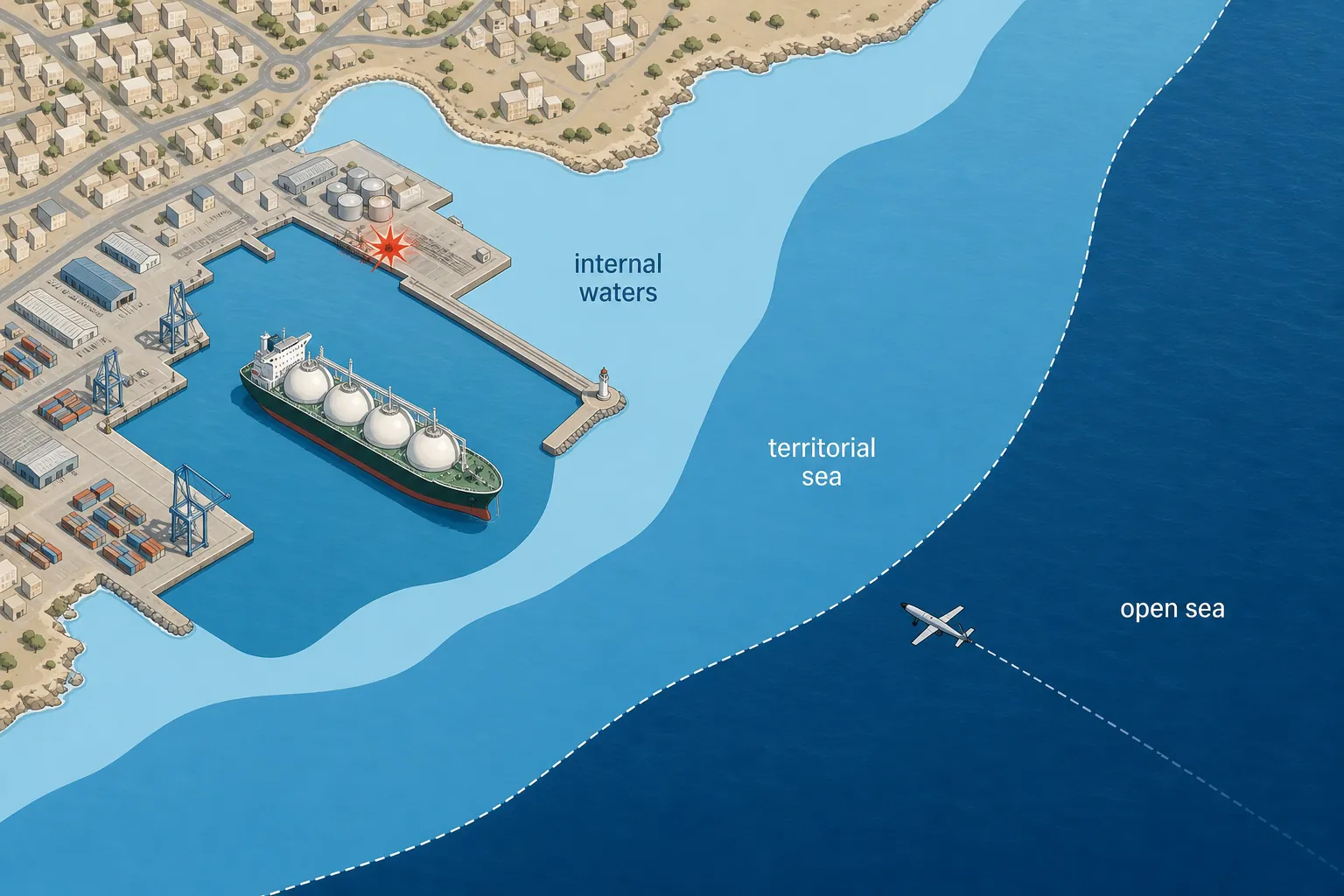
The neutral-waters route is independent of the vessel-status route. Damietta is a port in Egypt. Under the San Remo Manual’s maritime-zone framing, neutral waters include internal waters, territorial sea, and archipelagic waters of neutral states. UNCLOS supplies the baseline internal-waters frame for ports, and Hague XIII supplies the older neutrality rule set for belligerent conduct in neutral ports and waters. Just Security’s expert Q&A on the Iran conflict states the naval-warfare rule in practical terms: belligerent attacks may not be conducted in neutral waters. [8][11][12][13]
Egypt is not identified in the public record as a belligerent in the 2026 U.S.-Iran armed conflict. Just Security treats that conflict as an international armed conflict for law-of-war purposes under common Article 2, but that classification does not dissolve the legal position of third states. [13] A belligerent may not carry the conflict into the internal waters of a non-belligerent state because a target there is convenient, exposed, or economically significant.
That is why the Damietta location matters so much. If a belligerent launched the drone, the attack would presumptively breach Egyptian neutrality and sovereignty even before reaching the more granular debate over whether the LNG vessels were military objectives. If a non-state actor launched it, the neutral-waters rule may not map onto state belligerency in the same way, but the civilian-vessel and Egyptian-sovereignty problems remain. Either way, the port-state fact cannot be treated as scenery.
Attribution matters, but it does not cure the target or location problem
The reported Houthi denial, the secondary reports of Iranian-official statements, and Trump’s implication of Iran belong in the record. They matter for state responsibility, sanctions exposure, countermeasure analysis, war-risk underwriting, and government briefings. They do not decide whether civilian merchant vessels in Egyptian internal waters were lawful targets. [3][5][6]
This distinction prevents a common filing error. If the first page of the analysis says “Iran did it,” every subsequent legal issue starts to bend around that assumption. The cleaner order is vessel, water, belligerency, then attribution. On the present record, the first two items are much firmer than the fourth.
What the incident changes for risk teams now
No insurer, charterer, procurement officer, or government-contracts lawyer needs a final attribution finding before opening the file. Just Security notes that U.N. Security Council Resolution 2817 in 2026 deplored attacks on neutral vessels, and Reuters reported a March 2026 precedent in which ship insurers cancelled war-risk cover because of the Iran conflict. [13][14] Those are not determinations on Damietta, but they show why a drone strike on commercial gas carriers in a neutral port becomes a contract event quickly.
- War-risk and hull insurers will want the location, cause, and attribution posture separated. A drone-caused fire in internal waters presents a different notice and coverage profile from a casualty on the high seas.
- Charterparty teams should check war-risk clauses, safe-port language, off-hire provisions, deviation rights, force-majeure wording, and any clause that turns on restraint of princes, hostilities, terrorism, or warlike operations.
- Energy procurement teams should avoid treating the incident as a generic supply-chain disruption. If the clause requires illegality, sanctions impact, physical impossibility, or port closure, the legal consequence will depend on the exact trigger.
- Sanctions and export-control teams should keep attribution separate from vessel ownership. The Energos ownership chain should be verified before any memo treats a parent, affiliate, operator, or insured as settled.
- Government-contracts teams should preserve the neutral-port element. A strike in Egyptian internal waters can affect risk allocation, performance excuses, and political-risk reporting even if the contract counterparty is not Egyptian.
For adjacent legal framing, the closest comparison is not a general energy-security piece but law-of-naval-warfare treatment of attacks on commercial shipping. Prior analyses of drone attacks on cargo ships under international law, Houthi Red Sea blockade claims, and Hormuz tanker seizures are useful only if the neutral-waters fact in Damietta is kept distinct.
The supported judgment
On the present record, the Damietta strike is presumptively unlawful on two independent grounds. First, the known targets were civilian merchant gas carriers, and the public record does not show the effective military contribution required to treat them as military objectives. Second, the strike occurred inside the internal waters of Egypt, a non-belligerent state, where belligerent attack is prohibited regardless of which belligerent benefits from the strike.
Attribution remains unresolved as of July 31, 2026. So does the outer edge of the war-sustaining doctrine. Neither uncertainty is a reason to flatten the legal posture into “strategic energy target.” A commercial vessel burning at berth in a neutral port is not a footnote to the conflict; it is the fact that makes the legal risk acute.
References
- Drone hits gas storage tanker at Egypt's Mediterranean port, Reuters, July 29, 2026.
- BBC report on the Damietta port incident, BBC.
- Fire erupts on ships at Egypt's Damietta port, Al Jazeera, July 29, 2026.
- Drone strike hits Energos FSRU and a LNG carrier in Egypt’s Damietta port, Seatrade Maritime.
- Ynet report carrying New York Times-sourced Iranian-official claims on the Damietta strike, Ynet.
- Egypt drone gas ship Damietta port Iran war, CNBC, July 30, 2026.
- Drone hits US LNG vessel at Damietta in first attack on Egyptian soil, Euronews, July 30, 2026.
- San Remo Manual on International Law Applicable to Armed Conflicts at Sea, 12 June 1994, ICRC IHL Databases, June 12, 1994.
- Merchant Shipping as Military Objectives and Naval Economic Warfare, Lieber Institute.
- The Closure of the Strait of Hormuz by Iran: Considerations over the Law of the Sea and Law of Naval Warfare, Opinio Juris, May 6, 2026.
- United Nations Convention on the Law of the Sea, United Nations.
- Hague Convention XIII concerning the Rights and Duties of Neutral Powers in Naval War, ICRC IHL Databases, October 18, 1907.
- Expert Q&A on Key Law of Naval Warfare Issues in the Conflict with Iran, Just Security.
- Ship insurers cancel war risk cover due to Iran conflict, Reuters, March 2, 2026.
Related records
Tool profile
Browse tool evaluations →Governing regulation
Browse the obligations tracker →Preventive workflow
Browse verification workflows →
Report a correction or tip
Spotted an outdated figure, a misstated fact, or a ruling this case record should reflect? Public comments are disabled for this content given the professional cost of a misreported case outcome, penalty amount, or rule text — use the structured correction channel instead.
Report a correction or tip for this record →