
Daniel Adongo Deported: Laken Riley Act Due Process Risk
Examines the due-process vulnerability created by the Laken Riley Act's mandatory-detention provision for non-citizens arrested for low-level theft crimes, using former NFL player Daniel Adongo's June 2026 deportation as a case study. Explains why a single district-court ruling (Doe v. Moniz, binding only in Massachusetts) does not protect against nationwide ICE enforcement, requiring jurisdiction-by-jurisdiction tracking for counsel and risk managers.
- Jurisdiction
- US Federal
- Court
- U.S. District Court for the District of Massachusetts
- Judge
- Talwani
- AI tool named
- None
- Ruling date
- Sep 5, 2025
- Source document
- View primary court order ↗
- Last verified
- Jul 30, 2026
Lex Machina Review is an independent risk-tracking and reference resource. Nothing on this site is legal advice, and using it does not create an attorney-client relationship. Every record is reviewed against primary sources but may not reflect the most current status of a matter — always verify directly against the cited court order, rule text, or a licensed attorney before relying on it.
Companion explanation — secondary to the source document above
The practical question after Daniel Adongo’s deportation is not whether a former NFL player received unusual treatment. It is whether a non-citizen held under the Laken Riley Act can get a bond hearing outside Massachusetts after one federal district judge called the Act’s arrest-based detention unconstitutional.
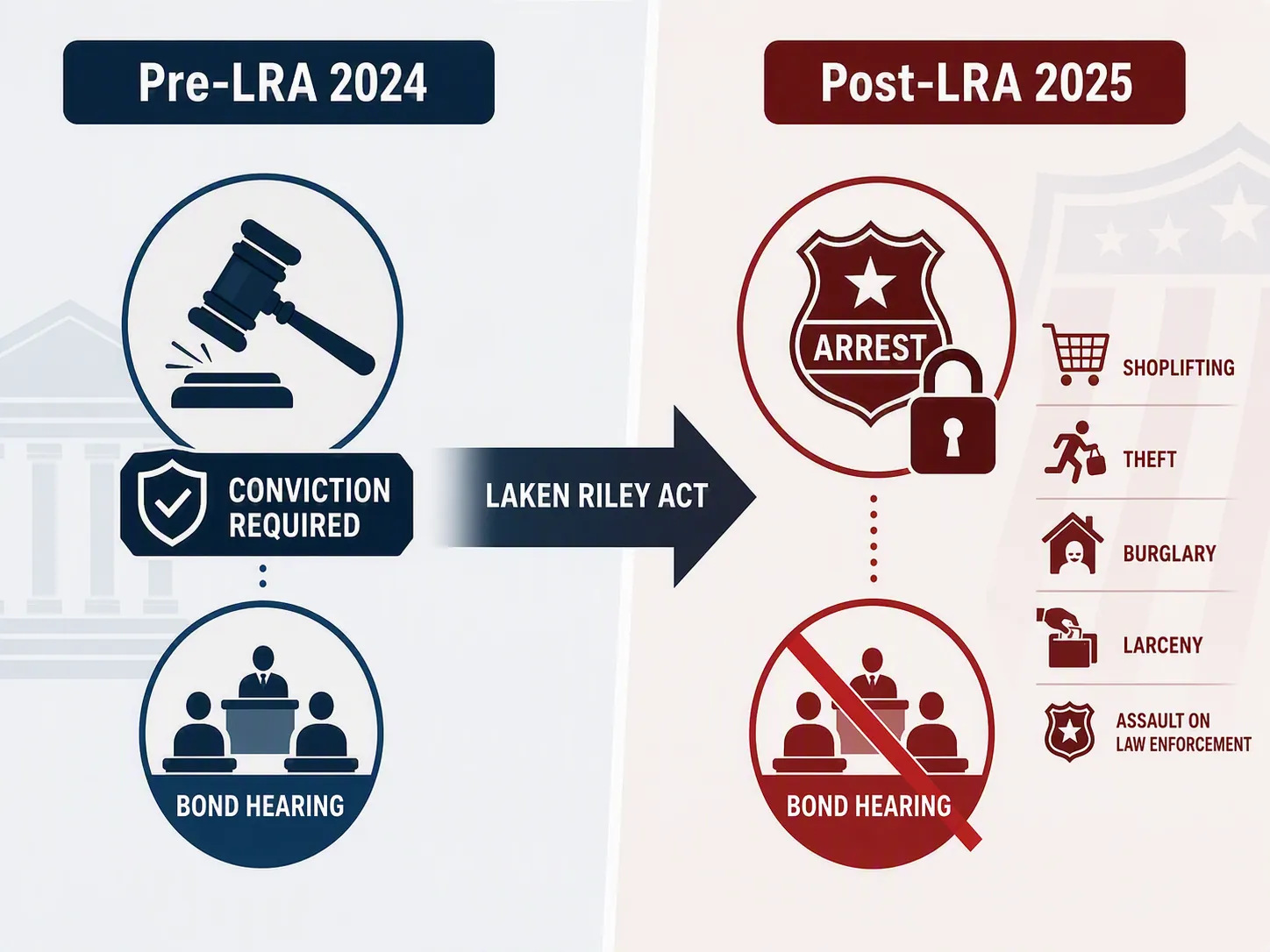
That answer is still jurisdictional. The Laken Riley Act took effect on January 29, 2025, and amended immigration detention provisions in the INA, including sections 1225(b), 1226, and 1226(c). Its operative expansion reaches non-citizens who are “arrested for, charged with, convicted of, or admit” certain theft-related offenses and assault on law enforcement, including shoplifting, theft, burglary, and larceny.[1] In September 2025, Judge Talwani of the District of Massachusetts held in Doe v. Moniz that detention without a bond hearing based solely on an arrest violates Fifth Amendment due process.[2] ICE, however, has continued to enforce the Act elsewhere, and in June 2026 announced that it had removed Daniel Adongo to Kenya.[3]

That sequence matters because a bond hearing is not a decorative hearing on the calendar. It is the procedural moment when the government must justify continued custody and the detainee can contest flight risk or danger. Removing that hearing from a broader class of cases changes the leverage of every early decision: criminal charging, ICE transfer, detention strategy, habeas timing, and removal-defense preparation.
What changed under the Laken Riley Act
Before the LRA, mandatory immigration detention was already harsh, but its core logic was more conviction-centered. The post-IIRIRA framework, enacted in 1996, tied mandatory detention to categories such as aggravated felonies, controlled-substance offenses, and human trafficking.[4] Those categories were not benign, and litigation over prolonged detention long predated the LRA. But the trigger usually depended on a more developed criminal record than a bare arrest.
The LRA moves the line earlier. For covered non-citizens, the detention trigger can arise when the person has merely been arrested for or charged with listed offenses. The words “arrested for” and “charged with” do the legal work. They allow mandatory custody to attach before a conviction, before a plea, and in some cases before the criminal case has sorted out whether the allegations can be proved.
| Detention question | Pre-LRA baseline | LRA expansion |
|---|---|---|
| What commonly mattered most | Conviction-linked mandatory detention categories such as aggravated felonies, drug offenses, and trafficking | Arrest, charge, conviction, or admission for listed offenses |
| Timing pressure | Custody often followed a more developed criminal record | Custody can follow an arrest or charge |
| Bond-hearing risk | Existing mandatory-detention litigation focused on established detention categories and duration | Due-process challenge focuses on detention without bond based only on an arrest |
| Operational consequence | Review older INA category and criminal disposition | Review the exact LRA trigger language and local bond-hearing law |
The Act does not simply increase penalties after criminal adjudication. It changes the point at which immigration custody can become mandatory. That is why a theft or shoplifting arrest, even one that looks minor in the criminal docket, can become a detention event with immediate removal-defense consequences.
Why Doe v. Moniz matters, and why it does not travel automatically
Doe v. Moniz is important because it addresses the precise constitutional defect created by the LRA’s timing. The plaintiff was detained under the Act based on an arrest, without any bond hearing. Judge Talwani held that the Fifth Amendment does not permit detention without an individualized bond hearing when the statutory basis is only an arrest, rather than proof of guilt or another sufficiently reliable ground for custody.[2]
The ruling gives immigration counsel a serious due-process argument. It does not give counsel a national safe harbor. Doe is a district-court decision from the District of Massachusetts. Available sources identify no appellate ruling on the LRA mandatory-detention provision and no existing circuit split. Until an appellate court rules, or other district courts adopt the same reasoning, the decision is best treated as persuasive authority outside Massachusetts, not binding protection.

That distinction is easy to blur in client alerts and intake notes. A sentence saying “a federal court found the Laken Riley Act unconstitutional” is formally true only if the next sentence explains the venue, the posture, and the limited force of the order. Outside that district, ICE officers, immigration judges, federal habeas judges, and government litigators are not necessarily operating under the same command.
Where Daniel Adongo’s removal fits
ICE’s June 2026 release on Daniel Adongo is useful because it shows the LRA being used in ordinary enforcement terms after Doe, not because Adongo’s football career changes the legal analysis. ICE Chicago announced that officers removed Adongo, a Kenyan national and former Indianapolis Colts player, to Kenya and described him as a “criminal illegal alien.”[3]
The release should not be made to carry more than it says. It does not specify which LRA subcategory ICE relied on for Adongo—burglary, theft, larceny, shoplifting, or another covered basis. It also does not resolve whether he sought a bond hearing, whether a Doe-style constitutional argument was raised, or how any court treated that argument. As a legal-risk example, its value is narrower: ICE was still announcing LRA-linked removals outside the Massachusetts ruling’s direct reach.
The bond-hearing question now has to be tracked by court
For practice management, the immediate error would be to treat Doe as either irrelevant or nationally dispositive. It is neither. It is a credible Fifth Amendment ruling on the exact feature that makes the LRA different: mandatory detention without bond based on an arrest. But because it is not appellate authority, counsel needs a live jurisdictional map rather than a single national answer.
- Identify the detention district before relying on Doe as binding authority.
- Separate arrest-based LRA custody from older conviction-based INA mandatory-detention categories.
- Check whether local habeas practice has adopted, limited, ignored, or rejected Doe’s reasoning.
- Do not describe a circuit split unless appellate courts have actually divided on the LRA provision.
- Preserve the Fifth Amendment argument early enough that custody does not become the practical default.
The reported scale of LRA detention reinforces the need for tracking, but it should be handled carefully. Available sources identify a 17,500-detention figure reported through Wikipedia as citing a December 2025 DHS report; that underlying DHS source was not independently verified in the available materials. The figure can suggest magnitude. It should not be used as the evidentiary base for a constitutional conclusion.
There is also a separate litigation vector in the statute: a private right of action for state attorneys general.[1] The available sources do not show how courts will apply that mechanism. For risk teams, the point is not to predict a wave of state-led suits, but to mark the provision as another reason the LRA will not develop only through detained individuals’ habeas cases.
Why the arrest-based trigger is easy to miss
The LRA creates a knowledge-management problem because many immigration templates, checklists, and drafting tools were built around pre-2025 detention patterns. A model trained to ask first for convictions may still produce a competent older INA analysis while missing the newer statutory trigger that matters most. Under the LRA, the dangerous fact may be the arrest entry itself.
For AI-assisted immigration drafting, that distinction is not cosmetic. A tool that collapses “arrest,” “charge,” and “conviction” into a generic criminal-history field may fail to flag the due-process issue. The intake or document automation logic should force the user to identify which trigger ICE is invoking and where the person is detained. Without those two fields, the tool cannot reliably distinguish an older mandatory-detention analysis from an LRA bond-hearing challenge.
The same discipline applies to human drafting. A habeas petition or bond request should not merely say the client was detained under a controversial statute. It should say whether detention rests on an arrest, a charge, a conviction, or an admission; whether the alleged offense is one of the listed LRA categories; whether the client is within the District of Massachusetts; and whether local federal courts have treated Doe as persuasive or distinguishable.
That is where the current law rests in Q3 2026. Doe v. Moniz exposes a serious Fifth Amendment vulnerability in arrest-based LRA detention without bond. Adongo’s removal shows ICE enforcement continuing outside that ruling’s direct geographic force. The operational answer is not a national defense memo; it is court-by-court tracking of bond-hearing availability, with special attention to the statutory words that moved mandatory detention from conviction toward arrest.
References
- Laken Riley Act, Pub. L. 119–1, Congress.gov, January 29, 2025, link
- Federal Court Declares Noncitizens’ Detention Under Laken Riley Act Unconstitutional, ACLU, September 5, 2025, link
- ICE Chicago removes former NFL player, criminal illegal alien to Kenya, ICE, link
- Illegal Immigration Reform and Immigrant Responsibility Act of 1996, Congress.gov, 1996, link
Related records
Tool profile
Browse tool evaluations →Governing regulation
Browse the obligations tracker →Preventive workflow
Browse verification workflows →
Report a correction or tip
Spotted an outdated figure, a misstated fact, or a ruling this case record should reflect? Public comments are disabled for this content given the professional cost of a misreported case outcome, penalty amount, or rule text — use the structured correction channel instead.
Report a correction or tip for this record →