
Why Was Daniel Adongo Deported Under the Laken Riley Act
The removal of former NFL player Daniel Adongo in June 2026 is one of the first high-profile applications of the Laken Riley Act to a visa overstayer. This record examines how the Act's mandatory-detention provisions applied to Adongo’s case despite his lawful entry, dismissed charges, and professional-athlete status.
- Jurisdiction
- US Federal
- Court
- Immigration Court
- AI tool named
- None
- Ruling date
- Mar 23, 2026
- Source document
- View primary court order ↗
- Last verified
- Jul 27, 2026
Lex Machina Review is an independent risk-tracking and reference resource. Nothing on this site is legal advice, and using it does not create an attorney-client relationship. Every record is reviewed against primary sources but may not reflect the most current status of a matter — always verify directly against the cited court order, rule text, or a licensed attorney before relying on it.
Companion explanation — secondary to the source document above
Daniel Adongo was deported because, by ICE’s account, he had remained in the United States long after his P-1A athlete visa expired, had a criminal record and later charges that ICE treated as falling under the Laken Riley Act, and was ordered removed by a Department of Justice immigration judge before ICE carried out that order. The operative dates matter more than the former NFL label: ICE says the immigration judge ordered him removed on March 23, 2026, and that ICE removed him to Kenya on June 20, 2026.[1]
That is the short answer to why Daniel Adongo was deported under visa overstay law. The harder question is why the case was publicly framed under the Laken Riley Act when the most serious criminal allegations had been dismissed. On the record now available, the answer is not that Adongo was convicted of a new felony. It is that the Act’s detention trigger turns on being arrested for, charged with, convicted of, or admitting to certain listed offenses—not only on a final conviction.[2]

The Removal Record Comes First
ICE’s Chicago field office announced in July 2026 that it had removed Daniel Ogama Adongo, a Kenyan national and former Indianapolis Colts linebacker, after he “failed to depart” when his authorized stay ended and after an immigration judge ordered him removed.[1] NBC News separately reported the same central sequence: Adongo came to the United States on a P-1A visa, the visa expired in 2016, and ICE removed him in June 2026 after a March 2026 removal order.[3]
The primary immigration-court file is not part of the public record reviewed here, so the removal order should be described with that limitation: ICE reports the order, and news accounts corroborate it, but the docket itself has not been independently examined. That distinction is not a technicality. In Laken Riley Act screening, the difference between a source document, a government characterization, and a media paraphrase can change the advice a lawyer gives before a client walks into an interview or court appearance.
ICE also supplied the agency’s public framing. Assistant Field Office Director Douglas Thompson said, “Those who violate immigration law are held equally accountable, including former professional athletes.”[1] The line explains why the case got attention, but it should not become the legal analysis. Professional status did not create the removal ground, and it did not insulate him from custody.
Lawful Entry Did Not Cure the Overstay
Adongo’s entry history is important because it is easy to misread. He was not described as someone who crossed without inspection. ICE and subsequent reports describe him as a Kenyan national who entered on a P-1A visa, the temporary classification used for certain internationally recognized athletes, and whose authorized stay expired in 2016.[1][3]
A lawful entry answers one question: how the person first came into the country. It does not answer whether the person remained authorized after the visa period ended. Once the authorized stay expired and he remained, the overstay became the immigration-law problem that made removal proceedings possible. In Adongo’s case, that alleged period ran for roughly a decade before removal was executed in June 2026.[1]
For counsel advising visa holders, that sequence is the first screening failure to avoid. “Entered legally” is not a custody-risk conclusion. It is one fact in a larger timeline: entry classification, expiration date, any extension or change of status, unlawful presence, criminal contact, charging history, custody authority, and removal posture.
The Criminal Record Was Narrower Than the Headline
The criminal history described in the public record is not a long list of convictions. ICE said Adongo’s record included a 2020 conviction for criminal mischief involving damage, with a 364-day sentence and six months served with time served credited; the agency also referenced felony intimidation, battery, and disorderly conduct charges that were dismissed.[1] Fox News reported the same general criminal-history profile, including the dismissed charges and the misdemeanor property-damage conviction.[4]
That mix is exactly why the case matters for Laken Riley Act analysis. If a practitioner only asks, “Was there a conviction for the serious charge?” the answer may look reassuring. If the statute asks whether the person was arrested for or charged with a listed category of offense, the dismissed-charge fact does not disappear from the custody screen.
| Record fact | Why it matters |
|---|---|
| P-1A athlete visa expired in 2016 | Lawful original entry did not prevent an overstay-based removal case. |
| 2020 misdemeanor criminal-mischief conviction involving damage | The property-damage record became part of ICE’s enforcement narrative. |
| Felony intimidation, battery, and disorderly conduct charges dismissed | Dismissal limits conviction-based consequences, but does not necessarily end arrest-or-charge screening. |
| Immigration judge ordered removal on March 23, 2026 | ICE identifies this as the removal order it later executed. |
| ICE removed Adongo on June 20, 2026 | The custody-and-removal sequence had already moved from allegation to execution. |
The Laken Riley Act Trigger Is Not a Conviction-Only Trigger
The Laken Riley Act was signed into law on January 29, 2025, after passing the Senate 64-35 and the House 263-156.[2][5] Its mandatory-detention amendments require federal immigration authorities to detain certain noncitizens who are inadmissible or deportable and who have been arrested for, charged with, convicted of, or admit having committed covered criminal conduct.[2]
Congress.gov lists the covered categories to include burglary, theft, larceny, shoplifting, assault of a law enforcement officer, and crimes that result in death or serious bodily injury.[2] That wording is the statutory hinge. The custody question is not confined to whether a prosecutor obtained a conviction. The arrest or charge itself can be enough to move the person into mandatory detention if the offense fits the listed category and the immigration-status predicates are met.
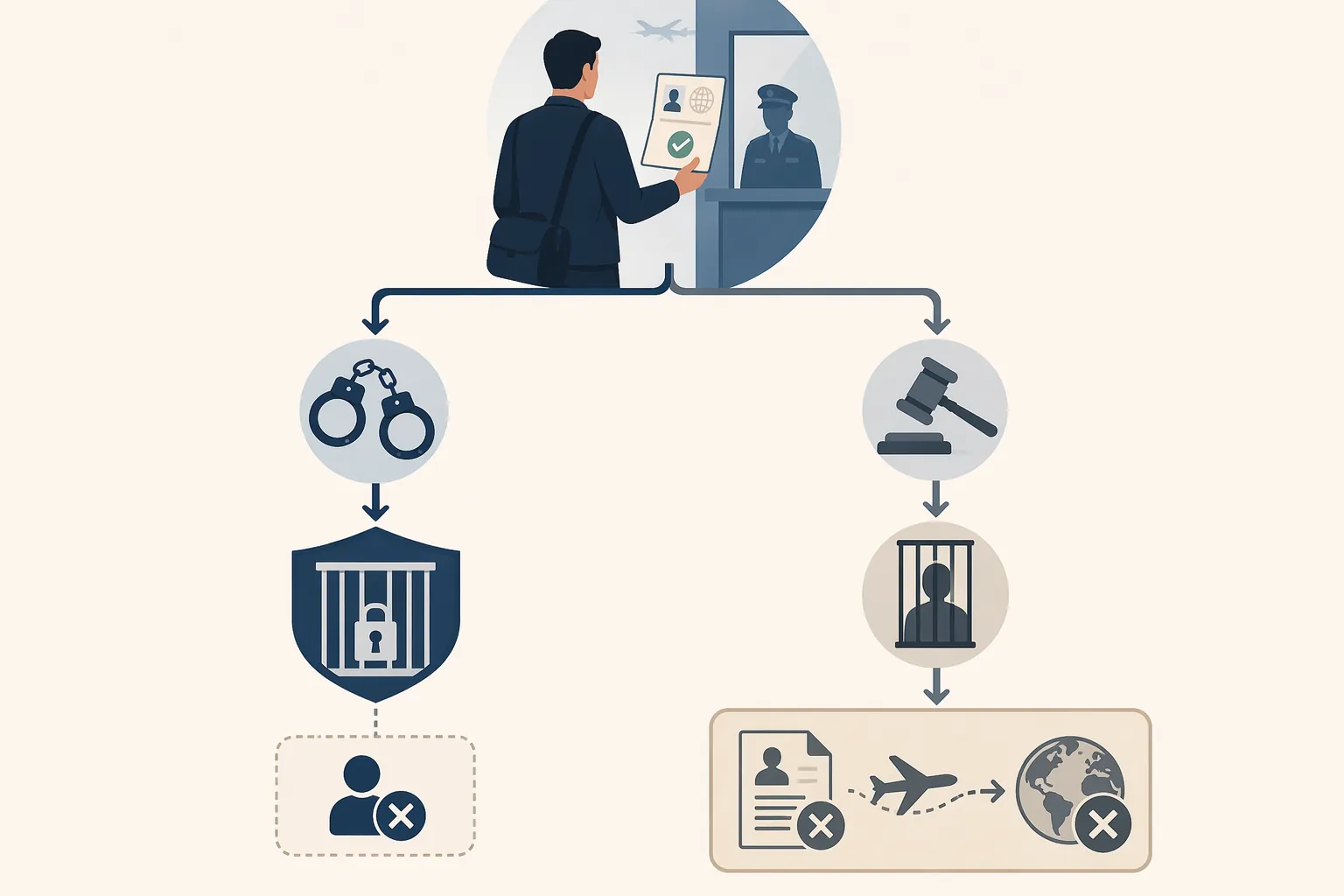
That is a different conversation from the older, more familiar conviction-based immigration analysis. A dismissed charge may still be contestable, explainable, and non-disqualifying for some immigration benefits. Under an arrest-or-charge detention provision, however, it can still be the fact that gets the client detained while the rest of the legal argument is sorted out.
This is where Adongo’s case has practical force. ICE did not need to persuade the public that his former NFL career was irrelevant; immigration law already does that. The agency needed only an overstay posture, a removal order, and a criminal-history hook it treated as covered by the Act. On the public record, that is the sequence ICE says existed.[1]
The Statutory Mapping Is Still Too Blunt
The weak point in the public explanation is the statutory mapping. ICE says Adongo’s “most recent charges” fell under the Laken Riley Act, but the announcement does not identify the exact subcategory: burglary, theft, larceny, shoplifting, assault on law enforcement, or a death-or-serious-injury offense.[1][2]
That omission matters because “criminal mischief with damage” is not self-evidently the same phrase as theft, larceny, shoplifting, burglary, or assault on a law enforcement officer. Some summaries describe criminal mischief with property damage as falling under the Act’s scope, but the public ICE release does not spell out the legal bridge. Unless a charging document, state statute, immigration-court order, or ICE legal theory identifies the precise hook, the safest formulation is narrower: ICE treated the property-damage criminal history and most recent charges as qualifying under the Laken Riley Act.
That is not a reason to ignore the case. It is a reason to screen it carefully. Government shorthand often arrives before the documents that would let counsel test the categorical fit, the charge language, the custody statute, and any argument for release or habeas relief.
What Had to Be True for Removal to Proceed
The public record supports a practical sequence rather than a celebrity-deportation story. First, Adongo had a lawful temporary entry as an athlete. Second, that status expired in 2016. Third, he remained in the United States without current authorization, according to ICE. Fourth, his criminal history included one misdemeanor conviction and dismissed serious charges. Fifth, an immigration judge ordered him removed on March 23, 2026. Sixth, ICE executed the removal on June 20, 2026. Seventh, ICE publicly framed the enforcement action as falling under the Laken Riley Act.[1][3]
Each step does a different kind of work. The expired status supports removability. The criminal-history facts support ICE’s custody and enforcement framing. The immigration judge’s order supplies the legal authorization for removal. The Laken Riley Act supplies the mandatory-detention significance, assuming the arrest, charge, or conviction fits one of the covered categories.
The case therefore should not be reduced to “he overstayed a visa” or “he had a criminal record.” Many overstays do not become high-profile LRA cases. Many criminal allegations do not end in removal. What makes this case worth tracking is the combination: a long-expired temporary athlete visa, a misdemeanor property-damage conviction, dismissed serious charges, a removal order, and an agency statement invoking a statute that does not wait for conviction in every covered circumstance.
Why Dismissed Charges Still Belong in the Risk Screen
A dismissed charge is not the same as a conviction. It should not be described as proof that the person committed the offense. But for Laken Riley Act detention screening, the dismissal does not end the inquiry because the statute also uses arrest and charge language.[2]
That distinction changes intake. A lawyer advising a noncitizen with an expired visa or unstable status cannot stop at the rap sheet’s conviction column. The intake has to ask what the client was arrested for, what the complaint or information charged, whether any amended count falls into a listed LRA category, and whether the government may use the dismissed matter as a detention trigger even if it cannot use it as a conviction-based removability ground.
- Do not treat lawful original entry as a custody shield after status expiration.
- Do not treat dismissal as irrelevant if the statute uses arrest-or-charge language.
- Do not rely on offense labels without checking the charging statute and facts alleged.
- Do not accept an ICE press-release category as the final statutory mapping when the sub-provision is not identified.
This is also where bond advice becomes more difficult. If the government classifies the client under a mandatory-detention provision, the client may be fighting from custody before the merits arguments are fully developed. That custody consequence is not collateral in practice; it affects evidence gathering, family coordination, employment loss, plea negotiations, and litigation posture.
The Athlete Biography Is Context, Not an Exception
Adongo’s sports biography explains the news value. He was a Kenyan rugby player before becoming the first Kenyan-born player in the NFL, and he spent time with the Indianapolis Colts.[3] NewsNation likewise framed the story around the former NFL and Kenyan rugby player’s removal.[6]
None of that changes the legal path. Immigration enforcement does not become surprising because the person once held a professional-athlete visa or played in a major league. If anything, the case is useful because it removes a common distraction: social status did not soften the overstay analysis, and a high-profile biography did not prevent the agency from presenting the case as an LRA enforcement action.
The Practitioner Consequence
The Adongo removal is best read as an early high-profile warning about custody screening, not as a broad referendum on the Laken Riley Act. The public facts support a narrower conclusion: ICE is willing to apply the Act to a noncitizen who originally entered lawfully, overstayed, had a misdemeanor property-damage conviction, and had dismissed charges that the agency treated as part of a qualifying criminal-history profile.[1][2]
For immigration lawyers and risk-management staff, the lesson is not to predict removal from headlines. It is to run the custody screen before the client is in custody. Pull the visa history. Confirm the expiration date. Obtain the criminal complaint, amendments, disposition, and sentencing record. Map each arrest or charge to the LRA’s listed categories. Then separate what the government has actually charged from what ICE has merely characterized.
Adongo’s deportation signals that LRA exposure for visa holders cannot be screened only by conviction history, lawful entry, or professional status. The live question is whether any arrest, charge, conviction, or admission can be placed into a qualifying statutory category—and whether the government can defend that mapping when the press-release shorthand gives way to the record.
References
- ICE Chicago removes former NFL player, criminal illegal alien from Kenya — U.S. Immigration and Customs Enforcement.
- S.5 — Laken Riley Act, 119th Congress (2025-2026) — Congress.gov.
- First Kenyan-born NFL player deported, ICE says — NBC News.
- Former Colts linebacker Daniel Ogama Adongo deported by ICE Chicago — Fox News.
- President Trump Signs the Laken Riley Act into Law — U.S. Department of Homeland Security, January 29, 2025.
- Ex-NFL, Kenyan rugby player Daniel Adongo deported by ICE — NewsNation.
Related records
Tool profile
Browse tool evaluations →Governing regulation
Browse the obligations tracker →Preventive workflow
Browse verification workflows →
Report a correction or tip
Spotted an outdated figure, a misstated fact, or a ruling this case record should reflect? Public comments are disabled for this content given the professional cost of a misreported case outcome, penalty amount, or rule text — use the structured correction channel instead.
Report a correction or tip for this record →