
What Daniel Siad's Death Reveals About France's Epstein Probe
Daniel Siad's death at the preliminary-investigation stage terminates the criminal action against him under French procedure but does not end the broader Epstein probe. This article explains the procedural consequences for the investigation, victims' access to justice, and cross-border evidence sharing.
- Jurisdiction
- France – Nanterre
- Ruling date
- Jul 20, 2026
- Source document
- View primary court order ↗
Lex Machina Review is an independent risk-tracking and reference resource. Nothing on this site is legal advice, and using it does not create an attorney-client relationship. Every record is reviewed against primary sources but may not reflect the most current status of a matter — always verify directly against the cited court order, rule text, or a licensed attorney before relying on it.
Companion explanation — secondary to the source document above
This is not a new inquiry into Jeffrey Epstein’s own 2019 death. The live question in France in July 2026 is narrower: what happens to the French Epstein probe after Daniel Siad, a modeling scout linked to Epstein, died before French investigators had formally questioned him or placed him under formal investigation.
Status as last reviewed on July 23, 2026: Siad was found dead at his home in the Paris suburbs on July 20; the Nanterre prosecutor opened a death investigation and ordered an autopsy; the cause of death had not been officially determined; and the French Epstein probes remained open.[1] Reuters reported Siad’s lawyer as saying he died of a heart attack caused by stress and anxiety from the investigation, but that is a lawyer’s attribution, not an autopsy finding.[2]
The procedural fact that matters most is plain and easily lost in louder coverage: Siad had not been formally questioned by investigators before his death.[1] He had also not been placed under mise en examen, the French status that marks formal placement under investigation by an investigating judge. That leaves a different record from a case in which a suspect has been interrogated, confronted with complainant accounts, and moved into a formal judicial investigation.
There were reasons for investigators to care about him. Le Monde reported that Siad’s name appeared roughly 2,000 times in released Epstein files, and victims’ lawyers criticized the pace of the French investigation after his death.[3] Reuters reported that at least five women had accused him of rape and human trafficking.[2] Those facts explain investigative relevance. They do not convert allegation into adjudicated guilt.
Where the French File Stood When Siad Died
The French Epstein investigation was opened in February 2026 by the Nanterre prosecutor’s specialized human-trafficking unit, about a month after the U.S. Department of Justice’s January 2026 Epstein Files Transparency Act release. The French work was reported as two parallel probes: one concerning human trafficking and aggravated pimping, and another concerning financial crimes such as money laundering, corruption, and tax fraud.[4]
By mid-May 2026, Paris prosecutor Laure Beccuau said roughly 10 to 20 victims had come forward in France’s Epstein investigation, and France 24 reported that no potential subjects had yet been questioned at that point.[4] Siad’s death two months later therefore did not occur after a completed cycle of suspect questioning. It occurred while the state had publicly opened a serious inquiry but before the process had generated the suspect-side record that later proceedings often depend on.
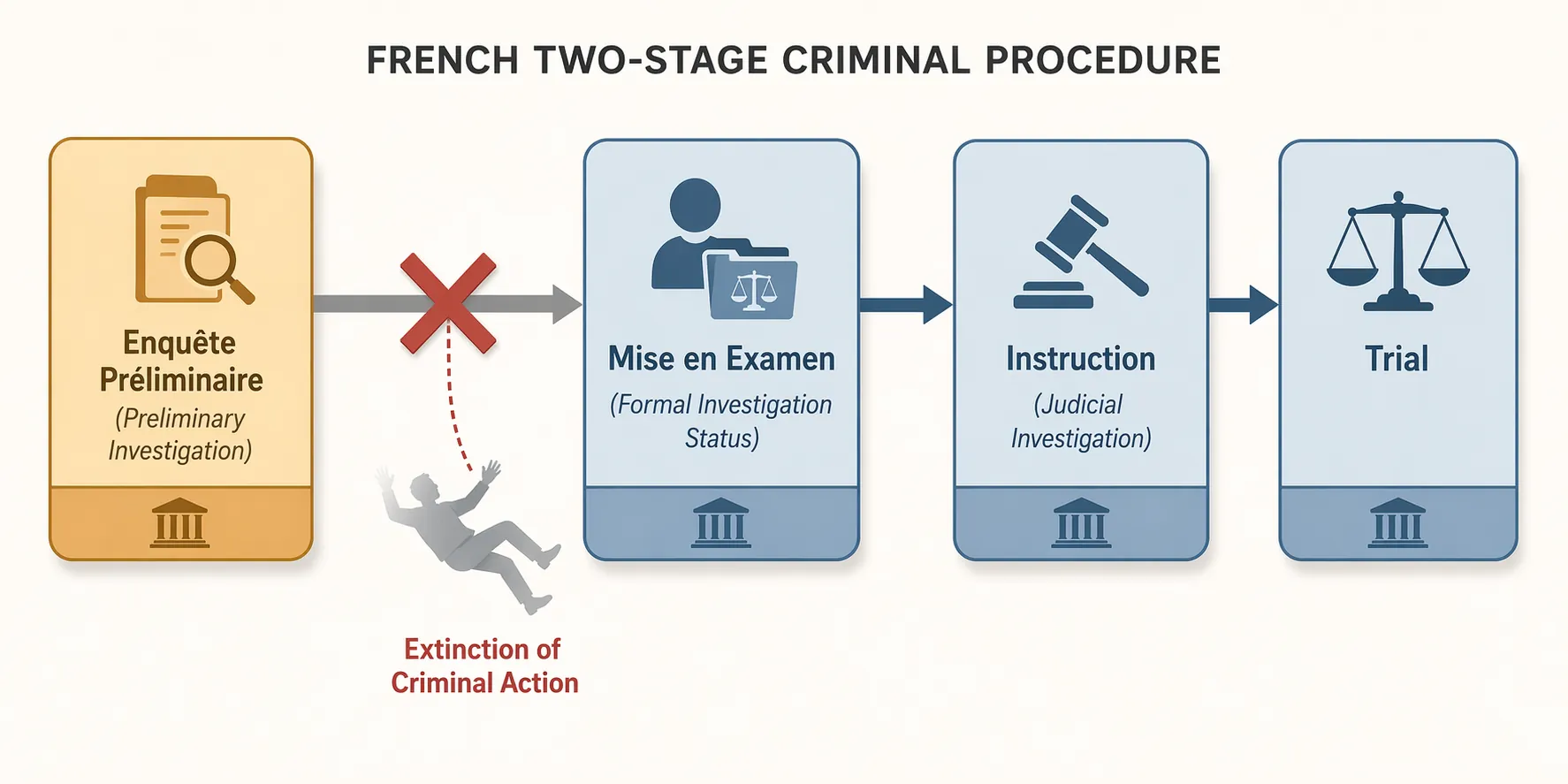
That timing is the center of the matter. In French criminal procedure, an enquête préliminaire is a prosecutor-led preliminary investigation. It can collect complaints, documents, witness accounts, and other material, but it is not the same thing as a formal judicial investigation, or instruction, conducted under an investigating judge. Mise en examen belongs to that more formal phase and indicates that a person has been formally placed under investigation.[5]
When a suspect dies before that threshold, the criminal action against that person cannot mature into a trial. There can be no custodial questioning of Siad, no confrontation between him and complainants in a criminal proceeding, no indictment-style progression against him, and no criminal judgment determining whether he was guilty. The broader file does not vanish, but the case against him as a living defendant ends.
What Death Before Mise en Examen Changes
The distinction is not semantic. A suspect questioned before death may leave behind denials, admissions, inconsistencies, explanations of documents, names of intermediaries, or accounts that can be tested against other evidence. A suspect formally placed under investigation may also have been confronted with the legal shape of the accusation. If the person later dies, investigators and victims still lose a defendant, but they do not necessarily lose the same evidentiary layer.
Siad’s file, as publicly described, stopped before that layer. The BBC reported that he had never been formally questioned.[1] France 24’s mid-May account had already shown that the French investigation had not yet reached potential-subject questioning.[4] Le Monde’s reporting on the frequency of his name in the Epstein files shows why he was not a marginal figure in the investigative map, but frequency in a document trove is still only a reason to investigate, not a verdict.[3]
The practical loss is therefore specific. Investigators can no longer ask Siad why his name appeared where it did, what role he says he played, whether he disputes complainant accounts, who else was involved, how money moved, or what records may exist outside the released files. Victims’ lawyers can no longer pursue a criminal process in which he is required to answer as an accused person. Courts can no longer produce a trial-tested finding against him.
This is also where restraint matters. The open death investigation and ordered autopsy are not decorative facts; they are the line between a public record and speculation.[1] Until the medical and prosecutorial record is official, a cause-of-death narrative should not be treated as proved merely because it fits an online pattern or satisfies a theory about the Epstein network.

Why the Brunel Comparison Helps, and Where It Stops
Jean-Luc Brunel is the obvious comparison, but only if it is used carefully. Brunel died in 2022 after he had been placed under mise en examen and while he was in pre-trial detention. That means his death occurred after the French process had crossed a formal threshold that Siad’s case, as publicly reported, never reached.
The comparison is useful because it shows why “another Epstein-linked death” is too blunt a category. In Brunel’s case, there had already been formal placement under investigation. In Siad’s case, the reported posture was preliminary investigation, no formal questioning, no mise en examen, and no instruction against him. Both deaths may frustrate victims. They do not leave the same procedural remains.
For readers tracking the broader liability questions around alleged Epstein-era recruiters, the separate analysis of Daniel Siad and the Legal Implications for Epstein-Era Recruiters addresses the wider U.S. and French liability issues. The point here is narrower: French procedure treats a death before formal placement under investigation differently from a death after that threshold has been crossed.
What Victims Lose, and What They Do Not
The loss to complainants is not abstract. A criminal case can give victims something more precise than public belief: a record tested through procedure. It can require an accused person to answer. It can put documents, witness accounts, and denials into a structured confrontation. It can end in acquittal, conviction, or dismissal, but it produces a legally accountable path to that result.
Siad’s death forecloses that path against him. It does not prove the accusations. It also prevents the French courts from determining them against him in a criminal trial. That is a hard distinction to maintain in a case surrounded by notorious names, but it is the distinction that protects both the presumption of innocence and the integrity of complainants’ claims.
Victims may still have procedural avenues as civil parties, depending on the posture of the remaining proceedings and the evidence available. The broader investigation can still consider complainant accounts, documents, financial records, and other persons. What victims lose is not every legal possibility. They lose the possibility of a criminal judgment against Siad and the evidentiary contribution that his questioning might have supplied.
That is why the complaint timeline matters. Le Monde reported criticism from victims’ lawyers about the slow pace of the investigation after Siad’s death.[3] France 24 had reported in May that victims had come forward while potential subjects had not yet been questioned.[4] Delay is not merely a public-relations problem in this setting. It can decide whether a file ever obtains Siad’s answers, which later cannot be reconstructed.
For a broader overview of the remaining legal questions after Siad’s death, see What Daniel Siad's Death Means for the Epstein Investigation. This article is concerned with the narrower procedural mechanism: what was lost because death came before mise en examen.
Why the Broader French Probe Continues
The death of one uncharged suspect does not terminate the French Epstein investigation. The two Nanterre probes remain capable of examining other persons, financial flows, documents, complainant accounts, and any links between conduct in France and the wider Epstein network.[4] The criminal action against Siad is extinguished because he is dead; the investigative interest in evidence connected to him is not.
That distinction is important for risk teams and reporters. A dead suspect cannot be charged, detained, confronted, or tried. But documents associated with him may still help establish timelines, identify other actors, corroborate or contradict witness accounts, or support financial-crime analysis. The probative value of that material will depend on admissibility, provenance, and the rules of the proceeding in which someone tries to use it.
Cross-border evidence sharing fits into the same practical frame. Siad can no longer answer French investigators or foreign authorities. Released Epstein-file references, prior records, complainant accounts, financial documents, and materials gathered in France may still matter to other authorities if they are lawfully obtained and usable under the receiving system’s procedure. What cannot be exported is the interview that never happened.
The Structural Gap
The uncomfortable lesson is procedural rather than theatrical. French criminal procedure allows substantial work to occur in a preliminary phase before a person is formally placed under investigation. That structure can be sensible: premature formal action can damage rights, distort evidence, and convert suspicion into stigma too quickly. But a long preliminary phase also creates a window in which complainants have come forward, investigators have a named subject, and yet no formal suspect-side record exists.
Siad died inside that window. The French Epstein probe can continue through its human-trafficking and financial-crime lines. Other evidence may still be useful. Other persons may still be examined. But against Siad himself, the state no longer has the living subject whose answers could have been tested, challenged, compared, and, if warranted, placed before a court.
That is the gap his death exposes: not proof of guilt, not proof of conspiracy, and not the end of the French Epstein investigation, but the disappearance of a trial-capable path against the person complainants accused before French procedure had converted suspicion into a fuller evidentiary record.
References
- Modelling scout linked to Epstein found dead in Paris suburbs, BBC News, July 22, 2026.
- French modelling scout linked to Epstein found dead, Reuters, July 22, 2026.
- Epstein case: French model scout and alleged recruiter found dead, Le Monde, July 22, 2026.
- Around 10 'new' victims come forward in France's Epstein investigation, France 24, May 17, 2026.
- French criminal procedure, Wikipedia.
Related records
Tool profile
Browse tool evaluations →Governing regulation
Browse the obligations tracker →Preventive workflow
Browse verification workflows →
Report a correction or tip
Spotted an outdated figure, a misstated fact, or a ruling this case record should reflect? Public comments are disabled for this content given the professional cost of a misreported case outcome, penalty amount, or rule text — use the structured correction channel instead.
Report a correction or tip for this record →