
Cornell's Darius Paduch sexual abuse settlement: $1B+
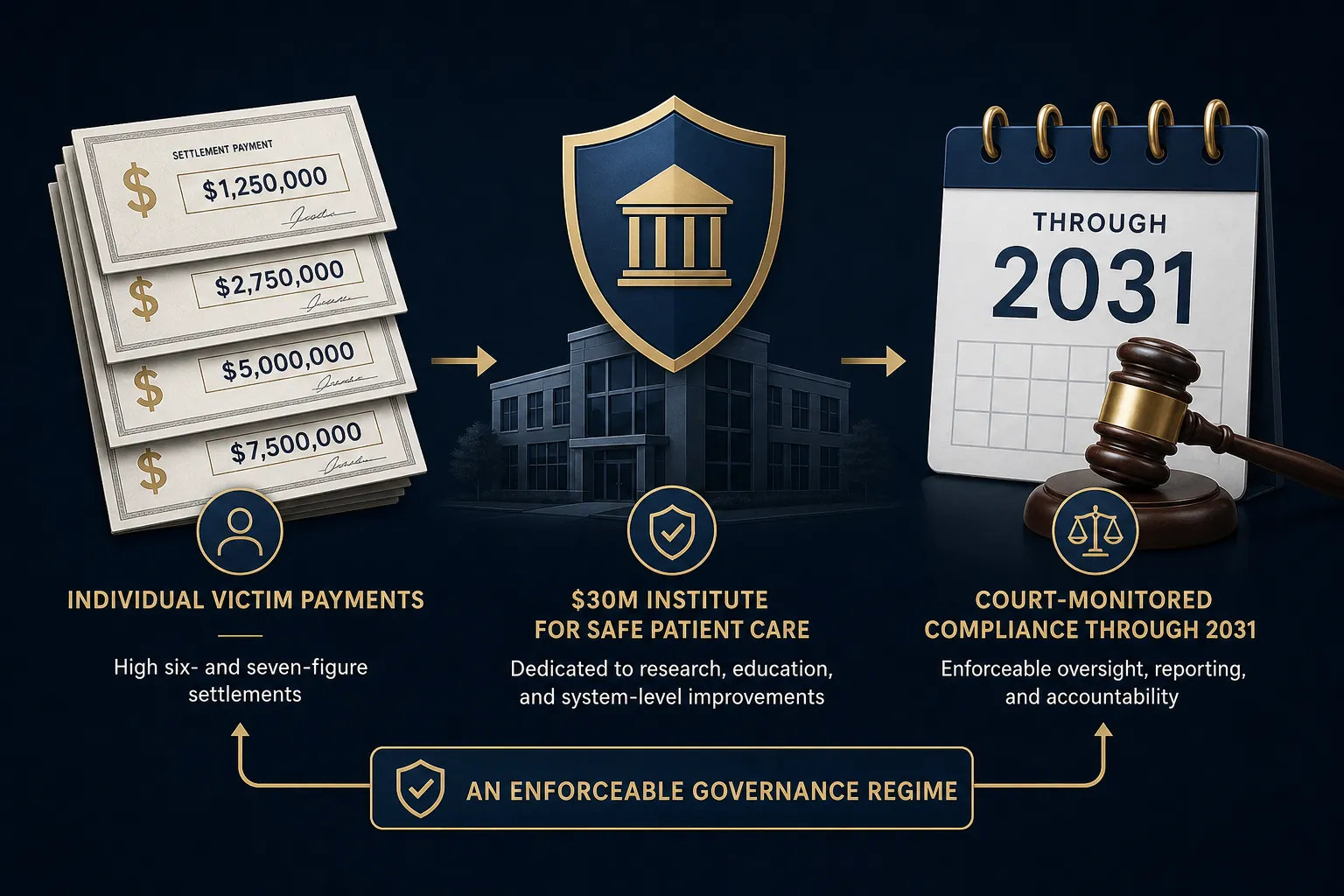
The July 2026 voluntary resolution between Weill Cornell Medicine and the US Attorney's Office requires over $1 billion in victim settlements, a $30 million Institute for Safe Patient Care, and court-monitored compliance through at least 2031, establishing a new liability standard for institutions that fail to act on documented clinician abuse complaints.
- Jurisdiction
- US Federal
- Court
- U.S. District Court for the Southern District of New York
- AI tool named
- None
- Ruling date
- Jul 27, 2026
- Source document
- View primary court order ↗
- Last verified
- Jul 28, 2026
Lex Machina Review is an independent risk-tracking and reference resource. Nothing on this site is legal advice, and using it does not create an attorney-client relationship. Every record is reviewed against primary sources but may not reflect the most current status of a matter — always verify directly against the cited court order, rule text, or a licensed attorney before relying on it.
Companion explanation — secondary to the source document above
Risk Digest record — last verified in Q3 2026, using July 28, 2026 as the verification date. The current public record for the Darius Paduch sexual abuse lawsuit settlement at Cornell centers on a July 27, 2026 voluntary resolution between Weill Cornell Medicine and the U.S. Attorney’s Office for the Southern District of New York. Cornell publicly acknowledged the agreement and the creation of a $30 million Institute for Safe Patient Care; Newsday reported that the confidential settlement structure exceeds $1 billion in victim settlements; and Crain’s New York Business reported the court-monitored compliance framework extending through at least 2031. [1][2][3]
Those three elements matter more than the headline number alone. The resolution combines compensation, dedicated safety funding, and future oversight. It is not simply a payout after physician misconduct; it is a governance remedy imposed after documented warnings about a clinician were not acted on with sufficient force.
What is resolved, and what is not
The resolved institutional record, as publicly described, concerns Weill Cornell Medicine’s agreement with federal prosecutors over its response to sexual abuse by former urologist Darius Paduch. Cornell’s own statement said the institution “failed to detect or stop” Paduch’s conduct and that its patient-protection policies were inadequate. [1]
Paduch’s underlying abuse allegations and criminal proceedings remain important context, but they are not the central risk issue in the 2026 Cornell settlement. The institutional question is narrower: when a hospital receives warnings that a physician may be abusing patients, who is responsible for escalation, investigation, restriction, reporting, and patient protection — and what happens when those steps fail.
The public sources do not support treating every related claim as fully closed. Northwell Health, also named in civil suits, did not have a public settlement agreement as of July 27, 2026, according to Newsday, and case-count figures vary across public sources. [2]
The notice record is the liability record
For institutional liability, the chronology is not background. It is the case. Prosecutors identified abuse beginning as early as 2009 and at least 50 patients abused at Cornell. The notice history included internal complaints dating to 2012, a colleague report in 2015, and a state-board complaint in 2018 that went unaddressed. [2]
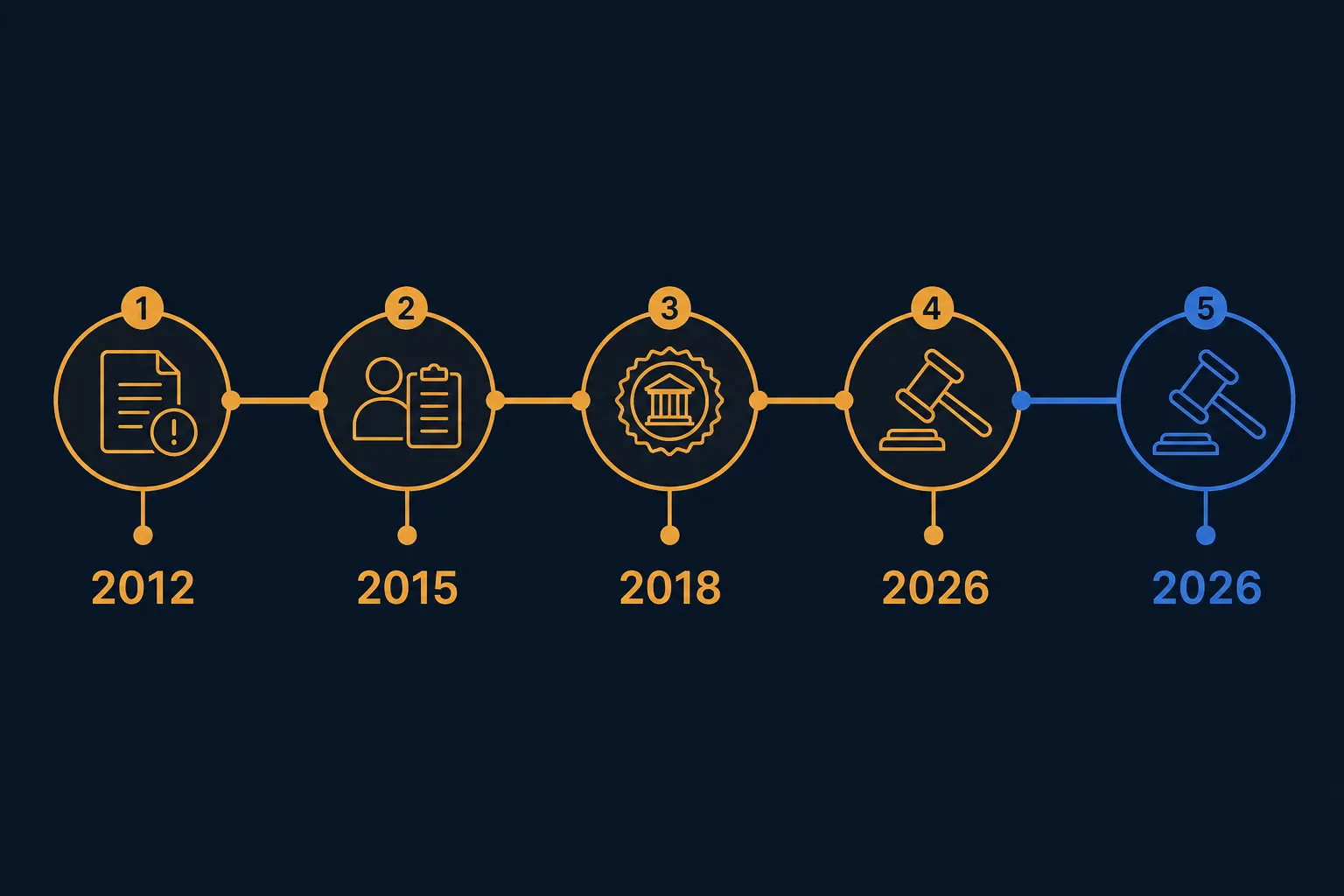
That sequence changes the character of the exposure. A single complaint can be mishandled in many ways: poor documentation, deference to a senior clinician, uncertainty about patient memory, or a belief that peer review will quietly solve the problem. By 2015, however, the record included a colleague report. By 2018, it included a state-board complaint. The risk file was no longer a vague discomfort about bedside manner. It was a documented chain of warnings involving patients, internal personnel, and external regulators.
Cornell’s later admission is therefore central. The institution did not merely settle claims while denying all operational significance. It acknowledged that the policies designed to protect patients were inadequate and failed to detect or stop the conduct. [1]
| Date or period | Verified public record | Risk significance |
|---|---|---|
| As early as 2009 | Prosecutors identified abuse beginning as early as this period. | Expands the potential duration of institutional exposure. |
| 2012 | Internal complaints dated to this year. | Shows early notice inside the institution. |
| 2015 | A colleague report was made. | Moves the record from patient-only complaints to professional notice. |
| 2018 | A state-board complaint was made and went unaddressed. | Adds external regulatory notice to the failure-to-act sequence. |
| July 27, 2026 | Weill Cornell entered a voluntary resolution with the U.S. Attorney’s Office for the Southern District of New York. | Turns the chronology into a settlement and compliance benchmark. |
The most damaging compliance fact is not that a physician was accused. Hospitals face difficult clinical and personnel complaints routinely. The damaging fact is that warnings accumulated across years and channels, while patient-protection controls were later admitted to have been inadequate.
Settlement mechanics: payment, safety funding, monitoring
The 2026 Cornell resolution has three public-facing components that a hospital board or compliance committee should read together.
- Individual victim settlements: Newsday reported that the confidential settlement structure exceeds $1 billion. A separate law-firm disclosure stated that one firm alone secured more than $3 million in settlements for Paduch victims. [2][4]
- Dedicated patient-safety funding: Cornell announced a $30 million Institute for Safe Patient Care as part of the agreement. [1]
- Ongoing compliance oversight: Crain’s reported a court-monitored compliance structure extending through at least 2031. [3]
Individual payments address past injury. The institute and monitoring framework address institutional recurrence. That distinction matters because a settlement that only compensates victims leaves the next compliance team with lessons, but not necessarily enforceable architecture. A monitored structure creates continuing duties, reporting expectations, and a calendar that outlasts the press cycle.
A court-monitored period through at least 2031 also changes the internal audience. The responsible parties are not only litigation counsel negotiating releases. They include the general counsel, compliance office, physician leadership, patient-safety personnel, credentialing committees, graduate medical education administrators, and anyone who owns complaint intake or escalation pathways.
Why the $30 million institute is not a side term
The $30 million Institute for Safe Patient Care is easy to treat as reputational repair. In risk terms, it is more concrete than that. It earmarks institutional money for patient-safety infrastructure after an admitted failure of patient-protection policies. [1]
That type of term asks a different question than damages alone: what system will exist after the settlement that did not exist, or did not function, before it? For a healthcare institution, the answer has to appear in reporting lines, investigation triggers, clinician restrictions, patient notification protocols, documentation standards, and board-level visibility.
Why monitoring through 2031 matters
A compliance-monitoring panel through at least 2031 prevents the resolution from ending at signature. It gives the remedy a future-facing enforcement period. [3]
That is the part most relevant to institutions trying to assess their own exposure. A complaint policy can be revised in a week. A monitored governance regime tests whether revised policies actually change how physicians are supervised, how reports are escalated, and how reluctant departments are made to act when the accused clinician is valuable or senior.
The Cornell resolution in the Columbia/Hadden pattern
The obvious comparison is Columbia University and former OB/GYN Robert Hadden. ABA Health Law Section reporting described a $165 million settlement in 2022 and a $750 million settlement in 2025 for survivors of Hadden’s sexual abuse. [5]
The comparison should be kept disciplined. The specialties, institutional histories, claim groups, settlement structures, and public records are not identical. The useful pattern is narrower: major academic medical institutions are now seeing nine- and ten-figure exposure when allegations involve clinician sexual abuse, repeated warning signs, and alleged institutional failure to protect patients.
Cornell’s 2026 resolution appears to move beyond prior settlement arithmetic because it combines the reported billion-plus victim-settlement scale with a dedicated patient-safety institute and court-monitored compliance obligations extending years beyond the resolution date. [1][2][3]
What counsel and compliance teams can safely infer
The 2026 Cornell settlement should not be treated as a formal nationwide rule. It is a voluntary resolution. The public record is strong enough to identify a liability benchmark, but not strong enough to reconstruct every legal covenant, release, admission, or enforcement mechanism in the agreement.
The safer inference is operational: where clinician-abuse reports are documented and an institution fails to respond adequately, exposure now includes more than civil damages. A resolution may require institutional admissions, dedicated patient-safety funding, external monitoring, and years of governance oversight.
For healthcare systems, the record also sharpens what should be preserved and reviewed when a serious physician-misconduct complaint arrives:
- the original complaint and any prior similar reports;
- who received the report and who had authority to restrict the clinician;
- whether peer review, human resources, compliance, legal, and patient safety were all notified;
- what interim patient-protection measures were imposed while the facts were investigated;
- whether external reporting duties were considered and documented;
- whether later complaints were linked to earlier warnings rather than handled as isolated events.
Those are not cosmetic file-management points. They determine whether a future board memo describes a difficult complaint handled with visible controls, or a years-long notice record that no one with authority forced into action.
Remaining uncertainties
Three limitations should remain attached to any professional use of this record. First, the full DOJ agreement was not available from the justice.gov press-release path during this verification, so the public analysis depends on Cornell’s statement and news reporting rather than the complete agreement text. Second, Northwell Health’s public settlement status remained unclear as of July 27, 2026, despite its inclusion in civil litigation reporting. Third, pending-case totals differ across public sources, with more than 300 filed cases described in law-firm materials and more than 800 anticipated claims reported by Newsday for Cornell and Northwell combined. [2]
Those uncertainties do not erase the central risk conclusion. For healthcare institutions, documented clinician-abuse reports followed by inadequate action now carry a visible 2026 benchmark: billion-scale settlement exposure, dedicated patient-safety funding, and court-monitored compliance extending years beyond the resolution date.
References
- Agreement with the U.S. Attorney’s Office, Cornell University, July 27, 2026.
- Darius Paduch billion settlement sex abuse trial, Newsday.
- CNY Weill Cornell Medicine DOJ agreement, Crain’s New York Business, July 28, 2026.
- Over $3 Million in Settlements Secured for Victims of Dr. Darius Paduch, Lawyer Time.
- $750M Settlement for Survivors of Former OB-GYN’s Sexual Abuse, ABA Health Law Section, 2025.
Related records
Tool profile
Browse tool evaluations →Governing regulation
Browse the obligations tracker →Preventive workflow
Browse verification workflows →
Report a correction or tip
Spotted an outdated figure, a misstated fact, or a ruling this case record should reflect? Public comments are disabled for this content given the professional cost of a misreported case outcome, penalty amount, or rule text — use the structured correction channel instead.
Report a correction or tip for this record →