
Daycare Workers Face Uneven Legal Risks After Abuse Allegations
An evidence-led overview of the criminal, regulatory, and civil consequences daycare workers face after abuse allegations in 2026, highlighting how enforcement gaps in states like Arizona and Hawaii create dramatic jurisdictional disparities that counsel must account for.
- Jurisdiction
- United States
- Court
- State courts
- AI tool named
- None
- Ruling date
- Jan 9, 2026
- Source document
- View primary court order ↗
- Last verified
- Jul 30, 2026
Lex Machina Review is an independent risk-tracking and reference resource. Nothing on this site is legal advice, and using it does not create an attorney-client relationship. Every record is reviewed against primary sources but may not reflect the most current status of a matter — always verify directly against the cited court order, rule text, or a licensed attorney before relying on it.
Companion explanation — secondary to the source document above
The legal consequences of daycare abuse allegations in 2026 are easiest to misread when they are treated as a single track. In Alabama, the Happy Hearts prosecution produced a five-year prison term on a 20-year split sentence, with no parole and 36 months of probation, after physical abuse was captured on surveillance video.[1] In Arizona, a worker at Brighter Angels Learning Center in Phoenix was filmed beating a 21-month-old with a broom; the regulatory consequence reported for the facility was a $300 fine, calculated as three violations at $100 each, and the facility retained its license.[2]
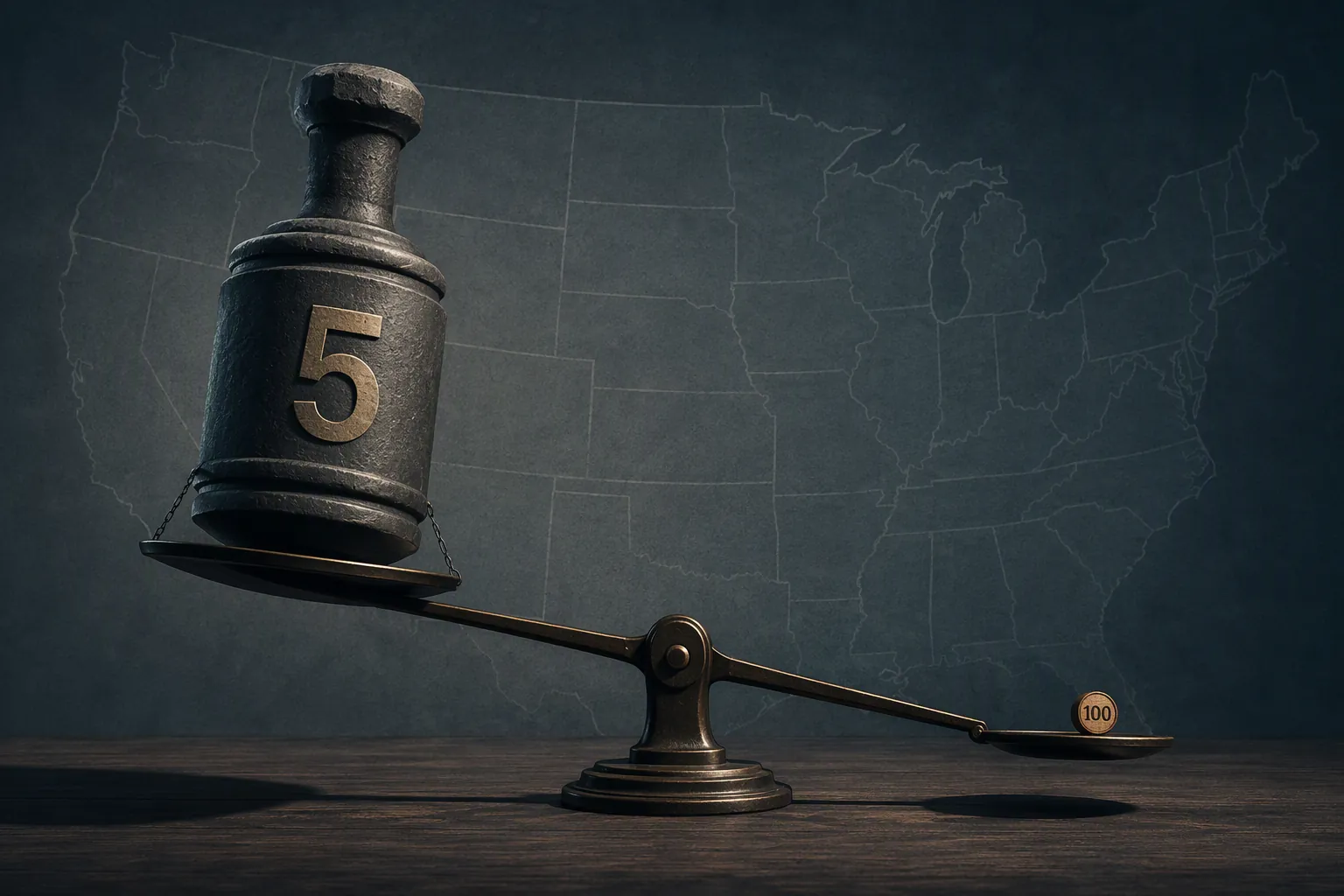
Both examples involve childcare abuse allegations, but they do not describe the same legal event. One shows what criminal punishment can look like when prosecutors have evidence and choose to pursue a severe sentence. The other shows a licensing system whose monetary sanction may remain small even when the underlying conduct is grave. For counsel assessing the legal consequences of daycare abuse allegations against workers in 2026, that distinction is not academic. The operative question is which legal track has teeth in the jurisdiction that controls the worker, the facility, and the licensing agency.
National child-welfare data gives scale, but it should not be stretched beyond its function. NCANDS FY2024 reported 532,228 children confirmed as abuse or neglect victims and 410,676 unique perpetrators; 76.3% of those perpetrators were parents.[3] That does not make daycare workers the dominant perpetrator group. It does explain why childcare allegations sit inside a broader reporting environment in which professional reporters matter: 70.9% of screened-in abuse reports came from professionals, including legal and law-enforcement personnel, educators, and medical personnel.[3]
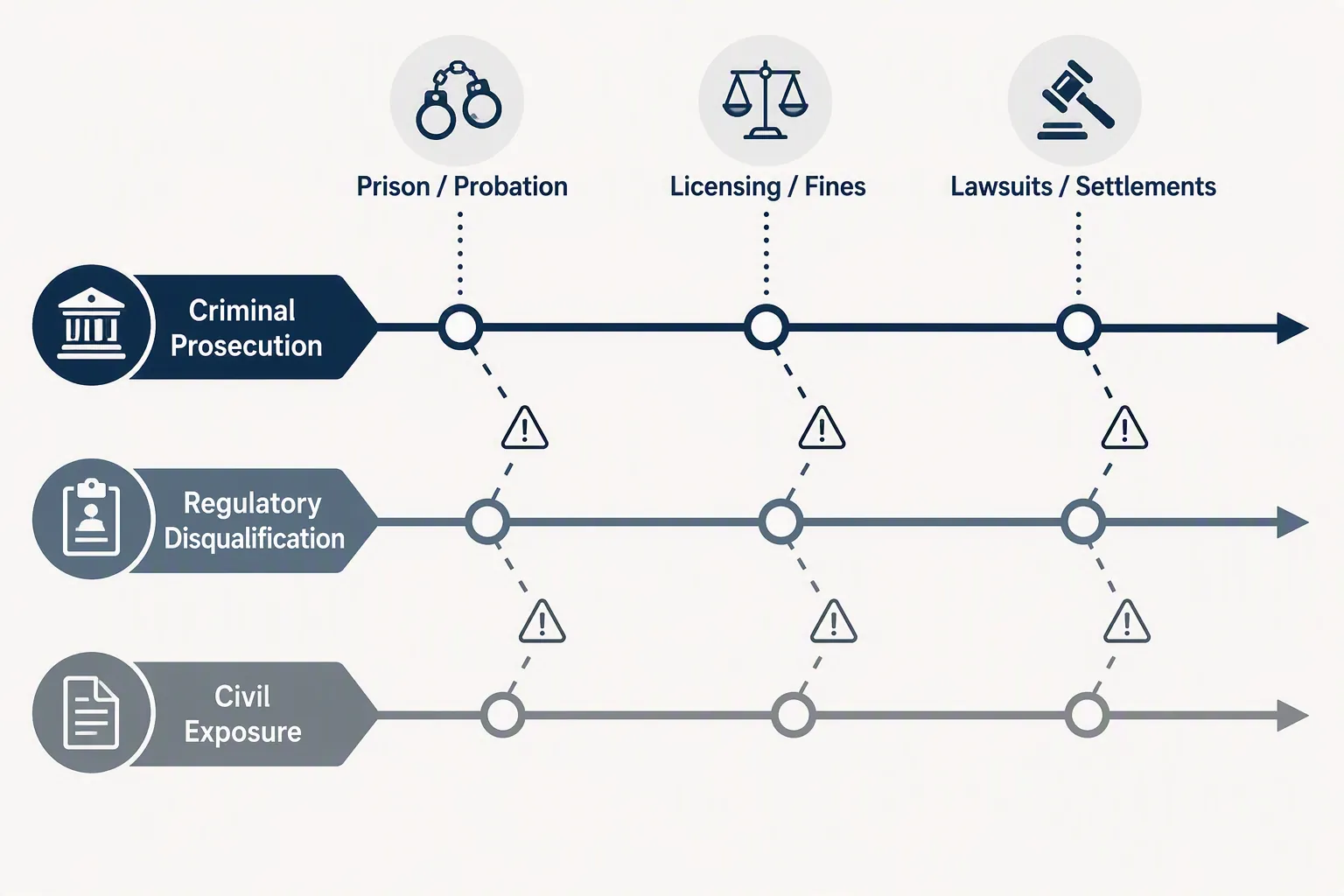
The three tracks do different work
A daycare worker accused of abuse may face criminal investigation, licensing or employment disqualification, and civil claims. Those tracks can overlap, but none is a substitute for the others. A criminal conviction may trigger permanent employment consequences in federally funded childcare. A licensing agency may fine or discipline a facility even when prosecutors decline charges. A civil case may proceed on negligence, supervision, hiring, retention, or direct-abuse theories regardless of whether a criminal sentence has already been imposed.
| Track | Primary legal question | Who is usually exposed | What can happen |
|---|---|---|---|
| Criminal prosecution | Did the worker commit conduct meeting a state criminal offense? | Worker; sometimes others if charging theories reach supervision or reporting conduct | Jail or prison, probation, criminal record, collateral employment consequences |
| Regulatory and disqualification | May the worker or facility continue operating in licensed or federally funded childcare? | Worker, facility, license holder, agency | Background-check exclusion, suspension, revocation, fines, corrective action, reporting findings |
| Civil exposure | Who must pay for injury, trauma, negligent supervision, or institutional failure? | Worker, facility, owner/operator, insurer, sometimes related entities | Settlement, judgment, defense costs, insurance disputes, reputational and operating consequences |
The timing also differs. A worker may be removed from a classroom while an investigation is pending, charged months later, and sued before or after the criminal case resolves. A facility may receive a licensing citation without a criminal conviction. An agency may be bound by state fine caps even when the evidence would make a civil complaint or criminal information look far more serious.
Criminal exposure supplies the visible high end
The Alabama Happy Hearts sentence is the kind of outcome that makes criminal exposure easy to describe and dangerous to generalize. A five-year prison term on a 20-year split sentence, without parole, reflects a severe prosecution posture tied to physical abuse captured on surveillance.[1] It does not establish a national baseline for daycare abuse sentencing. It does show that when the proof record is strong and the prosecutor treats the case as serious child abuse rather than workplace misconduct, incarceration can become the dominant risk for the individual worker.
West Virginia offers a statutory example of state-specific escalation. HB 2047, enacted in 2025 and effective in 2026, increased imprisonment for abuse causing bodily harm from one to five years to two to ten years, increased the range for serious bodily harm from two to ten years to five to fifteen years, and provides that subsequent offenses double the base penalty.[4] That is meaningful for conduct governed by West Virginia law. It should not be presented as proof of a uniform national crackdown without multi-state legislative tracking.
At the lower end of the reported sentencing range, a Minnesota Blaine daycare worker was sentenced to 90 days in jail for maliciously punishing a child.[5] The contrast between that sentence and the Alabama result is not a contradiction. It is the ordinary consequence of jurisdiction, charge selection, injury severity, available evidence, plea posture, and sentencing law doing separate work.
For the worker, the criminal case is also not over when the sentence is pronounced. Under the federal CCDF rule at 45 CFR § 98.43, conviction of a violent felony against a child, child abuse, child endangerment, or specified violent misdemeanors permanently disqualifies an individual from employment in federally funded childcare.[6] That rule matters because it converts certain convictions into an employment bar, not merely a punishment already served.
Regulatory consequences are where the gaps become harder to defend
Licensing enforcement is supposed to be the operational layer: the place where agencies decide whether a worker remains eligible, whether a facility keeps a license, whether corrective action is enough, and whether a fine changes behavior. In practice, the regulatory layer is also where statutory design can drain consequence from serious facts.
Arizona is the cleanest example in the current record. ARS 36-891 caps daycare fines at $100 per violation per day. By contrast, ARS 36-431.01 caps fines for health care institutions at $1,000 per violation per day, a 10-to-1 disparity; the investigation reporting this comparison also noted no inflation adjustment since enactment.[2] A fine cap does not prove that every Arizona enforcement action is weak. It does mean the agency’s monetary sanction is bounded in a way that can look detached from the conduct.
The Brighter Angels example is why that statutory ceiling matters. A filmed broom assault on a toddler generated a total regulatory fine of $300, and the facility retained its license.[2] That fact does not answer whether prosecutors, parents, insurers, or civil plaintiffs pursued other remedies. It answers a narrower but important question: what did the licensing fine do on the reported record? Very little.
Arizona’s reporting record leaves another hole. The state had 14 substantiated abuse findings in CCDF-eligible care in FY2023, 33 in FY2024, and 24 in FY2025; the jump from FY2023 to FY2024 was a 136% single-year increase, with no published causal analysis in the cited investigation.[2] Arizona also published no aggregate enforcement summary from 2020 through 2025.[2] Without that summary, counsel cannot responsibly infer whether the increase reflects more abuse, better reporting, changed classification, enforcement emphasis, or some combination not visible in the public record.
That is not a small transparency problem. A facility defending its practices, a plaintiff evaluating negligent supervision, and an agency lawyer defending enforcement discretion all need to know whether citations, fines, suspensions, and license actions are isolated or patterned. The absence of aggregate enforcement summaries shifts the analysis back to individual inspection files and case examples, which are often too narrow to support system-wide conclusions.
Federal disqualification can be stronger than state licensing fines
The federal CCDF disqualification rule cuts differently from state fine schedules. A state may have limited fine authority against a facility, but a qualifying conviction can still permanently bar the worker from federally funded childcare employment.[6] That produces a practical asymmetry: the individual worker may face a durable federal employment consequence while the facility’s state administrative penalty remains modest.
For risk analysis, that asymmetry matters more than the label attached to the allegation. A worker’s exposure turns on charge and conviction categories. A facility’s exposure turns on licensing law, supervision evidence, reporting obligations, insurance, and civil claims. The same incident can therefore produce a permanent employment bar for one person and only a small fine for the licensed entity, unless other enforcement tools are used.
Hawaii shows how definition gaps can frustrate compliance
Hawaii presents a different regulatory problem. As of 2026, it was reported as the only state that had not finalized definitions for “serious injury” and “child abuse” in childcare settings, making it impossible to comply with federal CCDBG reporting requirements first mandated in 2014.[7] This is not merely a drafting issue. Reporting regimes depend on definitions because definitions decide which incidents are counted, escalated, and compared.
A federal reporting expectation can exist on paper while state implementation remains incomplete. For counsel, that creates a different problem than Arizona’s fine cap. In Arizona, the sanction ceiling is visible. In Hawaii, the unresolved definitions affect the front end of reporting and classification. Either way, the result is a mismatch between national childcare safety architecture and state-level machinery.
Civil exposure is real, but the available figures are case-result examples
Civil exposure runs on a different theory of consequence. The plaintiff is not asking whether the worker should be incarcerated or barred from childcare. The plaintiff is asking who must pay for harm and whether the facility failed in hiring, training, supervision, staffing, reporting, or response.
The available settlement figures in the research record are attorney-reported case-result examples, not comprehensive national averages. Reported examples include $5,000 for minor supervision-lapse injuries, $125,000 for a moderate abuse injury, and $2,250,000 for catastrophic harm involving an infant brain injury.[8][9] They are useful as magnitude markers. They should not be used as a settlement table for all daycare abuse claims.
The civil track also redistributes attention. A criminal case may focus tightly on a worker’s act. A civil case often expands to the facility’s staffing model, prior complaints, background checks, camera footage, incident reporting, parent communications, and insurer positions. That is where a weak regulatory sanction can become evidentiary texture rather than the endpoint. A $300 fine does not cap a civil claim.
The allegation is one fact pattern, not one consequence
A daycare abuse allegation can begin with a parent complaint, an educator’s report, video review, a medical referral, a licensing inspection, or a law-enforcement contact. From there, the tracks separate. Prosecutors need a chargeable offense and admissible proof. Licensing agencies need statutory authority and administrative findings. Civil plaintiffs need liability theories and damages. Employers need to decide whether continued classroom access is defensible while those processes unfold.
This is why the same fact pattern can look severe in one file and under-enforced in another. Alabama shows the criminal high end when evidence and prosecutorial will align. West Virginia shows a state-specific statutory increase effective in 2026. Minnesota shows that jail time may be far shorter for different conduct and charging outcomes. The federal CCDF rule shows that some convictions carry a permanent childcare employment consequence. Arizona shows how a licensing fine can remain strikingly low. Hawaii shows that unresolved definitions can impair reporting compliance before sanctions are even reached.
For counsel, the risk assessment in 2026 has to remain jurisdiction-specific. Criminal severity, federal disqualification, state licensing penalties, reporting compliance, civil exposure, and insurance response do not move together. Treating them as one merged consequence gives false comfort in weak administrative states and false precision in severe criminal cases. The harder and more useful analysis is to identify which track controls which actor, what authority exists in that jurisdiction, and where the law’s promised deterrence ends before the facts do.
References
- Happy Hearts case, Gilley/Koker, WOWT.com, Jan. 9, 2026.
- Arizona daycare fine cap and enforcement investigation, AZ Law Now.
- NCANDS FY2024, CPGN.org, 2026.
- HB 2047, WV Legislature blog, Feb. 27, 2025.
- Minnesota Blaine daycare worker sentencing report, Storms Dworak / KARE 11.
- 45 CFR § 98.43, Cornell LII / CFR.
- Hawaii childcare definitions and CCDBG reporting, Honolulu Civil Beat, June 2026.
- Daycare injury settlement examples, Ledger Law, 2026.
- Daycare abuse settlement examples, DaycareAttorneys.com.
Related records
Tool profile
Browse tool evaluations →Governing regulation
Browse the obligations tracker →Preventive workflow
Browse verification workflows →
Report a correction or tip
Spotted an outdated figure, a misstated fact, or a ruling this case record should reflect? Public comments are disabled for this content given the professional cost of a misreported case outcome, penalty amount, or rule text — use the structured correction channel instead.
Report a correction or tip for this record →