
The DEA Hearing Record and the Future of Cannabis Rescheduling
The DEA's one-sided hearing generated a record with multiple preserved APA claims and three D.C. Circuit petitions that could delay or unravel the cannabis rescheduling rule. This analysis examines the strongest legal grounds—including the arbitrary switch in CAMU framework and Dr. Chiapperino's concession—and the timelines for each challenge.
- Jurisdiction
- US Federal
- Court
- D.C. Circuit
- AI tool named
- N/A
- Ruling date
- Apr 23, 2026
- Source document
- View primary court order ↗
- Last verified
- Jul 25, 2026
Lex Machina Review is an independent risk-tracking and reference resource. Nothing on this site is legal advice, and using it does not create an attorney-client relationship. Every record is reviewed against primary sources but may not reflect the most current status of a matter — always verify directly against the cited court order, rule text, or a licensed attorney before relying on it.
Companion explanation — secondary to the source document above
For anyone still using the label “cannabis rescheduling legal update 2025,” the operative record is now in 2026. As of July 25, the DEA hearing on broader marijuana rescheduling has closed, post-hearing briefs are due August 17, no Administrator final order exists, and the official corrected transcript has not yet been posted. The hearing began June 29 under DEA’s announced schedule, and contemporaneous hearing coverage reports that the evidentiary phase ended with opponents building a record for review rather than merely arguing policy.[1][2]
That posture matters because the next fight is not a single lawsuit waiting for a final decision. The record already contains several possible routes: an APA challenge to participant selection, an arbitrary-and-capricious challenge to the HHS/FDA change in accepted medical use analysis, transcript-dependent use of the government’s own fact witness testimony, and a separate D.C. Circuit attack on the April 2026 Final Order under 21 U.S.C. § 811(d)(1). Those routes do not rise or fall together.
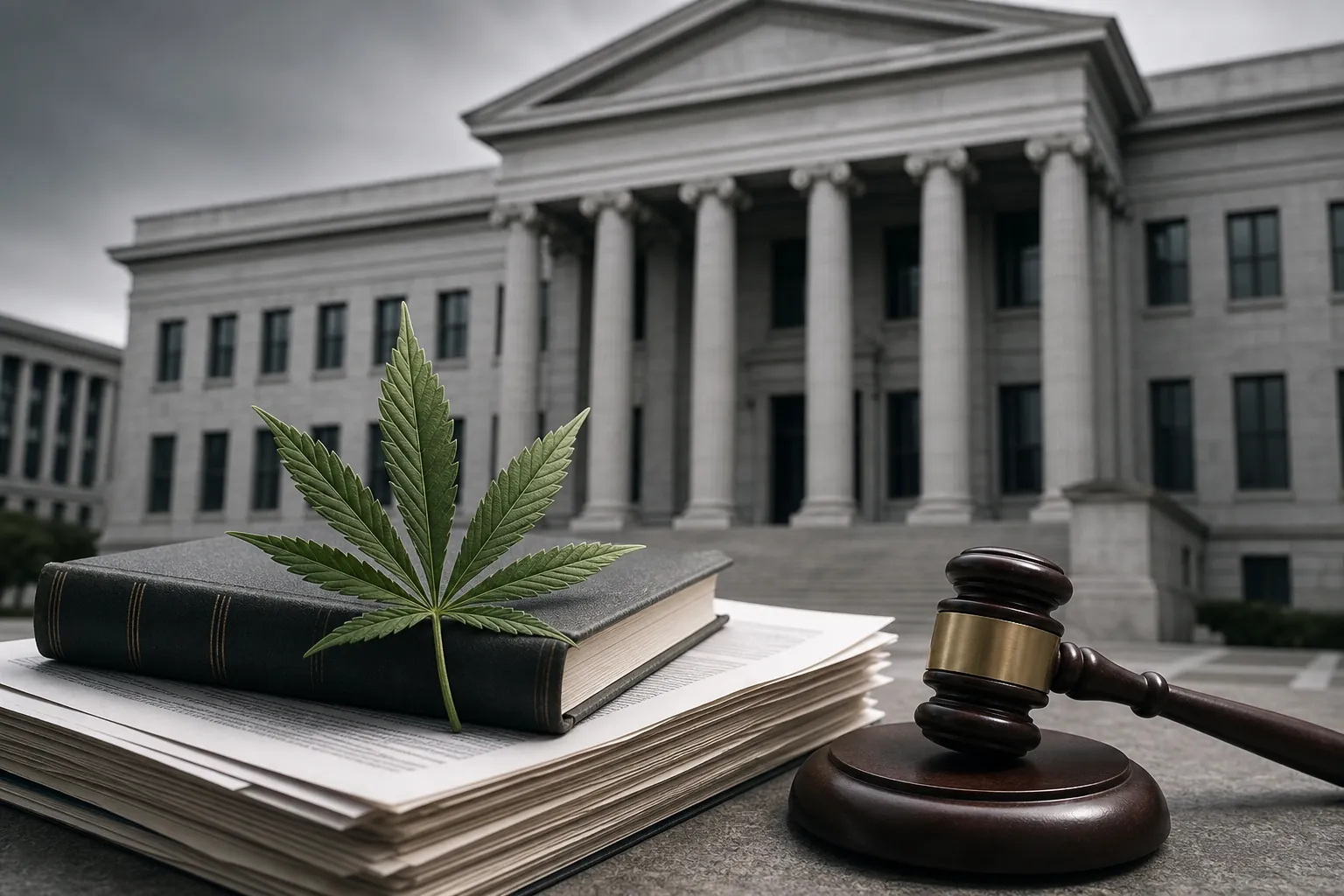
The Hearing Record Starts With Who Was Allowed In
The DEA did not conduct a balanced policy symposium. It admitted seven hearing participants, and all seven opposed rescheduling: the National Drug & Alcohol Screening Association, Smart Approaches to Marijuana, the Tennessee Bureau of Investigation, the States of Nebraska, Idaho, Indiana, and Louisiana, DUID Victim Voices, and two physicians. Pro-rescheduling organizations, including NORML and the National Cannabis Industry Association, were excluded on standing or participation grounds.[3]
That does not automatically invalidate anything. Agencies may limit hearings, define participation rules, and refuse to turn rulemaking into a town hall. The litigation problem is narrower and more serious: if the final order relies on a record developed only by anti-rescheduling participants after pro-rescheduling applicants were excluded under a contested application of “interested person,” the government will have to defend both the selection rule and the resulting evidentiary asymmetry.
The asymmetry is especially awkward because the dispute is not simply that some disappointed applicants wanted a microphone. The reported objection is that the DEA applied the “interested person” definition in 21 CFR 1300.01(b) differently in 2026 than it had in the earlier 2024 hearing process, with pro-rescheduling applicants excluded while opponents were admitted.[3] If that issue was preserved, it gives challengers a procedural claim that does not require proving marijuana should be in Schedule III. It asks whether the agency gave like applicants unlike treatment and then used the resulting record to support a final rule.
For appellate purposes, that is the sort of claim that can survive disappointment with the merits. A reviewing court does not need to decide whether cannabis policy is wise, popular, or overdue. It can ask whether the agency explained why it admitted one set of affected participants and excluded the other, and whether that choice mattered to the evidence the Administrator later credited.
The CAMU Switch Is the Cleaner APA Issue
The strongest merits challenge is not “marijuana belongs in Schedule I.” That argument may be politically familiar, but it is not the cleanest administrative-law ground. The cleaner claim is that HHS and FDA moved from the historically used five-part accepted medical use framework to a two-part CAMU framework without a sufficiently reasoned explanation.
A framework change is not forbidden. Agencies can revise analytic methods. But they must acknowledge the change, explain why the old approach no longer governs, and address serious reliance or consistency problems where the new analysis produces a materially different outcome. If the agency’s final order treats the two-part framework as self-evidently available, opponents will argue that the agency did not just update its science; it changed the legal test that determines whether marijuana has a currently accepted medical use.
That distinction is where a court is most likely to spend time. Review under the APA tends to punish unexplained analytic movement more readily than contested policy judgment. The government can win a fight over how much weight to give medical evidence. It has a harder brief if the record lets challengers say the agency selected a new test because the old one would not support the desired result.
The admitted opponents appear to have understood that. The hearing record, as described in contemporaneous summaries, was built less around generalized anti-cannabis argument than around the claim that the rescheduling proposal rests on an unexplained departure from FDA’s prior five-part accepted medical use analysis.[2][4] That is the point that travels best from an agency hearing room to the D.C. Circuit.
Dr. Chiapperino’s Testimony Gives Opponents a Record Hook
The most consequential reported moment came from Dr. Dominic Chiapperino, an FDA fact witness. According to Vicente LLP’s week-by-week hearing summaries, Dr. Chiapperino testified that marijuana likely would not have satisfied the historical five-part CAMU test used in FDA drug-approval analysis, and the government did not repair that testimony on redirect.[4]
That account should be handled carefully. The official DEA transcript has not yet been published, and the present public understanding depends on contemporaneous observer summaries rather than the corrected transcript the parties and reviewing court will eventually read.[2][4] A precise appellate argument will turn on the actual question, answer, objections, context, and any later agency explanation.
Still, if the summary holds, the concession is not a decorative quote. It supplies an evidentiary bridge between the framework-change argument and the final order. Opponents can say: the government’s own FDA witness acknowledged marijuana likely fails under the older test; the agency used a newer two-part test; and the agency did not adequately explain why that switch was lawful or reasoned. That sequence is more useful than a hundred pages of disagreement over cannabis policy.
The absence of redirect, if confirmed by the transcript, also matters for ordinary record hygiene. Agencies can often neutralize damaging testimony by clarifying scope, correcting ambiguity, or eliciting the witness’s explanation of why an answer does not control the agency’s legal analysis. Leaving the point unrepaired does not concede the case, but it gives petitioners a cleaner sentence to put in a statement of facts.
| Record Issue | Likely Use on Review | What Remains Uncertain |
|---|---|---|
| All admitted hearing participants opposed rescheduling | Procedural fairness and arbitrary participant-selection arguments | How the final order explains the “interested person” rulings |
| Pro-rescheduling groups excluded | Claim that the agency built an evidentiary record after screening out affected supporters | Whether excluded applicants preserved objections in a form sufficient for review |
| Shift from five-part to two-part CAMU analysis | Arbitrary-and-capricious challenge to unexplained methodological change | How HHS/FDA and DEA justify the switch in the final reasoning |
| Dr. Chiapperino’s reported concession | Transcript-based support for the argument that the old test would not have been satisfied | Exact wording and context in the official corrected transcript |
The April 2026 Final Order Is a Separate Lane
The hearing-record challenge should not be collapsed into the separate litigation over the April 2026 Final Order. On April 23, the Department of Justice announced that FDA-approved marijuana products and products containing marijuana would be placed in Schedule III, while the broader marijuana rescheduling issue would proceed through expedited administrative process.[5] That order created immediate partial Schedule III treatment before the broader hearing record reached an Administrator final decision.

Three consolidated petitions in the D.C. Circuit challenge that April order on treaty-authority grounds under 21 U.S.C. § 811(d)(1). Petitioners rely on NORML v. DEA, 559 F.2d 735 (D.C. Cir. 1977), for the proposition that § 811(d)(1) does not give DEA the kind of free-standing authority the April order assumes. A stay motion had been briefed by early July 2026, with no public ruling available as of July 25.[6]
This is not a preview of the same final-order appeal. It targets a different agency action, on a different theory, before the broader rescheduling rule is final. If the petitioners obtain a stay or later prevail, the partial medical-marijuana Schedule III status created by the April order could be narrowed or undone before the main rulemaking finishes. That is live procedural exposure, not a prediction.
The government’s defense of the April order therefore has to carry weight independent of whatever record the ALJ and Administrator develop after the hearing. A later, better-explained rescheduling decision may not cure an earlier order if the court concludes DEA lacked statutory authority for that interim step. Conversely, a government win on the April order would not immunize the final rescheduling rule from APA challenges built out of the hearing record.
The Calendar Leaves Little Room for a Quiet Q4 Finish
The post-hearing schedule supplies the spine. Briefs are due August 17, 2026. The ALJ then issues a recommended decision. Parties have a 20-day window to file exceptions. The Administrator then issues a final order. After that, 21 U.S.C. § 877 gives aggrieved parties 30 days to seek judicial review.[2]
| Step | Procedural Significance |
|---|---|
| Post-hearing briefs due August 17, 2026 | Parties preserve and organize objections for the ALJ and Administrator |
| ALJ recommended decision | Creates a recommended path but does not itself end the agency process |
| 20-day exception window | Parties identify errors before the Administrator acts |
| Administrator final order | Final agency action on the broader rescheduling rule |
| 30-day § 877 review window | Petitions for judicial review can be filed in the court of appeals |
A final agency decision before Q4 2026 is unlikely on that sequence, and a final decision in Q4 would not end the dispute. It would start the next judicial-review window. Petitioners do not need to persuade the Administrator to preserve the issues that matter; they need to make sure the objections are in the record and then ask the court whether the agency’s explanation survives review.
That is why the missing transcript is more than an inconvenience. Until the corrected transcript is posted, counsel can describe the public record only with caveats. Once posted, it will fix the wording of the CAMU testimony, the objections, the government’s responses, and the ALJ’s handling of disputed points. Those details will determine whether the most attractive claims are preserved cleanly or merely suggested by public commentary.
Tax and Market Relief Depend on More Than the Announcement
Schedule III status has obvious business consequences, especially for operators watching Internal Revenue Code § 280E. But the tax piece should not be overstated in this posture. Treasury announced on April 23 that guidance addressing the transition from Schedule I to Schedule III treatment would be forthcoming; that announcement is not itself a binding revenue ruling.[7]
The narrower point is enough. Businesses and tax advisers may have to plan around partial Schedule III relief, forthcoming Treasury guidance, the pending stay motion, the April-order petitions, and the unfinished broader rulemaking at the same time. A compliance position that assumes uninterrupted Schedule III treatment is making a litigation assumption, not just a tax assumption.
The Risk Map After the Hearing
The first route is procedural: excluded pro-rescheduling participants can argue that DEA applied the “interested person” standard unevenly and then produced a one-sided evidentiary record. That claim is strongest if the final order relies on the hearing record without seriously confronting the participation rulings.
The second route is methodological: opponents can argue that HHS/FDA changed the accepted-medical-use framework from five parts to two without adequate explanation. Dr. Chiapperino’s reported testimony matters because it turns that issue from an abstract legal complaint into a concrete record problem, assuming the corrected transcript confirms the public summaries.
The third route is statutory and already pending: the D.C. Circuit petitions challenging the April 2026 Final Order under § 811(d)(1). That lane can affect partial medical-marijuana Schedule III status regardless of how the Administrator later resolves the broader rulemaking.
Those are non-overlapping vulnerabilities. The agency could defeat the treaty-authority challenge and still face a serious APA attack on the final order. It could explain the CAMU switch and still have to defend participant selection. It could proceed to a final rescheduling order in Q4 and still spend the following review window defending the record it chose to make. The legal risk, as of July 25, is not that DEA has delayed. It is that the present record gives challengers several ways to slow, narrow, or undo the result after the Administrator acts.
References
- DEA Hearing on Proposed Marijuana Rescheduling Begins June 29, DEA, June 25, 2026.
- Final Week: DEA Marijuana Rescheduling Hearing Ends; Opposition Builds Appellate Record But Leaves Statutory Gaps, Vicente LLP, July 22, 2026.
- Law and Politics: Why Marijuana Rescheduling’s One-Sided Hearing Matters, Harris Sliwoski Canna Law Blog, 2026.
- DEA Rescheduling Hearing Update: Week 1: Government Rests Its Case and NDASA Opens Opposition Testimony, Vicente LLP, July 3, 2026.
- Justice Department Places FDA-Approved Marijuana Products and Products Containing Marijuana, DOJ, April 23, 2026.
- Clearing the Haze: Federal Marijuana Rescheduling Heads to DEA Hearing as Legal Challenges Loom, Ropes & Gray, June 2026.
- Treasury Releases Statement on Federal Marijuana Rescheduling, U.S. Treasury, April 23, 2026.
Related records
Tool profile
Browse tool evaluations →Governing regulation
Browse the obligations tracker →Preventive workflow
Browse verification workflows →
Report a correction or tip
Spotted an outdated figure, a misstated fact, or a ruling this case record should reflect? Public comments are disabled for this content given the professional cost of a misreported case outcome, penalty amount, or rule text — use the structured correction channel instead.
Report a correction or tip for this record →