
Can a Dealership Sue You for a Negative Review?
Worried a car dealership might sue you over a bad online review? This article explains why honest, opinion-based reviews are strongly protected under the First Amendment, the Consumer Review Fairness Act, and recent FTC and anti-SLAPP laws — and the narrow circumstances where a defamation claim could succeed.
- Jurisdiction
- Ohio
- Ruling date
- Jan 1, 2024
- Source document
- View primary court order ↗
Lex Machina Review is an independent risk-tracking and reference resource. Nothing on this site is legal advice, and using it does not create an attorney-client relationship. Every record is reviewed against primary sources but may not reflect the most current status of a matter — always verify directly against the cited court order, rule text, or a licensed attorney before relying on it.
Companion explanation — secondary to the source document above
Yes, a dealership can sue you for a negative review. Anyone with a filing fee and a lawyer can start a lawsuit. The better question is whether the dealership has a strong claim, and for an honest review about your own buying experience, the answer is usually no.
The law gives buyers real room to say what happened, what they thought was unfair, and why they would not go back. Opinion is protected. Truth is a defense to defamation. And a review that stays tied to your own experience is much harder to attack than a review that announces broad accusations you cannot prove. Consumer-facing legal explainers still give the same basic warning: a negative online review becomes risky when it makes a false statement of fact that can harm the business, not merely because it is harsh or embarrassing.[1]
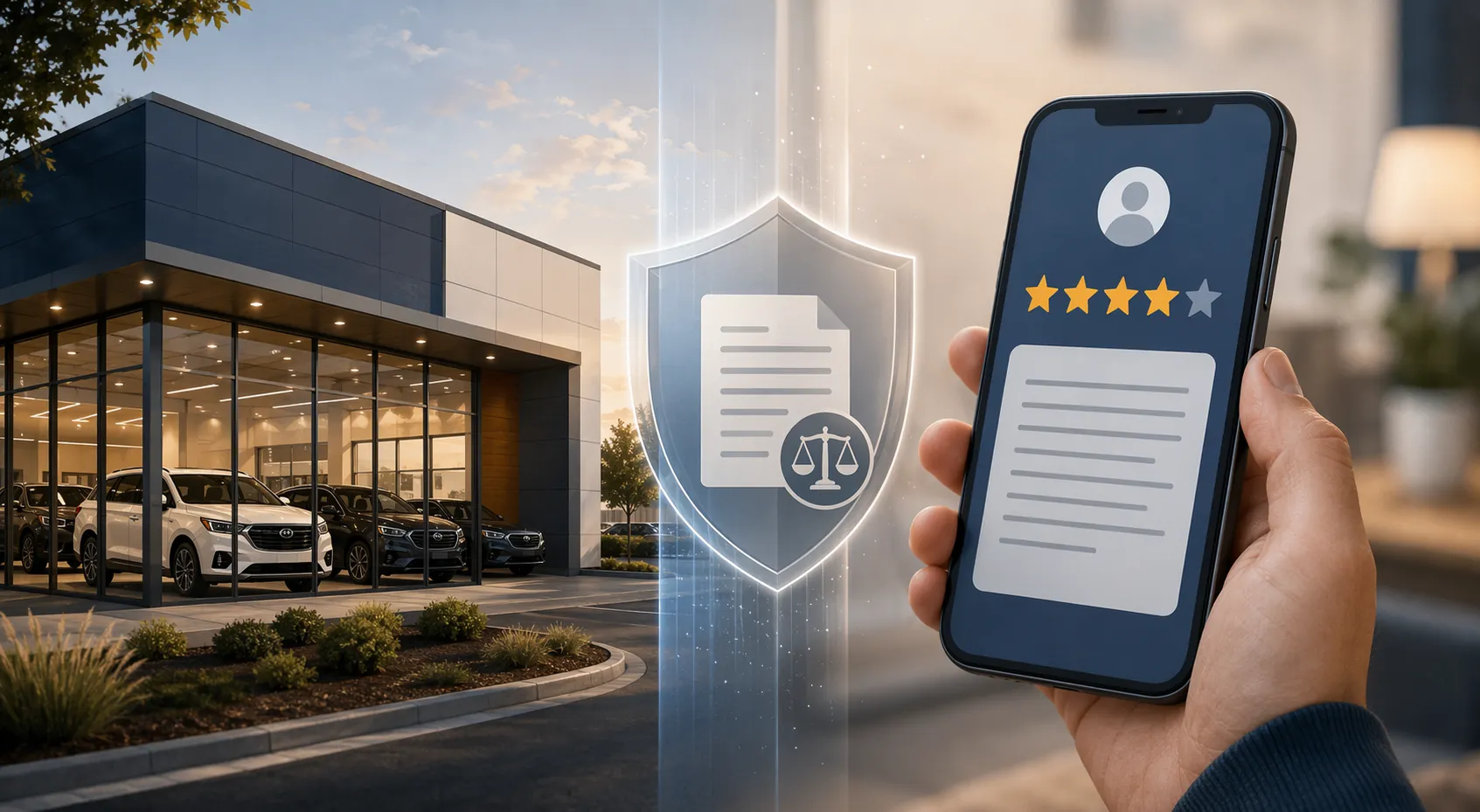
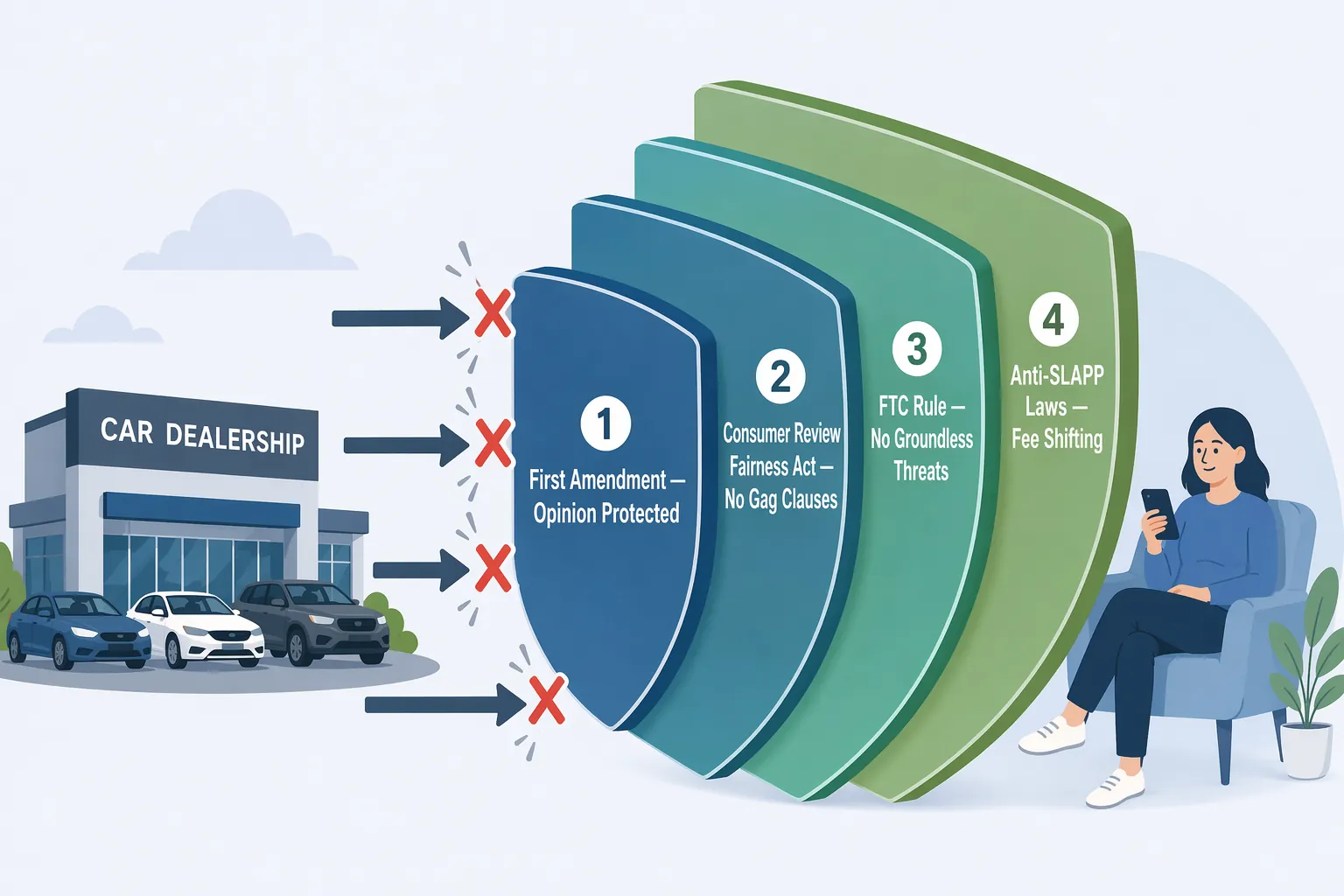
Dealership threats also sit in a different legal environment than they did a decade ago. The Consumer Review Fairness Act makes form-contract clauses that restrict honest consumer reviews generally void and unenforceable.[2] The FTC’s 2024 Consumer Reviews Rule, effective October 21, 2024, bans businesses from using unfounded or groundless legal threats to suppress reviews.[3] Anti-SLAPP laws have been enacted in 40 states, with Michigan, South Dakota, and Missouri added in the 2025-2026 cycle; Missouri’s statute was enacted in July 2026 but is not effective until August 28, 2026.[4]
The review itself matters more than the dealership’s anger
A manager saying “we’ll sue you” does not tell you much. The words in the review do. Courts do not treat every one-star review the same way. They look at whether the challenged sentence is opinion, personal experience, a true factual statement, or a factual allegation that can be proven false.
| Review wording | Typical risk |
|---|---|
| “In my opinion, the sales process was awful.” | Low risk; this is opinion. |
| “I waited three hours after being told the paperwork was ready.” | Depends on proof; this is a factual claim about your experience. |
| “I felt misled about the add-on warranty.” | Usually safer than accusing fraud; it describes your perception. |
| “They committed fraud.” | Higher risk if you cannot prove the legal or factual basis. |
| “They sold me a stolen car.” | High risk if false; this is a specific factual allegation. |
| “Avoid this place. I would never buy from them again.” | Low risk; this is opinion and recommendation. |
That distinction is the whole ballgame. “I felt pressured” is not the same as “they falsified my loan documents.” “The price changed from what I expected” is not the same as “they run a bait-and-switch scheme.” The first set describes the customer’s experience and reaction. The second set accuses the dealership of specific misconduct. If you can prove the accusation, that is one thing. If you are guessing, it is exactly the kind of sentence that should be edited before it becomes the dealership’s exhibit A.
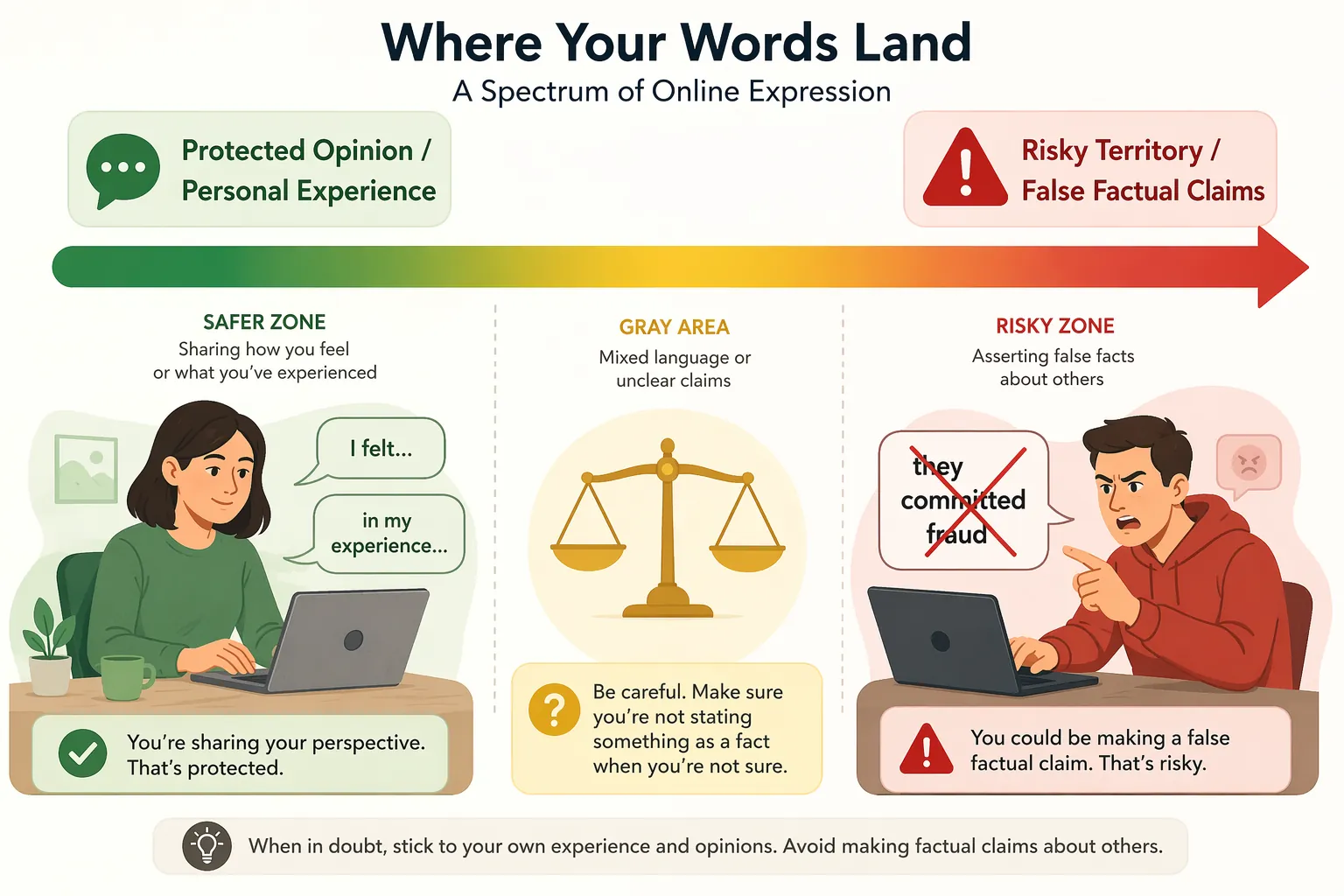
What is usually protected
A dealership generally cannot win a defamation case just because your review cost it business, hurt its feelings, or made the sales manager look bad. Defamation law is not a customer-service shield. The dealership would need to point to a statement of fact, show that it is false, and connect it to reputational harm. Consumer review guidance commonly separates protected opinion from false factual assertions for that reason.[1]
These kinds of statements are usually on safer ground:
- Your opinion: “I thought the finance office was pushy.”
- Your recommendation: “I would not recommend this dealership.”
- Your emotional reaction: “I left feeling misled and frustrated.”
- Your documented experience: “The written quote showed one price, and the contract I was given later showed a higher amount.”
- Your fair conclusion from disclosed facts: “Based on that, I do not trust how they handle pricing.”
Notice the anchor. The review tells the reader what happened to you, then gives your reaction. That is very different from claiming to know the dealership’s internal intent, criminal conduct, or treatment of every customer.
Where a review starts creating legal risk
The risky sentences are usually the ones that sound satisfying in the moment: “scam,” “fraud,” “criminals,” “stolen,” “forged,” “illegal,” “they do this to everyone.” Some of those words may be defensible if they are true and supported. But they are not magic opinion words just because they appear in a review.
A court decision from Ohio in 2024 shows why this matters. In Amaro v. DeMichael, which involved a law firm rather than a car dealership, an appeals court allowed claims to proceed over online reviews that allegedly made specific false factual accusations. The ABA Journal reported that 62 of 99 challenged reviews were treated as potentially actionable because they went beyond mere opinion into statements that could be proven true or false.[5]
That case does not mean dealerships usually win against reviewers. It means courts still read the words. If a review says, “They charged me more than the advertised price,” a court can ask whether that happened. If it says, “They forged my signature,” a court can ask whether the signature was forged. If it says, “This was the worst sales experience I have ever had,” there is much less for a defamation case to grab.
The safest edit is often simple: trade accusation for observation. Instead of “they committed fraud,” write what you saw: “The final paperwork included a fee I did not remember agreeing to, and the dealership would not remove it when I asked.” If you have documents, keep them. If you do not, do not pretend certainty you do not have.
A contract clause usually does not gag your review
Some buyers worry because they signed a stack of dealership paperwork and have no idea what was buried in it. That fear is understandable. Car purchase documents are long, rushed, and often handed over when the buyer is tired. But a dealership generally cannot use a standard-form contract to punish you for leaving an honest review.
The Consumer Review Fairness Act targets form contracts that restrict a consumer’s ability to review a seller’s goods, services, or conduct. The FTC tells businesses that provisions barring or penalizing honest reviews are generally void and that companies should not use them.[2]
That does not give a reviewer permission to lie, reveal someone’s private information, or post something unrelated and malicious. The point is narrower and still important: a dealership cannot turn ordinary sales paperwork into a private censorship tool for truthful consumer criticism.
The FTC rule makes empty legal threats more dangerous for businesses
The FTC’s 2024 Consumer Reviews Rule matters because many review disputes never start with a lawsuit. They start with pressure: a late phone call, a vague letter, a demand to delete the review “or else,” or a manager implying that criticism violates dealership policy. The rule bans businesses from using unfounded or groundless legal threats, physical threats, intimidation, or certain false public accusations to prevent or remove reviews.[3]
For dealerships, this is not an abstract advertising rule. A dealership-specific analysis published after the rule warned dealers that they should not threaten lawsuits merely because they dislike a negative review and identified then-current civil penalties of up to $51,744 per violation under the rule.[6]
That does not mean every demand letter is illegal. A dealership can still complain about a review it believes contains false factual claims. It can ask for correction. It can preserve its rights. The line the rule puts pressure on is the bluff: threatening legal consequences without a real basis to scare a customer into silence.
Anti-SLAPP laws can shift the cost back
The ugliest part of a weak defamation suit is not always the final judgment. It is the cost of getting there. A reviewer may have to hire a lawyer, respond to filings, miss work, and live with the stress of being sued. That is why anti-SLAPP laws matter.
SLAPP stands for “strategic lawsuit against public participation.” In plain terms, it is a lawsuit that uses litigation pressure to punish or chill speech on a matter of public concern. Many anti-SLAPP statutes let a defendant ask the court to dismiss the case early and, in some states, recover attorney’s fees if the case should not have been brought.
As of the Institute for Free Speech’s July 14, 2026 update, 40 states have enacted anti-SLAPP laws. The count includes new laws in Michigan, South Dakota, and Missouri during 2025-2026, with the Missouri timing caveat that enactment came in July 2026 and effectiveness begins August 28, 2026.[4]
That state-by-state detail matters. Anti-SLAPP protection is not identical everywhere. Some statutes are strong and allow fee-shifting. Some are narrower. Some federal courts apply them differently. If a dealership actually files suit, the first serious question is not “Can they be mad?” It is “What anti-SLAPP protection applies where this was filed?”
The old dealership lawsuit stories need context
There are real examples of businesses suing over reviews, including auto-related disputes. In 2015, Zeibak Auto Trading in California sued a customer over a Yelp review, and the reported case was dismissed.[7] That is useful as a reminder that dealerships have tried this. It is not enough, by itself, to describe the legal pressure points in 2026.
Since then, the Consumer Review Fairness Act, the FTC’s 2024 rule, and wider anti-SLAPP adoption have changed the risk calculation for businesses that try to bully ordinary reviewers. A dealership thinking about suing over an honest review now has to worry not only about losing, but also about fee-shifting, regulatory scrutiny, and looking worse for having tried.
The chilling effect is still real. Reported disputes such as Footprints Floors are often cited because they show how a review fight can impose legal bills and stress even when the reviewer is not cleanly “defeated.” The commonly repeated dollar figures from that dispute should be checked against primary court filings before being treated as litigation accounting, but the practical lesson does not depend on the exact numbers: a weak lawsuit can still be expensive to endure.
Google and Yelp are usually not the real issue
People sometimes hear about Section 230 and think it protects them personally. It does not. Section 230 generally protects platforms from being treated as the publisher of user posts, which is why a dealership usually has a harder time suing Google or Yelp for hosting a review. The reviewer who wrote the words remains responsible for those words.
So if your plan is “I posted anonymously, so I’m safe,” slow down. Anonymous reviewers can be targeted through John Doe lawsuits and subpoenas seeking identifying information from a platform or internet service provider. Whether the dealership gets that information depends on court procedures and the strength of the showing it must make, but anonymity should not be treated as armor.
How to look at your own review before a fight starts
If you are about to post, or if the dealership has already threatened you, read the review sentence by sentence. Do not ask whether the whole review is “negative.” Negative is allowed. Ask what each sentence claims.
- Keep: opinions, ratings, recommendations, and descriptions of how you felt.
- Keep if documented: dates, prices, promises, fees, delays, names, and written statements you can support.
- Revise: legal labels such as fraud, scam, forgery, theft, or criminal conduct unless you can prove the underlying facts.
- Avoid: claims about what the dealership does to “everyone” unless you have reliable support beyond your own transaction.
- Save: contracts, texts, emails, ads, screenshots, repair records, financing documents, and the original review.
A strong review does not need courtroom language. It needs accuracy. “Here is what happened to me, here is what I was told, here is what the paperwork showed, and here is why I would not return” is harder to attack than a paragraph full of accusations.
If the dealership threatens you
Do not panic-delete everything just because someone at the dealership sounds official. Also do not fire back with a longer, angrier accusation. Preserve the threat, the review, and the documents behind the review. If the dealership claims a particular sentence is false, look at that sentence carefully. If it is wrong, correct it. If it is an opinion or a documented fact, the threat may be more bluster than law.
A vague cease-and-desist letter is different from a subpoena or a filed complaint. A subpoena seeking your identity, a court summons, or a complaint with a case number deserves prompt attention. Anti-SLAPP deadlines and response deadlines can be short, and missing them can create problems that had nothing to do with whether your review was truthful.
For most buyers, the practical answer is this: an honest, opinion-based negative dealership review is strongly protected, and many dealership threats over such reviews are legally weak. The narrow danger zone is a review that states damaging facts you cannot prove. Stay with what happened, keep your receipts, and take actual court papers seriously.
References
- Can I Get Sued for a Negative Online Review? - Super Lawyers, updated June 2026 - link
- Consumer Review Fairness Act: What Businesses Need to Know - Federal Trade Commission - link
- Federal Trade Commission Announces Final Rule Banning Fake Reviews and Testimonials - Federal Trade Commission, August 2024 - link
- Updates to the 2025 Anti-SLAPP Report Card - Institute for Free Speech, July 14, 2026 - link
- Law firm can sue over alleged fake online reviews that toppled its top rating, appeals court says - ABA Journal, August 2024 - link
- Complying with the FTC’s New Rule on Customer Reviews: What Dealerships Need to Know - Bernstein Shur, October 2024 - link
- California auto trading company sues man for bad Yelp review - 6abc, 2015 - link
Related records
Tool profile
Browse tool evaluations →Governing regulation
Browse the obligations tracker →Preventive workflow
Browse verification workflows →
Report a correction or tip
Spotted an outdated figure, a misstated fact, or a ruling this case record should reflect? Public comments are disabled for this content given the professional cost of a misreported case outcome, penalty amount, or rule text — use the structured correction channel instead.
Report a correction or tip for this record →