
DEI Keyword Searches and the Federal Grants Lawsuit
The ACLS v. McDonald ruling held that DOGE's use of ChatGPT to classify over 1,400 NEH grants as DEI—without defining the term to the AI or independently reviewing its outputs—violated the First and Fifth Amendments. This article explains the constitutional claims, the triggering facts, and what the precedent means for litigators challenging algorithmic government decisions.
- Jurisdiction
- United States - Southern District of New York
- Court
- United States District Court for the Southern District of New York
- AI tool named
- ChatGPT
- Ruling date
- May 7, 2026
- Source document
- View primary court order ↗
- Last verified
- Jul 25, 2026
Lex Machina Review is an independent risk-tracking and reference resource. Nothing on this site is legal advice, and using it does not create an attorney-client relationship. Every record is reviewed against primary sources but may not reflect the most current status of a matter — always verify directly against the cited court order, rule text, or a licensed attorney before relying on it.
Companion explanation — secondary to the source document above
The useful starting point in the federal grants lawsuit over DEI keyword searches is not the phrase “DEI.” It is the handoff. DOGE staffers took grant descriptions, fed them into ChatGPT one at a time, recorded the model’s yes-or-no answers in a spreadsheet, and used that spreadsheet in a process that cancelled more than 1,400 National Endowment for the Humanities grants worth over $100 million, according to discovery materials released by the plaintiffs.[1]
That sequence mattered because it gave the Southern District of New York a record, not just a suspicion. By the time ACLS v. McDonald reached summary judgment on May 7, 2026, the plaintiffs had discovery, depositions, Signal messages, and the actual spreadsheet used in the review. The court was not asked to decide whether artificial intelligence is generally too risky for public administration. It was asked what happens when an agency uses a general-purpose chatbot to classify grants for termination, gives the model no operative definition of the decisive category, and then treats the output as a government decision.
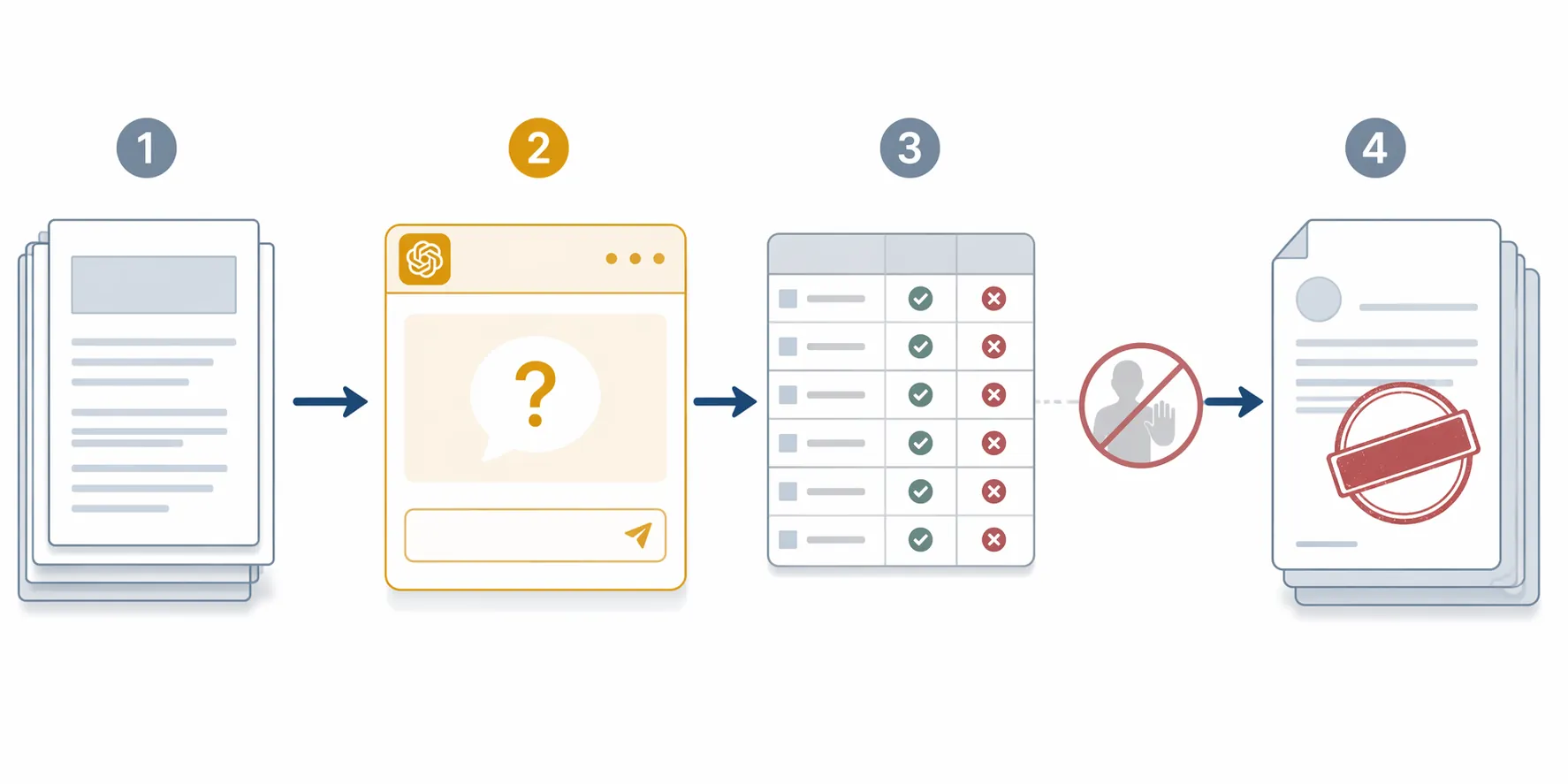
The Classification Pipeline Was the Constitutional Event
The record described a short pipeline with large consequences. Grant descriptions went into ChatGPT. The question presented to the model asked whether the grant was DEI-related. The response went into a spreadsheet. The spreadsheet then became the operative screen for termination. The plaintiffs’ discovery summary says DOGE did not independently review the AI responses before the grants were cancelled.[1]
The missing step was not cosmetic. If an agency defines “DEI” in advance, assigns trained reviewers, preserves reviewer notes, and makes a final decision on stated statutory or programmatic grounds, the later lawsuit has to challenge those grounds. Here, the court had a different problem in front of it: a category that carried constitutional risk was not defined for the model before the model was asked to sort grants into it. Once the government adopted those classifications, the injury was traceable to the screen itself.
That is why it is too imprecise to call the case a “keyword search” case and stop there. The record included keyword-like reasoning, but the challenged act was not merely a human searching a database for a term. Nor was it simply ChatGPT producing stray text in an experiment. The legal act was the government’s adoption of model outputs as a cancellation mechanism. For litigators, that distinction decides where to look: the prompt, the category definition, the spreadsheet, the identity of the human approver, and the documents showing whether anyone checked the machine’s answer before money stopped flowing.
| Record Point | Why It Mattered |
|---|---|
| Grant descriptions were submitted to ChatGPT one at a time | The model was used as a classification tool, not merely as a research aid |
| The decisive category was DEI-relatedness | The category implicated viewpoint and protected-characteristic concerns |
| The plaintiffs said no operative DEI definition was supplied to the model | The screen lacked a stable rule that reviewers or recipients could test |
| Yes-or-no responses were entered into a spreadsheet | The record connected model output to termination decisions |
| The plaintiffs said there was no independent human review | The agency could not easily recharacterize the spreadsheet as harmless internal triage |
The Mismatches Made the Screen Legible
The examples in the record did work that abstractions cannot. Terminated projects reportedly included Holocaust survivor narratives, Chinese-American veterans’ histories, African-American newspaper digitization, Native American language preservation, and Appalachian photograph collections. The same discovery summary said parallel grants concerning veterans generally were not flagged in the same way.[1]
Those examples do not prove, by themselves, that every terminated grant was unlawfully classified. Their force is more specific. They show why the screen could plausibly be operating through protected characteristics or viewpoints rather than through a neutral programmatic criterion. A grant about veterans can be treated as ordinary public history, while a grant about Chinese-American veterans becomes suspect. A newspaper digitization project can become a DEI project because the newspaper was African-American. A language-preservation project can become disfavored because the language belongs to a Native American community.
The National Ornamental Metal Museum example sharpened the point because it did not look like a conventional civil-rights program at all. The discovery materials said a grant for the “preservation, promotion, and advancement of fine metalwork” was classified as DEI because it sought to promote “understanding and inclusivity.”[1] At that point, the screen was not just identifying projects about protected groups. It was treating a broad vocabulary of inclusion as evidence of disqualifying viewpoint.
In litigation terms, these were not colorful anecdotes. They were the bridge between the spreadsheet and the constitutional claims. The plaintiffs needed to show that the government’s process did more than make arbitrary funding choices. They needed to show that the sorting principle burdened protected expression and used protected characteristics as criteria. The grant examples made that theory concrete enough for summary judgment.
Why the Court Saw Viewpoint Discrimination
The First Amendment claim did not depend on a free-floating right to receive a humanities grant. The problem was the basis on which the government withdrew funding. A government funder may set program priorities, but it cannot use funding decisions to penalize a disfavored viewpoint in a way the Constitution forbids. In ACLS, the court treated the DEI screen as a viewpoint-based criterion because the grants were selected for cancellation based on expressive content associated with diversity, equity, inclusion, identity, and related perspectives.
That conclusion was not softened by the fact that ChatGPT sat in the middle. A model can generate the classification, but the government owns the decision when it adopts the classification as the basis for official action. The agency did not escape First Amendment scrutiny by inserting a chatbot between the grant description and the termination notice.
Nor did the undefined nature of “DEI” help the government. Undefined criteria can sometimes make a record murky; here, the court had enough evidence to see how the term functioned. If “DEI” captures a Holocaust survivor narrative, African-American newspaper preservation, Native American language work, and a metalwork grant that uses the words “understanding and inclusivity,” the term is doing more than marking a budget category. It is sorting expression by subject matter and viewpoint.
Epstein Becker Green’s analysis of the decision reports that the court found “beyond any dispute” that the government used protected characteristics as criteria for identifying grants for termination.[2] That finding is the hinge. Sloppy administration might support an Administrative Procedure Act theory. Bad contracting hygiene might support a procurement critique. But using protected-characteristic-linked and viewpoint-linked criteria to terminate public grants is a constitutional injury.
The Fifth Amendment Claim Was Not an Afterthought
The Fifth Amendment equal protection theory addressed a related but distinct defect. The court’s analysis, as reported in secondary coverage, turned on the use of protected characteristics including race, national origin, religion, sex, and sexual orientation as criteria for identifying grants.[2] That matters because a facially technical workflow can still classify by protected characteristics if the chosen labels and examples direct it to do so.
This is where AI governance language often becomes too vague to be useful. “Human in the loop” would not answer the constitutional question unless the record showed what the human did. A reviewer who rubber-stamps a spreadsheet is not the same as a decisionmaker who applies a defined legal standard, checks false positives, documents reasons, and takes responsibility for the final agency action. The ACLS record, as described in the discovery materials, gave the court a path to treat the model-assisted screen as the government’s classification mechanism rather than as a preliminary convenience.[1]
The absence of a definition also mattered differently under equal protection. If the government cannot identify the category it instructed the model to apply, it becomes harder to show that the process was narrowly tied to a lawful objective and easier to infer that protected-characteristic markers were doing the work. A spreadsheet may look neutral because each cell says yes or no. The constitutional question is what the yes or no means.
ACLS and Thakur Are Useful Together, but They Are Not the Same Case
The Ninth Circuit’s May 26, 2026 opinion in Thakur v. Trump gives ACLS a neighboring appellate reference point, especially on the First Amendment treatment of DEI, DEIA, and environmental-justice expression.[3] But the cases should not be collapsed. ACLS is a May 7, 2026 summary judgment ruling from the Southern District of New York on a record centered on the ChatGPT spreadsheet and the NEH termination process. Thakur is ongoing, with the Ninth Circuit having addressed preliminary and jurisdictional issues rather than entering final judgment on every claim.
The most important comparison is remedial and jurisdictional. Thakur drew a practical line between cancellations explained in DEI-related terms and cancellations explained generically. Reporting on the ruling described a two-track result: the government could continue generic research-grant cancellations, while DEI-based cancellations were barred on First Amendment grounds.[4] The Ninth Circuit also treated certain APA claims as barred by the Tucker Act, routing some grant-dispute theories toward the Court of Federal Claims rather than allowing them to proceed in district court.[3]
That forum point is not a technical footnote. If a plaintiff pleads only that the government breached a grant agreement or failed to pay money owed, Tucker Act problems may dominate. If the record shows that the government cancelled grants because of disfavored viewpoint expression or protected-characteristic criteria, the plaintiff has a different constitutional theory. ACLS is valuable because it shows how an algorithmic classification record can supply that bridge.
The comparison also counsels restraint. Thakur’s stipulations are litigation admissions, not final adjudicated findings on every factual issue. ACLS may be appealed. And neither case creates a general rule that every grant termination involving the word “DEI” is unlawful. The stronger lesson is narrower and more usable: when the government’s own record ties cancellation to an undefined DEI screen, protected-characteristic markers, and disfavored viewpoints, constitutional claims become much harder to dismiss as ordinary funding disputes.
What Future Plaintiffs Need in the Record
The case is a reminder that algorithmic-government challenges are won or lost on administrative plumbing. A complaint that says “AI was used” will usually be too thin. The stronger pleading identifies the decisional category, the source of the inputs, the prompt or search terms, the output format, the human review step, and the document that connects the output to the government act.
- Ask who defined the category before the tool was used, and whether that definition appears in the record.
- Identify whether the tool produced recommendations, classifications, scores, or final decision lists.
- Separate keyword searches from model classifications; the constitutional theory may depend on that distinction.
- Trace the output to the injury: termination notice, payment stoppage, suspension, or other official action.
- Look for mismatches showing that protected characteristics or viewpoints, rather than lawful program criteria, explain the result.
- Preserve forum arguments early, especially where the government will characterize the dispute as contractual or monetary.
Discovery should be aimed at the points where the government may try to blur responsibility. If the agency says the spreadsheet was only advisory, ask who had authority to disagree with it and how often anyone did. If the agency says humans reviewed the outputs, ask for reviewer instructions, notes, sampling procedures, false-positive checks, and the final approval chain. If the agency says the AI merely helped identify grants, ask what non-AI criteria independently justified each termination.
The ACLS record shows why those requests matter. The plaintiffs were not limited to arguing from public rhetoric. They had the spreadsheet. They had communications. They had examples of grants swept in and grants left out. That evidentiary posture let the court see the classification process as a government decision system with constitutional consequences.
What Government Defendants and Counsel Should Take From It
The defensive lesson is not that agencies can never use AI to review grants. Tools that make administrative records searchable, cluster similar applications, or surface documents for human review can be useful. The danger begins when a tool’s classification becomes the operative legal trigger and the agency cannot show a defined criterion, a responsible decisionmaker, and a review process capable of catching constitutionally significant errors.
A lawful process would need more than a procurement memo saying the tool is efficient. It would need a category defined in legal and programmatic terms before screening begins. It would need documentation showing why each grant fits that category. It would need a way to test whether protected characteristics are serving as proxies for disfavored viewpoints. And it would need a human decisionmaker whose role is more than transcribing or approving the machine’s answer.
That kind of record may be tedious, but constitutional administration is often tedious. The absence of tedium was part of the problem in ACLS. A fast spreadsheet can become excellent evidence against the government when it shows that the agency converted an undefined model output into a dispositive funding action.
The Precedent Is Powerful Because It Is Record-Bound
ACLS v. McDonald should not be overstated into a universal anti-AI rule or a final appellate settlement of DEI funding litigation. It is a district-court summary judgment ruling, decided on May 7, 2026, and it may be appealed. Its force comes from the specificity of the record: an undefined DEI classification task, ChatGPT yes-or-no responses, a spreadsheet, no independent human review as described by the plaintiffs, and grant examples showing that protected characteristics and viewpoints were doing legally significant work.[1][2]
That is enough to make the decision important. The ruling translates an AI-screening failure into constitutional terms without needing to decide whether generative AI is inherently unreliable. The constitutional defect was the government’s use of the tool to make categorical funding decisions based on undefined criteria tied to viewpoint and protected characteristics. Future challengers will still have to build the record. ACLS shows what that record can prove.
References
- Discovery Released in Lawsuit by Humanities Groups Reveals ChatGPT-Powered Process by DOGE in Cancelling Grants for Schools, Libraries, and Community Organizations, PRNewswire, March 7, 2026
- Defunding DEI Hits a Legal Wall: Courts Shield Federal Funding Recipients from Biased Artificial Intelligence (AI) Overreach, Epstein Becker Green Workforce Bulletin
- Thakur v. Trump, United States Court of Appeals for the Ninth Circuit, May 26, 2026
- Court permits Trump to continue generic research grant cancellations, bans DEI-based cancellations, The Daily Californian
Related records
Tool profile
How to Read Legal AI Benchmarks Ahead of the OpenAI IPOGoverning regulation
Browse the obligations tracker →Preventive workflow
Browse verification workflows →
Report a correction or tip
Spotted an outdated figure, a misstated fact, or a ruling this case record should reflect? Public comments are disabled for this content given the professional cost of a misreported case outcome, penalty amount, or rule text — use the structured correction channel instead.
Report a correction or tip for this record →