
Delta Close Call: FAA Probe Highlights Five Liability Layers
An analysis of the July 27, 2026 Delta Atlanta close call identifies five distinct liability layers—FAA penalties, FTCA claims, Montreal Convention, product liability, and organizational exposure—with direct parallels to the legal risks of AI-generated outputs.
- Jurisdiction
- US Federal
- Court
- Federal Aviation Administration
- AI tool named
- TCAS (Traffic Alert and Collision Avoidance System)
- Ruling date
- Jul 27, 2026
- Source document
- View primary court order ↗
- Last verified
- Jul 30, 2026
Lex Machina Review is an independent risk-tracking and reference resource. Nothing on this site is legal advice, and using it does not create an attorney-client relationship. Every record is reviewed against primary sources but may not reflect the most current status of a matter — always verify directly against the cited court order, rule text, or a licensed attorney before relying on it.
Companion explanation — secondary to the source document above
The legally interesting moment in the Delta jet close call at Atlanta was not the exclamation on the air-traffic-control recording, although “my goodness” will understandably travel farther online. It was the pilot’s radio call: “responding RA.” At that point, the cockpit was no longer merely receiving advice from an automated system. The crew was responding to a TCAS Resolution Advisory in a regulated workflow where the automated command can override a conflicting human instruction.
That is why the July 27, 2026 event matters beyond aviation. The current FAA investigation into the Delta close call at Atlanta has not produced a probable-cause finding, an enforcement action, or any adjudicated fault as of July 30, 2026. The liability analysis below is therefore prospective: it maps possible exposure channels if facts later support them; it does not assign fault to Delta, air traffic control, any pilot, or any equipment manufacturer.
| Verification point | Current record |
|---|---|
| Incident date | July 27, 2026 |
| Flights involved | Delta Flight 1568, Boston to Atlanta, and Delta Flight 2472, Atlanta to Cincinnati |
| Aircraft and passenger figure best supported in the available reporting | Flight 1568 was reported as a Boeing 737-900ER with about 150 customers and 6 crew, based on Delta-cited reporting; other passenger counts appeared in contemporaneous reports |
| FAA status | FAA investigation announced July 28–29, 2026; no public probable-cause determination or enforcement action identified as of July 30, 2026 |
| Nature of this article | Legal-risk mapping, not legal advice and not a finding of liability |
The best-supported public sequence is compact. Delta Flight 1568 was arriving at Hartsfield-Jackson Atlanta International Airport and initiated a go-around from Runway 27. Delta Flight 2472 had been cleared for departure on intersecting Runway 26R. The aircraft entered a loss-of-separation event, a TCAS Resolution Advisory issued, and the Flight 1568 crew climbed in response while ATC audio captured the controller’s alarmed reaction. Delta-cited reporting placed Flight 1568 at about 150 customers and 6 crew, a useful figure for exposure modeling even though public passenger counts varied across early reports.[1]
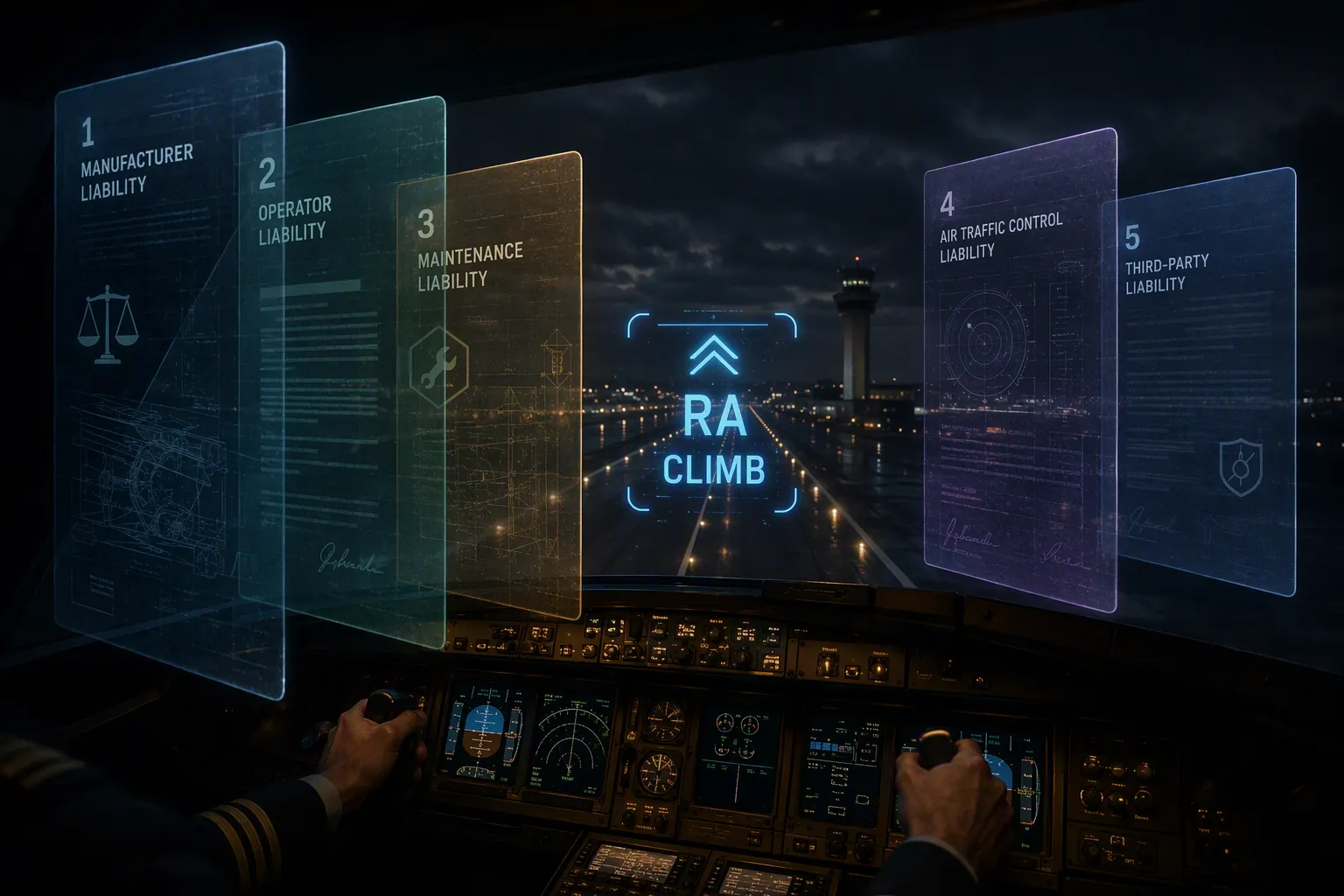
The command conflict is the hinge. Under 14 CFR § 91.123 and the TCAS operating rules reflected in the research materials, a pilot responding to a TCAS Resolution Advisory may deviate from an ATC clearance or instruction, and the operational expectation is immediate compliance with the RA rather than continued obedience to an inconsistent ATC instruction.[2] That makes the close call a clean risk-allocation problem: when the professional does what the automated safety system directs, exposure does not disappear. It relocates into several channels at once.
The first channel: FAA operator penalties
The first possible liability channel is administrative, not tort-based. The FAA can pursue civil penalties for violations of aviation statutes and regulations. The research materials identify FAA civil penalty authority under 49 USC § 46301 at up to $1,200,000 per entity per violation in the relevant category of enforcement exposure.[3] That figure should not be read as a forecast for this incident. It is the outer frame for operator-facing regulatory risk if the agency later concludes that a certificate holder, operator, or regulated party violated applicable requirements.
This layer matters because it separates operator compliance from pilot obedience. If the crew properly followed the RA, that fact may be central to the individual conduct analysis. It does not by itself answer whether runway-use procedures, dispatch practices, training, cockpit communication, or other operator-controlled systems complied with FAA requirements. A regulated operator can face scrutiny even when the person at the controls did the safest legally available thing in the final seconds.
The second channel: government exposure for operational ATC error
A separate channel runs through air traffic control and, potentially, the Federal Tort Claims Act. Aviation-law analysis by Kreindler distinguishes between judgment-based ATC decisions that may be shielded by the discretionary-function exception and operational failures, including failures to maintain required separation minima, that may fall outside that shield.[4] The distinction is not cosmetic. It determines whether a claimant is challenging protected policy or discretion, or alleging that controllers failed to carry out an operational duty already defined by rule, procedure, or standard practice.
The Delta Atlanta close call has not yet been placed on either side of that line by any public adjudication. The point is narrower: conflicting instructions during a TCAS RA do not automatically make the cockpit the only legally relevant site. If the chain of events began with intersecting-runway clearance, sequencing, or separation management, the government-system layer remains analytically distinct from the airline-operator layer.
The third channel: passenger claims under the Montreal Convention
Passenger recovery, if any, would require its own threshold showing. Under the Montreal Convention framework described in the research materials, an international-carriage passenger claim depends on whether an “accident” caused a compensable injury, with the familiar strict-liability tier identified at about 113,100 SDR, roughly $150,000, before carrier defenses become relevant.[5] That structure should not be converted into a conclusion that every frightened passenger has a viable claim.
Psychological-harm claims are especially easy to overstate after a near miss. The available materials note legal discussion of emotional-distress recovery, including the possibility of psychological harm without physical injury in some contexts, but the Montreal Convention inquiry remains conditional. The claimant still needs an accident, an injury recognized by the governing law, causation, and a route within the convention’s scope. A close call can be terrifying and still leave a difficult damages case.
The fourth channel: product liability if the automated command was defective
The TCAS layer is the one most likely to be misunderstood. A pilot’s compliance with an RA does not prove that the RA was correct, and an automated command’s safety function does not immunize its designer. The research file identifies a Spanish Supreme Court TCAS product-liability precedent, referenced through SESAR/ALIAS Project materials and KU Leuven research, in which a manufacturer was described as liable for a defective Resolution Advisory.[6]
That precedent should be handled cautiously. The current research rests on secondary academic references rather than a directly reviewed Spanish Supreme Court opinion, and the opinion’s date, damages, and factual details would need direct verification before publication as a fully developed case note. Even in that narrower form, the example is useful because it rejects the simplest defense: the human complied, so the machine cannot be in the liability chain. Product exposure begins precisely where a compliant operator can show that the authoritative command itself was defective.
The fifth channel: organizational exposure as an amplifier
Delta’s broader 2026 legal docket should not be used as character evidence for this incident. A fuel-dump settlement reported at $78.75 million, TechOps wrongful-death litigation, an EEOC enforcement action, and a greenwashing class action do not explain what happened on Runways 27 and 26R.[7] They do, however, affect how an insurer, regulator, plaintiff lawyer, or board committee may perceive the organization’s risk environment.
Organizational exposure is rarely a standalone cause. It is an amplifier. Prior litigation can affect reserve decisions, renewal questions, document-preservation posture, internal-audit scope, and the appetite for early resolution. It may also change how aggressively counterparties look for patterns in training, reporting, safety-management systems, or escalation practices. None of that proves fault in the Delta close call. It explains why a single operational event does not arrive at the legal department as a single operational event.
What changes when the automated command is a legal-AI output?
The aviation analogy has limits. A hallucinated citation is not a runway conflict. A defective brief is not a near collision. No court should import aviation safety law wholesale into professional-responsibility doctrine. But the architecture of exposure is recognizable: operator, institutional safety net, strict professional duty, product maker, and organizational risk environment.
The FAA’s AI safety-assurance work is useful here only as a modest bridge. The research materials identify an FAA warning against personifying AI because doing so can create ambiguity over responsibility assignment.[8] That concern travels well. Once an organization says “the AI did it,” the next question should be which human or entity had the duty to select, configure, verify, supervise, insure, and correct the system.
Law firm as operator
In the legal-AI version, the law firm occupies the operator position. The lawyer or firm chooses the tool, defines the matter context, submits queries or documents, incorporates outputs, and signs or files the final work product. If the output contains fabricated authority, omitted controlling law, or an unsupported factual assertion, the first professional-duty question is not whether the model behaved badly. It is whether the lawyer verified the material before using it.
That is where competence and candor obligations do work similar to aviation operating rules. Model Rule 1.1 frames the duty to understand the technology well enough to use it competently; Model Rule 3.3 makes candor to the tribunal non-delegable in practice. For a fuller treatment of those duties in the 2026 enforcement environment, see From Ethics Opinions to Enforcement: The Professional Responsibility of AI Compliance for Attorneys in 2026.
The aviation lesson is not that lawyers must distrust every automated output. It is that regulated professionals do not escape accountability by pointing to the system they chose to use. The professional may be entitled, or even required in some settings, to rely on a tool for a defined function. The professional still has to know when independent verification is mandatory and what record will prove it happened.
Court and adversarial process as the safety net
The legal system’s institutional layer is not identical to ATC, but it performs a related safety-net function. Judges, clerks, opposing counsel, citation-checking practices, local rules, and sanctions procedures can catch false legal outputs before they do irreversible damage. When they fail, the loss is not always private. Court time is consumed, adversaries incur costs, and public confidence in filings declines.
This is why AI hallucination sanctions cases matter less as anecdotes and more as system-stress tests. They show how a false output can pass from a tool, to a lawyer, to a filed document, to a court order requiring explanation. The professional-duty foundation for those cases is discussed in AI Hallucinations and Attorney Ethics: Which Professional Responsibility Rules Are Triggered and How Sanctions Have Escalated.
AI developer as possible product-defect actor
The product-liability layer is the hardest to state cleanly because legal-AI tools vary. A general-purpose chatbot, a research platform with retrieval-augmented generation, a contract-analysis tool, and an embedded drafting assistant do not present the same claims, warnings, user controls, audit logs, or foreseeable-use profile. Some outputs fail because the lawyer used the tool outside its stated limits. Others may fail because the system’s design made a foreseeable error difficult for an ordinary professional user to detect.
A product-defect theory becomes more plausible when the alleged error can be traced to a design choice: missing source boundaries, defective retrieval logic, misleading confidence signals, inadequate warnings, poor jurisdictional filters, or an interface that makes generated authority appear verified when it is not. That does not make the vendor automatically liable. It means the vendor remains in the exposure map when the tool’s design contributes to the professional’s error.
Firm compliance history as the amplifier
The organizational layer is where insurers usually stop treating AI use as an isolated mistake. A firm with written AI-use rules, matter-level approvals, vendor diligence, verification logs, training records, and escalation protocols presents one risk profile. A firm that adopted tools informally and cannot reconstruct who used what, on which matter, under which restriction, presents another.
That is the practical reason to build compliance around workflows rather than policy language alone. The relevant record after an AI error is not a press release about responsible innovation. It is the file showing tool approval, user training, source verification, partner review, client-confidentiality controls, and remediation. The workflow approach is developed in The Double-Compliance Burden: Building an AI Compliance Framework for Law Firms.
The allocation lesson
The Delta Atlanta close call is useful because it resists a one-defendant story. FAA enforcement authority, FTCA doctrine, passenger-claim rules, product-liability concepts, and organizational-risk analysis can all be relevant without collapsing into a single blame theory. The RA did not erase human responsibility. It changed the command structure at the most pressured moment and forced the legal system to ask which duties existed before that moment arrived.
Legal AI should be analyzed with the same discipline. Hallucinated citations and defective legal outputs are not aviation accidents, but the liability architecture is familiar. A firm cannot reduce it to “the lawyer is always responsible” without ignoring tool design, vendor representations, and institutional safeguards. A vendor cannot reduce it to “the user is always responsible” without confronting foreseeable professional reliance. The actual map is layered, and the party best positioned to prevent or absorb each failure may change from layer to layer.
References
- FAA investigating after Delta jets come too close at Atlanta airport, WTOC / Atlanta News First, July 29, 2026
- 14 CFR § 91.123 — Compliance with ATC clearances and instructions, Electronic Code of Federal Regulations
- Legal Enforcement Actions, Federal Aviation Administration
- Aviation Collisions: Legal Duties and Responsibilities of Air Traffic Control and Pilots, Kreindler & Kreindler
- Can I Sue an Airline for Emotional Distress?, LawInfo
- ALIAS Project materials on TCAS Resolution Advisory liability, SESAR Joint Undertaking
- Delta Air Lines Faces Wave of Legal Headwinds in 2026, Airways Magazine
- AI Safety Assurance Roadmap, Federal Aviation Administration, August 2024
Related records
Tool profile
Browse tool evaluations →Governing regulation
Browse the obligations tracker →Preventive workflow
Browse verification workflows →
Report a correction or tip
Spotted an outdated figure, a misstated fact, or a ruling this case record should reflect? Public comments are disabled for this content given the professional cost of a misreported case outcome, penalty amount, or rule text — use the structured correction channel instead.
Report a correction or tip for this record →