
Three product liability theories from the Discovery camera recall
This article analyzes the product-liability theories available after Jaguar Land Rover's July 2026 recall of 15,535 Discovery SUVs for a rearview camera defect, and explains how the NHTSA's FMVSS 111 non-compliance finding strengthens each theory.
- Jurisdiction
- US
- Court
- NHTSA
- AI tool named
- Land Rover Discovery rearview camera
- Ruling date
- Jul 1, 2026
- Source document
- View primary court order ↗
- Last verified
- Jul 27, 2026
Lex Machina Review is an independent risk-tracking and reference resource. Nothing on this site is legal advice, and using it does not create an attorney-client relationship. Every record is reviewed against primary sources but may not reflect the most current status of a matter — always verify directly against the cited court order, rule text, or a licensed attorney before relying on it.
Companion explanation — secondary to the source document above
The recall record starts with a physical defect, not a consumer grievance
The legal-liability question around the Land Rover Discovery rearview camera recall begins with NHTSA recall ID 26V458: Jaguar Land Rover’s July 2026 recall of 15,535 Discovery SUVs after water could enter the rearview camera assembly, damage the camera, and leave the display blank or unclear when the vehicle is backing up. The recall record also states that the condition does not comply with Federal Motor Vehicle Safety Standard No. 111, the rear-visibility standard. Just as important, the Part 573 materials identify an estimated defect rate of 100% for the affected population. That is the fact to circle before the vehicle count, because it points toward a common condition rather than a scattering of owner complaints. [1]
The useful boundaries should be stated before the theories start doing too much work. No camera-specific class action has been identified from the available materials. The recall record reports no crashes, injuries, or fires tied to the condition. And the affected model should be checked against the recall documents: the record addressed here is the Discovery, not the Discovery Sport, a distinction that matters more in pleadings than it may appear to matter in headlines. [1]
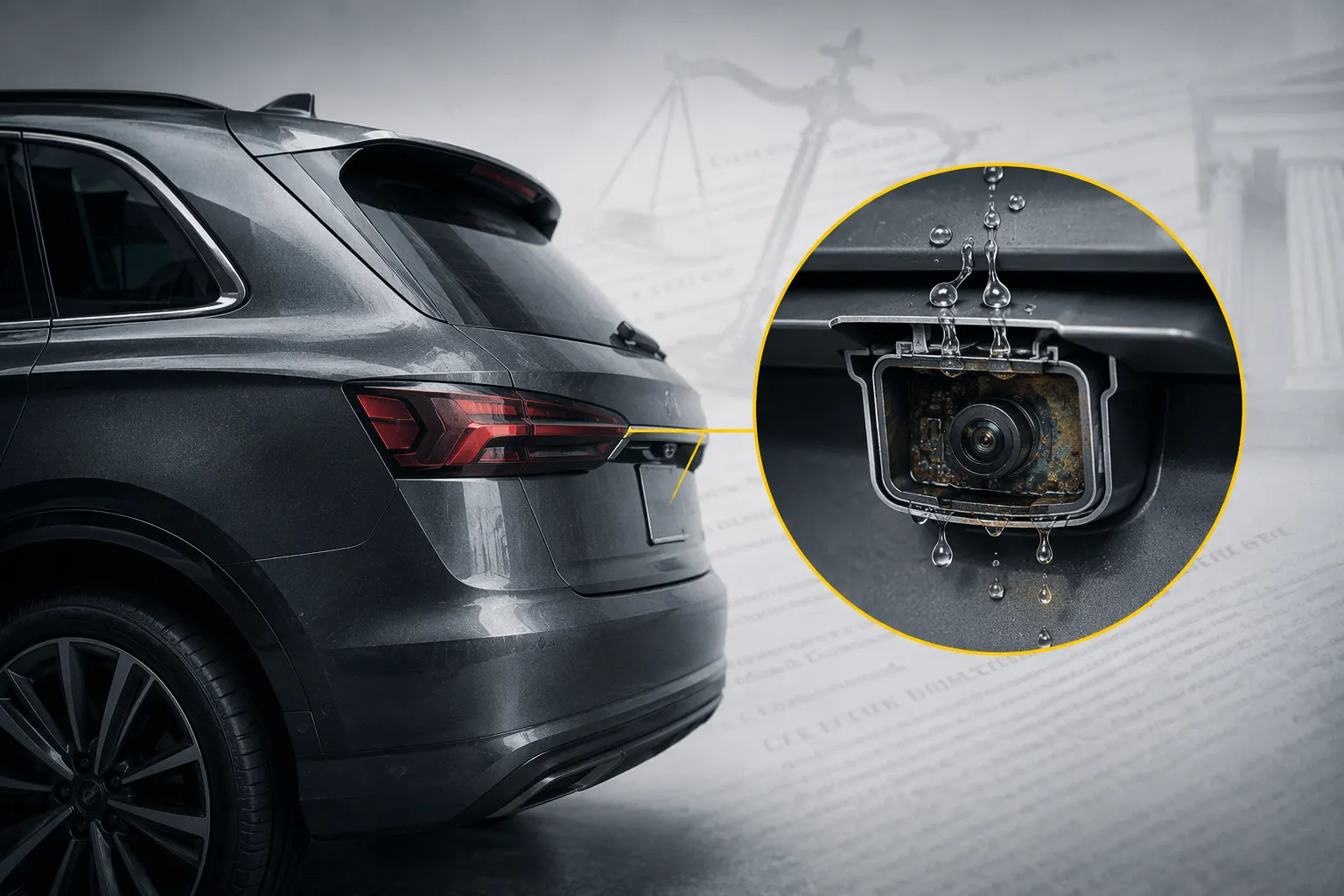
The mechanical pathway is unusually clean for a modern vehicle-defect file: insufficient drainage, water intrusion, camera damage, then a blank or degraded rear image. The reported remedy reinforces that pathway. Land Rover’s fix, as described in coverage of the recall, involves drilling additional drain holes to allow water to escape from the rear camera area. [2]
A recall is not an automatic damages award, and it is not a confession on every element of a product-liability claim. It is also not just a customer-service event when the manufacturer identifies a condition that violates an express federal safety standard. The right way to use this recall is to separate the same facts into the theories they can actually support: design defect, manufacturing defect, and failure to warn.
Design defect has the strongest fit
The design-defect theory is the natural first claim because the recall materials describe a shared drainage problem across the affected vehicles. A plaintiff does not have to begin with a mystery malfunction or ask the court to infer a hidden electrical gremlin from scattered failures. The alleged condition is built around the camera’s physical environment: water gets where it should not, and the camera loses the ability to provide a reliable rear image.
The 100% estimated defect rate matters here. In a manufacturing-defect case, a lawyer looks for units that departed from the intended design. In this recall, the available record instead suggests that the affected vehicles share the same vulnerable configuration. That does not prove defect under every state’s risk-utility or consumer-expectation test, but it gives plaintiffs a coherent design story from the first page: the affected Discovery camera assembly allegedly lacked adequate drainage to prevent water-related failure. [1]
The remedy makes that story easier to visualize. If the field fix is to drill drain holes, plaintiffs will argue that the absence or insufficiency of those holes was not incidental. It was part of the architecture owners received. A manufacturer can answer that a recall remedy is not the same thing as proof that the original design was legally defective, but the remedial measure still helps explain the alleged mechanism in a way a judge, juror, or claims administrator can understand. [2]
FMVSS 111 sharpens the design claim. The standard is not a generic quality benchmark; it concerns rear visibility. A camera condition that can produce no image or an unclear image sits directly inside the safety function the standard is meant to protect. Depending on the jurisdiction and claim pleaded, that non-compliance finding may support negligence per se, a statutory presumption, or strong evidence of defect. It should not be written as automatic civil liability, because states handle the effect of regulatory violations differently and plaintiffs still have to prove injury, causation, and recoverable loss.
That distinction will matter if the case is pleaded before any crash record exists. The absence of reported crashes does not erase the safety-standard violation. FMVSS 111 compliance is not measured only after someone is hit while backing up. But the absence of crashes may narrow the damages conversation, especially if owners received the recall repair and cannot show out-of-pocket loss, diminished value, loss of use, or another compensable injury. [1]
Manufacturing defect is available, but it is not the lead theory on these facts
A manufacturing-defect claim would ask a different question: did particular vehicles depart from the manufacturer’s intended design or specifications? The current recall record is not a natural fit for that theory. A 100% estimated defect rate usually points away from random production variance and toward a condition common to the affected design. [1]
That does not make manufacturing defect impossible. Discovery in a lawsuit could reveal that certain assemblies were installed incorrectly, certain batches had blocked or malformed drainage paths, or certain supplier components failed to meet specifications. Those would be manufacturing facts. They are not established by the recall materials summarized here.
Plaintiffs sometimes plead design and manufacturing theories together at the outset, especially before they have engineering records. That may be permissible under ordinary pleading rules, but the theories should not be treated as interchangeable. If the defect exists in every affected vehicle because the drainage design was inadequate, manufacturing variance becomes a weaker explanation. If the defect exists only in some vehicles because something went wrong during production or assembly, the 100% recall estimate becomes harder to reconcile with that theory.
The pre-2026 production resolution also cuts in different directions. For plaintiffs, it may suggest that the company identified and corrected a design or production condition before the recall population was fully addressed. For the defense, it helps limit the affected universe and may support an argument that later vehicles did not share the same condition. Either way, it is a boundary fact; it should not be blurred into a claim about all Land Rover rear cameras or all Discovery-family vehicles. [1]
Failure to warn turns on the warranty-claim timeline
The warning theory is less visually tidy than the design theory, but the chronology gives it force. The available recall chronology states that JLR received the first warranty claims involving 2021 model year Discoveries as early as August 2021, opened a formal Product Safety and Compliance Committee investigation on February 20, 2026, and had accumulated 100 claims and field reports through March 2026. [1]
That timeline raises the real question in a failure-to-warn case: when did the manufacturer know enough to say something more clearly to owners, dealers, or regulators? A single warranty claim in August 2021 would not, by itself, establish that JLR knew a safety defect existed. A growing body of claims about rear camera water damage is different, particularly when the eventual recall identifies a federal rear-visibility non-compliance.
Plaintiffs would likely frame the delay as a missed-warning period. If the camera could blank or produce an unclear image while reversing, an owner might have changed behavior, sought service earlier, or pressed a dealer for inspection if the risk had been disclosed sooner. Dealer communications may matter as much as owner notices. Service departments are often the first place where a pattern becomes visible, and a warning theory can turn on whether dealers were told enough to identify water intrusion as a safety-related camera condition rather than an isolated warranty annoyance.
The defense has room to work. Warranty claims are not always safety-defect knowledge. They can be intermittent, poorly described, duplicated, or tied to conditions that have not yet been linked to a uniform cause. The formal investigation date in February 2026 gives JLR an argument that the company escalated the issue once the pattern had matured. The warning fight would turn on the content of the earlier claims, internal engineering assessments, field reports, dealer bulletins, and any decision points before the formal investigation opened.
There is a corporate-knowledge comparison available, but it should be kept in its lane. Sumrell v. Jaguar Land Rover, filed July 9, 2026, alleges that JLR concealed DC/DC converter defects in certain hybrid Land Rover and Range Rover SUVs. That case is not about the Discovery rearview camera and does not prove camera-specific concealment. At most, it may be cited as a separate dispute over JLR’s defect-disclosure practices if a court allows that kind of comparison. [3]
FMVSS 111 is the accelerant, not a separate fourth tort
The FMVSS 111 non-compliance finding should run through the product-liability theories rather than sit beside them as a freestanding claim. In a design-defect count, it helps plaintiffs argue that the product failed a safety requirement tied to the exact function at issue. In a manufacturing-defect count, it may help show that a non-conforming camera system was not merely inconvenient. In a failure-to-warn count, it makes the timing question more serious once enough field information existed to connect water intrusion with rear-visibility failure.
The jurisdictional label matters. Some states treat violation of a safety statute or regulation as negligence per se. Others treat it as evidence of negligence or defect. Some product-liability statutes create presumptions from regulatory compliance or non-compliance but allow those presumptions to be rebutted. A complaint that simply says “FMVSS violation, therefore liability” skips steps that judges do not usually skip.
The better pleading use is narrower and stronger: the recall identifies a condition that can deprive the driver of a federally required rear-visibility function; the condition is tied to a physical drainage flaw; and the affected population is estimated at 100%. Those facts can support defect and breach theories before a plaintiff has a crash file. They do not eliminate the need to prove standing, damages, causation, reliance where required, and the availability of classwide proof.
The defenses are not cosmetic
The strongest defense fact is the current injury record. The recall materials report no crashes, injuries, or fires associated with the condition. That does not defeat a safety-standard theory, but it complicates damages. A plaintiff who paid for a repair before the recall, lost use of the vehicle, overpaid for a vehicle with an undisclosed defect, or still has an unrepaired camera problem is in a different position from an owner who received a free recall fix and experienced no malfunction. [1]
The simplicity of the remedy is another defense point. Drilling drain holes is not a multi-system redesign, a buyback program, or an admission that the entire vehicle is unsafe. JLR can argue that the recall cure is targeted, practical, and adequate. Plaintiffs will answer that a simple fix can make the original omission look more avoidable, not less. Both arguments are plausible; which one carries weight depends on the cost, timing, durability, and effectiveness of the remedy. [2]
Class certification would present its own problems. A uniform defect rate helps commonality, but damages may vary by owner. Some owners may have experienced a blank camera; some may have had only the recall notice; some may have paid for pre-recall service; some may have bought used vehicles after the relevant information was public; and some may have received the repair without loss. A clean defect theory does not automatically produce a clean damages model.
The model-name issue is a smaller but real defense trap. If a demand letter, complaint, or expert report slides between Discovery and Discovery Sport, the error invites the manufacturer to attack the plaintiff’s command of the record. The recall population should be pleaded from the Part 573 materials, not from shorthand descriptions in secondary coverage. [1]
Ford’s rear-camera penalty is enforcement context, not a liability template
NHTSA’s 2024 Ford consent order belongs late in the analysis because it shows regulatory seriousness around rearview camera recalls without making Ford and JLR interchangeable. NHTSA announced a $165 million civil penalty against Ford, described as the second-largest civil penalty in the agency’s history, over delayed rearview camera recalls and related compliance issues. [4]
The comparison has limits. Reporting on the Ford matter described a much larger vehicle population, more than 620,000 vehicles, and an enforcement record involving delayed recalls and alleged reporting failures. Those facts differ materially from the Discovery camera recall record available here. Ford may be useful to show that NHTSA treats rear-camera recall timing as an enforcement priority; it should not be used as if it proves JLR delayed, concealed, or misreported this particular camera defect. [5]
The litigation exposure is real, but it is not unlimited
The Discovery recall gives plaintiffs a strong starting record for design defect: a physical drainage condition, an estimated 100% defect rate in the affected population, a remedy that appears to address drainage directly, and an express FMVSS 111 non-compliance finding. Those facts are enough to make the case more than a routine “my camera failed” complaint.
Manufacturing defect is the least natural of the three theories unless later evidence identifies deviations in specific vehicles, batches, or supplier components. Failure to warn is more substantial because the warranty-claim chronology creates a serious knowledge-and-timing question, especially if internal documents show that JLR understood the water-intrusion mechanism well before the formal 2026 investigation.
The recall does not solve damages, class certification, warning causation, or the effect of a completed repair. It does give plaintiffs a regulatory and mechanical foundation that manufacturers usually prefer not to see in the same file. The exposure sits there: strong enough to plead carefully, fact-dependent enough to defend seriously.
References
- July 2026 Land Rover Recall for Rear Camera Water Damage That Can Blank the Display, Affecting 15,535 Vehicles — BizzyCar
- Water Keeps Wrecking Discovery's Camera, So Land Rover Is Reaching For A Drill — Carscoops
- Class Action Lawsuit Claims Certain Hybrid Land Rover, Range Rover SUVs Equipped with Defective Converters — ClassAction.org
- NHTSA Issues $165 Million Civil Penalty, Second Largest in Agency's History — Ford Consent Order — NHTSA
- Ford Motor hit with $165 million U.S. penalty over delayed rearview camera recalls — CNBC
Related records
Tool profile
Browse tool evaluations →Governing regulation
Browse the obligations tracker →Preventive workflow
Browse verification workflows →
Report a correction or tip
Spotted an outdated figure, a misstated fact, or a ruling this case record should reflect? Public comments are disabled for this content given the professional cost of a misreported case outcome, penalty amount, or rule text — use the structured correction channel instead.
Report a correction or tip for this record →