
How Acting AG Todd Blanche Reshaped DOJ Reliability
Under Todd Blanche's leadership, the DOJ has lost over 16,000 employees, fired hundreds of prosecutors, and drawn judicial rebukes—creating concrete institutional reliability risks that federal litigators must factor into case strategy.
- Jurisdiction
- us-federal
- Court
- United States Department of Justice
- AI tool named
- None
- Ruling date
- Jul 15, 2026
- Source document
- View primary court order ↗
- Last verified
- Jul 29, 2026
Lex Machina Review is an independent risk-tracking and reference resource. Nothing on this site is legal advice, and using it does not create an attorney-client relationship. Every record is reviewed against primary sources but may not reflect the most current status of a matter — always verify directly against the cited court order, rule text, or a licensed attorney before relying on it.
Companion explanation — secondary to the source document above
The useful question is not whether Todd Blanche’s move from Trump criminal defense lawyer to acting attorney general is politically remarkable. For federal litigators in Q3 2026, the question is whether the Department of Justice can still be treated as the same background constant it used to be: staffed deeply enough, supervised predictably enough, and careful enough in court that opposing counsel can price reliance in the ordinary way.
That is now a risk question, not a mood. Blanche became deputy attorney general in March 2025 and has served as acting attorney general since April 2026, while his nomination for attorney general remains pending.[1] During that period, advocacy and bar-association materials report more than 16,000 DOJ employee departures, including roughly 4,000 attorneys; Blanche also reportedly told CPAC in March 2026 that the department had fired “more than 200 prosecutors and agents” who worked on Trump-related cases and that “there is not a single man or woman at DOJ who had anything to do with those prosecutions.”[2][3]
This is a Risk Digest companion analysis, not legal advice and not a nomination brief. The numbers need source discipline. The employee-loss figures appear in a Justice Connection fact sheet and in a New York City Bar Association opposition letter that attributes them to publicly reported DOJ data; they should be checked against primary personnel records before anyone treats them as audited counts.[2][3] But even with that caveat, the combination of attorney departures, targeted removals, weakened oversight claims, and court credibility problems is enough to change how litigators should manage reliance.
| Signal | What is reported | Source status | Reliability weight for litigators |
|---|---|---|---|
| Workforce loss | More than 16,000 DOJ employees departed, including roughly 4,000 attorneys | Advocacy fact sheet and NYC Bar letter citing publicly reported DOJ data | High enough to affect risk analysis, but still worth primary-source verification |
| Targeted firings | Blanche said more than 200 prosecutors and agents tied to Trump-related cases were fired | Reported quotation in opposition materials | Operationally significant because removals appear tied to case history, not only headcount |
| Professional-responsibility oversight | OPR described as dismantled; director position described as vacant for over a year | Advocacy-source claim requiring DOJ-record cross-check | Important, but should be treated as a verification item |
| Court credibility | Judges have called out DOJ for false, incomplete, or misleading representations | Public reporting and litigation trackers | Strong litigation signal where tied to actual orders, transcripts, or docket entries |
| Grand jury credibility | Grand juries reportedly refused indictments because of credibility concerns | NYC Bar letter claim | Serious if confirmed, but weaker than court orders unless case records can be identified |
What Attorney Loss Does To Litigation Work
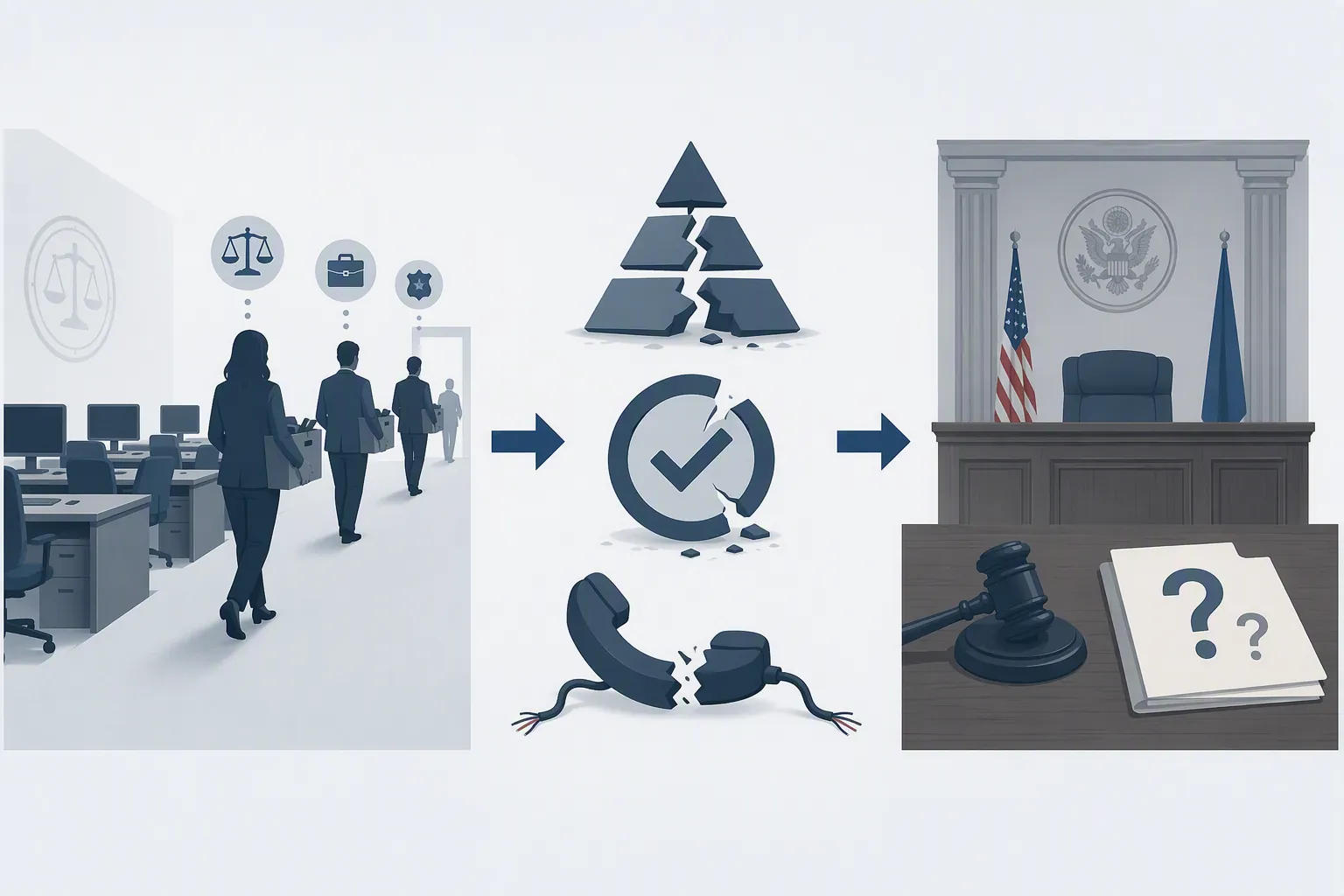
The first-order effect of losing attorneys is obvious: fewer lawyers remain to draft, review, appear, negotiate, and certify. The second-order effect is the one that matters in federal practice. Legal reliability depends on memory and review paths as much as it depends on headcount. A representation in court often carries invisible labor behind it: a line attorney checks the case file, a supervisor remembers an earlier position, an appellate lawyer flags a possible inconsistency, a discovery coordinator confirms whether the production universe is complete, and someone with institutional authority decides whether the government can live with the sentence being spoken to the judge.
When roughly 4,000 attorneys are reported gone, the risk is not simply that briefs get shorter or hearings get continued.[2][3] The risk is that review becomes thinner in exactly the places where mistakes are hardest to see from outside the department. A prosecutor new to a matter may know the live motion but not the prior concession. A civil attorney may know the agency client’s current instruction but not the record representation made by another DOJ component months earlier. A supervisor covering more matters may approve a filing for legal sufficiency without detecting that the factual premise no longer matches the discovery record.
Those are not dramatic failures. They are ordinary workflow failures that become litigation events: a deadline slips, a privilege log arrives with gaps, a Rule 16 issue becomes avoidable motion practice, a settlement term has to be re-cleared, or a court learns that the government’s earlier statement was incomplete. Opposing counsel then absorbs work the institution used to perform internally. They re-check docket history, compare agency letters against pleadings, insist on written confirmations, and spend client money testing statements that previously would have been treated as low-friction representations from the United States.
The targeted-firing claim changes the analysis because it is not merely a capacity signal. If more than 200 prosecutors and agents were removed because they worked on Trump-related cases, and if Blanche accurately described the department as having no remaining personnel connected to those prosecutions, then the department did not just lose labor. It lost matter history, witness history, credibility history, and internal dissent history in a concentrated category of cases.[2][3] That matters even outside Trump-adjacent litigation because it tells practitioners how leadership is willing to value institutional memory when political salience is high.
This does not mean every DOJ lawyer appearing in 2026 is unreliable. That would be both unfair and analytically lazy. Career attorneys and assistant U.S. attorneys often do the hardest repair work after leadership decisions have already created the mess. The practical point is narrower: outside counsel should stop assuming that a DOJ representation has passed through the same internal filters it would have passed through three years earlier.
The Courtroom Signals Are More Important Than The Confirmation Theater
Blanche’s prior role as Trump’s criminal defense lawyer explains why senators and commentators focus on loyalty. At his July 2026 confirmation hearing, senators questioned his relationship to Trump and his independence from the president.[4] That context is relevant, but only up to a point. Federal litigators do not need another character study to decide whether to preserve an objection. They need to know whether courts are already discounting DOJ statements.
On that question, judicial rebukes carry more weight than rhetoric from either side. The New York City Bar letter states that federal judges have increasingly faulted DOJ lawyers for false, incomplete, or misleading statements in court, and points to a broader pattern of credibility concerns.[3] Public reporting and oversight materials have also identified DOJ credibility concerns during this period.[5] For risk purposes, a judge’s finding matters because it changes the expected cost of reliance. Once a court has had to correct the government on a material representation, opposing counsel can justify more verification, more written preservation, and less informal reliance in adjacent matters.
The strongest form of this signal is a docketed order, transcript, or written opinion identifying the defect. The weaker form is a secondary account that groups incidents together without enough case-level detail. Both are worth reading, but they should not be given the same evidentiary value. In a risk memo, a judicial order belongs in the findings column. A bar-association characterization belongs in the leads-to-verify column unless it identifies the underlying case record.
The reported grand jury issue sits in that second category. The NYC Bar letter says grand juries have refused to return indictments because of credibility concerns.[3] If documented through case-specific records, that would be a serious sign that DOJ credibility problems are reaching citizens asked to authorize criminal charges. As presented in the available materials, however, the claim is harder to verify than a published judicial rebuke. It should sharpen diligence, not become a free-floating assertion in a brief.
Why OPR Matters Even When No One Mentions It In Court
Professional-responsibility infrastructure is easy to overlook until it is gone. The Office of Professional Responsibility is not a courtroom advocate; it is part of the internal machinery that makes courtroom advocacy safer. The Justice Connection fact sheet says OPR has been dismantled and that the director position has been vacant for over a year.[2] That claim needs confirmation against DOJ organizational records or congressional testimony before being used as a settled institutional fact. But as a risk indicator, it belongs on the same dashboard as attorney departures and judicial rebukes.
The reason is practical. Internal responsibility offices create delay and discomfort inside an agency, and that is precisely their value. They make someone pause before a close representation is made. They give line lawyers a place to elevate concerns. They make it harder for a politically preferred litigation position to move straight from leadership pressure to filed paper without friction. If that channel is weakened, vacant, or perceived as unavailable, the first fully independent review may occur only after an opposing party has moved for sanctions or a judge has demanded an explanation.
That is where institutional degradation becomes expensive for everyone else. Court clerks spend time sorting emergency corrections. Judges have to ask whether the United States has accurately described its own conduct. Defense counsel and civil litigators must decide whether to rely on a government assurance or build a record showing that they asked twice. Clients then receive advice that sounds more cautious, not because counsel has become theatrical, but because the review environment has changed.
What Changes In Case Strategy
The immediate change is not to accuse every DOJ filing of bad faith. That is rarely useful and often counterproductive. The better adjustment is to treat DOJ assertions as risk-weighted. A statement from a career attorney with case history, tied to a document, confirmed in writing, and consistent with prior docket positions carries one risk level. A statement from a newly assigned lawyer about another component’s conduct, delivered orally under time pressure, with no document citation, carries another.
- Ask for material representations in writing when they affect deadlines, discovery scope, privilege, settlement authority, charging posture, or remedial commitments.
- Preserve objections without assuming a later correction will fully cure reliance costs.
- Compare new DOJ positions against prior pleadings, agency letters, hearing transcripts, and related-case representations.
- Document reliance explicitly, including who made the representation, when it was made, and what action the client took because of it.
- Reassess settlement leverage where DOJ staffing, authority, or internal review appears unstable.
Discovery is the easiest place to see the consequences. If the government says a search is complete, counsel should ask what repositories were searched, which custodians were included, whether component-level systems were excluded, and who confirmed the answer. If the government says a production problem is isolated, counsel should test whether the same process generated other productions. If the government asks for an extension because a supervisor is unavailable or a component is still reviewing, the extension may be reasonable, but the delay also supplies information about internal capacity.
Settlement analysis also changes. DOJ authority has never been monolithic; components, agencies, Main Justice, and U.S. attorney’s offices already create layers. But personnel loss and politically salient removals make it harder to know whether a settlement position reflects durable institutional judgment or a temporary clearance path. A client deciding whether to accept a federal settlement offer needs to know whether the government’s representative can deliver the promised approval, whether a leadership change could reopen the position, and whether comparable matters are being handled consistently.
Criminal matters require a still more careful separation between capacity risk and merits. A staffing problem does not make an indictment defective. A political-removal pattern does not prove selective prosecution in a particular case. But those conditions can support more targeted inquiry into charging consistency, Brady/Giglio processes, agent continuity, supervisory approval, and whether representations about investigative history are coming from someone with actual knowledge.
How Much Can Be Concluded Now
The evidence is not all of the same quality. The reported personnel losses are central because they are numerical, repeated across available materials, and attributed to public reporting, though still not primary-source verified in the materials provided.[2][3] Blanche’s CPAC statement is central because it describes removals in leadership’s own terms, if accurately quoted.[2][3] Judicial rebukes are central where they are tied to case records. OPR dismantlement and grand jury refusal claims are important but should be treated as verification targets before they carry the same weight.
The narrower conclusion is still consequential. Federal litigators should no longer treat DOJ institutional reliability as a background constant. That does not mean assuming bad faith. It means pricing thinner staffing, lost institutional memory, politically affected personnel decisions, uncertain professional-responsibility channels, and documented court credibility concerns into ordinary litigation judgment.
In practice, that means verifying representations more aggressively, preserving objections earlier, documenting reliance with more care, reassessing settlement leverage, and distinguishing DOJ source assertions by their support rather than by the seal on the caption. The department may still be right in a given case. The mistake is assuming the institution has already done all the checking that federal practice used to expect.
References
- Todd Blanche, Wikipedia
- Fact Sheet: Todd Blanche’s Devastating Leadership at DOJ, Justice Connection
- Oppose Todd Blanche Attorney General Nomination, New York City Bar Association, July 13, 2026
- Todd Blanche’s loyalty to Trump questioned in Senate confirmation hearing, Al Jazeera, July 15, 2026
- Blanche AG Confirmation Would Undermine DOJ Independence, Project On Government Oversight
Related records
Tool profile
Browse tool evaluations →Governing regulation
Browse the obligations tracker →Preventive workflow
Browse verification workflows →
Report a correction or tip
Spotted an outdated figure, a misstated fact, or a ruling this case record should reflect? Public comments are disabled for this content given the professional cost of a misreported case outcome, penalty amount, or rule text — use the structured correction channel instead.
Report a correction or tip for this record →