
What American Airlines' 2026 Penalties Mean for Delay Compensation
Recent DOT consent orders and FAA penalties against American Airlines reveal a pattern of increasing enforcement aggressiveness on delay-related violations. Legal advisors tracking airline compliance need to understand the specific penalty amounts, the Frontier consent order's mitigation playbook, and the continuing ambiguity of renumbered-flight refund enforcement.
- Jurisdiction
- US federal
- Court
- U.S. Department of Transportation
- AI tool named
- None
- Ruling date
- Dec 1, 2025
- Source document
- View primary court order ↗
- Last verified
- Jul 30, 2026
Lex Machina Review is an independent risk-tracking and reference resource. Nothing on this site is legal advice, and using it does not create an attorney-client relationship. Every record is reviewed against primary sources but may not reflect the most current status of a matter — always verify directly against the cited court order, rule text, or a licensed attorney before relying on it.
Companion explanation — secondary to the source document above
The useful answer to “american airlines flight delay compensation legal rights 2026” is narrower than the search phrase suggests. Recent enforcement materials do not mean every delayed American Airlines passenger automatically has a 2026 compensation claim. They do show something more concrete for counsel and compliance teams: delay-related and adjacent consumer-protection failures can produce sizable penalties, and the current enforcement map is split across DOT consent orders, FAA penalty proposals, state attorney general coordination, and a refund-rule enforcement pause.
The distinction matters because the strongest American Airlines penalty figures are not all the same kind of event. One is a final DOT tarmac-delay consent order from 2023. One is a December 2025 modified DOT consent order using penalty funds remedially. One is an April 2026 FAA proposed penalty, not a final liability finding. Another, involving Frontier rather than American, is important less for the dollar amount than for the crediting formula DOT accepted for voluntary passenger compensation.
The enforcement baseline
| Source of risk | Status | What it actually supports |
|---|---|---|
| DOT American Airlines tarmac-delay consent order | Final consent order announced in August 2023 | $4.1 million civil penalty; 43 domestic flights, concentrated at DFW, affecting 5,821 passengers; described by DOT as the largest tarmac-delay fine in DOT history. [1] |
| DOT American Airlines modified consent order | December 2025 modified consent order | $16.8 million order redirecting penalty exposure from Treasury payment toward spending benefiting passengers with disabilities. [2] |
| FAA American Airlines penalty matter | April 2026 proposed civil penalty | $255,000 proposed penalty for alleged drug and alcohol follow-up testing failures involving flight attendants; useful as a parallel aviation-compliance signal, but not a final penalty. [3] |
| DOT Frontier consent order | April 2026 consent order | $162,500 civil penalty fully credited for voluntary passenger compensation; relevant as a mitigation precedent rather than as American Airlines liability. [3] |
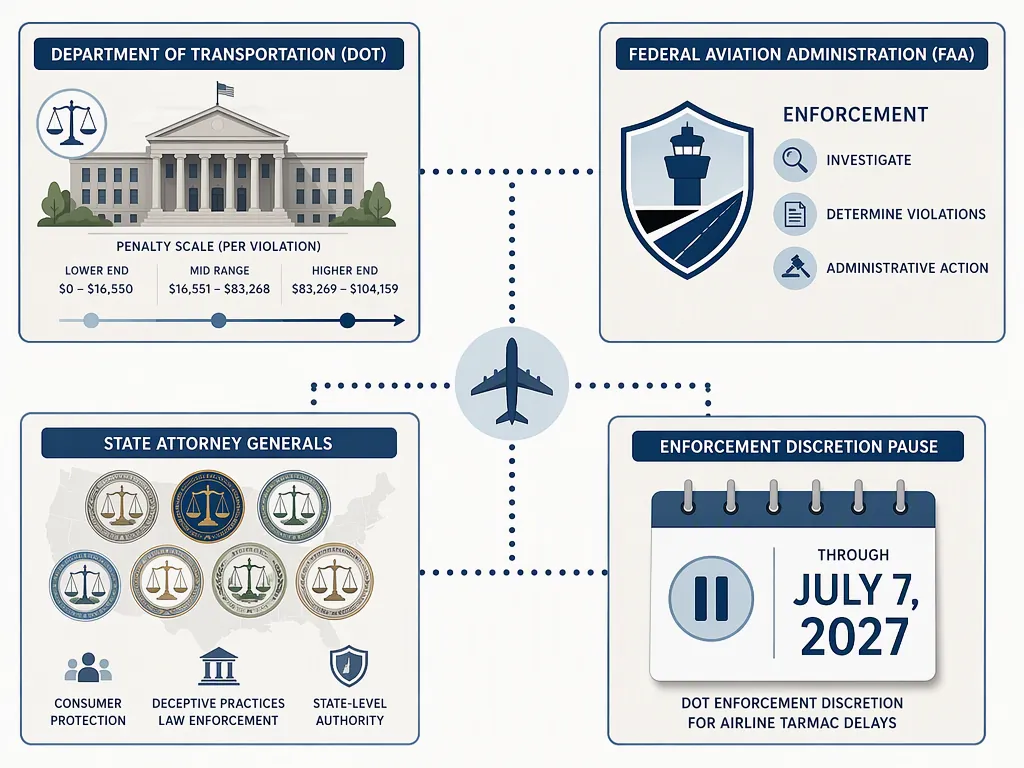
| DOT/state AG and refund-rule posture | April 2026 disclosure-rule context | DOT’s partnership with 18 state attorneys general broadens enforcement capacity, while enforcement discretion on renumbered-flight refunds was extended through July 7, 2027. [4] |
Read that table as a docket screen, not a passenger pamphlet. The numbers are real, but they do different work. The $4.1 million order anchors the risk of tarmac-delay violations. The $16.8 million modified order shows DOT using penalty architecture to force remedial spending. The FAA proposal belongs in the same monitoring file because it concerns carrier operational compliance, but it should not be written as if American has already paid it. The Frontier matter deserves its own shelf because it shows how voluntary passenger compensation can be converted into civil-penalty credit.
What the American Airlines orders actually prove
The American Airlines tarmac-delay fine is the easiest number to overuse. It is concrete, large, and attached to a passenger count: 5,821 people on 43 domestic flights. That is not abstract consumer dissatisfaction; it is a documented group of passengers held in delay conditions serious enough to generate DOT’s largest tarmac-delay civil penalty to date. The order’s age also matters. It was announced in August 2023, so it is not, by itself, a new 2026 policy announcement. It is better treated as the established floor in the current enforcement record: DOT has already shown it will put a multimillion-dollar number on tarmac-delay violations when the facts support it. [1]
For legal advisors, the affected-passenger count should not be lost behind the headline fine. A tarmac-delay failure is not merely a bad operations day that later becomes a press problem. Once the record identifies flights, locations, affected passengers, and rule violations, the enforcement file starts to look less like customer-service triage and more like penalty math. The same facts that make the story visible to consumers also make it administrable for regulators.
The December 2025 American Airlines modified consent order is a different kind of signal. Its $16.8 million figure matters, but the more interesting feature is the remedial structure: DOT described penalty funds being redirected from payment to the Treasury toward spending benefiting passengers with disabilities. [2] That is not a classic delay-compensation model. It is a regulator using a consent order to convert penalty exposure into operational and passenger-facing remediation.
That difference should affect how counsel reads American’s exposure. A civil penalty can be more than a check written after an investigation. It can become a negotiated architecture for required spending, monitoring, internal process change, or passenger benefit. The compliance consequence is broader than the accounting entry: business units need to know which remedial commitments are being funded, who owns them, and how proof of performance will be preserved if DOT later asks whether the carrier did what the order required.
Frontier’s crediting formula is the mitigation fact to save
The April 2026 Frontier consent order is not an American Airlines order, and that boundary should stay intact. Its practical value is that DOT credited Frontier’s $162,500 civil penalty in full for voluntary passenger compensation. [3] In a year crowded with passenger-rights rhetoric, that is the kind of enforcement detail that changes negotiation behavior.
The order does not establish a universal exchange rate between goodwill payments and civil penalties. It does, however, give carriers and their advisors a live example of DOT accepting voluntary compensation as penalty mitigation. That should move the question from “Should we compensate passengers?” to a more disciplined set of operational questions: which passengers were included, what was paid or credited, when the carrier acted, what records prove it, and how the company will describe the payment if the matter later becomes an enforcement negotiation.
In a hypothetical irregular-operations event, the legal value of voluntary compensation would not come from generosity alone. It would come from the carrier’s ability to connect the compensation to a defined affected group, document the decision before the enforcement posture hardens, and show that the remedy was not just a press release. The Frontier order makes that documentation work more valuable because it supplies a recent example of full credit, but it does not guarantee the same credit in a different fact pattern.
This is where passenger compensation becomes a compliance instrument rather than a customer-relations afterthought. If the finance team, airport operations, legal, and customer-care functions cannot reconstruct what was offered and why, the carrier may still have spent money without building the record needed to ask for penalty credit.
The refund-rule gap is a compliance ambiguity, not a clean consumer answer
The renumbered-flight issue is where the 2026 landscape becomes untidy. Crowell & Moring’s April 2026 analysis describes DOT extending enforcement discretion on renumbered-flight refunds through July 7, 2027, limiting practical enforcement of a refund trigger associated with the 2024 automatic refund rule. [4] The result is not a simple statement that passengers have no refund interest, and not a simple statement that every renumbered flight must be treated as an enforceable refund event today. It is a gap between rule architecture and enforcement posture.
For carriers, that gap belongs on a compliance calendar. Internal policy may still need to identify renumbering events, customer communications, refund eligibility analysis, and escalation points. But the enforcement-discretion date changes the risk calculation around immediate DOT action. The legal problem is not only what the rule says; it is what the agency has said it will, and will not, prioritize during the discretion period.
Public-facing materials do not resolve that tension. American Airlines’ customer service plan, updated July 29, 2026, remains relevant as the carrier’s own published commitment document. [5] DOT’s Fly Rights materials remain relevant for passenger-facing federal guidance. [6] Neither should be mistaken for a complete enforcement-risk map when DOT is simultaneously using consent orders aggressively in some areas and pausing enforcement discretion in another.
State attorneys general add reach and fragmentation
The DOT’s Bipartisan Airline Passenger Protection Partnership with 18 state attorneys general is not just an announcement to file under intergovernmental cooperation. [4] It changes the shape of airline consumer-protection risk by adding more public enforcers to a field already divided among DOT rules, consent-order practice, carrier policies, and FAA operational oversight.
The careful point is not that 18 states will necessarily bring 18 different cases. The record does not support that prediction. The point is that enforcement visibility can now develop through more channels. A delay, cancellation, refund, disclosure, or accommodation practice that once sat principally in a DOT complaint and investigation pathway may also attract attention from state offices participating in the partnership. That is enough to complicate intake, privilege, escalation, and settlement strategy.
Fragmentation also affects messaging. A carrier can no longer assume that satisfying one federal-facing narrative will answer every public enforcement concern. The same incident may require one record for DOT, a different explanation for a state attorney general inquiry, and a separate operational remediation file for internal audit. Counsel do not need to invent state-law theories to see the problem; the participating-enforcer structure creates the coordination burden by itself.
The FAA proposal belongs in the file, with a red status label
The April 2026 FAA matter against American Airlines should be read cautiously. The reported $255,000 civil penalty is proposed, and it concerns alleged drug and alcohol follow-up testing failures involving flight attendants. [3] It is not a DOT passenger-compensation order, and it is not a final adjudicated penalty. Treating it as either would flatten the enforcement record in exactly the wrong way.
It still matters. Airlines do not experience regulatory risk in neat subject-matter silos. An operations failure, a passenger-handling failure, a disclosure problem, and a testing-program deficiency may move through different legal authorities, but they compete for the same internal compliance attention. The FAA proposal is a reminder that American’s 2026 risk file is not limited to DOT consumer-protection orders.
What should be monitored now
The monitoring list for 2026 is not a generic passenger-rights checklist. It is a set of enforcement variables that can change exposure before the next major irregular-operations event is fully closed.
- Penalty-credit language in new DOT consent orders, especially whether voluntary passenger compensation receives partial credit, full credit, or no stated credit.
- The final disposition of the FAA’s proposed $255,000 American Airlines penalty, because proposed penalties should not be treated as final liability events. [3]
- Any visible coordination between DOT and the 18 participating state attorneys general, including whether inquiries, settlements, or public statements begin to move in parallel. [4]
- The July 7, 2027 horizon for renumbered-flight refund enforcement discretion, because a paused enforcement trigger can become an active compliance issue again when the pause expires. [4]
- Carrier customer-service commitments and federal passenger-facing resources, while keeping them separate from enforceable consent-order obligations. [5][6]
Other materials can shape the background noise without changing the core analysis. DOT’s “Tell It to the Judge” resource points passengers toward small-claims options, and S.3347, the Flight Delay and Cancellation Compensation Act, reflects legislative attention to delay and cancellation compensation. [7][8] A reported $9.6 million federal jury verdict against American Airlines for medical-emergency mishandling is a separate reminder that private litigation exposure can exceed regulatory penalties, but it sits outside the DOT/FAA enforcement thesis. None of those materials is the same thing as a current DOT consent order against American Airlines, a final FAA penalty, or a presently enforceable compensation formula.
So the 2026 answer is deliberately limited. American Airlines’ recent enforcement record shows that delay-related and passenger-protection violations can carry real financial consequences. It does not supply one clean passenger-facing compensation rule. For legal advisors, the operative map is fragmented: DOT penalty orders, FAA status labels, voluntary-compensation credits, state attorney general coordination, carrier service-plan commitments, and the July 7, 2027 refund-enforcement-discretion horizon all have to be read together.
References
- DOT Fines American Airlines $4.1 Million — U.S. Department of Transportation
- Latest News — U.S. Department of Transportation Aviation Consumer Protection
- Aviation Regulatory Update April 2026 — Eckert Seamans
- DOT Issues New Passenger Rights Disclosure Rule — Crowell & Moring Transportation Law
- American Airlines Customer Service Plan — American Airlines
- Fly Rights — U.S. Department of Transportation
- Air Travelers: Tell It to the Judge — U.S. Department of Transportation
- S.3347 - Flight Delay and Cancellation Compensation Act — Congress.gov
Related records
Tool profile
Browse tool evaluations →Governing regulation
Browse the obligations tracker →Preventive workflow
Browse verification workflows →
Report a correction or tip
Spotted an outdated figure, a misstated fact, or a ruling this case record should reflect? Public comments are disabled for this content given the professional cost of a misreported case outcome, penalty amount, or rule text — use the structured correction channel instead.
Report a correction or tip for this record →