
Federal Law Consequences for Doxing an ICE Officer
18 U.S.C. § 119 makes doxing an ICE officer a federal felony with up to 5 years' imprisonment, but the statute requires specific intent to threaten or incite violence and covers only six enumerated categories of personal information. This briefing examines three 2025–2026 prosecutions to show the actual enforcement boundaries.
- Jurisdiction
- US Federal
- Court
- U.S. District Court for the Central District of California
- AI tool named
- None
- Ruling date
- Sep 1, 2025
- Source document
- View primary court order ↗
- Last verified
- Jul 29, 2026
Lex Machina Review is an independent risk-tracking and reference resource. Nothing on this site is legal advice, and using it does not create an attorney-client relationship. Every record is reviewed against primary sources but may not reflect the most current status of a matter — always verify directly against the cited court order, rule text, or a licensed attorney before relying on it.
Companion explanation — secondary to the source document above
Doxing an ICE officer can be a federal felony under 18 U.S.C. § 119. The maximum statutory exposure is up to five years’ imprisonment and a potential fine, described in available sentencing materials as up to $250,000. But that answer is only useful if it keeps the statute’s limits intact: the government must prove the person is covered, the information falls within the statute’s protected categories, and the defendant acted with the required intent to threaten, intimidate, or incite a crime of violence against that person or a close family member.[1]
That is a narrower legal rule than the phrase “doxing an ICE officer” often suggests in press statements or online arguments. Section 119 does not turn every identification of an officer, every workplace reference, every public-record discussion, or every recording at a protest into a federal felony. It targets a defined set of restricted personal information, published with a defined mental state.

The Six Categories That Matter Under § 119
For ICE officers, the practical starting point is the definition of “restricted personal information.” Section 119 covers these categories:[1]
- Social Security number
- Home address
- Home telephone number
- Mobile telephone number
- Personal email address
- Home fax number
That list does real work. A home address is in. A mobile number is in. A personal email address is in. A work address, agency email, badge number, public-facing professional profile, or video of an officer performing duties in public is not listed in that definition. Those other disclosures may raise safety, privacy, employment, platform-policy, or state-law questions, but § 119 is not a general anti-identification statute.
The covered-person element is usually less difficult for federal immigration agents than the information element. Section 119 protects individuals performing certain official duties, including federal officers and employees involved in law enforcement functions.[1] The harder questions tend to be what information was actually published and what the publisher intended to accomplish by publishing it.
Intent Is Not Window Dressing
The statute requires more than the act of putting information online. The government must tie publication of restricted personal information to an intent to threaten, intimidate, or incite the commission of a crime of violence against the covered person or an immediate family member.[1] That intent requirement is the difference between a safety-focused felony statute and a free-floating prohibition on unwanted attention.
In a charging analysis, that means the surrounding conduct matters. Following an ICE agent from a protest to a residence, livestreaming the movement, publishing the home address, and directing attention to the officer’s identity in the neighborhood would be assessed differently from filming an arrest team from a sidewalk and criticizing agency policy. The legal question is not whether the post is hostile. It is whether the facts support each statutory element.
| Disclosure or conduct | § 119 risk posture |
|---|---|
| Publishing an ICE officer’s home address with language encouraging violence | High federal felony exposure if the government can prove intent |
| Posting a mobile number and urging others to confront the officer at home | High exposure because the information category and intent evidence may align |
| Identifying an officer by name while filming in public | Not enough by itself under § 119 |
| Linking to a public-facing agency or professional profile | Not a listed restricted personal-information category by itself |
| Posting an office location or agency field office address | Not covered as a home address under the statutory definition |
What the 2025–2026 Prosecutions Actually Show
The best available enforcement signals are not broad DHS warnings. They are the actual cases in which prosecutors decided § 119 was worth charging. Even there, the available public record has gaps. The Raygoza and Curcio materials were not all accessible through clean, readable DOJ charging releases, so the case accounts have to be treated as enforcement indicators rather than a complete map of pleadings, evidence, and defenses.
Raygoza: Following the Agent Home
United States v. Raygoza et al. is the clearest public example of the kind of conduct federal prosecutors appear willing to characterize as ICE-officer doxing under § 119. According to news coverage of the September 2025 case in the Central District of California, three defendants were charged after allegedly following an ICE agent home from a Civic Center protest, livestreaming the pursuit, posting the agent’s home address on Instagram, and shouting identifying information to neighbors.[2][3]
Those facts, if proved, line up with the statute in a way that generic online naming does not. The alleged home address is one of the enumerated categories. The pursuit from a public protest to a private residence supplies context for intent. The alleged broadcast and neighborhood identification are not merely commentary about government conduct; they become evidence of what the defendants wanted others to know and potentially do.
Raygoza should not be overread. A charge is not a conviction, and publicly reported details do not substitute for the indictment, motions, plea terms, trial record, or jury instructions. But as a charging signal, the case points toward a practical federal threshold: prosecutors are most comfortable when the disclosure concerns residence-level information and the publication is embedded in conduct that looks like pursuit, exposure, intimidation, or mobilization.
Curcio: A Guilty Plea, but Thin Public Detail
United States v. Curcio is important because the available sources identify a September 2025 guilty plea to § 119 charges for doxing an ICE officer. The cited public source is a DHS press release condemning doxing and escalating threats against federal law enforcement.[4]
A guilty plea is stronger than a press accusation. It confirms that at least one defendant accepted criminal liability under the statute in the ICE-officer context. But the available DHS release is a poor substitute for the plea agreement, factual basis, and sentencing record. Without those documents, Curcio helps establish that § 119 is being used, but it does not let a risk analyst confidently generalize about the minimum facts necessary for conviction.
Kaetz: A Sentencing Marker, Not a Sentencing Grid
The Kaetz reference matters for a different reason. The cited sources identify a 2024 sentencing outcome of 16 months as the earliest § 119 sentencing data point.[4] That is useful because it keeps the discussion from stopping at the five-year statutory maximum. Real sentencing exposure is usually driven by plea posture, guidelines issues, criminal history, factual admissions, victim impact, and the court’s view of the threat environment.
One sentencing point does not create a range. It does, however, undercut the idea that § 119 is merely symbolic. A 16-month sentence shows that the statute can produce actual custody, even if the available material is too thin to say what a typical ICE-officer doxing sentence would be.
The Protected-Speech Edge Is Real
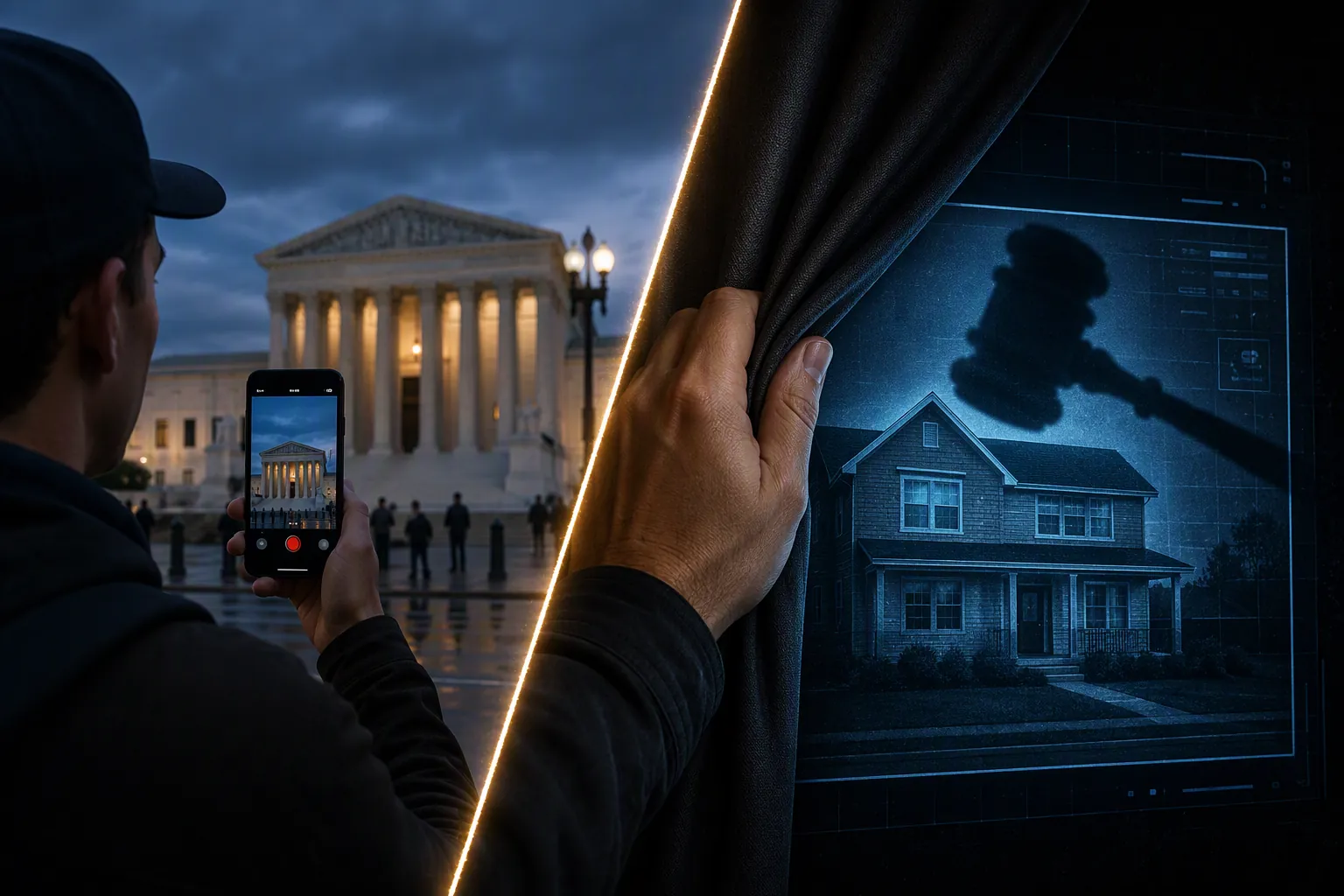
The First Amendment problem cannot be waved away by calling all exposure “doxing.” FIRE’s analysis notes that seven federal circuits protect a right to film federal agents in public.[5] That point is especially important in ICE-related encounters, where recording, identification, and criticism often occur in public spaces while officers are performing official duties.
Public observation and restricted personal-information disclosure are not the same act. A person recording an ICE operation from a sidewalk may capture faces, uniforms, vehicles, or tactical movements. That conduct can be contentious and may lead to separate disputes over obstruction, time-place-manner restrictions, or officer safety. But § 119 turns on protected personal information and intent. The statute does not say that filming an officer’s face is equivalent to publishing the officer’s home address.
The boundary becomes more dangerous when public observation is paired with private-location information. A video of an officer leaving a federal building is one thing. A post that identifies the officer, supplies a home address or mobile number, and urges others to make the officer afraid at home is another. The latter fact pattern gives prosecutors a statutory category, an intended target, and context from which to argue threat, intimidation, or incitement.
Public social-media profiles sit closer to the non-covered side of the line unless they reveal one of the listed categories or are used as part of an intimidation campaign. A profile may make someone identifiable, but identifiability is not the statutory trigger. The trigger is restricted personal information plus the required intent.
Why DHS Context Still Matters
DHS has framed doxing as part of a broader escalation in threats and violence against immigration enforcement personnel. In an October 2025 release, DHS reported a more-than-1000% increase in assaults and an 8000% increase in death threats against ICE officers since January 2025.[4] In a February 2026 release, DHS reported 182 documented vehicle attacks on ICE and CBP personnel from January 21, 2025, to January 24, 2026, and described that as a 3300% increase for ICE.[6]
Those claims matter as enforcement context. They help explain why agencies and prosecutors may treat personal-information exposure as a threat multiplier rather than as ordinary political speech. They may also influence detention arguments, victim-impact presentations, sentencing submissions, and the institutional appetite for test cases.
They do not prove the elements of a § 119 count. The DHS figures are agency claims made inside a politically charged enforcement campaign, and the available record does not include independent non-governmental verification. Even if the threat environment is worsening, the government still has to prove that a specific defendant published a specific protected category of information with the required intent.
The October 2025 404 Media report about hackers doxing hundreds of DHS, ICE, FBI, and DOJ officials belongs in the same category of risk escalation.[7] A large breach can make downstream intimidation easier, and it can change how agencies perceive later reposting or amplification. But the existence of a hack does not automatically convert every later reference to an official into a § 119 violation. Source, content, republication choices, and intent still matter.
Pending Bills Would Move the Boundary
Current federal analysis may not stay fixed. Pending proposals include the Protecting Law Enforcement from Doxxing Act, associated with Senator Marsha Blackburn and H.R. 5118/S. 5118, and the Stop the Doxx Act, associated with Representative Josh Gottheimer and H.R. 8927 in June 2026.[8][9]
The described proposals would expand coverage to state and local officers and lower the intent threshold.[8][9] That would matter. A lower mental-state requirement could move some cases from “ugly but hard to charge under § 119” toward easier federal exposure. Broader officer coverage would also reduce the distinction between federal immigration agents and local law-enforcement personnel involved in immigration-related operations.
The caveat is source quality. Congress.gov bill text for H.R. 5118 was not available in the reviewed sources, so the bill descriptions here rely on a Senate sponsor press release and a National Police Association endorsement page rather than final legislative text. That is enough to flag the direction of proposed change, not enough to treat either bill as enacted law or to parse operative language with confidence.
The Practical Federal-Risk Line
For a current federal-risk assessment, the highest-exposure fact pattern is publication of an ICE officer’s home address, mobile number, personal email, or similar listed information in a context that supports an inference of threat, intimidation, or violence-incitement. That is the territory where § 119, Raygoza-style charging facts, the Curcio plea signal, and the Kaetz sentencing reference all point in the same direction.
The lower-exposure side is not the same as “safe.” Recording federal officers in public, naming an officer involved in a public operation, criticizing ICE, referencing a field office, or linking to a public professional profile can still create other legal or practical problems. But those acts do not automatically satisfy § 119 unless the disclosure includes one of the statute’s restricted personal-information categories and the government can prove the required intent.
That is the answer clients usually need and rarely ask cleanly. Doxing an ICE officer can carry serious federal felony consequences. The strongest cases are not built on identification alone; they are built on protected personal information, threatening or violence-inciting context, and proof that the defendant meant to expose the officer or a family member to danger.
References
- 18 U.S. Code § 119 - Protection of individuals performing certain official duties, Cornell Legal Information Institute.
- Federal prosecutors charge 3 activists with doxing of ICE agent in Los Angeles, PBS NewsHour.
- ICE agent doxing indictment, The Hill.
- DHS Condemns Dangerous Doxxing and Escalating Threats Against Federal Law Enforcement, U.S. Department of Homeland Security, October 9, 2025.
- Doxxing, Free Speech, and the First Amendment, Foundation for Individual Rights and Expression.
- DHS Law Enforcement Experienced More Than 180 Vehicle Attacks Since President Trump Took Office, U.S. Department of Homeland Security, February 3, 2026.
- Hackers Dox Hundreds of DHS, ICE, FBI, and DOJ Officials, 404 Media, October 2025.
- Blackburn Introduces Legislation to Protect Federal Law Enforcement Officers from Doxxing, Office of Senator Marsha Blackburn, June 2025.
- The National Police Association Endorses the Stop the Doxx Act, National Police Association.
Related records
Tool profile
Browse tool evaluations →Governing regulation
Browse the obligations tracker →Preventive workflow
Browse verification workflows →
Report a correction or tip
Spotted an outdated figure, a misstated fact, or a ruling this case record should reflect? Public comments are disabled for this content given the professional cost of a misreported case outcome, penalty amount, or rule text — use the structured correction channel instead.
Report a correction or tip for this record →